 Referred to as “Anti-diabetic medication”.
 Drugs used in the treatment of diabetes mellitus by lowering the blood glucose
level.
 These are administered orally and are thus also called as oral hypoglycemic
agents or oral ant hyperglycemic agents.
 There are different class of antidiabetic drugs and their selection depends on
nature of diabetes ,age ,and situation of the person as well as other factors
 Diabetes mellitus is a group of metabolic diseases characterized by
hyperglycemia resulting from defects in insulin secretion, insulin action or
both.
 There are 2 major types of DM
• Type 1-
Immune β-cell destruction or idiopathic, leading to absolute
insulin deficiency
• Type 2-
Insulin resistance with relative insulin deficiency or insulin secretory
defects with insulin resistance
Other types include
• Gestational Diabetes-Diabetes diagnosed in the second or third
trimester of pregnancy that is not clearly shown diabetes
• Specific types of diabetes due to other cause-Neonatal diabetes,
maturity –onset diabetes of the,disease of the exocrine pancreas and
drug or chemical induced diabetes.
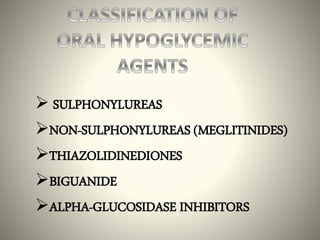
 SULPHONYLUREAS
NON-SULPHONYLUREAS (MEGLITINIDES)
THIAZOLIDINEDIONES
BIGUANIDE
ALPHA-GLUCOSIDASE INHIBITORS
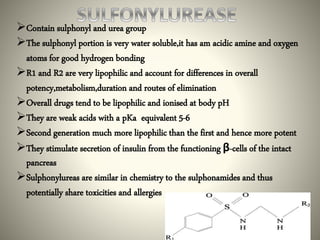
Contain sulphonyl and urea group
The sulphonyl portion is very water soluble,it has am acidic amine and oxygen
atoms for good hydrogen bonding
R1 and R2 are very lipophilic and account for differences in overall
potency,metabolism,duration and routes of elimination
Overall drugs tend to be lipophilic and ionised at body pH
They are weak acids with a pKa equivalent 5-6
Second generation much more lipophilic than the first and hence more potent
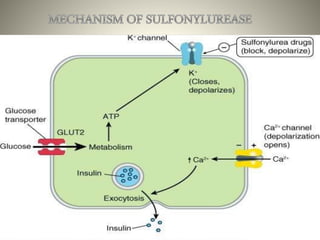
They stimulate secretion of insulin from the functioning β-cells of the intact
pancreas
Sulphonylureas are similar in chemistry to the sulphonamides and thus
potentially share toxicities and allergies
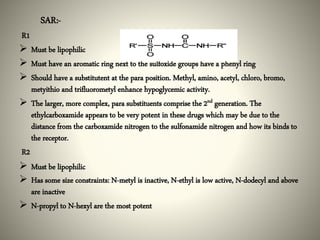
SAR:-
R1
 Must be lipophilic
 Must have an aromatic ring next to the sulfoxide groups have a phenyl ring
 Should have a substitutent at the para position. Methyl, amino, acetyl, chloro, bromo,
metyithio and trifluorometyl enhance hypoglycemic activity.
 The larger, more complex, para substituents comprise the 2nd generation. The
ethylcarboxamide appears to be very potent in these drugs which may be due to the
distance from the carboxamide nitrogen to the sulfonamide nitrogen and how its binds to
the receptor.
R2
 Must be lipophilic
 Has some size constraints: N-metyl is inactive, N-ethyl is low active, N-dodecyl and above
are inactive
 N-propyl to N-hexyl are the most potent
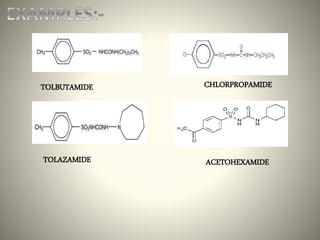
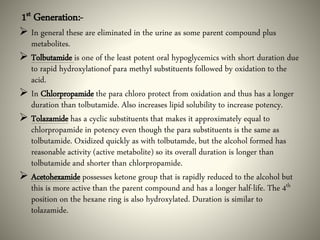
TOLBUTAMIDE CHLORPROPAMIDE
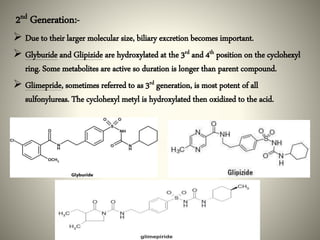
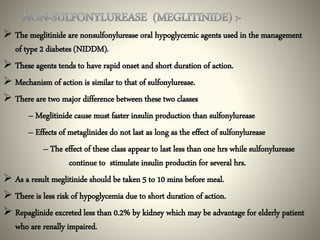
TOLAZAMIDE ACETOHEXAMIDE
1st Generation:-
 In general these are eliminated in the urine as some parent compound plus
metabolites.
 Tolbutamide is one of the least potent oral hypoglycemics with short duration due
to rapid hydroxylationof para methyl substituents followed by oxidation to the
acid.
 In Chlorpropamide the para chloro protect from oxidation and thus has a longer
duration than tolbutamide. Also increases lipid solubility to increase potency.
 Tolazamide has a cyclic substituents that makes it approximately equal to
chlorpropamide in potency even though the para substituents is the same as
tolbutamide. Oxidized quickly as with tolbutamde, but the alcohol formed has
reasonable activity (active metabolite) so its overall duration is longer than
tolbutamide and shorter than chlorpropamide.
 Acetohexamide possesses ketone group that is rapidly reduced to the alcohol but
this is more active than the parent compound and has a longer half-life. The 4th
position on the hexane ring is also hydroxylated. Duration is similar to
tolazamide.
2nd Generation:-
 Due to their larger molecular size, biliary excretion becomes important.
 Glyburide and Glipizide are hydroxylated at the 3rd and 4th position on the cyclohexyl
ring. Some metabolites are active so duration is longer than parent compound.
 Glimepride, sometimes referred to as 3rd generation, is most potent of all
sulfonylureas. The cyclohexyl metyl is hydroxylated then oxidized to the acid.
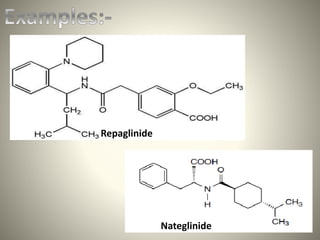
 The meglitinide are nonsulfonylurease oral hypoglycemic agents used in the management
of type 2 diabetes (NIDDM).
 These agents tends to have rapid onset and short duration of action.
 Mechanism of action is similar to that of sulfonylurease.
 There are two major difference between these two classes
-- Meglitinide cause must faster insulin production than sulfonylurease
-- Effects of metaglinides do not last as long as the effect of sulfonylurease
-- The effect of these class appear to last less than one hrs while sulfonylurease
continue to stimulate insulin productin for several hrs.
 As a result meglitinide should be taken 5 to 10 mins before meal.
 There is less risk of hypoglycemia due to short duration of action.
 Repaglinide excreted less than 0.2% by kidney which may be advantage for elderly patient
who are renally impaired.
Repaglinide
Nateglinide
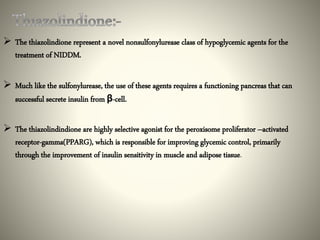
 The thiazolindione represent a novel nonsulfonylurease class of hypoglycemic agents for the
treatment of NIDDM.
 Much like the sulfonylurease, the use of these agents requires a functioning pancreas that can
successful secrete insulin from β-cell.
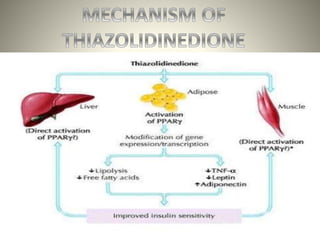
 The thiazolindindione are highly selective agonist for the peroxisome proliferator –activated
receptor-gamma(PPARG), which is responsible for improving glycemic control, primarily
through the improvement of insulin sensitivity in muscle and adipose tissue.
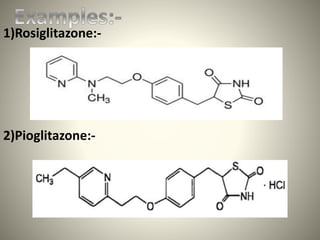
1)Rosiglitazone:-
2)Pioglitazone:-
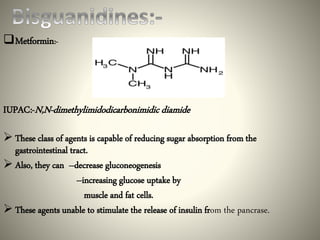
Metformin:-
IUPAC:-N,N-dimethylimidodicarbonimidic diamide
 These class of agents is capable of reducing sugar absorption from the
gastrointestinal tract.
 Also, they can --decrease gluconeogenesis
--increasing glucose uptake by
muscle and fat cells.
 These agents unable to stimulate the release of insulin from the pancrase.
 The enzyme α-glucosidase is present in the brush border of the small intestine
and is responsible for cleaving dietary carbohydrates and facilitating their
absorption into the body.
 Inhibition of these enzyme allows less dietary carbohydrates to be available for
absorption and, in turn, less available in the blood following a meal.
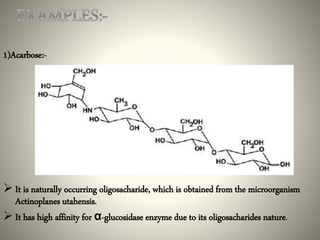
1)Acarbose:-
 It is naturally occurring oligosacharide, which is obtained from the microorganism
Actinoplanes utahensis.
 It has high affinity for α-glucosidase enzyme due to its oligosacharides nature.
2)Miglitol:-
 It is chemically known as 3,4,5-piperidinetriol
 It is soluble in water with pka 5.9
 In chemical strcture, these agent is very similar to sugar, with the heterocyclic
nitrogen serving as isosteric replacement of the sugar oxygen.
 This feature allows recognition by the α-glucosidase as a substrate.
 This result in the competative inhibition of enzyme and delays the
carbohydrates from the gastrointestinal tract.
THANK YOU........

presentation1-161002225546-1.pdf

  • 2.
     Referred toas “Anti-diabetic medication”.  Drugs used in the treatment of diabetes mellitus by lowering the blood glucose level.  These are administered orally and are thus also called as oral hypoglycemic agents or oral ant hyperglycemic agents.  There are different class of antidiabetic drugs and their selection depends on nature of diabetes ,age ,and situation of the person as well as other factors
  • 3.
     Diabetes mellitusis a group of metabolic diseases characterized by hyperglycemia resulting from defects in insulin secretion, insulin action or both.  There are 2 major types of DM • Type 1- Immune β-cell destruction or idiopathic, leading to absolute insulin deficiency • Type 2- Insulin resistance with relative insulin deficiency or insulin secretory defects with insulin resistance
  • 4.
    Other types include •Gestational Diabetes-Diabetes diagnosed in the second or third trimester of pregnancy that is not clearly shown diabetes • Specific types of diabetes due to other cause-Neonatal diabetes, maturity –onset diabetes of the,disease of the exocrine pancreas and drug or chemical induced diabetes.
  • 5.
  • 6.
    Contain sulphonyl andurea group The sulphonyl portion is very water soluble,it has am acidic amine and oxygen atoms for good hydrogen bonding R1 and R2 are very lipophilic and account for differences in overall potency,metabolism,duration and routes of elimination Overall drugs tend to be lipophilic and ionised at body pH They are weak acids with a pKa equivalent 5-6 Second generation much more lipophilic than the first and hence more potent They stimulate secretion of insulin from the functioning β-cells of the intact pancreas Sulphonylureas are similar in chemistry to the sulphonamides and thus potentially share toxicities and allergies
  • 8.
    SAR:- R1  Must belipophilic  Must have an aromatic ring next to the sulfoxide groups have a phenyl ring  Should have a substitutent at the para position. Methyl, amino, acetyl, chloro, bromo, metyithio and trifluorometyl enhance hypoglycemic activity.  The larger, more complex, para substituents comprise the 2nd generation. The ethylcarboxamide appears to be very potent in these drugs which may be due to the distance from the carboxamide nitrogen to the sulfonamide nitrogen and how its binds to the receptor. R2  Must be lipophilic  Has some size constraints: N-metyl is inactive, N-ethyl is low active, N-dodecyl and above are inactive  N-propyl to N-hexyl are the most potent
  • 9.
  • 10.
    1st Generation:-  Ingeneral these are eliminated in the urine as some parent compound plus metabolites.  Tolbutamide is one of the least potent oral hypoglycemics with short duration due to rapid hydroxylationof para methyl substituents followed by oxidation to the acid.  In Chlorpropamide the para chloro protect from oxidation and thus has a longer duration than tolbutamide. Also increases lipid solubility to increase potency.  Tolazamide has a cyclic substituents that makes it approximately equal to chlorpropamide in potency even though the para substituents is the same as tolbutamide. Oxidized quickly as with tolbutamde, but the alcohol formed has reasonable activity (active metabolite) so its overall duration is longer than tolbutamide and shorter than chlorpropamide.  Acetohexamide possesses ketone group that is rapidly reduced to the alcohol but this is more active than the parent compound and has a longer half-life. The 4th position on the hexane ring is also hydroxylated. Duration is similar to tolazamide.
  • 11.
    2nd Generation:-  Dueto their larger molecular size, biliary excretion becomes important.  Glyburide and Glipizide are hydroxylated at the 3rd and 4th position on the cyclohexyl ring. Some metabolites are active so duration is longer than parent compound.  Glimepride, sometimes referred to as 3rd generation, is most potent of all sulfonylureas. The cyclohexyl metyl is hydroxylated then oxidized to the acid.
  • 12.
     The meglitinideare nonsulfonylurease oral hypoglycemic agents used in the management of type 2 diabetes (NIDDM).  These agents tends to have rapid onset and short duration of action.  Mechanism of action is similar to that of sulfonylurease.  There are two major difference between these two classes -- Meglitinide cause must faster insulin production than sulfonylurease -- Effects of metaglinides do not last as long as the effect of sulfonylurease -- The effect of these class appear to last less than one hrs while sulfonylurease continue to stimulate insulin productin for several hrs.  As a result meglitinide should be taken 5 to 10 mins before meal.  There is less risk of hypoglycemia due to short duration of action.  Repaglinide excreted less than 0.2% by kidney which may be advantage for elderly patient who are renally impaired.
  • 13.
  • 14.
     The thiazolindionerepresent a novel nonsulfonylurease class of hypoglycemic agents for the treatment of NIDDM.  Much like the sulfonylurease, the use of these agents requires a functioning pancreas that can successful secrete insulin from β-cell.  The thiazolindindione are highly selective agonist for the peroxisome proliferator –activated receptor-gamma(PPARG), which is responsible for improving glycemic control, primarily through the improvement of insulin sensitivity in muscle and adipose tissue.
  • 16.
  • 17.
    Metformin:- IUPAC:-N,N-dimethylimidodicarbonimidic diamide  Theseclass of agents is capable of reducing sugar absorption from the gastrointestinal tract.  Also, they can --decrease gluconeogenesis --increasing glucose uptake by muscle and fat cells.  These agents unable to stimulate the release of insulin from the pancrase.
  • 18.
     The enzymeα-glucosidase is present in the brush border of the small intestine and is responsible for cleaving dietary carbohydrates and facilitating their absorption into the body.  Inhibition of these enzyme allows less dietary carbohydrates to be available for absorption and, in turn, less available in the blood following a meal.
  • 19.
    1)Acarbose:-  It isnaturally occurring oligosacharide, which is obtained from the microorganism Actinoplanes utahensis.  It has high affinity for α-glucosidase enzyme due to its oligosacharides nature.
  • 20.
    2)Miglitol:-  It ischemically known as 3,4,5-piperidinetriol  It is soluble in water with pka 5.9  In chemical strcture, these agent is very similar to sugar, with the heterocyclic nitrogen serving as isosteric replacement of the sugar oxygen.  This feature allows recognition by the α-glucosidase as a substrate.  This result in the competative inhibition of enzyme and delays the carbohydrates from the gastrointestinal tract.
  • 21.