GASTRIC PROTON PUMP
INHIBITOR
MEDICINAL CHEMISTRY
By
Miss. Wagh hrutuja
ASSISTANT PROFESSOR
LOKMANYA TILAK INSTITUTE OF PHARMACEUTICAL SCIENCES, PUNE.
GASTRIC PROTON PUMP INHIBITOR
• Proton-pump inhibitors (PPIs) are a class of medications that
cause a profound and prolonged reduction of stomach
acid production.
• They do so by irreversibly inhibiting the
stomach's H+/K+ ATPase proton pump.
• They are the most potent inhibitors of acid secretion available.
• Proton-pump inhibitors have largely superseded the H2-
receptor antagonists, a group of medications with similar
effects but a different mode of action, and antacids
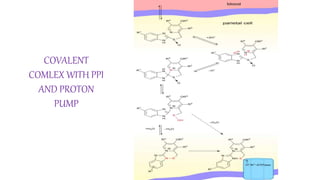
COVALENT
COMLEX WITH PPI
AND PROTON
PUMP
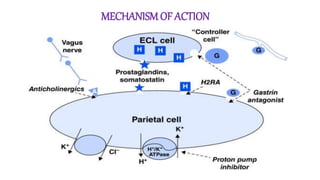
MECHANISM OF ACTION
MECHANISM OF ACTION
MECHANISMOF ACTION
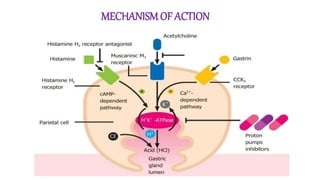
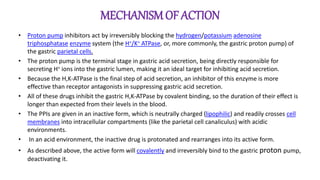
• Proton pump inhibitors act by irreversibly blocking the hydrogen/potassium adenosine
triphosphatase enzyme system (the H+/K+ ATPase, or, more commonly, the gastric proton pump) of
the gastric parietal cells.
• The proton pump is the terminal stage in gastric acid secretion, being directly responsible for
secreting H+ ions into the gastric lumen, making it an ideal target for inhibiting acid secretion.
• Because the H,K-ATPase is the final step of acid secretion, an inhibitor of this enzyme is more
effective than receptor antagonists in suppressing gastric acid secretion.
• All of these drugs inhibit the gastric H,K-ATPase by covalent binding, so the duration of their effect is
longer than expected from their levels in the blood.
• The PPIs are given in an inactive form, which is neutrally charged (lipophilic) and readily crosses cell
membranes into intracellular compartments (like the parietal cell canaliculus) with acidic
environments.
• In an acid environment, the inactive drug is protonated and rearranges into its active form.
• As described above, the active form will covalently and irreversibly bind to the gastric proton pump,
deactivating it.
Medical Uses
These medications are used in the treatment of many conditions, such as:
• Dyspepsia
• Peptic ulcer disease including after endoscopic treatment for bleeding
• As part of Helicobacter pylori eradication therapy
• Gastroesophageal reflux disease (GERD or GORD) including symptomatic endoscopy-
negative reflux disease[10] and associated laryngopharyngeal
reflux causing laryngitis[11] and chronic cough[12]
• Barrett's esophagus
• Eosinophilic esophagitis
• Stress gastritis and ulcer prevention in critical care
• Gastrinomas and other conditions that cause hypersecretion of acid
including Zollinger–Ellison syndrome (often 2–3x the regular dose is required)
CLASSIFICATION
1. OMEPRAZOLE
2. LANSOPRAZOLE
3. RABEPROZOLE
4. PANTAPRAZOLE
OMEPRAZOLE
• White to off white crystalline powder, very slightly soluble in water.
• Omeprazole is amphoteric compound and consistent with the proposed mechanism
of ation of the substituted benzimidazole,is acid labile.
• Hence it is an delayed release capsule containing enteruc coated granules.
• Absolute bioavailability is 30% to 40% related to first pass metabolism. where it is
95% bound to plasma protein.
Uses:
1. HERTBURN, GERD, DUODENAL ULCER, EROSIVE ESOPHAGITIS, GASTRIC ULCER
AND PATHOLOGICAL HYPERSECRETORY CONDITION.
LANSOPRAZOLE
• It is white to brownish white, odourless crystalline powder that is practically
insoluble in water.
• It is a weak base.
• Its is a prodrug and form active metabolite that irreversibally interact with target
ATPase of the pump..
• In the fasting time ,about 80% of a dose reaches to systemic circulation, where it is
97% bound to plasma protein.
Uses:
1. HERTBURN, GERD, DUODENAL ULCER, EROSIVE ESOPHAGITIS, GASTRIC ULCER
AND PATHOLOGICAL HYPERSECRETORY CONDITION.
2. Zollinger ellison syndrome.
rabeprazole
• It is a white to slightly yellowish white solid
• It is very soluble in water and methanol, freely soluble in ethanol, chloroform and
ethyl acetate and insoluble in etjher and hexane.
• In the fasting time ,about 52%of a dose reaches to systemic circulation, where it is
96% bound to plasma protein.
Uses:
1. EROSIVE AND ULCERATIVE GERD, DUODENAL ULCER, EROSIVE ESOPHAGITIS,
GASTRIC ULCER AND PATHOLOGICAL HYPERSECRETORY CONDITION.
2. H.PYROLI ERADICATION.
PANTOPRAZOLE
• White to off white crystalline powder, freely soluble in water,
practically insoluble in n hexane.
• Pantaprazole have rapid absorption..
• In the fasting time ,about 77% oral bioavailability, where it is
98% bound to plasma protein.
Uses:
1. EROSIVE ESOPHAGITIS, GASTRIC ULCER AND PATHOLOGICAL
HYPERSECRETORY CONDITION.
2. Zollinger ellison syndrome.
SIDE EFFECT
• The range and occurrence of adverse effects are similar for all of the PPIs, though
they have been reported more frequently with omeprazole.
• Common adverse effects include headache, nausea, diarrhea, abdominal
pain, fatigue, and dizziness.
• Infrequent adverse effects include rash, itch, flatulence, constipation, anxiety,
and depression.
• Also infrequently, PPI use may be associated with occurrence of myopathies,
including the serious reaction rhabdomyolysis.
Thank you

PROTON PUMP INHIBITOR.ppt

  • 1.
    GASTRIC PROTON PUMP INHIBITOR MEDICINALCHEMISTRY By Miss. Wagh hrutuja ASSISTANT PROFESSOR LOKMANYA TILAK INSTITUTE OF PHARMACEUTICAL SCIENCES, PUNE.
  • 2.
    GASTRIC PROTON PUMPINHIBITOR • Proton-pump inhibitors (PPIs) are a class of medications that cause a profound and prolonged reduction of stomach acid production. • They do so by irreversibly inhibiting the stomach's H+/K+ ATPase proton pump. • They are the most potent inhibitors of acid secretion available. • Proton-pump inhibitors have largely superseded the H2- receptor antagonists, a group of medications with similar effects but a different mode of action, and antacids
  • 3.
  • 4.
  • 5.
  • 6.
    MECHANISMOF ACTION • Protonpump inhibitors act by irreversibly blocking the hydrogen/potassium adenosine triphosphatase enzyme system (the H+/K+ ATPase, or, more commonly, the gastric proton pump) of the gastric parietal cells. • The proton pump is the terminal stage in gastric acid secretion, being directly responsible for secreting H+ ions into the gastric lumen, making it an ideal target for inhibiting acid secretion. • Because the H,K-ATPase is the final step of acid secretion, an inhibitor of this enzyme is more effective than receptor antagonists in suppressing gastric acid secretion. • All of these drugs inhibit the gastric H,K-ATPase by covalent binding, so the duration of their effect is longer than expected from their levels in the blood. • The PPIs are given in an inactive form, which is neutrally charged (lipophilic) and readily crosses cell membranes into intracellular compartments (like the parietal cell canaliculus) with acidic environments. • In an acid environment, the inactive drug is protonated and rearranges into its active form. • As described above, the active form will covalently and irreversibly bind to the gastric proton pump, deactivating it.
  • 7.
    Medical Uses These medicationsare used in the treatment of many conditions, such as: • Dyspepsia • Peptic ulcer disease including after endoscopic treatment for bleeding • As part of Helicobacter pylori eradication therapy • Gastroesophageal reflux disease (GERD or GORD) including symptomatic endoscopy- negative reflux disease[10] and associated laryngopharyngeal reflux causing laryngitis[11] and chronic cough[12] • Barrett's esophagus • Eosinophilic esophagitis • Stress gastritis and ulcer prevention in critical care • Gastrinomas and other conditions that cause hypersecretion of acid including Zollinger–Ellison syndrome (often 2–3x the regular dose is required)
  • 8.
  • 10.
    OMEPRAZOLE • White tooff white crystalline powder, very slightly soluble in water. • Omeprazole is amphoteric compound and consistent with the proposed mechanism of ation of the substituted benzimidazole,is acid labile. • Hence it is an delayed release capsule containing enteruc coated granules. • Absolute bioavailability is 30% to 40% related to first pass metabolism. where it is 95% bound to plasma protein. Uses: 1. HERTBURN, GERD, DUODENAL ULCER, EROSIVE ESOPHAGITIS, GASTRIC ULCER AND PATHOLOGICAL HYPERSECRETORY CONDITION.
  • 11.
    LANSOPRAZOLE • It iswhite to brownish white, odourless crystalline powder that is practically insoluble in water. • It is a weak base. • Its is a prodrug and form active metabolite that irreversibally interact with target ATPase of the pump.. • In the fasting time ,about 80% of a dose reaches to systemic circulation, where it is 97% bound to plasma protein. Uses: 1. HERTBURN, GERD, DUODENAL ULCER, EROSIVE ESOPHAGITIS, GASTRIC ULCER AND PATHOLOGICAL HYPERSECRETORY CONDITION. 2. Zollinger ellison syndrome.
  • 12.
    rabeprazole • It isa white to slightly yellowish white solid • It is very soluble in water and methanol, freely soluble in ethanol, chloroform and ethyl acetate and insoluble in etjher and hexane. • In the fasting time ,about 52%of a dose reaches to systemic circulation, where it is 96% bound to plasma protein. Uses: 1. EROSIVE AND ULCERATIVE GERD, DUODENAL ULCER, EROSIVE ESOPHAGITIS, GASTRIC ULCER AND PATHOLOGICAL HYPERSECRETORY CONDITION. 2. H.PYROLI ERADICATION.
  • 13.
    PANTOPRAZOLE • White tooff white crystalline powder, freely soluble in water, practically insoluble in n hexane. • Pantaprazole have rapid absorption.. • In the fasting time ,about 77% oral bioavailability, where it is 98% bound to plasma protein. Uses: 1. EROSIVE ESOPHAGITIS, GASTRIC ULCER AND PATHOLOGICAL HYPERSECRETORY CONDITION. 2. Zollinger ellison syndrome.
  • 14.
    SIDE EFFECT • Therange and occurrence of adverse effects are similar for all of the PPIs, though they have been reported more frequently with omeprazole. • Common adverse effects include headache, nausea, diarrhea, abdominal pain, fatigue, and dizziness. • Infrequent adverse effects include rash, itch, flatulence, constipation, anxiety, and depression. • Also infrequently, PPI use may be associated with occurrence of myopathies, including the serious reaction rhabdomyolysis.
  • 15.