






BY
K . MOUNIKA
16R21A0583
Contents:-
1.Introduction
2.What are optical fibers?
3.Evolution of optical fibers
4.Structure of optical fiber
5.Classification of optical fiber
6.Classification of optical fiber
7.Optical fiber communication system
8.advantages/disadvantages of
optical
fiber
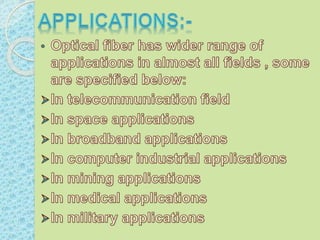
9.Applications
10.conclusion
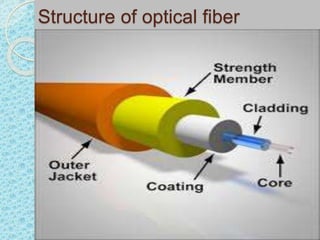
Structure of optical fiber
 Optical fiber is classified into two types .
They are:-
 1.Number of modes
 2.Refractive index
 Based on number of modes it is classified
into two types . They are:-
 1.Single Mode Fiber(SMF)
 2.Multi Mode Fiber(MMF)
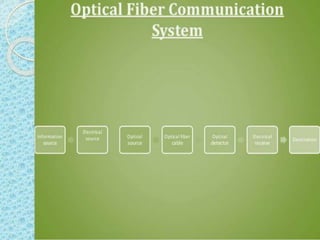
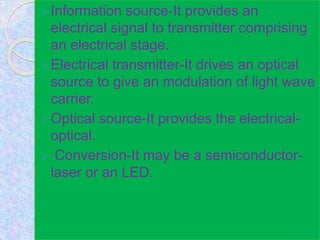
Information source-It provides an
electrical signal to transmitter comprising
an electrical stage.
Electrical transmitter-It drives an optical
source to give an modulation of light wave
carrier.
Optical source-It provides the electrical-
optical.
 Conversion-It may be a semiconductor-
laser or an LED.
Optical fiber communication

Optical fiber communication

  • 1.
  • 2.
    Contents:- 1.Introduction 2.What are opticalfibers? 3.Evolution of optical fibers 4.Structure of optical fiber 5.Classification of optical fiber 6.Classification of optical fiber 7.Optical fiber communication system 8.advantages/disadvantages of optical fiber 9.Applications 10.conclusion
  • 6.
  • 9.
     Optical fiberis classified into two types . They are:-  1.Number of modes  2.Refractive index  Based on number of modes it is classified into two types . They are:-  1.Single Mode Fiber(SMF)  2.Multi Mode Fiber(MMF)
  • 12.
    Information source-It providesan electrical signal to transmitter comprising an electrical stage. Electrical transmitter-It drives an optical source to give an modulation of light wave carrier. Optical source-It provides the electrical- optical.  Conversion-It may be a semiconductor- laser or an LED.