CONTENTS:
 What are optical fibers?
 History and evolution of Optical Fiber
 Structure of optical Fiber
 Working principle of Optical fiber
 Classification of optical fiber
 Advantages/ Disadvantages
 Applications
 Conclusion
 References
WHAT ARE OPTICAL FIBERS?
 Optical fiber is a thin, flexible, transparent fiber that
acts as a light pipe to transmit data between the two
ends of fiber.
 They are widely used in telecommunications and data
transmission due to their high bandwidth and low
signal loss.
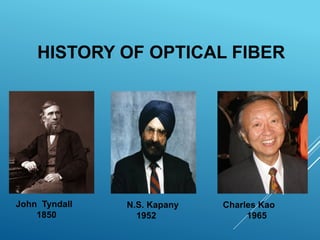
HISTORY OF OPTICAL FIBER
John Tyndall
1850
N.S. Kapany Charles Kao
1952 1965
WORKING PRINCIPLE OF OPTICAL
FIBER
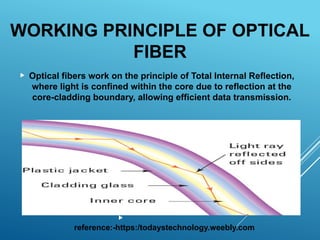
 Optical fibers work on the principle of Total Internal Reflection,
where light is confined within the core due to reflection at the
core-cladding boundary, allowing efficient data transmission.


reference:-https:/todaystechnology.weebly.com
CLASSIFICATION BASED ON
MATERIAL
 1. Plastic Fibers: Lower cost, used for short-distance and consumer
applications.
 2. Glass Fibers: High performance, used for long-distance
communication.
Classification based on modes:
 SMF
 MMF
MULTI MODE V/S SINGLE
MODE
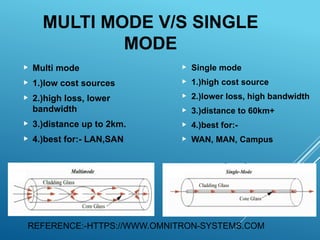
REFERENCE:-HTTPS://WWW.OMNITRON-SYSTEMS.COM
 Multi mode
 1.)low cost sources
 2.)high loss, lower
bandwidth
 3.)distance up to 2km.
 4.)best for:- LAN,SAN
 Single mode
 1.)high cost source
 2.)lower loss, high bandwidth
 3.)distance to 60km+
 4.)best for:-
 WAN, MAN, Campus
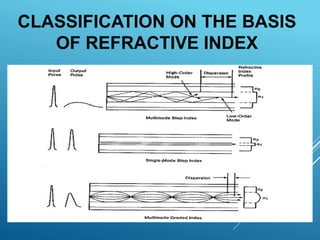
CLASSIFICATION ON THE BASIS
OF REFRACTIVE INDEX
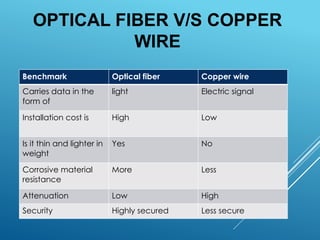
OPTICAL FIBER V/S COPPER
WIRE
Benchmark Optical fiber Copper wire
Carries data in the
form of
light Electric signal
Installation cost is High Low
Is it thin and lighter in
weight
Yes No
Corrosive material
resistance
More Less
Attenuation Low High
Security Highly secured Less secure
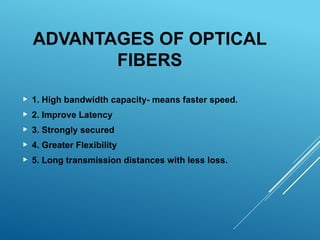
ADVANTAGES OF OPTICAL
FIBERS
 1. High bandwidth capacity- means faster speed.
 2. Improve Latency
 3. Strongly secured
 4. Greater Flexibility
 5. Long transmission distances with less loss.
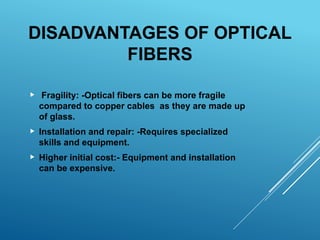
DISADVANTAGES OF OPTICAL
FIBERS
 Fragility: -Optical fibers can be more fragile
compared to copper cables as they are made up
of glass.
 Installation and repair: -Requires specialized
skills and equipment.
 Higher initial cost:- Equipment and installation
can be expensive.
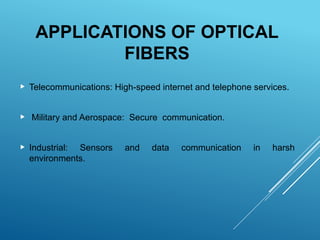
APPLICATIONS OF OPTICAL
FIBERS
 Telecommunications: High-speed internet and telephone services.
 Military and Aerospace: Secure communication.
 Industrial: Sensors and data communication in harsh
environments.
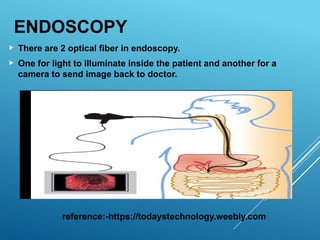
ENDOSCOPY
 There are 2 optical fiber in endoscopy.
 One for light to illuminate inside the patient and another for a
camera to send image back to doctor.
reference:-https://todaystechnology.weebly.com
CONCLUSION
 Optical fibers play a crucial role in modern
communication systems, offering high-speed,
reliable, and secure data transmission. As technology
advances, the use of optical fibers is expected to
grow.
REFERENCES:-
 N. S. Kapany , Fiber Optics: Principles and
Application
 J. Gower , optical communication system, 2nd
ed.,
Prentice Hall
 Optical Fiber Communications by JOHN M.
SENIOR
THANKYOU

OPTICAL_ +FIBER_ PPT [1].pptx

  • 1.
    CONTENTS:  What areoptical fibers?  History and evolution of Optical Fiber  Structure of optical Fiber  Working principle of Optical fiber  Classification of optical fiber  Advantages/ Disadvantages  Applications  Conclusion  References
  • 2.
    WHAT ARE OPTICALFIBERS?  Optical fiber is a thin, flexible, transparent fiber that acts as a light pipe to transmit data between the two ends of fiber.  They are widely used in telecommunications and data transmission due to their high bandwidth and low signal loss.
  • 3.
    HISTORY OF OPTICALFIBER John Tyndall 1850 N.S. Kapany Charles Kao 1952 1965
  • 4.
    WORKING PRINCIPLE OFOPTICAL FIBER  Optical fibers work on the principle of Total Internal Reflection, where light is confined within the core due to reflection at the core-cladding boundary, allowing efficient data transmission.   reference:-https:/todaystechnology.weebly.com
  • 7.
    CLASSIFICATION BASED ON MATERIAL 1. Plastic Fibers: Lower cost, used for short-distance and consumer applications.  2. Glass Fibers: High performance, used for long-distance communication. Classification based on modes:  SMF  MMF
  • 8.
    MULTI MODE V/SSINGLE MODE REFERENCE:-HTTPS://WWW.OMNITRON-SYSTEMS.COM  Multi mode  1.)low cost sources  2.)high loss, lower bandwidth  3.)distance up to 2km.  4.)best for:- LAN,SAN  Single mode  1.)high cost source  2.)lower loss, high bandwidth  3.)distance to 60km+  4.)best for:-  WAN, MAN, Campus
  • 9.
    CLASSIFICATION ON THEBASIS OF REFRACTIVE INDEX
  • 10.
    OPTICAL FIBER V/SCOPPER WIRE Benchmark Optical fiber Copper wire Carries data in the form of light Electric signal Installation cost is High Low Is it thin and lighter in weight Yes No Corrosive material resistance More Less Attenuation Low High Security Highly secured Less secure
  • 11.
    ADVANTAGES OF OPTICAL FIBERS 1. High bandwidth capacity- means faster speed.  2. Improve Latency  3. Strongly secured  4. Greater Flexibility  5. Long transmission distances with less loss.
  • 12.
    DISADVANTAGES OF OPTICAL FIBERS Fragility: -Optical fibers can be more fragile compared to copper cables as they are made up of glass.  Installation and repair: -Requires specialized skills and equipment.  Higher initial cost:- Equipment and installation can be expensive.
  • 13.
    APPLICATIONS OF OPTICAL FIBERS Telecommunications: High-speed internet and telephone services.  Military and Aerospace: Secure communication.  Industrial: Sensors and data communication in harsh environments.
  • 14.
    ENDOSCOPY  There are2 optical fiber in endoscopy.  One for light to illuminate inside the patient and another for a camera to send image back to doctor. reference:-https://todaystechnology.weebly.com
  • 15.
    CONCLUSION  Optical fibersplay a crucial role in modern communication systems, offering high-speed, reliable, and secure data transmission. As technology advances, the use of optical fibers is expected to grow.
  • 16.
    REFERENCES:-  N. S.Kapany , Fiber Optics: Principles and Application  J. Gower , optical communication system, 2nd ed., Prentice Hall  Optical Fiber Communications by JOHN M. SENIOR
  • 17.