PRESENTATION
ON
OPTICAL FIBER CABLE
Presented by :
Huzaifa Bin Nawab 2480181
Mubarrah Naeem 2480220
Zia Ullah 2480227
Abdul Moiz bin Irfan 2480167
Fatima Batool 2480245
Submitted to:-
Miss Aqsa Raees
Brief flow of presentation
• Introduction
• What are Optical Fibers ?
• Structure of optical fiber
• Working principle of optical fiber
• Optical fiber communication system
• Advantage / Disadvantage of optical fiber
• Application of optical fiber
• Conclusion
What is Optical Fiber ?
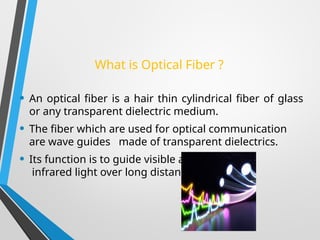
• An optical fiber is a hair thin cylindrical fiber of glass
or any transparent dielectric medium.
• The fiber which are used for optical communication
are wave guides made of transparent dielectrics.
• Its function is to guide visible and
infrared light over long distance.
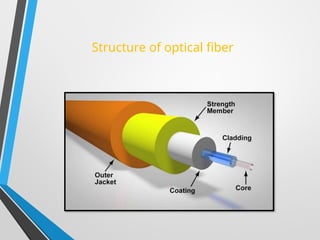
Structure of optical fiber
Conti…
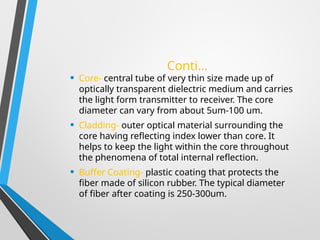
• Core- central tube of very thin size made up of
optically transparent dielectric medium and carries
the light form transmitter to receiver. The core
diameter can vary from about 5um-100 um.
• Cladding- outer optical material surrounding the
core having reflecting index lower than core. It
helps to keep the light within the core throughout
the phenomena of total internal reflection.
• Buffer Coating- plastic coating that protects the
fiber made of silicon rubber. The typical diameter
of fiber after coating is 250-300um.
Working principle
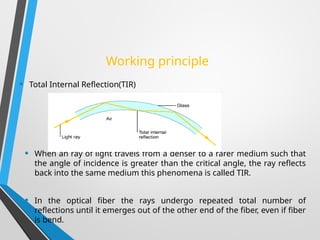
• Total Internal Reflection(TIR)
• When an ray of light travels from a denser to a rarer medium such that
the angle of incidence is greater than the critical angle, the ray reflects
back into the same medium this phenomena is called TIR.
• In the optical fiber the rays undergo repeated total number of
reflections until it emerges out of the other end of the fiber, even if fiber
is bend.
Classification of optical fiber
• Optical fiber is classified into two categories based on:-
1) The number of modes-
 Single mode fiber(SMF) and
 Multi-mode fiber(MMF)
2) The reflective index-
 Step index optical fiber
 Graded- index optical fiber
On basis of number of modes:-
Single mode fiber-
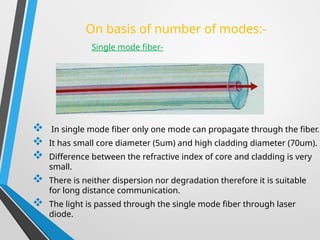
 In single mode fiber only one mode can propagate through the fiber.
 It has small core diameter (5um) and high cladding diameter (70um).
 Difference between the refractive index of core and cladding is very
small.
 There is neither dispersion nor degradation therefore it is suitable
for long distance communication.
 The light is passed through the single mode fiber through laser
diode.
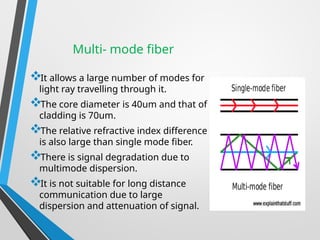
Multi- mode fiber
It allows a large number of modes for
light ray travelling through it.
The core diameter is 40um and that of
cladding is 70um.
The relative refractive index difference
is also large than single mode fiber.
There is signal degradation due to
multimode dispersion.
It is not suitable for long distance
communication due to large
dispersion and attenuation of signal.
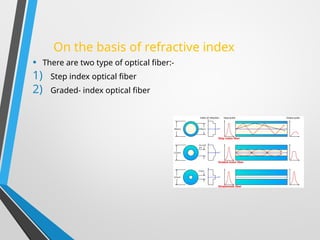
On the basis of refractive index
• There are two type of optical fiber:-
1) Step index optical fiber
2) Graded- index optical fiber
Single Index fiber:-
Step-index optical fiber-the refractive index of core and
cladding are constant.
The light ray propagate through it in the form of
meridiognal rays which cross the fiber axis during every
reflection at the core cladding boundary.
Graded Index Fiber:-
In this type of fiber core has a non uniform refractive index
that gradually decrease from the center towards the core
cladding interface.
The cladding has a uniform refractive index.
The light rays propagate through it in the form of helical
rays. They never cross the fiber axis.
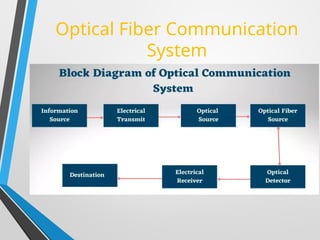
Optical Fiber Communication
System
• Information Source:
Generates the information to be transmitted (e.g., voice
data, video).
• Electrical Transmitter:
Converts the information signal into an electrical signal.
• Optical Source:
Converts the electrical signal into an optical signal (light
Typically uses a laser or LED.
• Optical Fiber:
Transmits the light signal over long distances with minim
loss.
• Optical Detector:
Converts the received light signal back into an electrical
signal.
• Electrical Receiver:
Demodulates the electrical signal to recover the original
information.
Amplifies the signal if necessary.
• Destination:
Receives the recovered information and processes it further.
Advantage of Optical Fiber
 Immense bandwidth to utilize
 Total electrical isolation in the transmission medium
 Very low transmission loss
 Small size and light weight
 High signal security
 Very low power consumption and wide scope of system expansion
etc.
Disadvantage
1) System installation is very costly.
2) Only point-to-point communication is possible.
3) Precise and costly instruments would be required.
4) Splicing is time consuming.
5) It accept only unipolar codes.
• 1. Fragility
• 2. High installation cost
• 3. Limited bend radius
• 4. Requires specialized equipment
• 5. Susceptible to environmental factors.
Limitations:
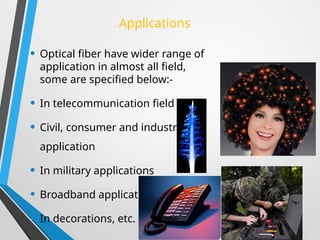
Applications
• Optical fiber have wider range of
application in almost all field,
some are specified below:-
• In telecommunication field
• Civil, consumer and industrial
application
• In military applications
• Broadband applications
• In decorations, etc.
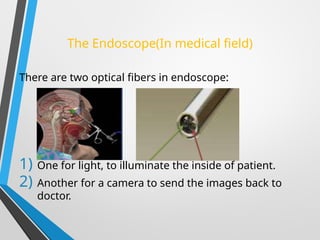
The Endoscope(In medical field)
There are two optical fibers in endoscope:
1) One for light, to illuminate the inside of patient.
2) Another for a camera to send the images back to
doctor.
Conclusion
At the last, there are some negatives of using
optical fiber communication system in terms of
splicing, coupling, set up expenses etc. but it is an un
avoidable fact that optical fiber has revolutionized the
field of communication. As soon as computers will be
capable of processing optical signals, the total arena
of communication will be opticalized immediately.

optical fiber presentation 2.0 introduction to computer

  • 1.
    PRESENTATION ON OPTICAL FIBER CABLE Presentedby : Huzaifa Bin Nawab 2480181 Mubarrah Naeem 2480220 Zia Ullah 2480227 Abdul Moiz bin Irfan 2480167 Fatima Batool 2480245 Submitted to:- Miss Aqsa Raees
  • 2.
    Brief flow ofpresentation • Introduction • What are Optical Fibers ? • Structure of optical fiber • Working principle of optical fiber • Optical fiber communication system • Advantage / Disadvantage of optical fiber • Application of optical fiber • Conclusion
  • 3.
    What is OpticalFiber ? • An optical fiber is a hair thin cylindrical fiber of glass or any transparent dielectric medium. • The fiber which are used for optical communication are wave guides made of transparent dielectrics. • Its function is to guide visible and infrared light over long distance.
  • 4.
  • 5.
    Conti… • Core- centraltube of very thin size made up of optically transparent dielectric medium and carries the light form transmitter to receiver. The core diameter can vary from about 5um-100 um. • Cladding- outer optical material surrounding the core having reflecting index lower than core. It helps to keep the light within the core throughout the phenomena of total internal reflection. • Buffer Coating- plastic coating that protects the fiber made of silicon rubber. The typical diameter of fiber after coating is 250-300um.
  • 6.
    Working principle • TotalInternal Reflection(TIR) • When an ray of light travels from a denser to a rarer medium such that the angle of incidence is greater than the critical angle, the ray reflects back into the same medium this phenomena is called TIR. • In the optical fiber the rays undergo repeated total number of reflections until it emerges out of the other end of the fiber, even if fiber is bend.
  • 7.
    Classification of opticalfiber • Optical fiber is classified into two categories based on:- 1) The number of modes-  Single mode fiber(SMF) and  Multi-mode fiber(MMF) 2) The reflective index-  Step index optical fiber  Graded- index optical fiber
  • 8.
    On basis ofnumber of modes:- Single mode fiber-  In single mode fiber only one mode can propagate through the fiber.  It has small core diameter (5um) and high cladding diameter (70um).  Difference between the refractive index of core and cladding is very small.  There is neither dispersion nor degradation therefore it is suitable for long distance communication.  The light is passed through the single mode fiber through laser diode.
  • 9.
    Multi- mode fiber Itallows a large number of modes for light ray travelling through it. The core diameter is 40um and that of cladding is 70um. The relative refractive index difference is also large than single mode fiber. There is signal degradation due to multimode dispersion. It is not suitable for long distance communication due to large dispersion and attenuation of signal.
  • 10.
    On the basisof refractive index • There are two type of optical fiber:- 1) Step index optical fiber 2) Graded- index optical fiber
  • 11.
    Single Index fiber:- Step-indexoptical fiber-the refractive index of core and cladding are constant. The light ray propagate through it in the form of meridiognal rays which cross the fiber axis during every reflection at the core cladding boundary. Graded Index Fiber:- In this type of fiber core has a non uniform refractive index that gradually decrease from the center towards the core cladding interface. The cladding has a uniform refractive index. The light rays propagate through it in the form of helical rays. They never cross the fiber axis.
  • 12.
  • 13.
    • Information Source: Generatesthe information to be transmitted (e.g., voice data, video). • Electrical Transmitter: Converts the information signal into an electrical signal. • Optical Source: Converts the electrical signal into an optical signal (light Typically uses a laser or LED. • Optical Fiber: Transmits the light signal over long distances with minim loss.
  • 14.
    • Optical Detector: Convertsthe received light signal back into an electrical signal. • Electrical Receiver: Demodulates the electrical signal to recover the original information. Amplifies the signal if necessary. • Destination: Receives the recovered information and processes it further.
  • 15.
    Advantage of OpticalFiber  Immense bandwidth to utilize  Total electrical isolation in the transmission medium  Very low transmission loss  Small size and light weight  High signal security  Very low power consumption and wide scope of system expansion etc.
  • 16.
    Disadvantage 1) System installationis very costly. 2) Only point-to-point communication is possible. 3) Precise and costly instruments would be required. 4) Splicing is time consuming. 5) It accept only unipolar codes.
  • 17.
    • 1. Fragility •2. High installation cost • 3. Limited bend radius • 4. Requires specialized equipment • 5. Susceptible to environmental factors. Limitations:
  • 18.
    Applications • Optical fiberhave wider range of application in almost all field, some are specified below:- • In telecommunication field • Civil, consumer and industrial application • In military applications • Broadband applications • In decorations, etc.
  • 19.
    The Endoscope(In medicalfield) There are two optical fibers in endoscope: 1) One for light, to illuminate the inside of patient. 2) Another for a camera to send the images back to doctor.
  • 20.
    Conclusion At the last,there are some negatives of using optical fiber communication system in terms of splicing, coupling, set up expenses etc. but it is an un avoidable fact that optical fiber has revolutionized the field of communication. As soon as computers will be capable of processing optical signals, the total arena of communication will be opticalized immediately.