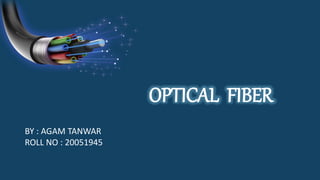
OPTICAL FIBER
BY : AGAM TANWAR
ROLL NO : 20051945
OVERVIEW
INTRODUCTION
STRUCTURE
WORKING PRINCIPLE
COMMUNICATION SYSTEM
TYPES
APPLICATIONS
ADV & DISADV.
CONCLUSION
What is Optical Fiber?
Optical fiber is a hair-like flexible and transparent
fiber which is used for the transmission of data
signals over large distances with a higher speed.
Hence optical fiber is used to provide the service of
internet, telephone and television etc. Optical
fiber works on the principle of total internal
reflection.
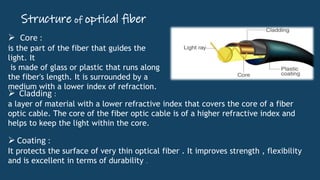
Structure of optical fiber
 Core :
is the part of the fiber that guides the
light. It
is made of glass or plastic that runs along
the fiber's length. It is surrounded by a
medium with a lower index of refraction.
 Cladding :
a layer of material with a lower refractive index that covers the core of a fiber
optic cable. The core of the fiber optic cable is of a higher refractive index and
helps to keep the light within the core.
 Coating :
It protects the surface of very thin optical fiber . It improves strength , flexibility
and is excellent in terms of durability .
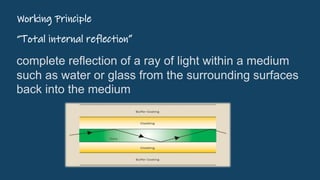
Working Principle
“Total internal reflection”
complete reflection of a ray of light within a medium
such as water or glass from the surrounding surfaces
back into the medium
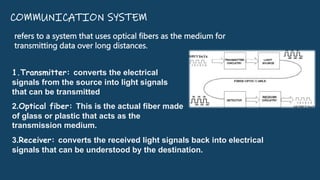
COMMUNICATION SYSTEM
refers to a system that uses optical fibers as the medium for
transmitting data over long distances.
1.Transmitter: converts the electrical
signals from the source into light signals
that can be transmitted
2.Optical fiber: This is the actual fiber made
of glass or plastic that acts as the
transmission medium.
3.Receiver: converts the received light signals back into electrical
signals that can be understood by the destination.
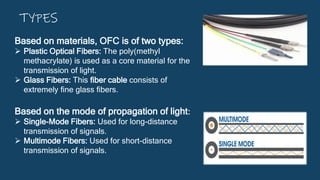
TYPES
Based on materials, OFC is of two types:
 Plastic Optical Fibers: The poly(methyl
methacrylate) is used as a core material for the
transmission of light.
 Glass Fibers: This fiber cable consists of
extremely fine glass fibers.
Based on the mode of propagation of light:
 Single-Mode Fibers: Used for long-distance
transmission of signals.
 Multimode Fibers: Used for short-distance
transmission of signals.
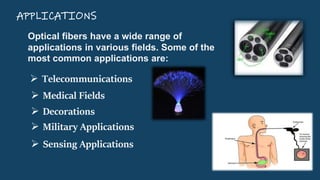
APPLICATIONS
 Telecommunications
 Medical Fields
 Decorations
Optical fibers have a wide range of
applications in various fields. Some of the
most common applications are:
 Military Applications
 Sensing Applications
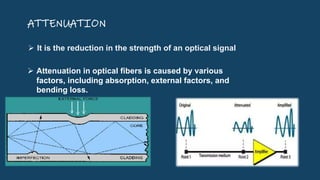
ATTENUATION
 It is the reduction in the strength of an optical signal
 Attenuation in optical fibers is caused by various
factors, including absorption, external factors, and
bending loss.
ADVANTAGES
 Greater Bandwidth.
 Longer Distances.
 Thin & Lightweight.
 Superior Carrying Capacity.
 Less Interference.
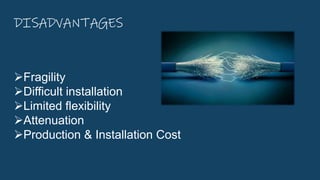
DISADVANTAGES
Fragility
Difficult installation
Limited flexibility
Attenuation
Production & Installation Cost
CONCLUSION
In conclusion, optical fiber is a highly reliable and efficient
technology for transmitting data over long distances. It
offers several advantages over traditional copper cables,
including higher bandwidth, lower signal degradation, and
increased security. Despite its high initial cost and some
installation challenges, the use of optical fiber is growing
as the demand for high-speed data transmission continues
to increase.
THANKYOU !

OPTICAL_FIBER.pptx

  • 1.
    OPTICAL FIBER BY :AGAM TANWAR ROLL NO : 20051945
  • 2.
  • 3.
    What is OpticalFiber? Optical fiber is a hair-like flexible and transparent fiber which is used for the transmission of data signals over large distances with a higher speed. Hence optical fiber is used to provide the service of internet, telephone and television etc. Optical fiber works on the principle of total internal reflection.
  • 4.
    Structure of opticalfiber  Core : is the part of the fiber that guides the light. It is made of glass or plastic that runs along the fiber's length. It is surrounded by a medium with a lower index of refraction.  Cladding : a layer of material with a lower refractive index that covers the core of a fiber optic cable. The core of the fiber optic cable is of a higher refractive index and helps to keep the light within the core.  Coating : It protects the surface of very thin optical fiber . It improves strength , flexibility and is excellent in terms of durability .
  • 5.
    Working Principle “Total internalreflection” complete reflection of a ray of light within a medium such as water or glass from the surrounding surfaces back into the medium
  • 6.
    COMMUNICATION SYSTEM refers toa system that uses optical fibers as the medium for transmitting data over long distances. 1.Transmitter: converts the electrical signals from the source into light signals that can be transmitted 2.Optical fiber: This is the actual fiber made of glass or plastic that acts as the transmission medium. 3.Receiver: converts the received light signals back into electrical signals that can be understood by the destination.
  • 7.
    TYPES Based on materials,OFC is of two types:  Plastic Optical Fibers: The poly(methyl methacrylate) is used as a core material for the transmission of light.  Glass Fibers: This fiber cable consists of extremely fine glass fibers. Based on the mode of propagation of light:  Single-Mode Fibers: Used for long-distance transmission of signals.  Multimode Fibers: Used for short-distance transmission of signals.
  • 8.
    APPLICATIONS  Telecommunications  MedicalFields  Decorations Optical fibers have a wide range of applications in various fields. Some of the most common applications are:  Military Applications  Sensing Applications
  • 9.
    ATTENUATION  It isthe reduction in the strength of an optical signal  Attenuation in optical fibers is caused by various factors, including absorption, external factors, and bending loss.
  • 10.
    ADVANTAGES  Greater Bandwidth. Longer Distances.  Thin & Lightweight.  Superior Carrying Capacity.  Less Interference.
  • 11.
  • 12.
    CONCLUSION In conclusion, opticalfiber is a highly reliable and efficient technology for transmitting data over long distances. It offers several advantages over traditional copper cables, including higher bandwidth, lower signal degradation, and increased security. Despite its high initial cost and some installation challenges, the use of optical fiber is growing as the demand for high-speed data transmission continues to increase.
  • 13.