1
Different types of Optical
Fiber
Md. Hasib Hossen
ID: 1403EEE00044
Dept. of EEE,
Manarat International University
Contents
Evolution of Optical Fiber
What is Optical Fiber
Structure of Optical Fiber
Classification of Optical Fiber
2
Evolution of Optical Fiber
 1880 – Alexander Graham Bell
 1930 – Patents on tubing
 1950 – Patent for two-layer glass wave-guide
 1960 – Laser first used as light source
 1965 – High loss of light discovered
 1970 – Refining of manufacturing process
 1980– OF technology becomes backbone of long
distance telephone networks in NA.
3
What is Optical Fiber?
 An optical fiber is a hair thin cylindrical fiber of glass
or any transparent dielectric medium.
 Light is kept in the "core" of the optical fiber by total
internal reflection.
4
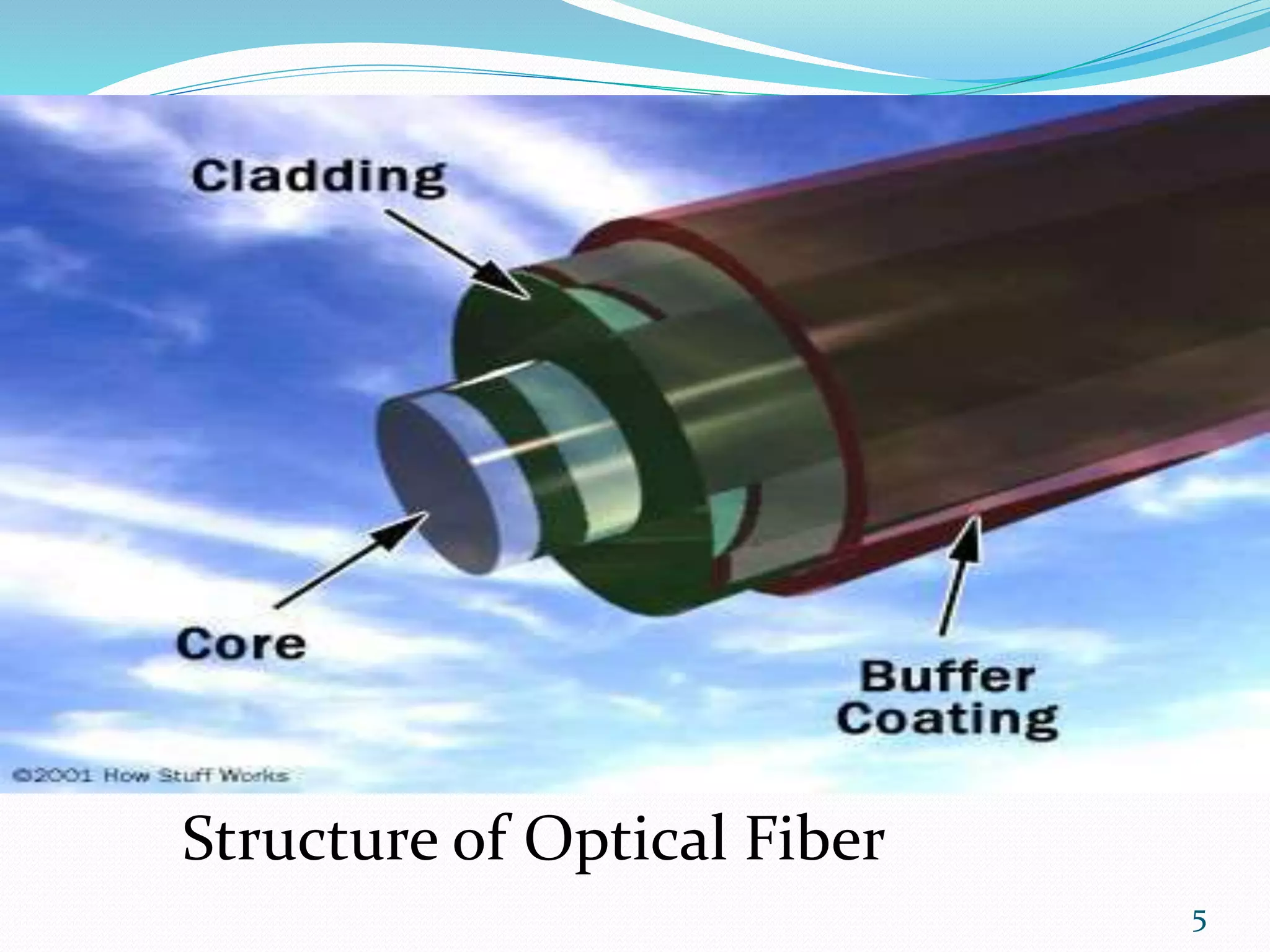
Structure of Optical Fiber
5
Structure of Optical Fiber
Structure of Optical Fiber
Core – central tube of very thin size made up of
optically transparent dielectric medium and carries
the light form transmitter to receiver. The core
diameter can vary from about 5um to 100 um.
 Cladding – outer optical material surrounding
the core having reflecting index lower than core.
Buffer Coating – plastic coating that protects
the fiber made of silicon rubber. The typical
diameter of fiber after coating is 250-300 um.
6
Classification of Optical Fiber
Optical fiber is classified into two categories
based on :-
1) The number of modes
2) The refractive index
7
On the basis of number of modes:-
 On the basis of number of modes of propagation the
optical fiber are classified into two types:
(i) Single mode fiber (SMF)
(ii) Multi-mode fiber (MMF)
Single-mode fiber (SMF)
• Core diameter in the range of upto 10 µm
• Allow one mode
• No Intermodal dispersion
• Higher bandwidth and longer transmission distance
8
On the basis of number of modes:-
Multi-mode fiber (MMF)
 Core diameter range up to 80 to 100 µm
 Allow many modes (hundreds or more)
 very large inter-
modal dispersion
 severe broadening
of signal pulses
 Large ISI effect
 Limited bandwidth
and distance
9
10
Refraction at a plane
surface
Refraction
Refraction is the changing direction of light
when it goes into a material of different
Density.
11
On the basis of Refractive index
There are two types of optical fiber:-
(i) Step-index optical fiber
(ii) Graded-index optical fiber
12
13
14

Optical fiber

  • 1.
    1 Different types ofOptical Fiber Md. Hasib Hossen ID: 1403EEE00044 Dept. of EEE, Manarat International University
  • 2.
    Contents Evolution of OpticalFiber What is Optical Fiber Structure of Optical Fiber Classification of Optical Fiber 2
  • 3.
    Evolution of OpticalFiber  1880 – Alexander Graham Bell  1930 – Patents on tubing  1950 – Patent for two-layer glass wave-guide  1960 – Laser first used as light source  1965 – High loss of light discovered  1970 – Refining of manufacturing process  1980– OF technology becomes backbone of long distance telephone networks in NA. 3
  • 4.
    What is OpticalFiber?  An optical fiber is a hair thin cylindrical fiber of glass or any transparent dielectric medium.  Light is kept in the "core" of the optical fiber by total internal reflection. 4
  • 5.
    Structure of OpticalFiber 5 Structure of Optical Fiber
  • 6.
    Structure of OpticalFiber Core – central tube of very thin size made up of optically transparent dielectric medium and carries the light form transmitter to receiver. The core diameter can vary from about 5um to 100 um.  Cladding – outer optical material surrounding the core having reflecting index lower than core. Buffer Coating – plastic coating that protects the fiber made of silicon rubber. The typical diameter of fiber after coating is 250-300 um. 6
  • 7.
    Classification of OpticalFiber Optical fiber is classified into two categories based on :- 1) The number of modes 2) The refractive index 7
  • 8.
    On the basisof number of modes:-  On the basis of number of modes of propagation the optical fiber are classified into two types: (i) Single mode fiber (SMF) (ii) Multi-mode fiber (MMF) Single-mode fiber (SMF) • Core diameter in the range of upto 10 µm • Allow one mode • No Intermodal dispersion • Higher bandwidth and longer transmission distance 8
  • 9.
    On the basisof number of modes:- Multi-mode fiber (MMF)  Core diameter range up to 80 to 100 µm  Allow many modes (hundreds or more)  very large inter- modal dispersion  severe broadening of signal pulses  Large ISI effect  Limited bandwidth and distance 9
  • 10.
    10 Refraction at aplane surface
  • 11.
    Refraction Refraction is thechanging direction of light when it goes into a material of different Density. 11
  • 12.
    On the basisof Refractive index There are two types of optical fiber:- (i) Step-index optical fiber (ii) Graded-index optical fiber 12
  • 13.
  • 14.