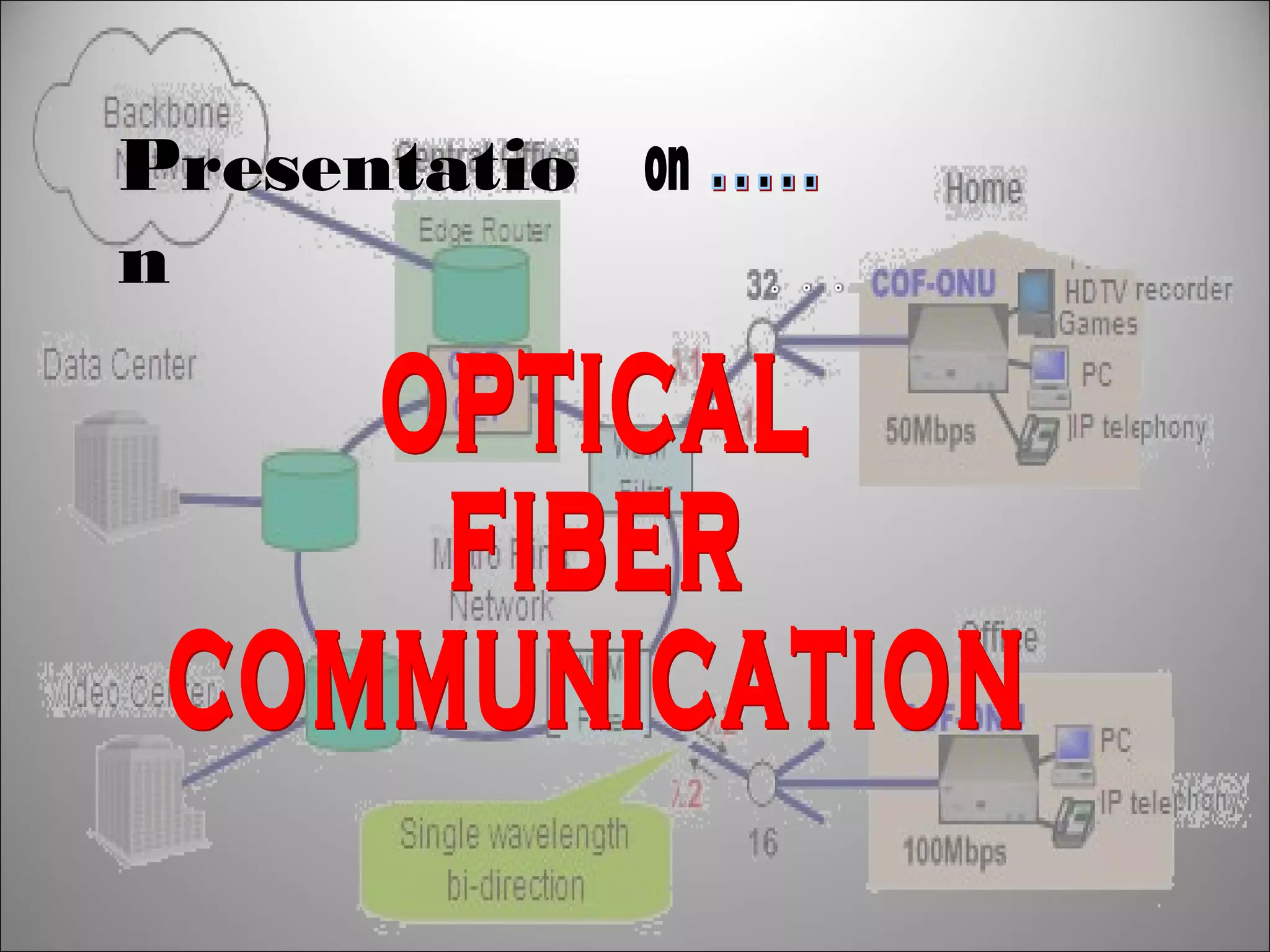
Presentatio
n
An optical fiber (or fibre) is a glass or plastic fiber that carries light along its 
length. 
Fiber optics is the overlap of applied science and engineering concerned with the 
design and application of optical fibers.
Optical fibers are widely used in fiber-optic communications, which permits 
transmission over longer distances and at higherbandwidths (data rates) than other 
forms of communications. Fibers are used instead of metal wires because signals 
travel along them with less loss, and they are also immune to 
electromagnetic interference. 
Fibers are also used for illumination, and are wrapped in bundles so they can be 
used to carry images, thus allowing viewing in tight spaces. Specially designed 
fibers are used for a variety of other applications, including sensors and fiber lasers. 
BASIC TRANSMISSION 
Fiber optics involves the transmission
of information by light through long
transparent fibers made from glass or
plastic. A light source modulates a
light emitting diode (LED), or a laser
turns on or off or varies in intensity in
a manner that represents the electrical
information input signal. The
modulating light is then coupled to an
optical fiber that propagates the light.
An optical detector at the opposite end
of the fiber receives the modulating
light and converts it back to an
electrical signal which is identical to
the input signal.
There are generally five elements that make up the construction of a
fiber-optic strand, or cable: the optic core, optic cladding, a buffer
material, a strength material and the outer jacket . The optic core is
the light carrying element at the center of the optical fiber. It is
commonly made from a combination of silica and germanium.
Surrounding the core is the optic cladding made of pure silica. It is
this combination that makes the principle of total internal reflection
possible. The difference in materials used in the making of the core
and the cladding creates an extremely reflective surface at the point
in which they interface. Light pulses entering the fiber core reflect off
the core/cladding interface and thus remain within the core as they
move down the line. 
WHAT ARE OPTICAL FIBERS?
Surrounding the cladding is a buffer material used to help shield the
core and cladding from damage. A strength material surrounds the
buffer, preventing stretch problems when the fiber cable is being
pulled. The outer jacket is added to protect against abrasion, solvents,
and other contaminants
Cut away of a fiber-optic cable. 
Two types of light sources are commonly used for
optical fiber in communications applications.
These sources are the light-emitting diode (LED) and
the semiconductor laser (or laser diode).
These two sources have distinct characteristics in
terms of performance, cost, and ease of use.
The selection is usually based on the higher cost and
higher performance of the laser versus the lower cost
and lower performance of the LED.
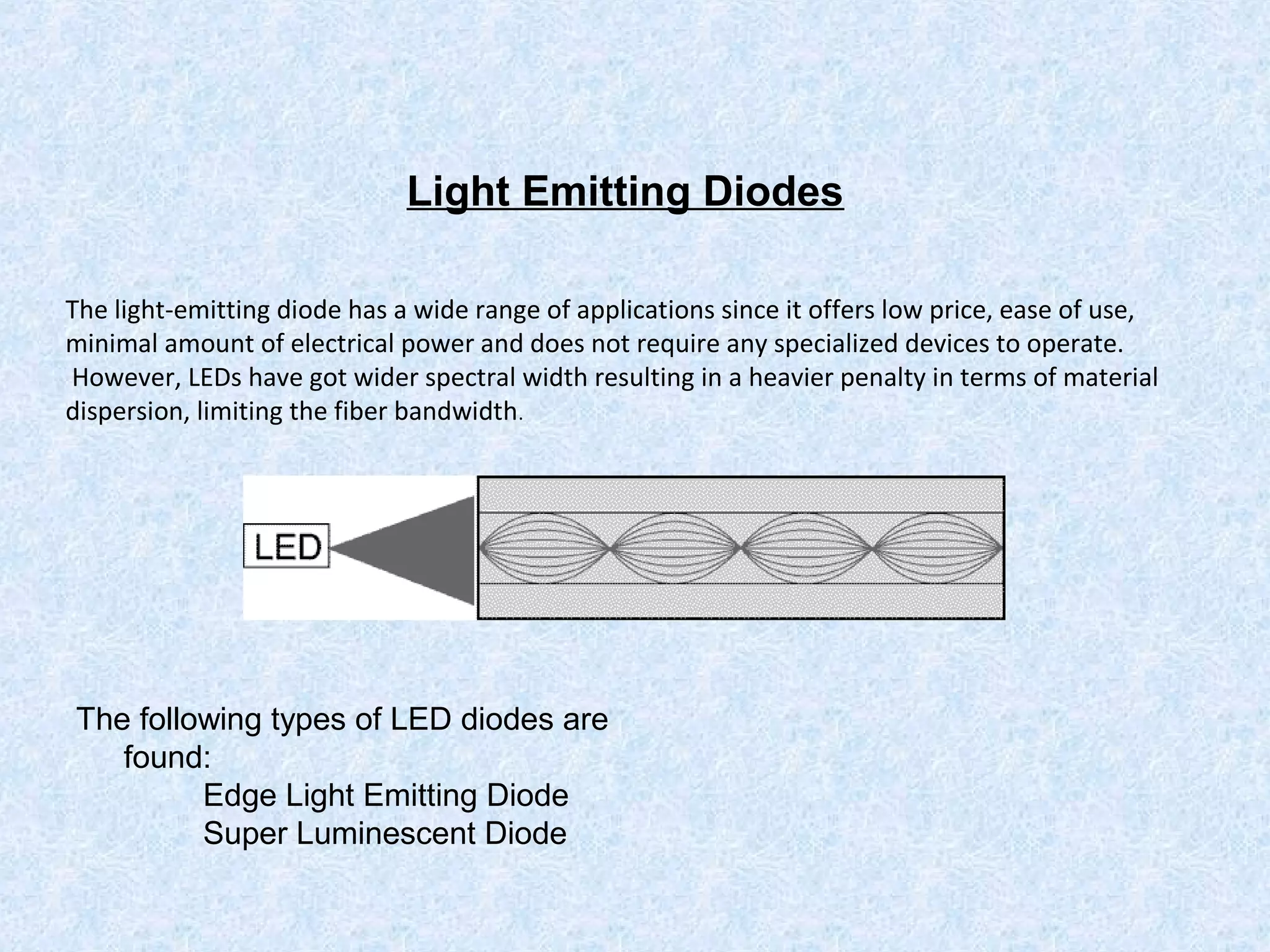
Light Emitting Diodes
The light-emitting diode has a wide range of applications since it offers low price, ease of use,
minimal amount of electrical power and does not require any specialized devices to operate.
However, LEDs have got wider spectral width resulting in a heavier penalty in terms of material
dispersion, limiting the fiber bandwidth.
The following types of LED diodes are
found:
Edge Light Emitting Diode
Super Luminescent Diode
The following types of Laser Diodes are found:
a)Gain-guided Laser Diodes
b)Index-guided Laser Diodes
LASER produces light that is highly directional, coherent, and
monochromatic. Thus laser diodes dictate the implementation of
high capacity systems. However, laser diodes have several
disadvantages which includes temperature dependence, non-
linear characteristics, requirement of cooling elements and
feedback control, and necessary coupling arrangements for
launching of laser into fiber.
LASER
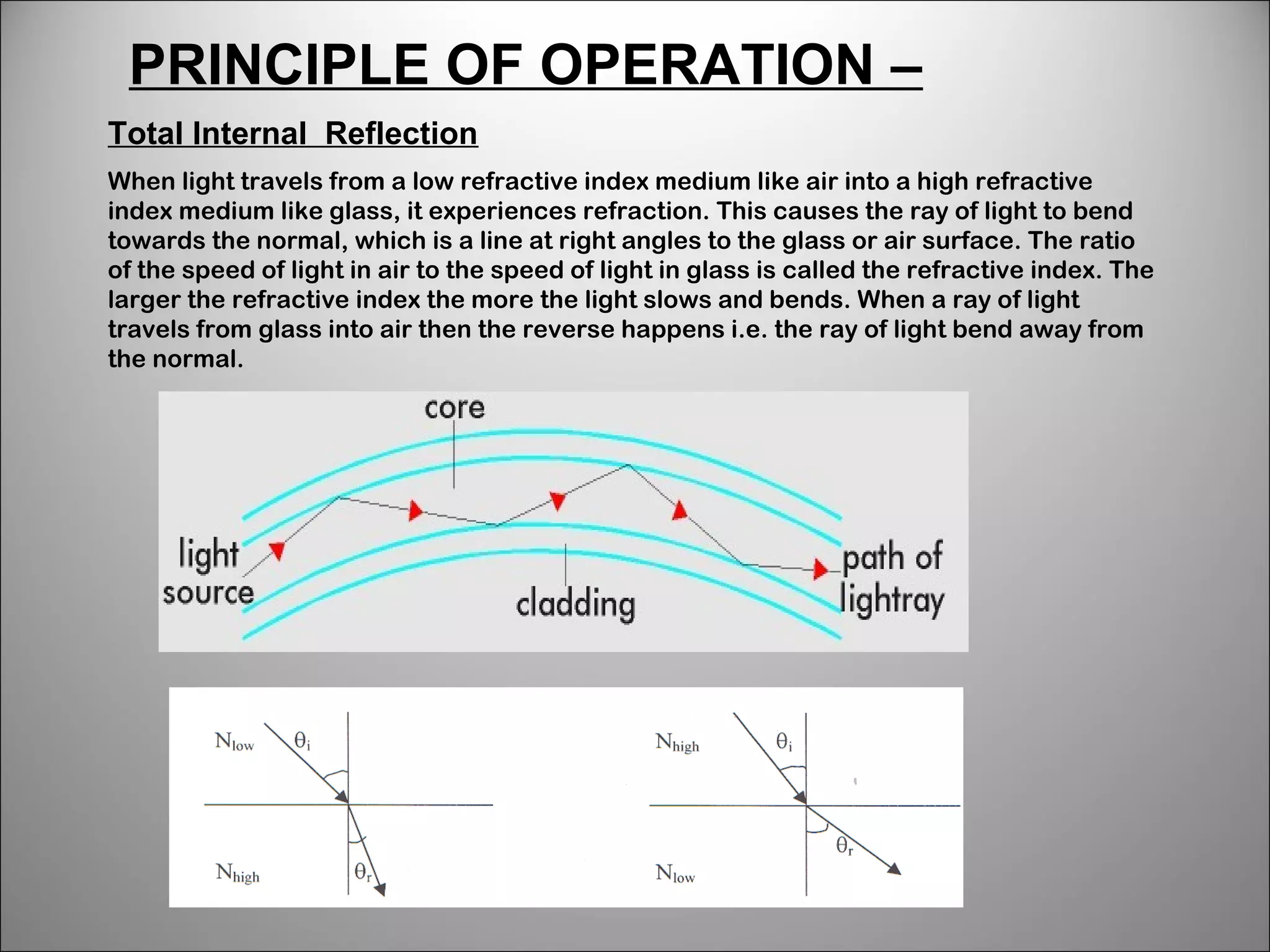
When light travels from a low refractive index medium like air into a high refractive
index medium like glass, it experiences refraction. This causes the ray of light to bend
towards the normal, which is a line at right angles to the glass or air surface. The ratio
of the speed of light in air to the speed of light in glass is called the refractive index. The
larger the refractive index the more the light slows and bends. When a ray of light
travels from glass into air then the reverse happens i.e. the ray of light bend away from
the normal.
PRINCIPLE OF OPERATION –
Total Internal Reflection
FIBER TYPES
Optical fibers are classified on the basis of inherent material from which they are made,
refractive index profile of the core , and the way light propagates within the core . Fibers are
selected with respect to different applications and requirements. Fibers are either made of
glass is far more common. Glass fiber, composed of silica or fused quartz, is extremely pure.
Adding specific impurities in to the glass matrix modifies the index of refrection and improves
the guiding properties of the fiber.
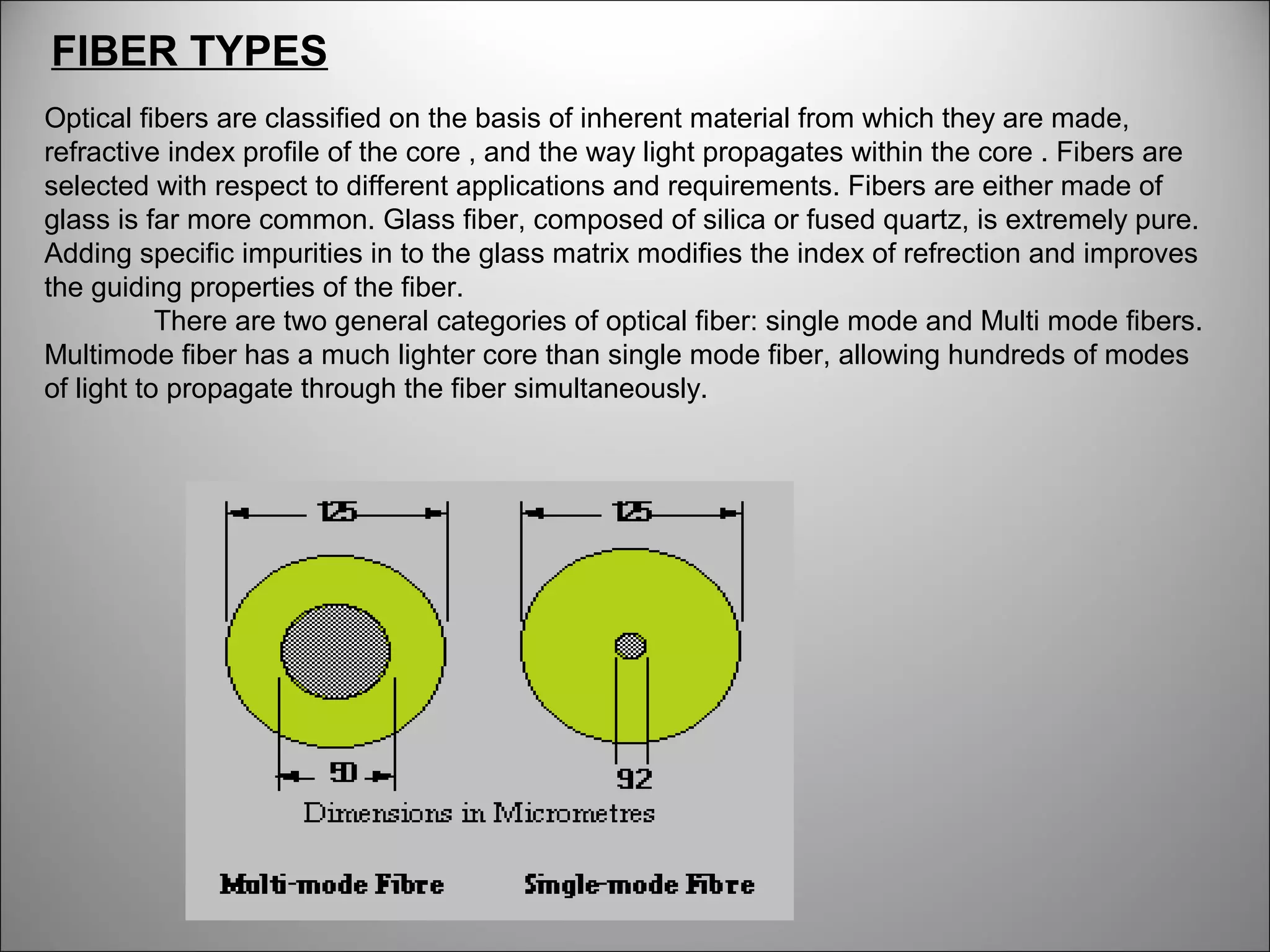
There are two general categories of optical fiber: single mode and Multi mode fibers.
Multimode fiber has a much lighter core than single mode fiber, allowing hundreds of modes
of light to propagate through the fiber simultaneously.
Single Mode:
Because its core is so narrow Single Mode fibre can support only one mode. This is called the
"Lowest Order Mode". Single mode fiber has some advantages over multimode fibre.
Multimode:
Although it may seem from what we have said about total internal reflection that any
ray of light can travel down the fibre, in fact, because of the wave nature of light, only
certain ray directions can actually travel down the fibre. These are called the "Fibre
Mode". In a multimode fibre, many different modes are supported by the fiber.
Step Index Fibre:
Step index fibre is so called because the refractive index of the fibre 'steps" up as
we move from the cladding to the core of the fibre. Within the cladding the refractive
index is constant, and within the core of the refractive index is constant.
Graded Index Fibre
Graded Index Fibre has a different core structure from single mode and multimode fibre.
Whereas in a step-index fibre the refractive index of the core is constant throughout the core,
in a graded index fibre the value of the refractive index changes from the centre of the core
onwards. In fact it has what we call a Quadratic Profile. This means that the refractive index
of the core is proportional to the square of the distance from the centre of the fibre.
FIBER LOSSES
• Attenuation losses –.
• Dispersion losses –
• Modal dispersion – .
• Chromatic dispersion –
• Material dispersion –
• Waveguide dispersion -
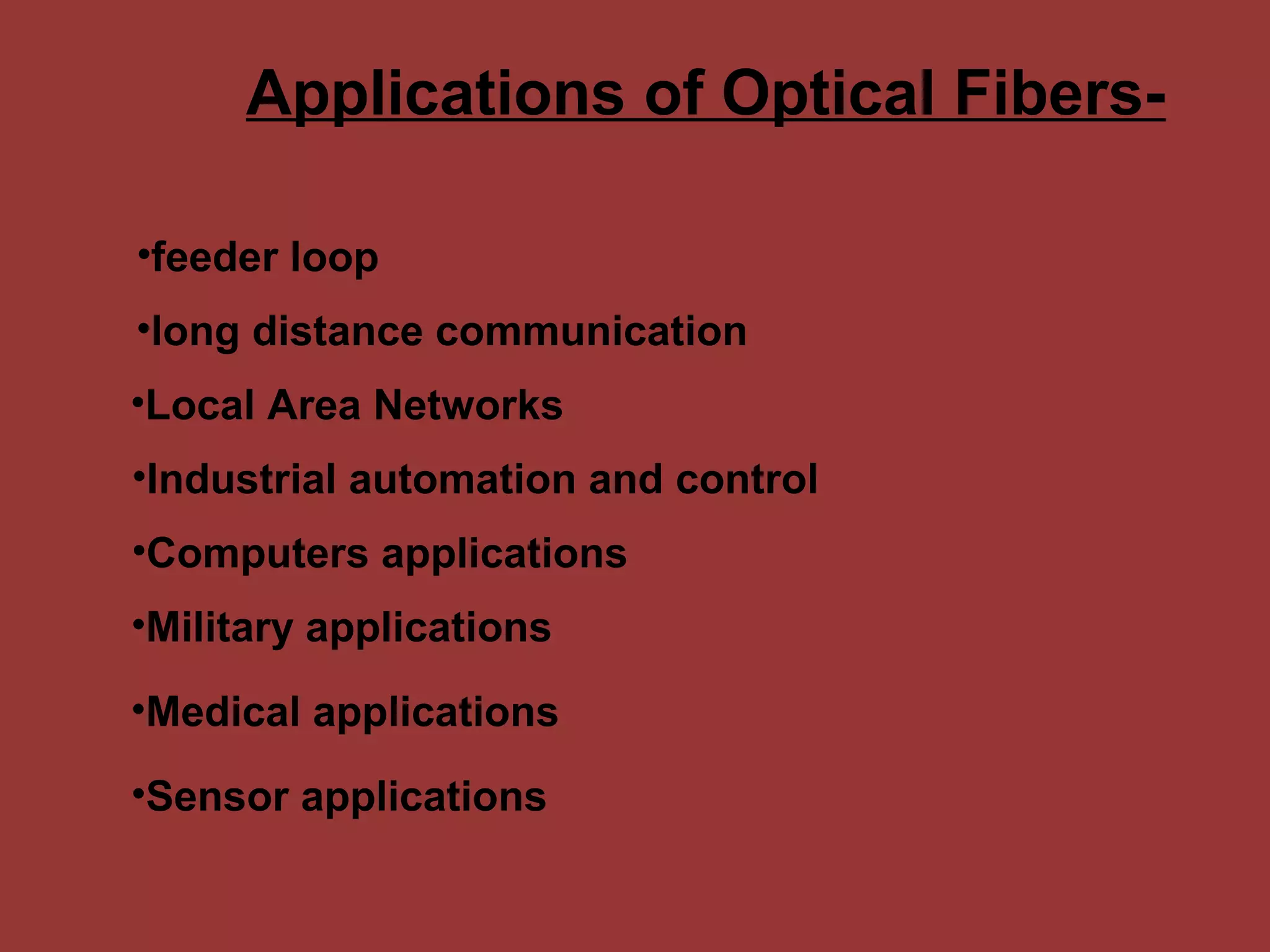
Applications of Optical Fibers-
•long distance communication
•feeder loop
•Local Area Networks
•Industrial automation and control
•Computers applications
•Military applications
•Medical applications
•Sensor applications
CONCLUSION
• Fiber-optic communication is a method of 
transmitting information from one place to 
another by sending pulses of light through 
an optical fiber
• DUE to the advantages of  Fiber-optic
communication over electrical transmission, 
optical fibers have largely replaced copper 
wire communications in core networks in 
the developed world.
•Principles Of Communication Systems: Herbt Taub and
Donald L.Schilling;
Tata Mcgraw-Hill Publishing Company Limited
•Telecommunications Engineers Reference Book :
Fraidan Mazda
•http://www.google.in
•http://www.wikipedia.com
References:
THANK YOU...

optical-fiber-communication

  • 1.
  • 2.
    An optical fiber (or fibre) is a glass or plastic fiber that carries light along its  length.  Fiber optics is the overlap of applied science and engineering concerned with the  design and application of optical fibers. Optical fibers are widely used in fiber-optic communications, which permits  transmission over longer distances and at higherbandwidths (data rates) than other  forms of communications. Fibers are used instead of metal wires because signals  travel along them with less loss, and they are also immune to  electromagnetic interference.  Fibers are also used for illumination, and are wrapped in bundles so they can be  used to carry images, thus allowing viewing in tight spaces. Specially designed  fibers are used for a variety of other applications, including sensors and fiber lasers. 
  • 3.
    BASIC TRANSMISSION  Fiber opticsinvolves the transmission of information by light through long transparent fibers made from glass or plastic. A light source modulates a light emitting diode (LED), or a laser turns on or off or varies in intensity in a manner that represents the electrical information input signal. The modulating light is then coupled to an optical fiber that propagates the light. An optical detector at the opposite end of the fiber receives the modulating light and converts it back to an electrical signal which is identical to the input signal.
  • 4.
    There are generallyfive elements that make up the construction of a fiber-optic strand, or cable: the optic core, optic cladding, a buffer material, a strength material and the outer jacket . The optic core is the light carrying element at the center of the optical fiber. It is commonly made from a combination of silica and germanium. Surrounding the core is the optic cladding made of pure silica. It is this combination that makes the principle of total internal reflection possible. The difference in materials used in the making of the core and the cladding creates an extremely reflective surface at the point in which they interface. Light pulses entering the fiber core reflect off the core/cladding interface and thus remain within the core as they move down the line.  WHAT ARE OPTICAL FIBERS? Surrounding the cladding is a buffer material used to help shield the core and cladding from damage. A strength material surrounds the buffer, preventing stretch problems when the fiber cable is being pulled. The outer jacket is added to protect against abrasion, solvents, and other contaminants
  • 5.
    Cut away ofa fiber-optic cable. 
  • 6.
    Two types oflight sources are commonly used for optical fiber in communications applications. These sources are the light-emitting diode (LED) and the semiconductor laser (or laser diode). These two sources have distinct characteristics in terms of performance, cost, and ease of use. The selection is usually based on the higher cost and higher performance of the laser versus the lower cost and lower performance of the LED.
  • 7.
    Light Emitting Diodes Thelight-emitting diode has a wide range of applications since it offers low price, ease of use, minimal amount of electrical power and does not require any specialized devices to operate. However, LEDs have got wider spectral width resulting in a heavier penalty in terms of material dispersion, limiting the fiber bandwidth. The following types of LED diodes are found: Edge Light Emitting Diode Super Luminescent Diode
  • 8.
    The following typesof Laser Diodes are found: a)Gain-guided Laser Diodes b)Index-guided Laser Diodes LASER produces light that is highly directional, coherent, and monochromatic. Thus laser diodes dictate the implementation of high capacity systems. However, laser diodes have several disadvantages which includes temperature dependence, non- linear characteristics, requirement of cooling elements and feedback control, and necessary coupling arrangements for launching of laser into fiber. LASER
  • 9.
    When light travelsfrom a low refractive index medium like air into a high refractive index medium like glass, it experiences refraction. This causes the ray of light to bend towards the normal, which is a line at right angles to the glass or air surface. The ratio of the speed of light in air to the speed of light in glass is called the refractive index. The larger the refractive index the more the light slows and bends. When a ray of light travels from glass into air then the reverse happens i.e. the ray of light bend away from the normal. PRINCIPLE OF OPERATION – Total Internal Reflection
  • 10.
    FIBER TYPES Optical fibersare classified on the basis of inherent material from which they are made, refractive index profile of the core , and the way light propagates within the core . Fibers are selected with respect to different applications and requirements. Fibers are either made of glass is far more common. Glass fiber, composed of silica or fused quartz, is extremely pure. Adding specific impurities in to the glass matrix modifies the index of refrection and improves the guiding properties of the fiber. There are two general categories of optical fiber: single mode and Multi mode fibers. Multimode fiber has a much lighter core than single mode fiber, allowing hundreds of modes of light to propagate through the fiber simultaneously.
  • 11.
    Single Mode: Because itscore is so narrow Single Mode fibre can support only one mode. This is called the "Lowest Order Mode". Single mode fiber has some advantages over multimode fibre.
  • 12.
    Multimode: Although it mayseem from what we have said about total internal reflection that any ray of light can travel down the fibre, in fact, because of the wave nature of light, only certain ray directions can actually travel down the fibre. These are called the "Fibre Mode". In a multimode fibre, many different modes are supported by the fiber.
  • 13.
    Step Index Fibre: Stepindex fibre is so called because the refractive index of the fibre 'steps" up as we move from the cladding to the core of the fibre. Within the cladding the refractive index is constant, and within the core of the refractive index is constant.
  • 14.
    Graded Index Fibre GradedIndex Fibre has a different core structure from single mode and multimode fibre. Whereas in a step-index fibre the refractive index of the core is constant throughout the core, in a graded index fibre the value of the refractive index changes from the centre of the core onwards. In fact it has what we call a Quadratic Profile. This means that the refractive index of the core is proportional to the square of the distance from the centre of the fibre.
  • 15.
    FIBER LOSSES • Attenuationlosses –. • Dispersion losses – • Modal dispersion – . • Chromatic dispersion – • Material dispersion – • Waveguide dispersion -
  • 16.
    Applications of OpticalFibers- •long distance communication •feeder loop •Local Area Networks •Industrial automation and control •Computers applications •Military applications •Medical applications •Sensor applications
  • 17.
    CONCLUSION • Fiber-optic communication is a method of  transmitting information from one place to  another by sending pulses of light through  an optical fiber •DUE to the advantages of  Fiber-optic communication over electrical transmission,  optical fibers have largely replaced copper  wire communications in core networks in  the developed world.
  • 18.
    •Principles Of CommunicationSystems: Herbt Taub and Donald L.Schilling; Tata Mcgraw-Hill Publishing Company Limited •Telecommunications Engineers Reference Book : Fraidan Mazda •http://www.google.in •http://www.wikipedia.com References:
  • 19.