SYED AHSAN RAZA
Overview of Contents
 Introduction
 Ray Theory Transmission
 Electromagnetic Mode Theory for Optical Propagation
 Cylindrical Fiber
 Single Mode Fibers
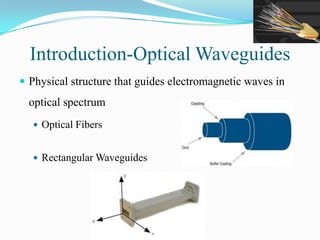
Introduction-Optical Waveguides
 Physical structure that guides electromagnetic waves in
optical spectrum
 Optical Fibers
 Rectangular Waveguides
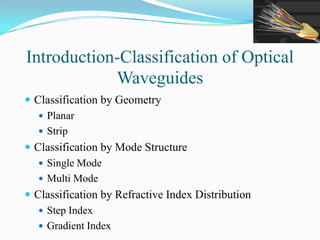
Introduction-Classification of Optical
Waveguides
 Classification by Geometry
 Planar
 Strip
 Classification by Mode Structure
 Single Mode
 Multi Mode
 Classification by Refractive Index Distribution
 Step Index
 Gradient Index
Purification of Materials in Optical
Fiber
 Proposals by Kao and Hockham in 1966 to utilize Optical Fiber as
communication medium (Loss>1000 dB/km)
 Conventional glass refining techniques used to bring optical fibers losses down to
4.2 dB/km
 Further research in glass refining processes allowed fiber manufacturing with
losses below 1dB/km(Operation in 0.8-0.9 μm)
 Reduced signal dispersion and lower losses found in operation at longer
wavelengths (1.1-1.6 μm)
 At 1.55 μm high performance fibers exhibited losses to the tune of 0.2 dB/km
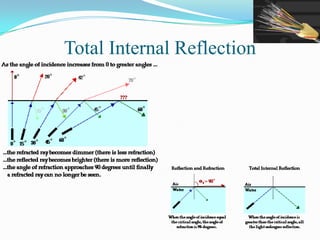
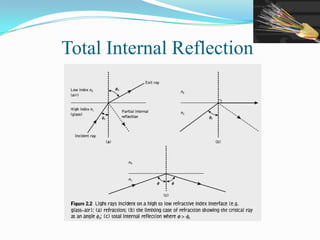
Total Internal Reflection
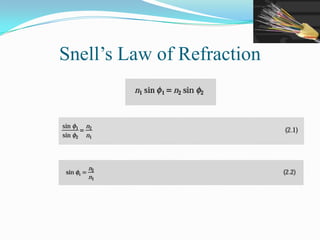
Snell’s Law of Refraction
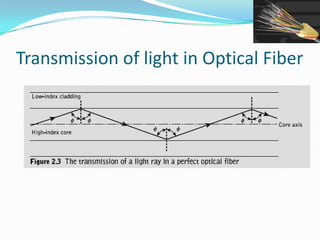
Transmission of light in Optical Fiber
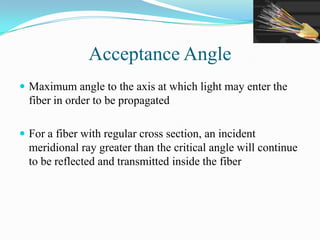
Acceptance Angle
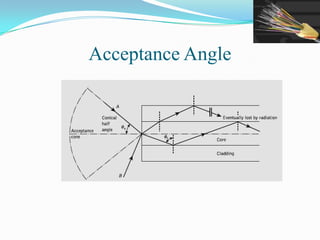
 Maximum angle to the axis at which light may enter the
fiber in order to be propagated
 For a fiber with regular cross section, an incident
meridional ray greater than the critical angle will continue
to be reflected and transmitted inside the fiber
Acceptance Angle
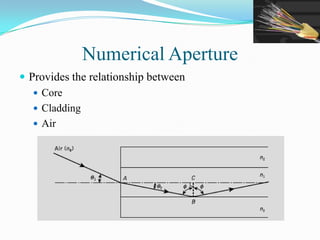
Numerical Aperture
 Provides the relationship between
 Core
 Cladding
 Air
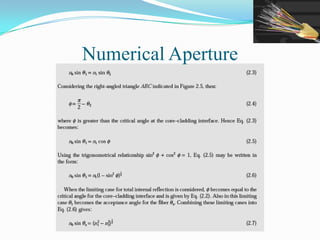
Numerical Aperture
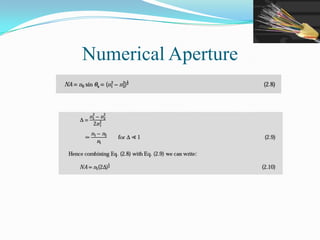
Numerical Aperture
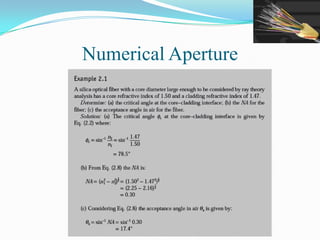
Numerical Aperture

02 optical fiber-waveguides