COMMUNICATION ENGINEERING
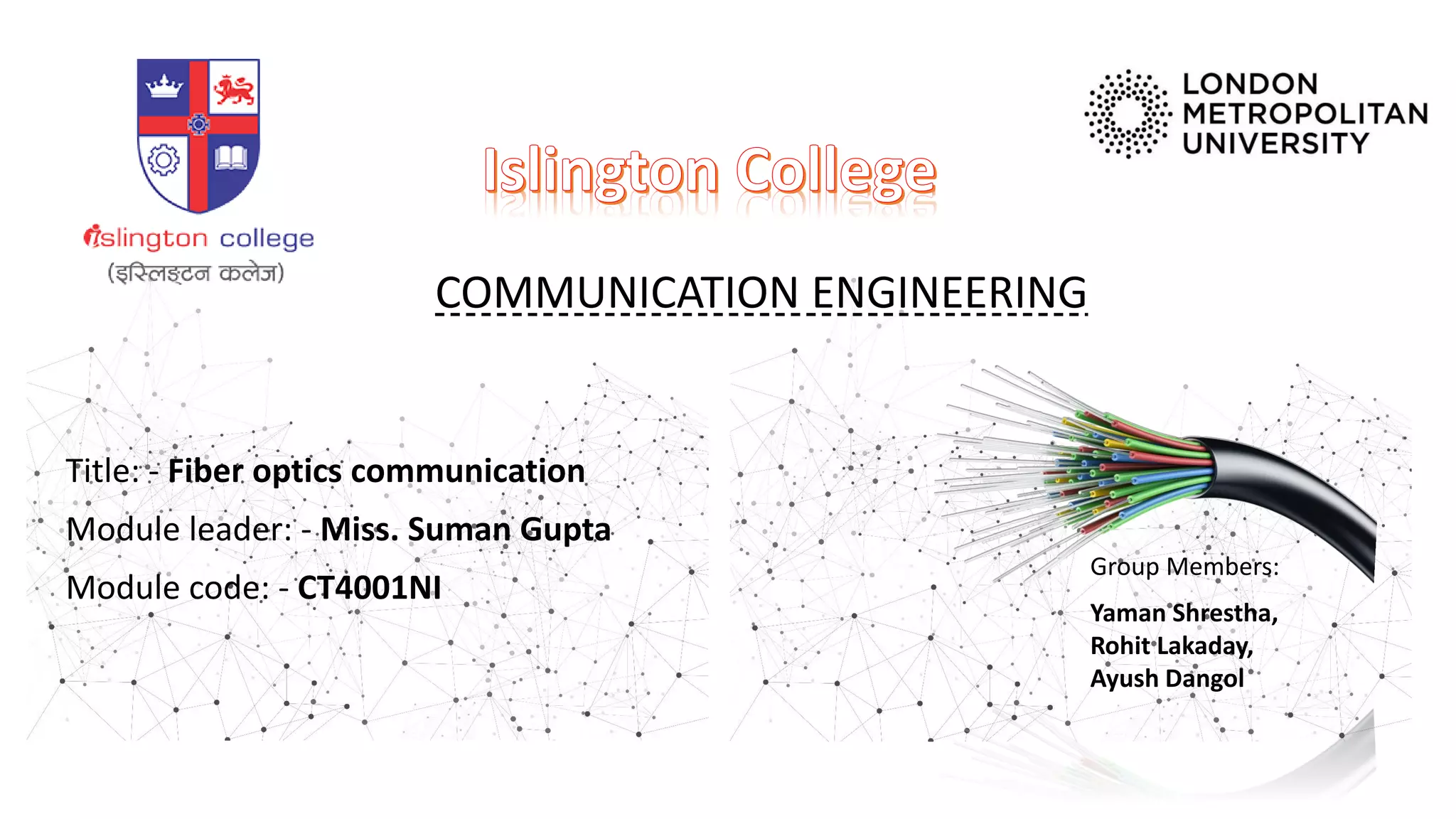
Title: - Fiber optics communication
Module leader: - Miss. Suman Gupta
Module code: - CT4001NI
Group Members:
Yaman Shrestha,
Rohit Lakaday,
Ayush Dangol
Objectives
 Understand the importance of fiber-optic technologies in the field of
telecommunication.
 Identify the fundamental components of a fiber-optic cable
 Understand the principles by which light travels within a fiber-optic
cable
Development of Fiber Optics communication
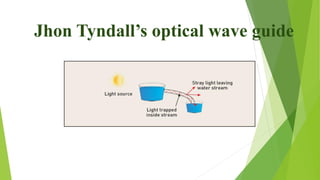
 1854 Jhon Tyndall demonstrated the optical wave guide principal
 1960 Theodore Maiman developed the first laser
 1970 Sir K C Kao and others from corning fabricated fiber of 20 dB/km loss
(low-attenuation silica glass fibers )
 1972 4dB/km loss fiber fabricated
 1982 Single mode fiber optic cable first reported
 1991 SONET telecommunications standards created.
( Synchronous optical networking (SONET) is a standardized digital communication protocol)
 1995 DWDM deployment began
 1998> 1Tbps demonstrated on one fiber
 2000 L band system and 40 Gbps transport systems demonstrated
(L band refers to the operating frequency range of 1–2 GHz in the radio spectrum. )
Jhon Tyndall’s optical wave guide
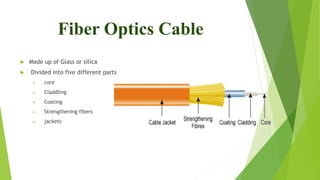
Fiber Optics Cable
 Made up of Glass or silica
 Divided into five different parts
➢ core
➢ Claddling
➢ Coating
➢ Strengthening fibers
➢ jackets
Fiber Optic Transmission System
•Optical Transmitter
•Optical receiver
Optical transmitter
• It is a transducer that converts electrical pulses to optical
pulses
• Can be characterized by modulation format, bandwidth,
optical power, wavelength.
• Laser diodes have better controlled parameters, higher optical
power and short rise times and therefore are better suited for
higher bit rates
• Light Emitting Diode (LED) transmit a wider band of
wavelengths are cheap and are better suited for lower bit
rates than laser transmitters.
Optical receiver
• It converts optical pulses into electrical pulses.
• It can also be characterized by bandwidth, noise,
wavelength, sensitivity.
• Semiconductor photodiodes are used as photodetectors
because of their compatibility with the system.
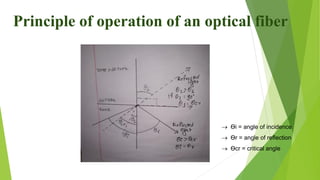
Principle of operation of an optical fiber
→ Ѳi = angle of incidence
→ Ѳr = angle of reflection
→ Ѳcr = critical angle
Types of optical Fiber
• Single-mode fiber
• Multimode fiber
➢ Step Index Fiber
➢Graded Index Fiber
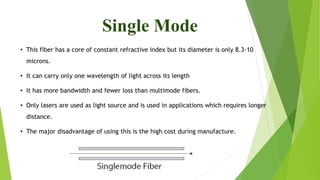
Single Mode
• This fiber has a core of constant refractive index but its diameter is only 8.3-10
microns.
• It can carry only one wavelength of light across its length
• It has more bandwidth and fewer loss than multimode fibers.
• Only lasers are used as light source and is used in applications which requires longer
distance.
• The major disadvantage of using this is the high cost during manufacture.
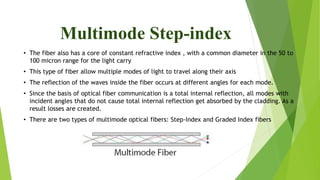
Multimode Step-index
• The fiber also has a core of constant refractive index , with a common diameter in the 50 to
100 micron range for the light carry
• This type of fiber allow multiple modes of light to travel along their axis
• The reflection of the waves inside the fiber occurs at different angles for each mode.
• Since the basis of optical fiber communication is a total internal reflection, all modes with
incident angles that do not cause total internal reflection get absorbed by the cladding. As a
result losses are created.
• There are two types of multimode optical fibers: Step-Index and Graded Index fibers
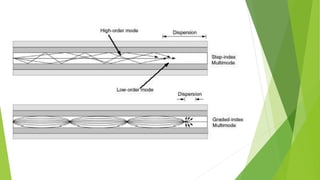
Step Index Fiber
• The refractive index of the core in the step index optical fiber is
uniform.
• It suffers from dispersion
• The diameter of the core is about 50-100 µm and this is wide
enough to allow several different waveguide modes to
propagate down the fiber.
Graded Index Fiber
• The refractive index of the core in the step index optical
fiber is not constant but decreases gradually as a function of
the radial distance from its center.
• The dispersion effect is much less compared to step-index
fibers.
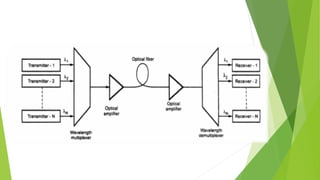
Wavelength Division Multiplexing (WDM)
 Several signals can be sent through the
same fiber simultaneously by using
different wavelengths (colors) of light
 That means more bandwidth—more data
per second
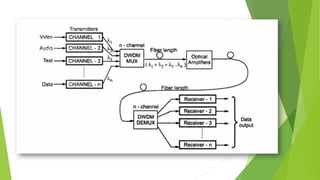
Dense Wavelength Division Multiplexing
(DWDM)
 Multiple data channels of optical signals are assigned different
wavelengths, and are multiplexed onto one fiber by multiplexer(MUX)
 Uses single mode fiber to carry multiple light of different frequencies
 Uses up to 100 wavelengths through a single fiber
 A demultiplexer (DEMUX) separates the received channels to individual
receivers
Applications of fiber optical communication
The use of optical fiber communication is growing rapidly day by day due to its advance
features which can overcome the problems faced by using copper data communication system.
So use of optic fiber can be seen in the following sectors listed below
• Medical
• Military
• Networking
• Lighting and Imaging
• Broadcast/CATV/Cable Television
• School/colleges etc
Advantages of using the fiber optical communication
 Greater Bandwidth and faster speed is its significant advantage as
optical fiber cables supports extremely high bandwidth and speed.
 It’s less expensive
 It’s thinner and light-weighted and can be drawn to smaller diameters
than copper wire.
 It’s flexible to fit in places where space is a concern.
 It has the higher carrying capacity which allows more phone lines to go
over the same cable or more channels to come through the cable into
your cable TV box.
 It has a less lost of signal than that in copper wire.
 it has longer life cycle for over 100 years.
Disadvantages of using the fiber optical communication
 Optical fiber has limited application as it can only be used on
ground, it can not work with the mobile communication.
 It has low power. although high power emitters are available to
improve power supply, it would add extra cost.
 Optical fiber cable should be bend or twist which causes the loss in
signal or gives poor signal.
 Repeaters are needed to be used to boost the signal
 The distance between the transmitter and receiver should keep short
to receive a good signal.
Optical fiber communication || History and working principle || Yaman Shrestha

Optical fiber communication || History and working principle || Yaman Shrestha

  • 1.
    COMMUNICATION ENGINEERING Title: -Fiber optics communication Module leader: - Miss. Suman Gupta Module code: - CT4001NI Group Members: Yaman Shrestha, Rohit Lakaday, Ayush Dangol
  • 2.
    Objectives  Understand theimportance of fiber-optic technologies in the field of telecommunication.  Identify the fundamental components of a fiber-optic cable  Understand the principles by which light travels within a fiber-optic cable
  • 3.
    Development of FiberOptics communication  1854 Jhon Tyndall demonstrated the optical wave guide principal  1960 Theodore Maiman developed the first laser  1970 Sir K C Kao and others from corning fabricated fiber of 20 dB/km loss (low-attenuation silica glass fibers )  1972 4dB/km loss fiber fabricated  1982 Single mode fiber optic cable first reported  1991 SONET telecommunications standards created. ( Synchronous optical networking (SONET) is a standardized digital communication protocol)  1995 DWDM deployment began  1998> 1Tbps demonstrated on one fiber  2000 L band system and 40 Gbps transport systems demonstrated (L band refers to the operating frequency range of 1–2 GHz in the radio spectrum. )
  • 4.
  • 5.
    Fiber Optics Cable Made up of Glass or silica  Divided into five different parts ➢ core ➢ Claddling ➢ Coating ➢ Strengthening fibers ➢ jackets
  • 6.
    Fiber Optic TransmissionSystem •Optical Transmitter •Optical receiver
  • 7.
    Optical transmitter • Itis a transducer that converts electrical pulses to optical pulses • Can be characterized by modulation format, bandwidth, optical power, wavelength. • Laser diodes have better controlled parameters, higher optical power and short rise times and therefore are better suited for higher bit rates • Light Emitting Diode (LED) transmit a wider band of wavelengths are cheap and are better suited for lower bit rates than laser transmitters.
  • 8.
    Optical receiver • Itconverts optical pulses into electrical pulses. • It can also be characterized by bandwidth, noise, wavelength, sensitivity. • Semiconductor photodiodes are used as photodetectors because of their compatibility with the system.
  • 9.
    Principle of operationof an optical fiber → Ѳi = angle of incidence → Ѳr = angle of reflection → Ѳcr = critical angle
  • 10.
    Types of opticalFiber • Single-mode fiber • Multimode fiber ➢ Step Index Fiber ➢Graded Index Fiber
  • 11.
    Single Mode • Thisfiber has a core of constant refractive index but its diameter is only 8.3-10 microns. • It can carry only one wavelength of light across its length • It has more bandwidth and fewer loss than multimode fibers. • Only lasers are used as light source and is used in applications which requires longer distance. • The major disadvantage of using this is the high cost during manufacture.
  • 12.
    Multimode Step-index • Thefiber also has a core of constant refractive index , with a common diameter in the 50 to 100 micron range for the light carry • This type of fiber allow multiple modes of light to travel along their axis • The reflection of the waves inside the fiber occurs at different angles for each mode. • Since the basis of optical fiber communication is a total internal reflection, all modes with incident angles that do not cause total internal reflection get absorbed by the cladding. As a result losses are created. • There are two types of multimode optical fibers: Step-Index and Graded Index fibers
  • 13.
    Step Index Fiber •The refractive index of the core in the step index optical fiber is uniform. • It suffers from dispersion • The diameter of the core is about 50-100 µm and this is wide enough to allow several different waveguide modes to propagate down the fiber. Graded Index Fiber • The refractive index of the core in the step index optical fiber is not constant but decreases gradually as a function of the radial distance from its center. • The dispersion effect is much less compared to step-index fibers.
  • 15.
    Wavelength Division Multiplexing(WDM)  Several signals can be sent through the same fiber simultaneously by using different wavelengths (colors) of light  That means more bandwidth—more data per second
  • 17.
    Dense Wavelength DivisionMultiplexing (DWDM)  Multiple data channels of optical signals are assigned different wavelengths, and are multiplexed onto one fiber by multiplexer(MUX)  Uses single mode fiber to carry multiple light of different frequencies  Uses up to 100 wavelengths through a single fiber  A demultiplexer (DEMUX) separates the received channels to individual receivers
  • 19.
    Applications of fiberoptical communication The use of optical fiber communication is growing rapidly day by day due to its advance features which can overcome the problems faced by using copper data communication system. So use of optic fiber can be seen in the following sectors listed below • Medical • Military • Networking • Lighting and Imaging • Broadcast/CATV/Cable Television • School/colleges etc
  • 20.
    Advantages of usingthe fiber optical communication  Greater Bandwidth and faster speed is its significant advantage as optical fiber cables supports extremely high bandwidth and speed.  It’s less expensive  It’s thinner and light-weighted and can be drawn to smaller diameters than copper wire.  It’s flexible to fit in places where space is a concern.  It has the higher carrying capacity which allows more phone lines to go over the same cable or more channels to come through the cable into your cable TV box.  It has a less lost of signal than that in copper wire.  it has longer life cycle for over 100 years.
  • 21.
    Disadvantages of usingthe fiber optical communication  Optical fiber has limited application as it can only be used on ground, it can not work with the mobile communication.  It has low power. although high power emitters are available to improve power supply, it would add extra cost.  Optical fiber cable should be bend or twist which causes the loss in signal or gives poor signal.  Repeaters are needed to be used to boost the signal  The distance between the transmitter and receiver should keep short to receive a good signal.