Brief flow of
presentation
1. What are Optical Fibers?
2. Introduction
3. Evolution of optical fiber
4. Structure of optical fiber
5. Workings principle of optical fiber
6. Classification of optical fiber
7. Optical fiber communication system
8. Advantages / Disadvantages of Optical fiber
9. Applications of Optical fiber
10. Conclusion
what is optical
fiBer? An optical fiber is a hair thin cylindrical fiber of glass or any
transparent dielectric medium.
 The fiber which are used for optical communication are wave
guides made of transparent dielectrics.
 Its function is to guide visible and infrared light over long
distances.
worKinG principle
Total Internal Reflection
 When a ray of light travels from a denser to a rarer
medium such that the angle of incidence is greater
than the critical angle, the ray reflects back into
the same medium this phenomena is called total
internal reflection.
 In the optical fiber the rays undergo repeated
total number of reflections until it emerges out of
the other end of the fiber, even if the fiber is bent.
History
 1880 Alexander Graham Bell
- Photo phone, transmit sound waves over beam of light
 1930: TV image through uncoated fiber cables
 1951: Flexible fiberscope: Medical applications
(endoscope).
camera
LIGHT
History Cont’d
 1960: Laser invented
 1967: New Communications medium: cladded fiber
 1960s: Extremely lossy fiber:
 More than 1000 dB /km
 1970: Corning Glass Work NY, Fiber with loss of less
than 2 dB/km
 70s & 80s : High quality sources and detectors
 Late 80s : Loss as low as 0.16 dB/km
 1990: Deployment of SONET systems
Optical Fiber: Advantages
 Capacity: much wider bandwidth (10 GHz)
 Long lyf of fibres compared to copper.
 Unaffected by interference of
 Lightening
 Magnetic fields
 Florescent light
 Higher environment immunity
 Weather, temperature, etc.
FREQ DISTRIBUTION
Optical Fiber: Advantages
• Attenuation is lower than coaxial cable or
twisted pair
• As it does not radiates energy any antenna or
detector cannot detects it hence provides signal
security
• There is no necessity of additional equipment
for protecting against grounding and voltage
problems.
ATTENUATION IN
COMMUNICATIONS
• More
information
carrying
capacity fibers
can handle
much higher
data rates than
copper. More
information can
be sent in a
second
Disadvantages
 Higher initial cost in installation
 Only point to point communication
 Strength
 Lower tensile strength
 Remote electric power
 More expensive to repair/maintain
 Tools: Specialized and sophisticated
 Staff : skilled and specialized
Optical Fiber
Architecture
Transmitter
Input
Signal
Coder or
Converter
Light
Source
Source-to-Fiber
Interface
Fiber-to-light
Interface
Light
Detector
Amplifier/Shaper
Decoder
Output
Fiber-optic Cable
Receiver
Optical Fiber Architecture –
Components
 Light source
 Two common types:
 LED (Light Emitting
Diode)
 ILD (Injection Laser
Diode)
 Source–to-fiber-coupler
(similar to a lens):
 A mechanical interface to
couple the light emitted
by the source into the
optical fiber
Input
Signal
Coder or
Converter
Light
Source
Source-to-Fiber
Interface
Fiber-to-light
Interface
Light
Detector
Amplifier/Shaper
Decoder
Output
Fiber-optic Cable
Receiver
 Light detector:
 PIN (p-type-intrinsic-n-type)
 APD (avalanche photo diode)
 Both convert light energy into
current
ILD versus LeD
 Advantages:
 more focused radiation pattern; smaller Fiber
 much higher radiant power; longer span
 faster ON, OFF time; higher bit rates possible
 monochromatic light; reduces dispersion
 Disadvantages:
 much more expensive
 higher temperature; shorter lifespan
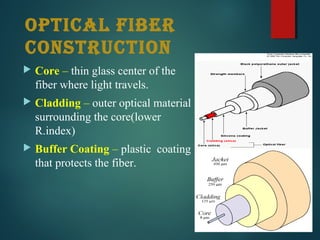
OptIcaL FIber
cOnstructIOn
 Core – thin glass center of the
fiber where light travels.
 Cladding – outer optical material
surrounding the core(lower
R.index)
 Buffer Coating – plastic coating
that protects the fiber.
FIber types
 Plastic core and cladding
 Glass core with plastic cladding PCS (Plastic-Clad
Silicon)
 Glass core and glass cladding SCS: Silica-clad silica
 Under research: non silicate: Zinc-chloride
 1000 time as efficient as glass
Classification of optical fiber
• Optical fiber is classified into two
categories based on :-
1)The number of modes
A.SINGLE MODE
B.MULTIMODE
2) The refractive index
A.STEP INDEX
B.GRADED INDEX
types OF OptIcaL
FIber
Single-mode Fiber
step-index Fiber
graded-index Fiber
n1 core
n2 cladding
no air
n2 cladding
n1 core
Variable
n
no air
Light
ray
Index profile
sIngLe-mODe FIber
Advantages:
 Minimum dispersion: all rays take same path, same time to
travel down the cable. A pulse can be reproduced at the
receiver very accurately.
 Less attenuation, can run over longer distance without
repeaters.
 Larger bandwidth and higher information rate
Disadvantages:
 Difficult to couple light in and out of the tiny core
 Highly directive light source (laser) is required
 Interfacing modules are more expensive
muLtI
mODe
 Multimode step-index Fibers:
 inexpensive
 easy to couple light into Fiber
 result in higher signal distortion
 lower TX rate
 Multimode graded-index Fiber:
 intermediate between the other two types of Fibers
Losses In optIcaL FIber
cabLes
 The predominant losses in optic Fibers are:
 absorption losses due to impurities in the Fiber
material
 material or Rayleigh scattering losses due to
microscopic irregularities in the Fiber
 chromatic or wavelength dispersion because of
the use of a non-monochromatic source
 radiation losses caused by bends and kinks in the
Fiber
 pulse spreading or modal dispersion due to rays
taking different paths down the Fiber (µs/km)
 coupling losses caused by misalignment &
imperfect surface finishes
Fiber Alignment
Impairments
Axial displacement Gap displacement
Angular displacement Imperfect surface finish
Causes of power loss as the light travels through the fiber!
WaveLength-DIvIsIon
MuLtIpLexIng
WDM sends information through a single optical Fiber using lights
of different wavelengths simultaneously.
Laser
Optical sources
λ1
λ2
λn
λn-1
λ3
λ1
λ2
λn
λn-1
λ3
Laser
Optical detectors
Optical
amplifier
Multiplexer demultiplexer
• Medical
• Military
• Electronics
 Telecommunications
 Computer applications
 Local Area Networks (LAN)
 Cable TV
 CCTV
 Optical Fiber Sensors
thanK
You
- ROHIT THAKUR
ECE SEC D
IPEC
optical fibre

optical fibre

  • 2.
    Brief flow of presentation 1.What are Optical Fibers? 2. Introduction 3. Evolution of optical fiber 4. Structure of optical fiber 5. Workings principle of optical fiber 6. Classification of optical fiber 7. Optical fiber communication system 8. Advantages / Disadvantages of Optical fiber 9. Applications of Optical fiber 10. Conclusion
  • 3.
    what is optical fiBer?An optical fiber is a hair thin cylindrical fiber of glass or any transparent dielectric medium.  The fiber which are used for optical communication are wave guides made of transparent dielectrics.  Its function is to guide visible and infrared light over long distances.
  • 4.
    worKinG principle Total InternalReflection  When a ray of light travels from a denser to a rarer medium such that the angle of incidence is greater than the critical angle, the ray reflects back into the same medium this phenomena is called total internal reflection.  In the optical fiber the rays undergo repeated total number of reflections until it emerges out of the other end of the fiber, even if the fiber is bent.
  • 6.
    History  1880 AlexanderGraham Bell - Photo phone, transmit sound waves over beam of light  1930: TV image through uncoated fiber cables  1951: Flexible fiberscope: Medical applications (endoscope). camera LIGHT
  • 7.
    History Cont’d  1960:Laser invented  1967: New Communications medium: cladded fiber  1960s: Extremely lossy fiber:  More than 1000 dB /km  1970: Corning Glass Work NY, Fiber with loss of less than 2 dB/km  70s & 80s : High quality sources and detectors  Late 80s : Loss as low as 0.16 dB/km  1990: Deployment of SONET systems
  • 8.
    Optical Fiber: Advantages Capacity: much wider bandwidth (10 GHz)  Long lyf of fibres compared to copper.  Unaffected by interference of  Lightening  Magnetic fields  Florescent light  Higher environment immunity  Weather, temperature, etc.
  • 9.
  • 10.
    Optical Fiber: Advantages •Attenuation is lower than coaxial cable or twisted pair • As it does not radiates energy any antenna or detector cannot detects it hence provides signal security • There is no necessity of additional equipment for protecting against grounding and voltage problems.
  • 11.
    ATTENUATION IN COMMUNICATIONS • More information carrying capacityfibers can handle much higher data rates than copper. More information can be sent in a second
  • 12.
    Disadvantages  Higher initialcost in installation  Only point to point communication  Strength  Lower tensile strength  Remote electric power  More expensive to repair/maintain  Tools: Specialized and sophisticated  Staff : skilled and specialized
  • 13.
  • 14.
    Optical Fiber Architecture– Components  Light source  Two common types:  LED (Light Emitting Diode)  ILD (Injection Laser Diode)  Source–to-fiber-coupler (similar to a lens):  A mechanical interface to couple the light emitted by the source into the optical fiber Input Signal Coder or Converter Light Source Source-to-Fiber Interface Fiber-to-light Interface Light Detector Amplifier/Shaper Decoder Output Fiber-optic Cable Receiver  Light detector:  PIN (p-type-intrinsic-n-type)  APD (avalanche photo diode)  Both convert light energy into current
  • 15.
    ILD versus LeD Advantages:  more focused radiation pattern; smaller Fiber  much higher radiant power; longer span  faster ON, OFF time; higher bit rates possible  monochromatic light; reduces dispersion  Disadvantages:  much more expensive  higher temperature; shorter lifespan
  • 16.
    OptIcaL FIber cOnstructIOn  Core– thin glass center of the fiber where light travels.  Cladding – outer optical material surrounding the core(lower R.index)  Buffer Coating – plastic coating that protects the fiber.
  • 17.
    FIber types  Plasticcore and cladding  Glass core with plastic cladding PCS (Plastic-Clad Silicon)  Glass core and glass cladding SCS: Silica-clad silica  Under research: non silicate: Zinc-chloride  1000 time as efficient as glass
  • 18.
    Classification of opticalfiber • Optical fiber is classified into two categories based on :- 1)The number of modes A.SINGLE MODE B.MULTIMODE 2) The refractive index A.STEP INDEX B.GRADED INDEX
  • 19.
    types OF OptIcaL FIber Single-modeFiber step-index Fiber graded-index Fiber n1 core n2 cladding no air n2 cladding n1 core Variable n no air Light ray Index profile
  • 20.
    sIngLe-mODe FIber Advantages:  Minimumdispersion: all rays take same path, same time to travel down the cable. A pulse can be reproduced at the receiver very accurately.  Less attenuation, can run over longer distance without repeaters.  Larger bandwidth and higher information rate Disadvantages:  Difficult to couple light in and out of the tiny core  Highly directive light source (laser) is required  Interfacing modules are more expensive
  • 21.
    muLtI mODe  Multimode step-indexFibers:  inexpensive  easy to couple light into Fiber  result in higher signal distortion  lower TX rate  Multimode graded-index Fiber:  intermediate between the other two types of Fibers
  • 22.
    Losses In optIcaLFIber cabLes  The predominant losses in optic Fibers are:  absorption losses due to impurities in the Fiber material  material or Rayleigh scattering losses due to microscopic irregularities in the Fiber  chromatic or wavelength dispersion because of the use of a non-monochromatic source  radiation losses caused by bends and kinks in the Fiber  pulse spreading or modal dispersion due to rays taking different paths down the Fiber (µs/km)  coupling losses caused by misalignment & imperfect surface finishes
  • 23.
    Fiber Alignment Impairments Axial displacementGap displacement Angular displacement Imperfect surface finish Causes of power loss as the light travels through the fiber!
  • 24.
    WaveLength-DIvIsIon MuLtIpLexIng WDM sends informationthrough a single optical Fiber using lights of different wavelengths simultaneously. Laser Optical sources λ1 λ2 λn λn-1 λ3 λ1 λ2 λn λn-1 λ3 Laser Optical detectors Optical amplifier Multiplexer demultiplexer
  • 25.
  • 26.
     Telecommunications  Computerapplications  Local Area Networks (LAN)  Cable TV  CCTV  Optical Fiber Sensors
  • 27.

Editor's Notes

  • #21 Single-mode fibers – in single mode fiber only one mode can propagate through the fiber. This type of fiber has small core diameter(5um) and high cladding diameter(70um) and the difference between the refractive index of core and cladding is very small. There is no dispersion i.e. no degradation of signal during travelling through the fiber. The light is passed through the single mode fiber through laser diode.
  • #22 Multi-mode fiber :- Multi mode fiber allows a large number of modes for the light ray travelling through it. The core diameter is (40um) and that of cladding is(70um) The relative refractive index difference is also larger than single mode fiber. There is signal degradation due to multimode dispersion. They are not suitable for long distance communication due to large dispersion and attenuation of the signal.