Optical Fiber Communication System Design
Zena Mohammed
Outline
Transmitter Design.
Advantages of optical fiber communication.
 Enormous potential bandwidth.
The optical carrier frequency in the range 1013
to 1016
Hz (generally in the
near infrared around 1014 Hz or 105 GHz) yields a far greater potential
transmission bandwidth than metallic cable systems.
 Small size and weight.
Optical fibers have very small diameters which are often no greater than the
diameter of a human hair. Hence, even when such fibers are covered with
protective coatings they are far smaller and much lighter than corresponding
copper cables.
 Signal security.
The light from optical fibers does not radiate significantly and
therefore they provide a high degree of signal security.
Advantages of Optical Fiber Communication
 Electrical Isolation.
Optical fibers which are fabricated from glass, or sometimes a plastic
polymer, are electrical insulators and therefore, unlike their metallic
counterparts, they do not exhibit earth loop and interface problems.
 Immunity to interference and crosstalk.
Optical fibers form a dielectric waveguide and are therefore free from
electromagnetic interference (EMI), radio-frequency interference
(RFI), or switching transients giving electromagnetic pulses (EMPs).
 Low transmission loss.
Fibers have been fabricated with losses as low as 0.15 dB km−1
and
this feature has become a major advantage of optical fiber
communications
 Ruggedness and flexibility
Although protective coatings are essential, optical fibers may be
manufactured with very high tensile strengths
 Potential low cost.
The glass which generally provides the optical fiber transmission medium is made
from sand – not a scarce resource.
 System reliability and ease of maintenance.
The reliability of the optical components is no longer a problem with predicted
lifetimes of 20 to 30 years being quite common. Both these factors also tend to
reduce maintenance time and costs.
Optical Transmitters (Optical System)
The role of the optical transmitter is to:
oconvert the electrical signal into optical form, and
olaunch the resulting optical signal into the optical
fiber.
Two Important Specifications of The Optical
Transmitter:
(i) the spectral linewidth and
(ii) the extinction ratio.
The values that can be achieved for these parameters
depends on whether direct or external modulation is
used.
Extinction Ratio.
▫ Optical transmitters, no matter if directly or externally modulated. do not shut off
completely when a zero is transmitted. This undesired effect is quantified by the
extinction ratio (ER), which is defined as follows:
ER=
𝑃1
𝑃0
where 𝑃0 is the optical power emitted for a zero and 𝑃1 the power for a one.
the spectral line-width
• In practice, it is difficult to build a transmitter with a linewidth as narrow
0.08nm for . only some types of external modulators can come
close to this ideal. Optical pulses that do have this narrow spectrum are
known as transform limited pulses.
 Incoherent emission from an LED usually displays a spectral line-width of between
20 and 50 nm when operating in the 0.8 to 0.9 μm wavelength range.
 LEDs have wide spectral line-width as compare to ILDs.
 Wide line width of the LEDs causes material dispersion within the fiber.
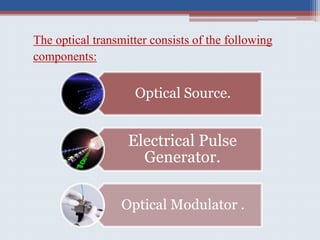
The optical transmitter consists of the following
components:
Optical Source.
Electrical Pulse
Generator.
Optical Modulator .
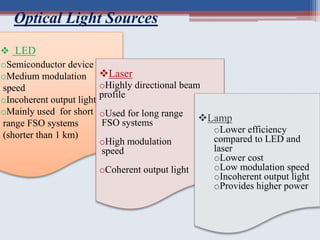
Optical Light Sources
 LED
oSemiconductor device
oMedium modulation
speed
oIncoherent output light
oMainly used for short
range FSO systems
(shorter than 1 km)
Laser
oHighly directional beam
profile
oUsed for long range
FSO systems
oHigh modulation
speed
oCoherent output light
Lamp
oLower efficiency
compared to LED and
laser
oLower cost
oLow modulation speed
oIncoherent output light
oProvides higher power
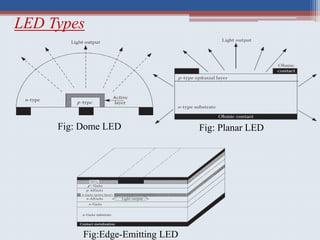
LED Types
Fig: Dome LED Fig: Planar LED
Fig:Edge-Emitting LED
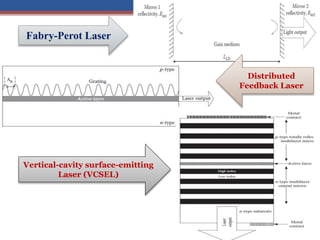
Fabry-Perot Laser
Distributed
Feedback Laser
Vertical-cavity surface-emitting
Laser (VCSEL)
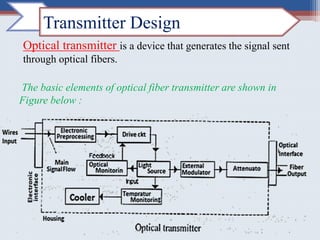
Optical transmitter is a device that generates the signal sent
through optical fibers.
The basic elements of optical fiber transmitter are shown in
Figure below :
Transmitter Design
The basic elements of optical fiber transmitter:
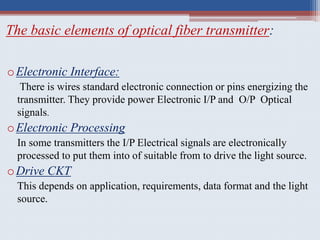
oElectronic Interface:
There is wires standard electronic connection or pins energizing the
transmitter. They provide power Electronic I/P and O/P Optical
signals.
oElectronic Processing
In some transmitters the I/P Electrical signals are electronically
processed to put them into of suitable from to drive the light source.
oDrive CKT
This depends on application, requirements, data format and the light
source.
oOptical Monitor
It Monitors the O/P of the LASER and provides feedback to
the drive CKT so that the O/P power remains stable.
oTemperature Monitor
The characteristic of semi-conductor LASER changes in
temperature. The lifetime of LASER decreases with increase
in operating temp and the O/P power also decrease which
produce some change in O/P wavelength of the light, to keep
the operating temp stable the Thermo-electric coolers are used
in optical fiber transmitters these coolers control the temp of
LASER.
Optical Modulator
The following modulators commonly are used in optical
transmitters:
o The electroabsorption modulator (EAM), which is small and
can be driven with a reasonably small voltage swing.
Electrically, it is a reverse-biased p-n junction.
o The Mach-Zehnder modulator (MZM), which generates the
highest-quality optical pulses with a controlled amount of
chirp and a high extinction ratio. Electrically, it is a
(terminated) transmission line.
• The maximum transmission distance that can be achieved
in an optical communication system is determined by a
combination of the chromatic dispersion limit, the
polarization-mode dispersion (PMD) limit, and the
attenuation limit.

optical transmitter

  • 1.
    Optical Fiber CommunicationSystem Design Zena Mohammed
  • 2.
    Outline Transmitter Design. Advantages ofoptical fiber communication.
  • 3.
     Enormous potentialbandwidth. The optical carrier frequency in the range 1013 to 1016 Hz (generally in the near infrared around 1014 Hz or 105 GHz) yields a far greater potential transmission bandwidth than metallic cable systems.  Small size and weight. Optical fibers have very small diameters which are often no greater than the diameter of a human hair. Hence, even when such fibers are covered with protective coatings they are far smaller and much lighter than corresponding copper cables.  Signal security. The light from optical fibers does not radiate significantly and therefore they provide a high degree of signal security. Advantages of Optical Fiber Communication
  • 4.
     Electrical Isolation. Opticalfibers which are fabricated from glass, or sometimes a plastic polymer, are electrical insulators and therefore, unlike their metallic counterparts, they do not exhibit earth loop and interface problems.  Immunity to interference and crosstalk. Optical fibers form a dielectric waveguide and are therefore free from electromagnetic interference (EMI), radio-frequency interference (RFI), or switching transients giving electromagnetic pulses (EMPs).  Low transmission loss. Fibers have been fabricated with losses as low as 0.15 dB km−1 and this feature has become a major advantage of optical fiber communications
  • 5.
     Ruggedness andflexibility Although protective coatings are essential, optical fibers may be manufactured with very high tensile strengths  Potential low cost. The glass which generally provides the optical fiber transmission medium is made from sand – not a scarce resource.  System reliability and ease of maintenance. The reliability of the optical components is no longer a problem with predicted lifetimes of 20 to 30 years being quite common. Both these factors also tend to reduce maintenance time and costs.
  • 6.
    Optical Transmitters (OpticalSystem) The role of the optical transmitter is to: oconvert the electrical signal into optical form, and olaunch the resulting optical signal into the optical fiber. Two Important Specifications of The Optical Transmitter: (i) the spectral linewidth and (ii) the extinction ratio. The values that can be achieved for these parameters depends on whether direct or external modulation is used.
  • 7.
    Extinction Ratio. ▫ Opticaltransmitters, no matter if directly or externally modulated. do not shut off completely when a zero is transmitted. This undesired effect is quantified by the extinction ratio (ER), which is defined as follows: ER= 𝑃1 𝑃0 where 𝑃0 is the optical power emitted for a zero and 𝑃1 the power for a one. the spectral line-width • In practice, it is difficult to build a transmitter with a linewidth as narrow 0.08nm for . only some types of external modulators can come close to this ideal. Optical pulses that do have this narrow spectrum are known as transform limited pulses.  Incoherent emission from an LED usually displays a spectral line-width of between 20 and 50 nm when operating in the 0.8 to 0.9 μm wavelength range.  LEDs have wide spectral line-width as compare to ILDs.  Wide line width of the LEDs causes material dispersion within the fiber.
  • 8.
    The optical transmitterconsists of the following components: Optical Source. Electrical Pulse Generator. Optical Modulator .
  • 9.
    Optical Light Sources LED oSemiconductor device oMedium modulation speed oIncoherent output light oMainly used for short range FSO systems (shorter than 1 km) Laser oHighly directional beam profile oUsed for long range FSO systems oHigh modulation speed oCoherent output light Lamp oLower efficiency compared to LED and laser oLower cost oLow modulation speed oIncoherent output light oProvides higher power
  • 10.
    LED Types Fig: DomeLED Fig: Planar LED Fig:Edge-Emitting LED
  • 11.
  • 13.
    Optical transmitter isa device that generates the signal sent through optical fibers. The basic elements of optical fiber transmitter are shown in Figure below : Transmitter Design
  • 14.
    The basic elementsof optical fiber transmitter: oElectronic Interface: There is wires standard electronic connection or pins energizing the transmitter. They provide power Electronic I/P and O/P Optical signals. oElectronic Processing In some transmitters the I/P Electrical signals are electronically processed to put them into of suitable from to drive the light source. oDrive CKT This depends on application, requirements, data format and the light source.
  • 15.
    oOptical Monitor It Monitorsthe O/P of the LASER and provides feedback to the drive CKT so that the O/P power remains stable. oTemperature Monitor The characteristic of semi-conductor LASER changes in temperature. The lifetime of LASER decreases with increase in operating temp and the O/P power also decrease which produce some change in O/P wavelength of the light, to keep the operating temp stable the Thermo-electric coolers are used in optical fiber transmitters these coolers control the temp of LASER.
  • 16.
    Optical Modulator The followingmodulators commonly are used in optical transmitters: o The electroabsorption modulator (EAM), which is small and can be driven with a reasonably small voltage swing. Electrically, it is a reverse-biased p-n junction. o The Mach-Zehnder modulator (MZM), which generates the highest-quality optical pulses with a controlled amount of chirp and a high extinction ratio. Electrically, it is a (terminated) transmission line. • The maximum transmission distance that can be achieved in an optical communication system is determined by a combination of the chromatic dispersion limit, the polarization-mode dispersion (PMD) limit, and the attenuation limit.

Editor's Notes

  • #4 (a) Enormous potential bandwidth. The optical carrier frequency in the range 1013 to 1016 Hz (generally in the near infrared around 1014 Hz or 105 GHz) yields a far greater potential transmission bandwidth than metallic cable systems (i.e. coaxial cable bandwidth typically around 20 MHz over distances up to a maximum of 10 km) or even millimeter wave radio systems (i.e. systems currently operating with modulation bandwidths of 700 MHz over a few hundreds of meters). (b) Small size and weight. Optical fibers have very small diameters which are often no greater than the diameter of a human hair. Hence, even when such fibers are covered with protective coatings they are far smaller and much lighter than corresponding copper cables. (f) Low transmission loss. The development of optical fibers over the last 20 years has resulted in the production of optical fiber cables which exhibit very low attenuation or transmission loss in comparison with the best copper conductors. Fibers have been fabricated with losses as low as 0.15 dB km−1 and this feature has become a major advantage of optical fiber communications (g) Ruggedness and flexibility. cable structures have been developed which have proved flexible, compact and extremely rugged. Taking the size and weight advantage into account, these optical fiber cables are generally superior in terms of storage, transportation, handling and installation to corresponding copper cables, while exhibiting at least comparable strength and durability. (c) Electrical isolation. Optical fibers which are fabricated from glass, or sometimes a plastic polymer, are electrical insulators and therefore, unlike their metallic counterparts, they do not exhibit earth loop and interface problems. (d) Immunity to interference and crosstalk. Optical fibers form a dielectric waveguide and are therefore free from electromagnetic interference (EMI), radio-frequency interference (RFI), or switching transients giving electromagnetic pulses (EMPs). Hence the operation of an optical fiber communication system is unaffected by transmission through an electrically noisy environment and the fiber cable requires no shielding from EMI. The fiber cable is also not susceptible to lightning strikes if used overhead rather than underground. (e) Signal security. The light from optical fibers does not radiate significantly and therefore they provide a high degree of signal security. (h) System reliability and ease of maintenance. system reliability is generally enhanced in comparison with conventional electrical conductor systems. Furthermore, the reliability of the optical components is no longer a problem with predicted lifetimes of 20 to 30 years being quite common. Both these factors also tend to reduce maintenance time and costs. (i) Potential low cost. The glass which generally provides the optical fiber transmission medium is made from sand – not a scarce resource. So, in comparison with copper conductors, optical fibers offer the potential for low-cost line communication.