
OPTICAL COMMUNICATION
Optical Fiber Communication
By: Saurabh Kumar
CONTENT
● Introduction to Optical Fiber.
● History of Optical Fiber.
● Principles of operation.
● Types of Fiber
a) On basis of mode
b) On basis of Index
● Manufacturing of OFC .
INTRODUCTION
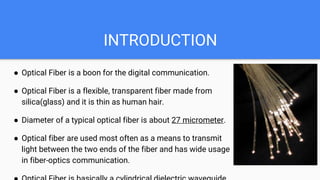
● Optical Fiber is a boon for the digital communication.
● Optical Fiber is a flexible, transparent fiber made from
silica(glass) and it is thin as human hair.
● Diameter of a typical optical fiber is about 27 micrometer.
● Optical fiber are used most often as a means to transmit
light between the two ends of the fiber and has wide usage
in fiber-optics communication.
HISTORY
● Fiber Optics was first introduced by Daniel Colladon and Jacques Babinet in
Paris in the early 1840s.
● Earlier it was developed for the image transmission through fiber bundles.
● In 1880, Alexander Graham Bell and Sumner Tainter invented photophone which
was first of it type uses optical beam for the transmission of voice signals.
● In late 20th century, optical fiber came out for the wide usage in
telecommunication.
PRINCIPLE OF
OPERATION
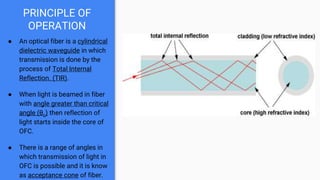
● An optical fiber is a cylindrical
dielectric waveguide in which
transmission is done by the
process of Total Internal
Reflection. (TIR).
● When light is beamed in fiber
with angle greater than critical
angle (θc) then reflection of
light starts inside the core of
OFC.
● There is a range of angles in
which transmission of light in
OFC is possible and it is know
as acceptance cone of fiber.
TYPES OF FIBER
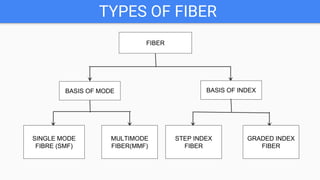
FIBER
BASIS OF MODE BASIS OF INDEX
SINGLE MODE
FIBRE (SMF)
MULTIMODE
FIBER(MMF)
STEP INDEX
FIBER
GRADED INDEX
FIBER
SINGLE MODE
FIBER(SMF)
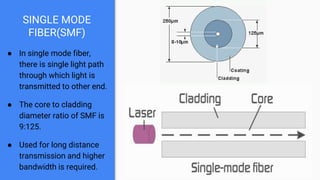
● In single mode fiber,
there is single light path
through which light is
transmitted to other end.
● The core to cladding
diameter ratio of SMF is
9:125.
● Used for long distance
transmission and higher
bandwidth is required.
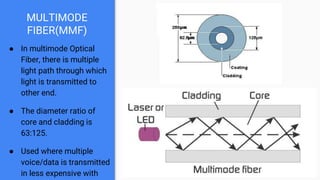
MULTIMODE
FIBER(MMF)
● In multimode Optical
Fiber, there is multiple
light path through which
light is transmitted to
other end.
● The diameter ratio of
core and cladding is
63:125.
● Used where multiple
voice/data is transmitted
in less expensive with
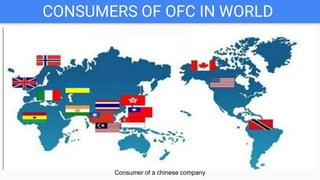
CONSUMERS OF OFC IN WORLD
Consumer of a chinese company
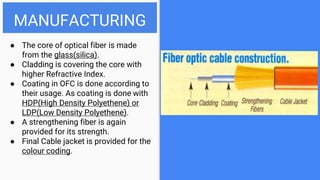
MANUFACTURING
● The core of optical fiber is made
from the glass(silica).
● Cladding is covering the core with
higher Refractive Index.
● Coating in OFC is done according to
their usage. As coating is done with
HDP(High Density Polyethene) or
LDP(Low Density Polyethene).
● A strengthening fiber is again
provided for its strength.
● Final Cable jacket is provided for the
colour coding.
TERMINATION AND SPLICING
Termination
● Optical Fibers are terminated using the connectors.These connectors are usually
of standard type such as FC,SC,LC connectors.
Ferrule Connector Square Connector Lucent Connector
TERMINATION AND SPLICING(Contd.)
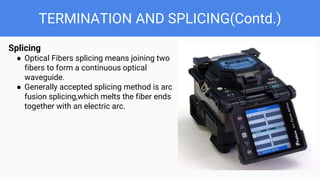
Splicing
● Optical Fibers splicing means joining two
fibers to form a continuous optical
waveguide.
● Generally accepted splicing method is arc
fusion splicing,which melts the fiber ends
together with an electric arc.
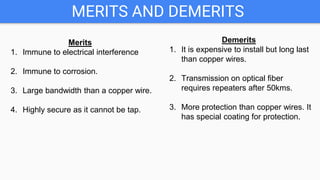
MERITS AND DEMERITS
Merits
1. Immune to electrical interference
2. Immune to corrosion.
3. Large bandwidth than a copper wire.
4. Highly secure as it cannot be tap.
Demerits
1. It is expensive to install but long last
than copper wires.
2. Transmission on optical fiber
requires repeaters after 50kms.
3. More protection than copper wires. It
has special coating for protection.
APPLICATIONS OF OFC
Thanks!

Optical fiber Communication

  • 1.
    OPTICAL COMMUNICATION Optical FiberCommunication By: Saurabh Kumar
  • 2.
    CONTENT ● Introduction toOptical Fiber. ● History of Optical Fiber. ● Principles of operation. ● Types of Fiber a) On basis of mode b) On basis of Index ● Manufacturing of OFC .
  • 3.
    INTRODUCTION ● Optical Fiberis a boon for the digital communication. ● Optical Fiber is a flexible, transparent fiber made from silica(glass) and it is thin as human hair. ● Diameter of a typical optical fiber is about 27 micrometer. ● Optical fiber are used most often as a means to transmit light between the two ends of the fiber and has wide usage in fiber-optics communication.
  • 4.
    HISTORY ● Fiber Opticswas first introduced by Daniel Colladon and Jacques Babinet in Paris in the early 1840s. ● Earlier it was developed for the image transmission through fiber bundles. ● In 1880, Alexander Graham Bell and Sumner Tainter invented photophone which was first of it type uses optical beam for the transmission of voice signals. ● In late 20th century, optical fiber came out for the wide usage in telecommunication.
  • 5.
    PRINCIPLE OF OPERATION ● Anoptical fiber is a cylindrical dielectric waveguide in which transmission is done by the process of Total Internal Reflection. (TIR). ● When light is beamed in fiber with angle greater than critical angle (θc) then reflection of light starts inside the core of OFC. ● There is a range of angles in which transmission of light in OFC is possible and it is know as acceptance cone of fiber.
  • 6.
    TYPES OF FIBER FIBER BASISOF MODE BASIS OF INDEX SINGLE MODE FIBRE (SMF) MULTIMODE FIBER(MMF) STEP INDEX FIBER GRADED INDEX FIBER
  • 7.
    SINGLE MODE FIBER(SMF) ● Insingle mode fiber, there is single light path through which light is transmitted to other end. ● The core to cladding diameter ratio of SMF is 9:125. ● Used for long distance transmission and higher bandwidth is required.
  • 8.
    MULTIMODE FIBER(MMF) ● In multimodeOptical Fiber, there is multiple light path through which light is transmitted to other end. ● The diameter ratio of core and cladding is 63:125. ● Used where multiple voice/data is transmitted in less expensive with
  • 9.
    CONSUMERS OF OFCIN WORLD Consumer of a chinese company
  • 10.
    MANUFACTURING ● The coreof optical fiber is made from the glass(silica). ● Cladding is covering the core with higher Refractive Index. ● Coating in OFC is done according to their usage. As coating is done with HDP(High Density Polyethene) or LDP(Low Density Polyethene). ● A strengthening fiber is again provided for its strength. ● Final Cable jacket is provided for the colour coding.
  • 11.
    TERMINATION AND SPLICING Termination ●Optical Fibers are terminated using the connectors.These connectors are usually of standard type such as FC,SC,LC connectors. Ferrule Connector Square Connector Lucent Connector
  • 12.
    TERMINATION AND SPLICING(Contd.) Splicing ●Optical Fibers splicing means joining two fibers to form a continuous optical waveguide. ● Generally accepted splicing method is arc fusion splicing,which melts the fiber ends together with an electric arc.
  • 13.
    MERITS AND DEMERITS Merits 1.Immune to electrical interference 2. Immune to corrosion. 3. Large bandwidth than a copper wire. 4. Highly secure as it cannot be tap. Demerits 1. It is expensive to install but long last than copper wires. 2. Transmission on optical fiber requires repeaters after 50kms. 3. More protection than copper wires. It has special coating for protection.
  • 14.
  • 15.