Prepared By:
Vanhishikha Bhargava
(0941631056)
CONTENTS



















Introduction to fiber optics and its Evolution
Basics of optical fiber
Color coating
Wavelength bands-Transmission windows
Types of optical fibers
Advantages and Disadvantages
Applications
Connectors
Adapters
Attenuators
Losses in optical fiber
Splitters and types
Field assembly connectors
Cables and types
Splicing and types
Wavelength Division Multiplexing and Types
INTRODUCTION


Communications systems that carry information through a
guided fiber cable are called fiber optic systems.



Use of optical fibers to replace conventional transmission
lines and microwave wave-guide in telecommunication
systems.



Light is effectively the same as RF radiation but at a much
higher frequency, theoretically the information-carrying
capacity of a fiber is much greater than that of microwave
radio systems.



As they are not electrically conductive, hence very suitable
for use in areas where electrical isolation and interference
are severe problems.
EVOLUTION OF FIBER








1880 – Alexander Graham Bell
1930 – Patents on tubing
1950 – Patent for two-layer glass wave-guide
1960 – Laser first used as light source
1965 – High loss of light discovered
1970s – Refining of manufacturing process
1980s – OF technology becomes backbone of long
distance telephone networks in NA.
OPTICAL FIBER







Optical fiber is made from thin strands of either glass or
plastic
It has little mechanical strength, so it must be enclosed
in a protective jacket
Often, two or more fibers are enclosed in the same
cable for increased bandwidth and redundancy in case
one of the fibers breaks
It is also easier to build a full-duplex system using two
fibers, one for transmission in each direction
TOTAL INTERNAL REFLECTION





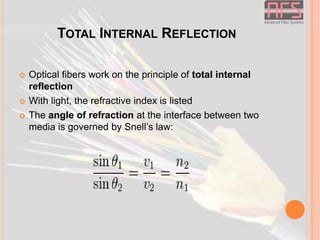
Optical fibers work on the principle of total internal
reflection
With light, the refractive index is listed
The angle of refraction at the interface between two
media is governed by Snell’s law:
REFRACTION
angle of incidence

normal
air
glass

angle of
refraction
NUMERICAL APERTURE


The angle of
acceptance is
twice that given
by the numerical
aperture
RAYLEIGH'S SCATTERING




Rayleigh scattering is the
elastic scattering of light or other
electromagnetic radiation by
particles much smaller than the
wavelength of the light.
It can occur when light travels
through transparent solids and
liquids, but is most prominently
seen in gases.
FRESNEL’S REFLECTION




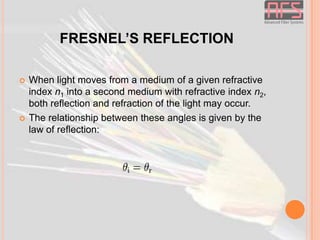
When light moves from a medium of a given refractive
index n1 into a second medium with refractive index n2,
both reflection and refraction of the light may occur.
The relationship between these angles is given by the
law of reflection:
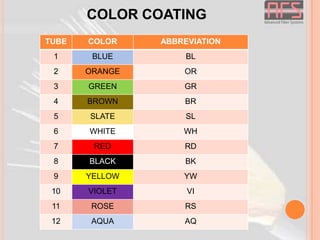
COLOR COATING
TUBE

COLOR

ABBREVIATION

1

BLUE

BL

2

ORANGE

OR

3

GREEN

GR

4

BROWN

BR

5

SLATE

SL

6

WHITE

WH

7

RED

RD

8

BLACK

BK

9

YELLOW

YW

10

VIOLET

VI

11

ROSE

RS

12

AQUA

AQ
WAVELENGTH BAND


Fiber optic system transmit using infrared light, invisible
to human eye, because it goes further in the optical fiber
at those wavelength.
TRANSMISSION WINDOW
Band

Wavelength range

Description

O- band

1260 nm- 1360 nm

Original band

E- band

1360 nm- 1460 nm

Extended band

S- band

1460nm- 1530 nm

Short wavelength band

C- band

1530 nm- 1565 nm

Conventional band

L- band

1565 nm- 1625 nm

Long wavelength band

U- band

1625 nm- 1675 nm

Ultra long wavelength
band
FIBER COMPOSITION




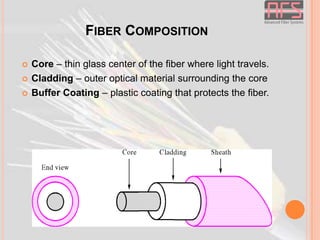
Core – thin glass center of the fiber where light travels.
Cladding – outer optical material surrounding the core
Buffer Coating – plastic coating that protects the fiber.
TYPES OF OPTICAL FIBERS

OPTICAL
FIBERS

SINGLEMODE
FIBERS

MULTIMODE
FIBERS

STEP INDEX

GRADED
INDEX

OM1/OM2/OM3

STEP INDEX
SINGLE-MODE STEP-INDEX FIBER





Used to transmit one signal per fiber.
Used in telephone and cable TV.
They have small cores(9 microns in diameter) .
Transmit infra-red light from laser.
MULTI-MODE STEP-INDEX FIBER





Used to transmit many signals per fiber.
Used in computer networks.
They have larger cores(62.5/50 microns in diameter)
Transmit infra-red light from LED.
MULTI-MODE GRADED-INDEX FIBER






Core diameter : 50/62.5 microns.
Cladding size: 125-140 microns.
Refractive index changes continuously.
Low dispersion.
Core refractive index is made to vary as a function of the
radial distance from the center of the fiber.
OM1/OM2/OM3
OM1: refer to the commonly used 62.5/125
multimode fiber.
 OM2: refer to the commonly used 50/125 cable.




Both OM1 and OM2 easily supports applications
ranging from Ethernet to gigabit Ethernet.



OM3: Typically this fiber optic patch cable is with



50/125 multimode fiber, with aqua jacket.
They support bandwidth up to 10GB upto 300 meters.
ADVANTAGES











Wide bandwidth
Light weight and small size
Immunity to electromagnetic interference
Lack of EMI cross talk between channels
Lack of sparking
Compatibility with solid state sources
Low cost
No emission licenses
DISADVANTAGES








High investment cost
Need for more expensive transmitters and receivers
Fragility
Opaqueness
Requires special skills
APPLICATIONS








Telecommunications
Local Area Networks
Cable TV
CCTV
Optical Fiber Sensors
Video Surveillance Links
FIBER OPTIC CONNECTORS



Terminates the fibers
Connects to other fibers or transmission equipment
FIBER CONNECTOR TYPE

E 2000

LC

SC

FC

MT- RJ

MPO

FSMA

FDDI

ST

BICONIC
FERRULE POLISH







To avoid an air gap
Ferrule is polished flat, or
Rounded (PC—Physical
Contact), or
Angled (APC)
 Reduces reflectance
 Cannot be mated with
the other polish types
ADAPTERS

SC

ST

MT- RJ

E 2000

LC
FC

MPO
BICONIC

FSMA

FDDI
ATTENUATORS

SC

LC

FC
MPO

ST

E 2000

MT- RJ
ATTENUATORS
VARIABLE ATTENUATORS




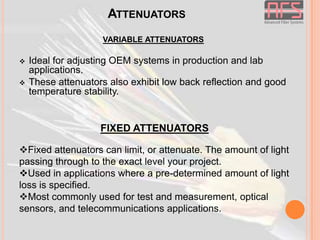
Ideal for adjusting OEM systems in production and lab
applications.
These attenuators also exhibit low back reflection and good
temperature stability.

FIXED ATTENUATORS
Fixed attenuators can limit, or attenuate. The amount of light
passing through to the exact level your project.
Used in applications where a pre-determined amount of light
loss is specified.
Most commonly used for test and measurement, optical
sensors, and telecommunications applications.
TYPES OF LOSSES

LOSSES

ATTENUATION

SCATTERING

ABSORPTION

DISPERSION

MODAL

CHROMATIC

POLARISATION
MODE
LOSS MECHANISM
DISPERSION
MODAL DISPERSION


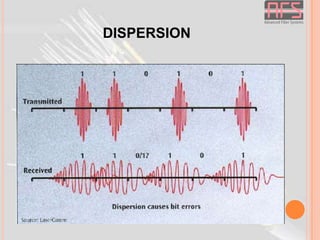
Modal dispersion is a distortion mechanism occurring
in multimode fibers and other waveguides, in which the
signal is spread in time because
the propagation velocity of the optical signal is not the
same for all modes.
POLARIZATION MODE DISPERSION


A special case of modal dispersion is polarization mode
dispersion (PMD), a fiber dispersion phenomena usually
associated with single-mode fibers. PMD results when two
modes that normally travel at the same speed due to fiber
core geometric and stress symmetry, travel at different
speeds due to random imperfections that break the symmetry
CHROMATIC DISPERSION




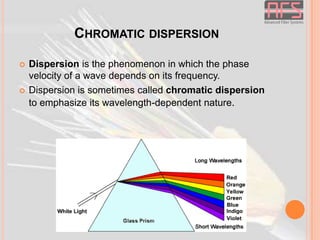
Dispersion is the phenomenon in which the phase
velocity of a wave depends on its frequency.
Dispersion is sometimes called chromatic dispersion
to emphasize its wavelength-dependent nature.
SPLITTERS






A splitter is a device used to split the cable signal if the
signal must be sent to two or more devices.
Optical splitters are also known as couplers. They are
base on the type of cable management product they will
be using.
Performance specifications of the splitters are given by
the ITU- T G671 standard.
TYPES OF
SPLITTERS

FUSED
BICONICAL
TAPER
SPLITTERS

PLANAR
LIGHTWAVE
CIRCUITS
FUSED BICONICAL TAPER SPLITTER













These are also known as
singlemode splitters..
Operating wavelength is
1310nm or1550nm and the
passband is 80nm.
The coupling ratio can change
from 1:99 to 50:50.
Low insertion loss.
Low excess loss.
High directivity.
Low polarization related loss.
More channels.
PLANAR LIGHTWAVE CIRCUITS









These type of splitters are
smaller in footprint.
They offer slightly better losses
across their split ratios than
FBTs
Low insertion loss.
Low excess loss.
High directivity.
High stability.
FIELD ASSEMBLY CONNECTORS










Designed for simple and fast
field termination of single fibers,
without polishing or adhesives.
The heart of the Quick-SC fast
connector is a pre-polished
ferrule and a mechanical splice
inside the connector body.
Compatible with conventional
SC and LC connector.
Easy and fast assembly without
special tool
Reliable assembly with
Assembly Jig and Fiber Holder
appended to connector kit
CABLES
Fiber optic "cable" refers to the complete assembly of
fibers, strength members and jacket. Fiber optic cables
come in lots of different types, depending on the number
of fibers and how and where it will be installed. There
are classified as :
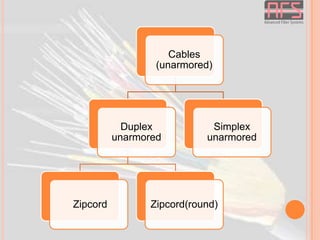
 Cables (armored)

Cables (unarmored)
 Distribution cables
 Drop cables

Cables
(armored)

Duplex
armored

Zipcord

Simplex
armored

Zipcord(round)
Cables
(unarmored)

Duplex
unarmored

Zipcord

Simplex
unarmored

Zipcord(round)
Distribution
cables

4-fiber

8-fiber

12-fiber

24-fiber

48-fiber
Drop cables

1-fiber

2-fiber

4-fiber

1-fiber
(messenger
wire)

2-fiber
(messenger
wire)
SPLICES


Splices are a permanent join of two fibers

Lower attenuation and reflectance than connectors
 Stronger and cheaper than connectors
 Easier to perform than connectorization
 Mass splicing does 12 fibers at a time, for ribbon
cables


SPLICER
FUSION SPLICING





Melts the fibers together to form a continuous fiber
Expensive machine
Strongest and best join for singlemode fiber
 May lower bandwidth of multimode fiber
MECHANICAL SPLICING







Mechanically aligns fibers
Contains index-matching gel to transmit light
Equipment cost is low
Per-splice cost is high
Quality of splice varies, but better than connectors
Fiber alignment can be tuned using a Visual Fault
Locator
COMPARISON

Mechanical
splicing
Reflection losses
(-45 db to -55 db)
Insertion loss
(0.2 db)
cost – high

Fusion splicing
No reflection losses
Very low insertion
loss
(0.1 db to .15 db)
Comparatively less
WAVELENGTH DIVISION MULTIPLEXING





Data from each TDM channel is loaded on one optical
frequency (or wavelength, ) of a particular wavelength
band
These wavelengths are then multiplexed onto one fiber
with the help of WDM multiplexers
Other side of the network these wavelengths are
demultiplexed by using either optical filters, gratings or
WDM demultiplexer
DENSE WAVELENGTH DIVISION
MULTIPLEXING


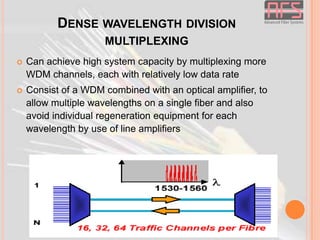
Can achieve high system capacity by multiplexing more
WDM channels, each with relatively low data rate



Consist of a WDM combined with an optical amplifier, to
allow multiple wavelengths on a single fiber and also
avoid individual regeneration equipment for each
wavelength by use of line amplifiers
COARSE WAVELENGTH DIVISION
MULTIPLEXING
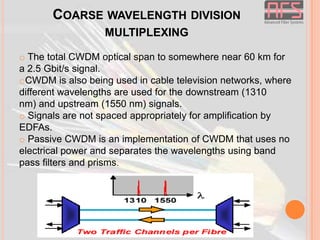
o The total CWDM optical span to somewhere near 60 km for
a 2.5 Gbit/s signal.
oCWDM is also being used in cable television networks, where
different wavelengths are used for the downstream (1310
nm) and upstream (1550 nm) signals.
o Signals are not spaced appropriately for amplification by
EDFAs.
o Passive CWDM is an implementation of CWDM that uses no
electrical power and separates the wavelengths using band
pass filters and prisms.
ANY QUESTIONS OR COMMENTS?
Optical Fiber Communication | FTTH

Optical Fiber Communication | FTTH