Brief flow of presentation
1. Introduction
2. What are Optical Fibers?
3. Evolution of optical fiber
4. Structure of optical fiber
5. Workings principle of optical fiber
6. Classification of optical fiber
7. Optical fiber communication system
8. Advantages / Disadvantages of Optical fiber
9. Applications of Optical fiber
10. Conclusion
Evolution of optical fiber
• 1880 – Alexander Graham Bell
• 1930 – Patents on tubing
• 1950 – Patent for two-layer glass wave-guide
• 1960 – Laser first used as light source
• 1965 – High loss of light discovered
• 1970s – Refining of manufacturing process
• 1980s – OF technology becomes backbone of long
distance telephone networks in NA.
What is optical Fiber?
• An optical fiber is a hair thin cylindrical fiber of
glass or any transparent dielectric medium.
• The fiber which are used for optical
communication are wave guides made of
transparent dielectrics.
• Its function is to guide visible and infrared
light over long distances.
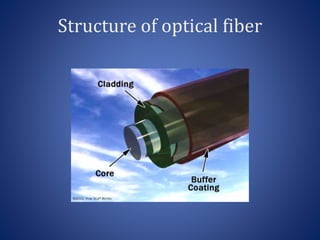
Structure of optical fiber
• Core – central tube of very thin size made up of
optically transparent dielectric medium and carries
the light form transmitter to receiver. The core
diameter can vary from about 5um to 100 um.
• Cladding – outer optical material surrounding the
core having reflecting index lower than core. It
helps to keep the light within the core throughout
the phenomena of total internal reflection.
• Buffer Coating – plastic coating that protects
the fiber made of silicon rubber. The typical
diameter of fiber after coating is 250-300 um.
Working principle
Total Internal Reflection
• When a ray of light travels from a denser to a
rarer medium such that the angle of incidence is
greater than the critical angle, the ray reflects
back into the same medium this phenomena is
called total internal reflection.
• In the optical fiber the rays undergo repeated
total number of reflections until it emerges out of
the other end of the fiber, even if the fiber is
bent.
The arrow and the bent pencil
Total internal reflection in
optical fiber
Classification of optical fiber
• Optical fiber is classified into two categories
based on :-
1) The number of modes, and
2) The refractive index
On the basis of number of modes:-
on the basis of number of modes of propagation the optical
fiber are classified into two types:
(i) Single mode fiber (SMF) and
(ii) Multi-mode fiber (MMF)
• Single-mode fibers – in single mode fiber only one mode
can propagate through the fiber. This type of fiber has
small core diameter(5um) and high cladding
diameter(70um) and the difference between the refractive
index of core and cladding is very small. There is no
dispersion i.e. no degradation of signal during travelling
through the fiber.
• The light is passed through the single mode fiber through
laser diode.
• Multi-mode fiber :-
• Multi mode fiber allows a large number of modes
for the light ray travelling through it.
• The core diameter is (40um) and that of cladding
is(70um)
• The relative refractive index difference is also larger
than single mode fiber.
• There is signal degradation due to multimode
dispersion.
• They are not suitable for long distance
communication due to large dispersion and
attenuation of the signal.
Refraction at a plane surface
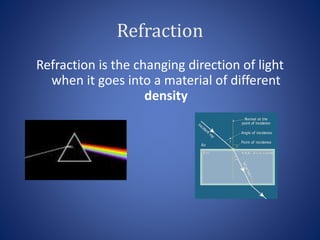
Refraction
Refraction is the changing direction of light
when it goes into a material of different
density
On the basis of Refractive index
• There are two types of optical fiber:-
• (i) Step-index optical fiber
• (ii) Graded-index optical fiber
• Step
Step index fiber
• The refractive index of core is constant
• The refractive index of cladding is also constant
• The light rays propagate through it in the form of
meridiognal rays which cross the fiber axis during
every reflection at the core cladding boundary.
Graded Index fiber
• In this type of fiber core has a non uniform
refractive index that gradually decrease from the
centre towards the core cladding interface.
• The cladding has a uniform refractive index.
• The light rays propagate through it in the form of
skew rays or helical rays. They do not cross the fiber
axis at any time.
How Optical Fiber’s are made??
• Three Steps are Involved in the manufacturing
of the optical fiber which are given below:-
-Making a Preform Glass Cylinder
-Drawing the Fiber’s from the preform
-Testing the Fibre
Optical Fiber Communication
System
Information
source
Electrical
source Optical
source
Optical fiber
cable
Optical
detector
Electrical
receive
Destination
• Information source- it provides an electrical
signal to a transmitter comprising an electrical
stage.
• Electrical transmitter- It drives an optical
source to give an modulation of the light wave
carrier.
• Optical source- It provides the electrical-optical
conversion .It may be a semiconductor laser or
an LED.
• Optical cable: It serves as transmission medium.
• Optical detector: It is responsible for optical to
electrical conversion of data and hence
responsible for demodulation of the optical
carrier. It may be a photodiodes, phototransistor,
and photoconductors.
• Electrical receiver: It is used for electrical
interfacing at the receiver end of the optical link
and to perform the signal processing electrically.
• Destination: It is the final point at which we
receive the information in the form of electrical
signal.
Attenuation
• Attenuation is the loss of the optical power.
• Attenuation in optical fiber take place due to
elements like coupler, splices, connector and
fiber itself.
• A fiber lower attenuation will allow more
power to reach a receiver than with a higher
attenuation.
• Attenuation may be categorised as –
(i) Intrinsic
(ii) Extrinsic
Factor causing attenuation in Fiber
• Fig. shows the factor affecting the attenuation
in fiber-
Attenuation
Intrinsic
Absorption Scattering
Extrinsic
Macrobending
Microbending
Variation of specific attenuation with
wavelength
Attenuation & Wavelength
• The specific attenuation ( power loss in dB per
unit length ) actually depends on the
wavelength of the radiation travelling along
the optic fibre
• The graph shows minima at 1310nm and
1550nm, which implies that these are
desirable wavelengths for optimal
transmission
• These are infra red wavelengths
Advantage of optical fiber
communication
1) The life of fiber is longer than copper wire
2) Handling and installation costs of optical fiber is very
nominal
3) It is unaffected with electromagnetic interference
4) Attenuation in optical fiber is lower than coaxial cable
or twisted pair.
5) There is no necessity of additional equipment for
protecting against grounding and voltage problems.
6) As it does not radiates energy any antenna or detector
cannot detects it hence provides signal security
Disadvantage
1) Highly skilled staff would be required for
maintenance
2) Only point to point working is possible on
optical fiber
3) Precise and costly instruments would be required
4) Costly if under utilized.
5) Accept unipolar codes only.
6) Jointing of fiber and splicing is also time
consuming.
Applications
• In telecommunication field
• In space applications
• Broadband applications
• Computer applications industrial applications
• Mining applications
• In medical applications
• In military applications etc.
• Optical fiber have wider range of application in
almost all field, some are been specified below
• Optical fiber have wider range of application in almost all field, i.e. in medical,
electronics, military etc .some are been specified below
• Medical
• Military
• Electronics
IBM microprocessors
The Endoscope
There are two optical fibres
One for light, to illuminate the
inside of the patient
One for a camera to send the
images back to the doctor.
Key hole surgery
Conclusion
This concludes our study of optical fiber
communications have looked at how they work
and how they are made. We have examined the
properties of fibers, and how fibers are joined
together. Although this presentation does not
cover all the aspects of optical fiber work it will
have equipped you knowledge and skills essential
to the fiber optic industry.
THANK YOU

Optical fiber communiction system

  • 2.
    Brief flow ofpresentation 1. Introduction 2. What are Optical Fibers? 3. Evolution of optical fiber 4. Structure of optical fiber 5. Workings principle of optical fiber 6. Classification of optical fiber 7. Optical fiber communication system 8. Advantages / Disadvantages of Optical fiber 9. Applications of Optical fiber 10. Conclusion
  • 3.
    Evolution of opticalfiber • 1880 – Alexander Graham Bell • 1930 – Patents on tubing • 1950 – Patent for two-layer glass wave-guide • 1960 – Laser first used as light source • 1965 – High loss of light discovered • 1970s – Refining of manufacturing process • 1980s – OF technology becomes backbone of long distance telephone networks in NA.
  • 4.
    What is opticalFiber? • An optical fiber is a hair thin cylindrical fiber of glass or any transparent dielectric medium. • The fiber which are used for optical communication are wave guides made of transparent dielectrics. • Its function is to guide visible and infrared light over long distances.
  • 5.
  • 6.
    • Core –central tube of very thin size made up of optically transparent dielectric medium and carries the light form transmitter to receiver. The core diameter can vary from about 5um to 100 um. • Cladding – outer optical material surrounding the core having reflecting index lower than core. It helps to keep the light within the core throughout the phenomena of total internal reflection. • Buffer Coating – plastic coating that protects the fiber made of silicon rubber. The typical diameter of fiber after coating is 250-300 um.
  • 7.
    Working principle Total InternalReflection • When a ray of light travels from a denser to a rarer medium such that the angle of incidence is greater than the critical angle, the ray reflects back into the same medium this phenomena is called total internal reflection. • In the optical fiber the rays undergo repeated total number of reflections until it emerges out of the other end of the fiber, even if the fiber is bent.
  • 8.
    The arrow andthe bent pencil
  • 9.
    Total internal reflectionin optical fiber
  • 10.
    Classification of opticalfiber • Optical fiber is classified into two categories based on :- 1) The number of modes, and 2) The refractive index
  • 11.
    On the basisof number of modes:- on the basis of number of modes of propagation the optical fiber are classified into two types: (i) Single mode fiber (SMF) and (ii) Multi-mode fiber (MMF) • Single-mode fibers – in single mode fiber only one mode can propagate through the fiber. This type of fiber has small core diameter(5um) and high cladding diameter(70um) and the difference between the refractive index of core and cladding is very small. There is no dispersion i.e. no degradation of signal during travelling through the fiber. • The light is passed through the single mode fiber through laser diode.
  • 12.
    • Multi-mode fiber:- • Multi mode fiber allows a large number of modes for the light ray travelling through it. • The core diameter is (40um) and that of cladding is(70um) • The relative refractive index difference is also larger than single mode fiber. • There is signal degradation due to multimode dispersion. • They are not suitable for long distance communication due to large dispersion and attenuation of the signal.
  • 13.
    Refraction at aplane surface
  • 14.
    Refraction Refraction is thechanging direction of light when it goes into a material of different density
  • 15.
    On the basisof Refractive index • There are two types of optical fiber:- • (i) Step-index optical fiber • (ii) Graded-index optical fiber • Step
  • 16.
    Step index fiber •The refractive index of core is constant • The refractive index of cladding is also constant • The light rays propagate through it in the form of meridiognal rays which cross the fiber axis during every reflection at the core cladding boundary.
  • 17.
    Graded Index fiber •In this type of fiber core has a non uniform refractive index that gradually decrease from the centre towards the core cladding interface. • The cladding has a uniform refractive index. • The light rays propagate through it in the form of skew rays or helical rays. They do not cross the fiber axis at any time.
  • 19.
    How Optical Fiber’sare made?? • Three Steps are Involved in the manufacturing of the optical fiber which are given below:- -Making a Preform Glass Cylinder -Drawing the Fiber’s from the preform -Testing the Fibre
  • 20.
    Optical Fiber Communication System Information source Electrical sourceOptical source Optical fiber cable Optical detector Electrical receive Destination
  • 21.
    • Information source-it provides an electrical signal to a transmitter comprising an electrical stage. • Electrical transmitter- It drives an optical source to give an modulation of the light wave carrier. • Optical source- It provides the electrical-optical conversion .It may be a semiconductor laser or an LED.
  • 22.
    • Optical cable:It serves as transmission medium. • Optical detector: It is responsible for optical to electrical conversion of data and hence responsible for demodulation of the optical carrier. It may be a photodiodes, phototransistor, and photoconductors. • Electrical receiver: It is used for electrical interfacing at the receiver end of the optical link and to perform the signal processing electrically. • Destination: It is the final point at which we receive the information in the form of electrical signal.
  • 23.
    Attenuation • Attenuation isthe loss of the optical power. • Attenuation in optical fiber take place due to elements like coupler, splices, connector and fiber itself. • A fiber lower attenuation will allow more power to reach a receiver than with a higher attenuation. • Attenuation may be categorised as – (i) Intrinsic (ii) Extrinsic
  • 24.
    Factor causing attenuationin Fiber • Fig. shows the factor affecting the attenuation in fiber- Attenuation Intrinsic Absorption Scattering Extrinsic Macrobending Microbending
  • 25.
    Variation of specificattenuation with wavelength
  • 26.
    Attenuation & Wavelength •The specific attenuation ( power loss in dB per unit length ) actually depends on the wavelength of the radiation travelling along the optic fibre • The graph shows minima at 1310nm and 1550nm, which implies that these are desirable wavelengths for optimal transmission • These are infra red wavelengths
  • 27.
    Advantage of opticalfiber communication 1) The life of fiber is longer than copper wire 2) Handling and installation costs of optical fiber is very nominal 3) It is unaffected with electromagnetic interference 4) Attenuation in optical fiber is lower than coaxial cable or twisted pair. 5) There is no necessity of additional equipment for protecting against grounding and voltage problems. 6) As it does not radiates energy any antenna or detector cannot detects it hence provides signal security
  • 28.
    Disadvantage 1) Highly skilledstaff would be required for maintenance 2) Only point to point working is possible on optical fiber 3) Precise and costly instruments would be required 4) Costly if under utilized. 5) Accept unipolar codes only. 6) Jointing of fiber and splicing is also time consuming.
  • 29.
    Applications • In telecommunicationfield • In space applications • Broadband applications • Computer applications industrial applications • Mining applications • In medical applications • In military applications etc. • Optical fiber have wider range of application in almost all field, some are been specified below
  • 30.
    • Optical fiberhave wider range of application in almost all field, i.e. in medical, electronics, military etc .some are been specified below • Medical • Military • Electronics IBM microprocessors
  • 31.
    The Endoscope There aretwo optical fibres One for light, to illuminate the inside of the patient One for a camera to send the images back to the doctor. Key hole surgery
  • 32.
    Conclusion This concludes ourstudy of optical fiber communications have looked at how they work and how they are made. We have examined the properties of fibers, and how fibers are joined together. Although this presentation does not cover all the aspects of optical fiber work it will have equipped you knowledge and skills essential to the fiber optic industry.
  • 33.