NUR HANISAH BINTI ZAINOREN
 Dilatation and evacuation
 Sucktion evacuation
 Menstral regulation
 Vacuum aspiration
 Hysterotomy
 Episiotomy
 Operative vaginal delivery
 Forceps
 Ventouse
 Version
 Destructive operations
 Cesarean section
 Dilatation and evacuation
 Sucktion evacuation
 Menstral regulation
 Vacuum aspiration
 Hysterotomy
 Episiotomy
 Operative vaginal delivery
 Forceps
 Ventouse
 Version
 Destructive operations
 Cesarean section
 Dilatation and evacuation
 Sucktion evacuation
 Menstral regulation
 Vacuum aspiration
 Hysterotomy
 Episiotomy
 Operative vaginal delivery
 Forceps
 Ventouse
 Version
 Destructive operations
 Cesarean section
 Dilatation and evacuation
 Sucktion evacuation
 Menstral regulation
 Vacuum aspiration
 Hysterotomy
 Episiotomy
 Operative vaginal delivery
 Forceps
 Ventouse
 Version
 Destructive operations
 Cesarean section
 Dilatation and evacuation
 Sucktion evacuation
 Menstral regulation
 Vacuum aspiration
 Hysterotomy
 Episiotomy
 Operative vaginal delivery
 Forceps
 Ventouse
 Version
 Destructive operations
 Cesarean section
PRELIMINARIES:
1. Anesthesia
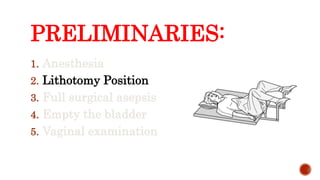
2. Lithotomy Position
3. Full surgical asepsis
4. Empty the bladder
5. Vaginal examination
PRELIMINARIES:
1. Anesthesia
2. Lithotomy Position
3. Full surgical asepsis
4. Empty the bladder
5. Vaginal examination
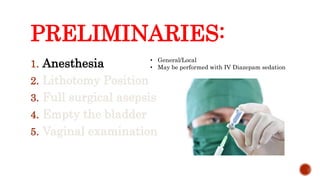
• General/Local
• May be performed with IV Diazepam sedation
PRELIMINARIES:
1. Anesthesia
2. Lithotomy Position
3. Full surgical asepsis
4. Empty the bladder
5. Vaginal examination
PRELIMINARIES:
1. Anesthesia
2. Lithotomy Position
3. Full surgical asepsis
4. Empty the bladder
5. Vaginal examination
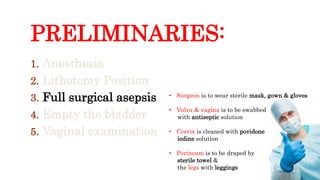
• Surgeon is to wear sterile mask, gown & gloves
• Vulva & vagina is to be swabbed
with antiseptic solution
• Cervix is cleaned with povidone
iodine solution
• Perineum is to be draped by
sterile towel &
the legs with leggings
PRELIMINARIES:
1. Anesthesia
2. Lithotomy Position
3. Full surgical asepsis
4. Empty the bladder
5. Vaginal examination
• If the patient is ambulant,
she is asked to empty the bladder
before she is placed on the table
• Otherwise, catheterization is to be done
PRELIMINARIES:
1. Anesthesia
2. Lithotomy Position
3. Full surgical asepsis
4. Empty the bladder
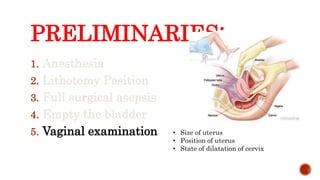
5. Vaginal examination • Size of uterus
• Position of uterus
• State of dilatation of cervix
DILATATION
of the cervix
EVACUATION
of the
product of
conception
FROM THE
UTERUS
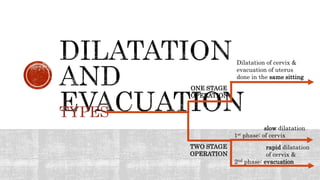
TYPES
ONE STAGE
OPERATION
TWO STAGE
OPERATION
Dilatation of cervix &
evacuation of uterus
done in the same sitting
rapid dilatation
of cervix &
2nd phase: evacuation
slow dilatation
1st phase: of cervix
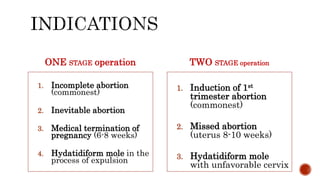
ONE STAGE operation
1. Incomplete abortion
(commonest)
2. Inevitable abortion
3. Medical termination of
pregnancy (6-8 weeks)
4. Hydatidiform mole in the
process of expulsion
TWO STAGE operation
1. Induction of 1st
trimester abortion
(commonest)
2. Missed abortion
(uterus 8-10 weeks)
3. Hydatidiform mole
with unfavorable cervix
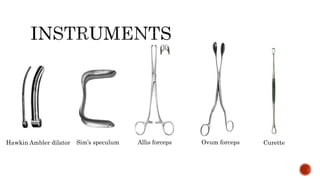
Hawkin Ambler dilator Sim’s speculum Allis forceps CuretteOvum forceps
TYPES
ONE STAGE
OPERATION
Dilatation of cervix &
evacuation of uterus
done in the same sitting
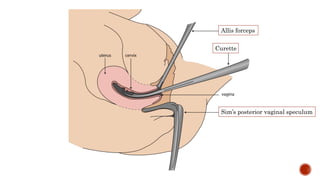
Sim’s posterior vaginal speculum
Allis forceps
Curette
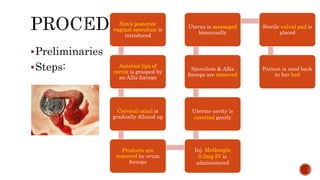
Preliminaries
Steps:
Sim’s posterior
vaginal speculum is
introduced
Anterior lips of
cervix is grasped by
an Allis forceps
Cervical canal is
gradually dilated up
Products are
removed by ovum
forceps
Inj. Methergin
0.2mg IV is
administered
Uterine cavity is
curetted gently
Speculum & Allis
forceps are removed
Uterus is massaged
bimanually
Sterile vulval pad is
placed
Patient is send back
to her bed
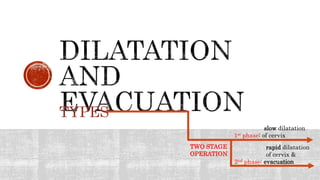
TYPES
TWO STAGE
OPERATION
rapid dilatation
of cervix &
2nd phase: evacuation
slow dilatation
1st phase: of cervix
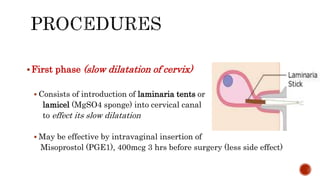
First phase (slow dilatation of cervix)
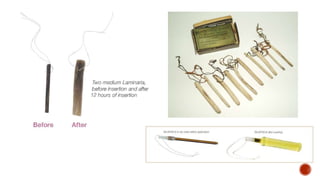
 Consists of introduction of laminaria tents or
lamicel (MgSO4 sponge) into cervical canal
to effect its slow dilatation
 May be effective by intravaginal insertion of
Misoprostol (PGE1), 400mcg 3 hrs before surgery (less side effect)
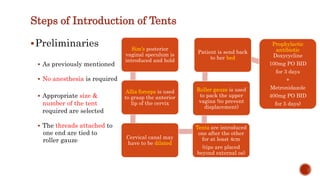
Preliminaries
 As previously mentioned
 No anesthesia is required
 Appropriate size &
number of the tent
required are selected
 The threads attached to
one end are tied to
roller gauze
Sim’s posterior
vaginal speculum is
introduced and hold
Allis forceps is used
to grasp the anterior
lip of the cervix
Cervical canal may
have to be dilated
Tents are introduced
one after the other
for at least 4cm
(tips are placed
beyond external os)
Roller gauze is used
to pack the upper
vagina (to prevent
displacement)
Patient is send back
to her bed
Prophylactic
antibiotic
Doxycycline
100mg PO BID
for 3 days
+
Metronidazole
400mg PO BID
for 5 days)
Steps of Introduction of Tents
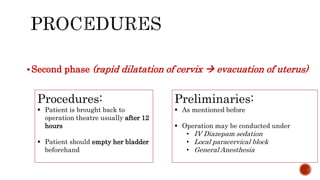
Second phase (rapid dilatation of cervix  evacuation of uterus)
Procedures:
 Patient is brought back to
operation theatre usually after 12
hours
 Patient should empty her bladder
beforehand
Preliminaries:
 As mentioned before
 Operation may be conducted under
• IV Diazepam sedation
• Local paracervical block
• General Anesthesia
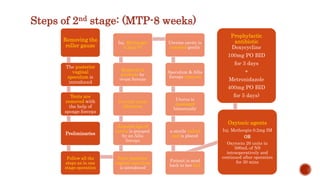
Removing the
roller gauze
The posterior
vaginal
speculum is
introduced
Tents are
removed with
the help of
sponge forceps
Preliminaries
Follow all the
steps as in one
stage operation
Sim’s posterior
vaginal speculum
is introduced
Anterior lips of
cervix is grasped
by an Allis
forceps
Cervical canal
dilatation
Removal of
products by
ovum forceps
Inj. Methergin
0.2mg IV
Uterine cavity is
curetted gently
Speculum & Allis
forceps removal
Uterus is
massaged
bimanually
a sterile vulval
pad is placed
Patient is send
back to her bed
Oxytocic agents
Inj. Methergin 0.2mg IM
OR
Oxytocin 20 units in
500mL of NS
intraoperatively and
continued after operation
for 30 mins
Prophylactic
antibiotic
Doxycycline
100mg PO BID
for 3 days
+
Metronidazole
400mg PO BID
for 5 days)
Steps of 2nd stage: (MTP-8 weeks)
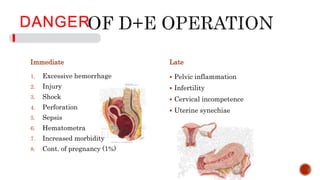
Immediate
1. Excessive hemorrhage
2. Injury
3. Shock
4. Perforation
5. Sepsis
6. Hematometra
7. Increased morbidity
8. Cont. of pregnancy (1%)
Late
 Pelvic inflammation
 Infertility
 Cervical incompetence
 Uterine synechiae
Depends on the location,
size & nature of
the instrument
causing perforation
Procedure is stopped
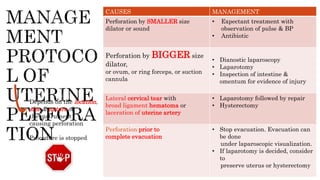
CAUSES MANAGEMENT
Perforation by SMALLER size
dilator or sound
• Expectant treatment with
observation of pulse & BP
• Antibiotic
Perforation by BIGGER size
dilator,
or ovum, or ring forceps, or suction
cannula
• Dianostic laparoscopy
• Laparotomy
• Inspection of intestine &
omentum for evidence of injury
Lateral cervical tear with
broad ligament hematoma or
laceration of uterine artery
• Laparotomy followed by repair
• Hysterectomy
Perforation prior to
complete evacuation
• Stop evacuation. Evacuation can
be done
under laparoscopic visualization.
• If laparotomy is decided, consider
to
preserve uterus or hysterectomy
Depends on the location,
size & nature of
the instrument
causing perforation
Procedure is stopped
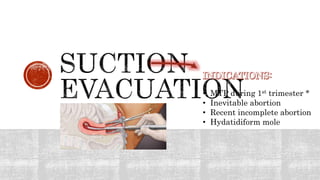
A procedure in which
the products of conception
are sucked out from the uterus
with the help of a cannula
fitted to a suction apparatus
• MTP during 1st trimester *
• Inevitable abortion
• Recent incomplete abortion
• Hydatidiform mole
PROCEDURES
Preliminaries:
 As mentioned before
 GA is usually not needed
 If patient is apprehensive,
IV Diazepam 5-10 mg (conscious sedation)
supplemented by paracervical block is
quite effective
 Patient is put on the table after bladder is emptied
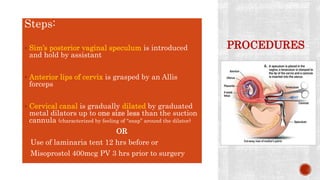
PROCEDURES
Steps:
 Sim’s posterior vaginal speculum is introduced
and hold by assistant
 Anterior lips of cervix is grasped by an Allis
forceps
 Cervical canal is gradually dilated by graduated
metal dilators up to one size less than the suction
cannula (characterized by feeling of “snap” around the dilator)
OR
Use of laminaria tent 12 hrs before or
Misoprostol 400mcg PV 3 hrs prior to surgery
PROCEDURES
Steps:
Injection Methergin 0.2mg IV
Appropriate suction cannula is
fitted to the suction apparatus
PROCEDURES
Steps:
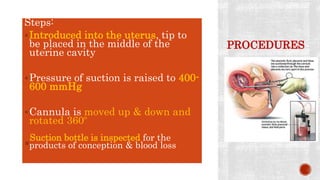
Introduced into the uterus, tip to
be placed in the middle of the
uterine cavity
Pressure of suction is raised to 400-
600 mmHg
Cannula is moved up & down and
rotated 360o

Suction bottle is inspected for the
products of conception & blood loss
 The END POINT OF SUCTION is denoted by:
1) no more material is being sucked out
2) gripping of the cannula by the
 contracting smaller size uterus
3) grating sensation
4) appearance of bubbles in the cannula
 or in the transparent tubing
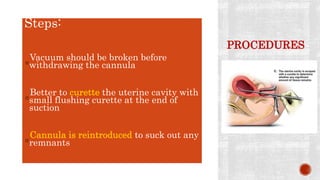
PROCEDURES
Steps:

Vacuum should be broken before
withdrawing the cannula

Better to curette the uterine cavity with
small flushing curette at the end of
suction

Cannula is reintroduced to suck out any
remnants
PROCEDURES
Steps:
After uterus is firmed &
bleeding is minimal, a sterile
vulval pad is placed
Patient is brought down from
the table
 Similar complications as mentioned in D+E operation may
occur
 Use of plastic cannula can minimize uterine perforation
 Blood loss & incomplete evacuation are less likely with
pregnancy of 8 weeks or less
 Use of USG during procedures shortens the operative time and
reduces complications
Syn: induction, aspiration
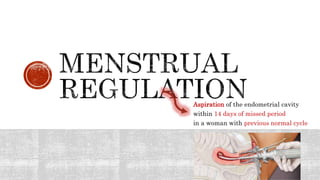
Aspiration of the endometrial cavity
within 14 days of missed period
in a woman with previous normal cycle
PROCEDURE
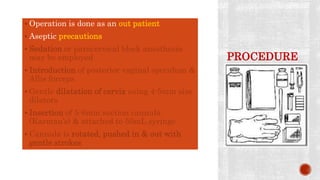
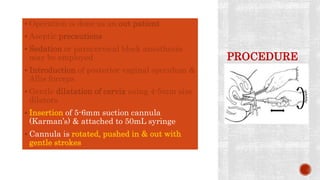
 Operation is done as an out patient
 Aseptic precautions
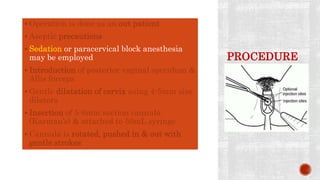
 Sedation or paracervical block anesthesia
may be employed
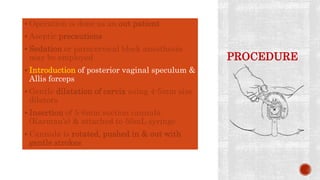
 Introduction of posterior vaginal speculum &
Allis forceps
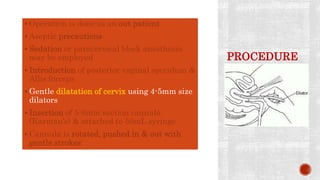
 Gentle dilatation of cervix using 4-5mm size
dilators
 Insertion of 5-6mm suction cannula
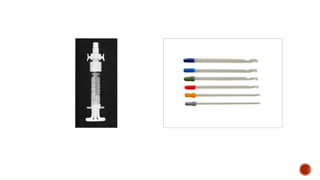
(Karman’s) & attached to 50mL syringe
 Cannula is rotated, pushed in & out with
gentle strokes
PROCEDURE
 Operation is done as an out patient
 Aseptic precautions
 Sedation or paracervical block anesthesia
may be employed
 Introduction of posterior vaginal speculum &
Allis forceps
 Gentle dilatation of cervix using 4-5mm size
dilators
 Insertion of 5-6mm suction cannula
(Karman’s) & attached to 50mL syringe
 Cannula is rotated, pushed in & out with
gentle strokes
PROCEDURE
 Operation is done as an out patient
 Aseptic precautions
 Sedation or paracervical block anesthesia
may be employed
 Introduction of posterior vaginal speculum &
Allis forceps
 Gentle dilatation of cervix using 4-5mm size
dilators
 Insertion of 5-6mm suction cannula
(Karman’s) & attached to 50mL syringe
 Cannula is rotated, pushed in & out with
gentle strokes
PROCEDURE
 Operation is done as an out patient
 Aseptic precautions
 Sedation or paracervical block anesthesia
may be employed
 Introduction of posterior vaginal speculum &
Allis forceps
 Gentle dilatation of cervix using 4-5mm size
dilators
 Insertion of 5-6mm suction cannula
(Karman’s) & attached to 50mL syringe
 Cannula is rotated, pushed in & out with
gentle strokes
PROCEDURE
 Operation is done as an out patient
 Aseptic precautions
 Sedation or paracervical block anesthesia
may be employed
 Introduction of posterior vaginal speculum &
Allis forceps
 Gentle dilatation of cervix using 4-5mm size
dilators
 Insertion of 5-6mm suction cannula
(Karman’s) & attached to 50mL syringe
 Cannula is rotated, pushed in & out with
gentle strokes
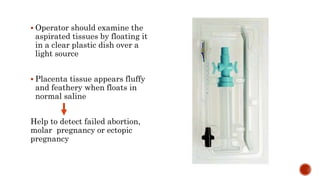
 Operator should examine the
aspirated tissues by floating it
in a clear plastic dish over a
light source
 Placenta tissue appears fluffy
and feathery when floats in
normal saline
Help to detect failed abortion,
molar pregnancy or ectopic
pregnancy
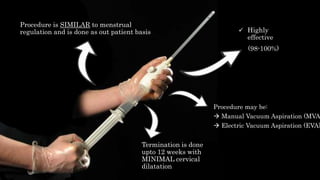
Procedure is SIMILAR to menstrual
regulation and is done as out patient basis  Highly
effective
(98-100%)
Procedure may be:
 Manual Vacuum Aspiration (MVA
 Electric Vacuum Aspiration (EVA)
Termination is done
upto 12 weeks with
MINIMAL cervical
dilatation
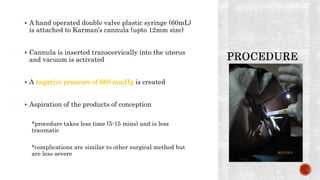
 A hand operated double valve plastic syringe (60mL)
is attached to Karman’s cannula (upto 12mm size)
 Cannula is inserted transcervically into the uterus
and vacuum is activated
 A negative pressure of 660 mmHg is created
 Aspiration of the products of conception
*procedure takes less time (5-15 mins) and is less
traumatic
*complications are similar to other surgical method but
are less severe
Clear?
Clear?
Clear?
INDICATI
LEGAL ABORT
MALAYSIA
Any medical condition that
can be worsened by
pregnancy.
A pregnancy with fetus that is
unlikely to survive like
anencephaly.
This is not applied to any
syndrome or congenital
malformation in which the baby
could survive like Down
syndrome.
A rape case in which the
pregnancy causing the
mental distress to the
patient.
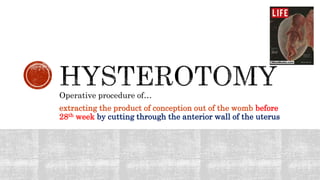
Operative procedure of…
extracting the product of conception out of the womb before
28th week by cutting through the anterior wall of the uterus
similar to a caesarean section,
but requiring a smaller incision
form of abortion in which
the uterus is opened
through an abdominal
incision and the fetus is
removed,
indications
Fibroids in the lower uterine
segment (obstructing evacuation) Midtrimester MTP where
other methods are failed or
contraindicated
indications
Completely
low lying placenta
(placenta previa)
Cervical cancer with
pregnancy
Uterine
anomalies
Women with multiple
previous cesarean delivery
(due to risk of placenta
accrete)
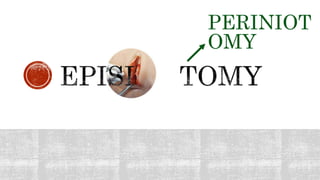
PERINIOT
OMY
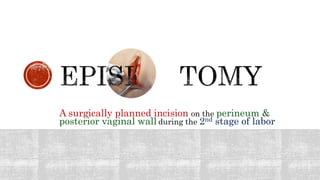
A surgically planned incision on the perineum &
posterior vaginal wall during the 2nd stage of labor
To enlarge vaginal introitus  facilitate easy
& safe delivery of the fetus
To minimize overstretching & rupture of
perineal muscles & fascia  reduce stress &
strain on the fetal head
Recommended in selective cases than
in routine
A constant care during the 2nd stage
reduces the incidence of episiotomy &
perineal trauma
 Elastic/rigid perineum
 arrest/delay in descent of
the presenting part as in
elderly primigravidae
 Operative delivery
 forceps delivery
 ventouse delivery
 Anticipating perineal tear
 big baby
 face to pubis delivery
 breech delivery
 shoulder dystocia
 Previous perineal surgery
 pelvic floor repair
 perineal reconstructive surgery
 Requires judgment
 EARLY  blood loss is more
LATE  fails to prevent invisible lacerations of
the perineal body  fails to protect pelvic floor
IDEAL TIME
 Bulging thinned perineum during contraction just
prior to crowning (3-4cm of head visible)
Maternal
 A clear & controlled incision is easy to
REPAIR AND HEALS better than a
lacerated wound that may occur
otherwise
 Reduction in the DURATION of 2nd
stage
 Reduction of TRAUMA to pelvic floor
muscle  reduces the incidence of prolapse &
urinary incontinence
Fetal
 Minimize the intracranial injuries
specially in premature babies or after-
coming head of breech
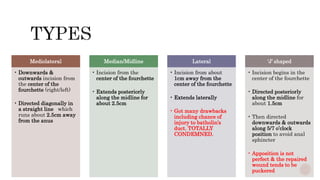
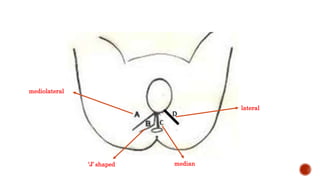
Mediolateral
• Downwards &
outwards incision from
the center of the
fourchette (right/left)
• Directed diagonally in
a straight line which
runs about 2.5cm away
from the anus
Median/Midline
• Incision from the
center of the fourchette
• Extends posteriorly
along the midline for
about 2.5cm
Lateral
• Incision from about
1cm away from the
center of the fourchette
• Extends laterally
• Got many drawbacks
including chance of
injury to batholin’s
duct. TOTALLY
CONDEMNED.
‘J’ shaped
• Incision begins in the
center of the fourchette
• Directed posteriorly
along the midline for
about 1.5cm
• Then directed
downwards & outwards
along 5/7 o’clock
position to avoid anal
sphincter
• Apposition is not
perfect & the repaired
wound tends to be
puckered
mediolateral
‘J’ shaped median
lateral
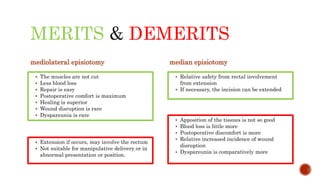
MERITS DEMERITS
mediolateral episiotomy
 The muscles are not cut
 Less blood loss
 Repair is easy
 Postoperative comfort is maximum
 Healing is superior
 Wound disruption is rare
 Dyspareunia is rare
median episiotomy
 Extension if occurs, may involve the rectum
 Not suitable for manipulative delivery or in
abnormal presentation or position.
 Relative safety from rectal involvement
from extension
 If necessary, the incision can be extended
 Apposition of the tissues is not so good
 Blood loss is little more
 Postoperative discomfort is more
 Relative increased incidence of wound
disruption
 Dyspareunia is comparatively more
1)Preliminaries
2)Incision
3)Repair
1)Preliminaries
2)Incision
3)Repair
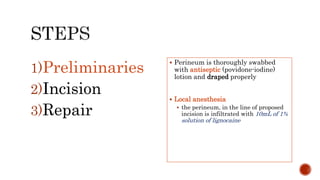
 Perineum is thoroughly swabbed
with antiseptic (povidone-iodine)
lotion and draped properly
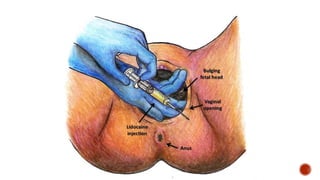
 Local anesthesia
 the perineum, in the line of proposed
incision is infiltrated with 10mL of 1%
solution of lignocaine
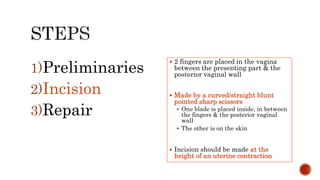
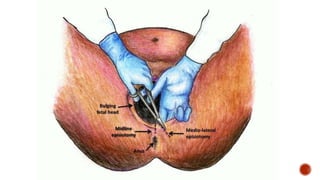
 2 fingers are placed in the vagina
between the presenting part & the
posterior vaginal wall
 Made by a curved/straight blunt
pointed sharp scissors
 One blade is placed inside, in between
the fingers & the posterior vaginal
wall
 The other is on the skin
 Incision should be made at the
height of an uterine contraction
1)Preliminaries
2)Incision
3)Repair
1)Preliminaries
2)Incision
3)Repair
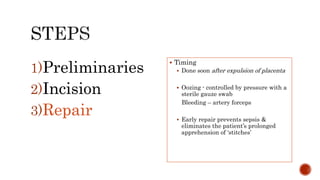
 Timing
 Done soon after expulsion of placenta
 Oozing - controlled by pressure with a
sterile gauze swab
Bleeding – artery forceps
 Early repair prevents sepsis &
eliminates the patient’s prolonged
apprehension of ‘stitches’
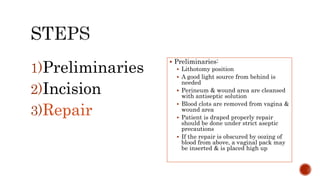
 Preliminaries:
 Lithotomy position
 A good light source from behind is
needed
 Perineum & wound area are cleansed
with antiseptic solution
 Blood clots are removed from vagina &
wound area
 Patient is draped properly repair
should be done under strict aseptic
precautions
 If the repair is obscured by oozing of
blood from above, a vaginal pack may
be inserted & is placed high up
1)Preliminaries
2)Incision
3)Repair
1)Preliminaries
2)Incision
3)Repair
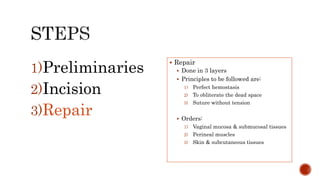
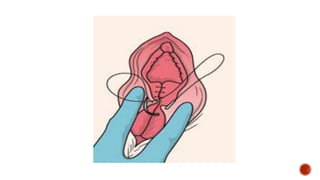
 Repair
 Done in 3 layers
 Principles to be followed are:
1) Perfect hemostasis
2) To obliterate the dead space
3) Suture without tension
 Orders:
1) Vaginal mucosa & submucosal tissues
2) Perineal muscles
3) Skin & subcutaneous tissues
POSTOPERATIVE CARE
 Dressing
 The wound is to be dressed each time
following urination & defecation
 To keep area clean & dry
 Swabbing with cotton swabs soaked in
antiseptic powder or ointment
(Furacin or Neosporin)
POSTOPERATIVE CARE
 Comfort
 To relieve pain in the area,
magnesium sulfate compress or
application of infrared heat may be
used
 Ice packs reduces swelling & pain also
 Analgesic drugs (Ibuprofen) may be
given when required
POSTOPERATIVE CARE
 Ambulance
 Patient is allowed to move out of the
bed after 24 hours
 Prior to that, she is allowed to roll
over on to her side or even to sit but
only with thighs apposed
POSTOPERATIVE CARE
 Removal of stitch
 When wound is sutured by catgut or
Dexon which will be absorbed, the
sutures need not be removed
 If non-absorbable material (silk/nylon)
is used, the stitches are to be cut on
6th day
POSTOPERATIVE CARE
 Dressing
 The wound is to be dressed each time
following urination & defecation
 To keep area clean & dry
 Swabbing with cotton swabs soaked in
antiseptic powder or ointment
(Furacin or Neosporin)
 Ambulance
 Patient is allowed to move out of the
bed after 24 hours
 Prior to that, she is allowed to roll
over on to her side or even to sit but
only with thighs apposed
 Comfort
 To relieve pain in the area,
magnesium sulfate compress or
application of infrared heat may be
used
 Ice packs reduces swelling & pain also
 Analgesic drugs (Ibuprofen) may be
given when required
 Removal of stitch
 When wound is sutured by catgut or
Dexon which will be absorbed, the
sutures need not be removed
 If non-absorbable material (silk/nylon)
is used, the stitches are to be cut on
6th day
immediate
Extension of the incision
Vulval hematoma
Wound dehiscence
Incontinence
remote
Dyspareunia
Chance of perineal
lacerations
Scar endometriosis (rare)
Conclusion…
FOR MAIN POINTS:
 DC Dutta ‘s Textbook of Obstetrics
FOR EXTRA POINTS:
 http://medicowesome.blogspot.in/2014/10/what-is-difference-between-menstrual.html
 http://www.glowm.com/section_view/heading/Surgical%20Techniques%20for%20First-
Trimester%20Abortion/item/439
 http://onlinelibrary.wiley.com/doi/10.1111/j.1471-0528.2011.03268.x/full
 http://www.academia.edu/7691081/Legal_Issues_of_Abortion_in_Malaysia
FOR VIDEO:
 https://www.youtube.com/watch?v=iHfRe7q7WEY
Thank
You…

Operative Obstetrics

  • 1.
  • 2.
     Dilatation andevacuation  Sucktion evacuation  Menstral regulation  Vacuum aspiration  Hysterotomy  Episiotomy  Operative vaginal delivery  Forceps  Ventouse  Version  Destructive operations  Cesarean section
  • 3.
     Dilatation andevacuation  Sucktion evacuation  Menstral regulation  Vacuum aspiration  Hysterotomy  Episiotomy  Operative vaginal delivery  Forceps  Ventouse  Version  Destructive operations  Cesarean section
  • 4.
     Dilatation andevacuation  Sucktion evacuation  Menstral regulation  Vacuum aspiration  Hysterotomy  Episiotomy  Operative vaginal delivery  Forceps  Ventouse  Version  Destructive operations  Cesarean section
  • 5.
     Dilatation andevacuation  Sucktion evacuation  Menstral regulation  Vacuum aspiration  Hysterotomy  Episiotomy  Operative vaginal delivery  Forceps  Ventouse  Version  Destructive operations  Cesarean section
  • 6.
     Dilatation andevacuation  Sucktion evacuation  Menstral regulation  Vacuum aspiration  Hysterotomy  Episiotomy  Operative vaginal delivery  Forceps  Ventouse  Version  Destructive operations  Cesarean section
  • 7.
    PRELIMINARIES: 1. Anesthesia 2. LithotomyPosition 3. Full surgical asepsis 4. Empty the bladder 5. Vaginal examination
  • 8.
    PRELIMINARIES: 1. Anesthesia 2. LithotomyPosition 3. Full surgical asepsis 4. Empty the bladder 5. Vaginal examination • General/Local • May be performed with IV Diazepam sedation
  • 9.
    PRELIMINARIES: 1. Anesthesia 2. LithotomyPosition 3. Full surgical asepsis 4. Empty the bladder 5. Vaginal examination
  • 10.
    PRELIMINARIES: 1. Anesthesia 2. LithotomyPosition 3. Full surgical asepsis 4. Empty the bladder 5. Vaginal examination • Surgeon is to wear sterile mask, gown & gloves • Vulva & vagina is to be swabbed with antiseptic solution • Cervix is cleaned with povidone iodine solution • Perineum is to be draped by sterile towel & the legs with leggings
  • 11.
    PRELIMINARIES: 1. Anesthesia 2. LithotomyPosition 3. Full surgical asepsis 4. Empty the bladder 5. Vaginal examination • If the patient is ambulant, she is asked to empty the bladder before she is placed on the table • Otherwise, catheterization is to be done
  • 12.
    PRELIMINARIES: 1. Anesthesia 2. LithotomyPosition 3. Full surgical asepsis 4. Empty the bladder 5. Vaginal examination • Size of uterus • Position of uterus • State of dilatation of cervix
  • 14.
  • 15.
  • 16.
    TYPES ONE STAGE OPERATION TWO STAGE OPERATION Dilatationof cervix & evacuation of uterus done in the same sitting rapid dilatation of cervix & 2nd phase: evacuation slow dilatation 1st phase: of cervix
  • 17.
    ONE STAGE operation 1.Incomplete abortion (commonest) 2. Inevitable abortion 3. Medical termination of pregnancy (6-8 weeks) 4. Hydatidiform mole in the process of expulsion TWO STAGE operation 1. Induction of 1st trimester abortion (commonest) 2. Missed abortion (uterus 8-10 weeks) 3. Hydatidiform mole with unfavorable cervix
  • 18.
    Hawkin Ambler dilatorSim’s speculum Allis forceps CuretteOvum forceps
  • 19.
    TYPES ONE STAGE OPERATION Dilatation ofcervix & evacuation of uterus done in the same sitting
  • 20.
    Sim’s posterior vaginalspeculum Allis forceps Curette
  • 21.
    Preliminaries Steps: Sim’s posterior vaginal speculumis introduced Anterior lips of cervix is grasped by an Allis forceps Cervical canal is gradually dilated up Products are removed by ovum forceps Inj. Methergin 0.2mg IV is administered Uterine cavity is curetted gently Speculum & Allis forceps are removed Uterus is massaged bimanually Sterile vulval pad is placed Patient is send back to her bed
  • 22.
    TYPES TWO STAGE OPERATION rapid dilatation ofcervix & 2nd phase: evacuation slow dilatation 1st phase: of cervix
  • 23.
    First phase (slowdilatation of cervix)  Consists of introduction of laminaria tents or lamicel (MgSO4 sponge) into cervical canal to effect its slow dilatation  May be effective by intravaginal insertion of Misoprostol (PGE1), 400mcg 3 hrs before surgery (less side effect)
  • 25.
    Preliminaries  As previouslymentioned  No anesthesia is required  Appropriate size & number of the tent required are selected  The threads attached to one end are tied to roller gauze Sim’s posterior vaginal speculum is introduced and hold Allis forceps is used to grasp the anterior lip of the cervix Cervical canal may have to be dilated Tents are introduced one after the other for at least 4cm (tips are placed beyond external os) Roller gauze is used to pack the upper vagina (to prevent displacement) Patient is send back to her bed Prophylactic antibiotic Doxycycline 100mg PO BID for 3 days + Metronidazole 400mg PO BID for 5 days) Steps of Introduction of Tents
  • 26.
    Second phase (rapiddilatation of cervix  evacuation of uterus) Procedures:  Patient is brought back to operation theatre usually after 12 hours  Patient should empty her bladder beforehand Preliminaries:  As mentioned before  Operation may be conducted under • IV Diazepam sedation • Local paracervical block • General Anesthesia
  • 27.
    Removing the roller gauze Theposterior vaginal speculum is introduced Tents are removed with the help of sponge forceps Preliminaries Follow all the steps as in one stage operation Sim’s posterior vaginal speculum is introduced Anterior lips of cervix is grasped by an Allis forceps Cervical canal dilatation Removal of products by ovum forceps Inj. Methergin 0.2mg IV Uterine cavity is curetted gently Speculum & Allis forceps removal Uterus is massaged bimanually a sterile vulval pad is placed Patient is send back to her bed Oxytocic agents Inj. Methergin 0.2mg IM OR Oxytocin 20 units in 500mL of NS intraoperatively and continued after operation for 30 mins Prophylactic antibiotic Doxycycline 100mg PO BID for 3 days + Metronidazole 400mg PO BID for 5 days) Steps of 2nd stage: (MTP-8 weeks)
  • 28.
    Immediate 1. Excessive hemorrhage 2.Injury 3. Shock 4. Perforation 5. Sepsis 6. Hematometra 7. Increased morbidity 8. Cont. of pregnancy (1%) Late  Pelvic inflammation  Infertility  Cervical incompetence  Uterine synechiae
  • 29.
    Depends on thelocation, size & nature of the instrument causing perforation Procedure is stopped
  • 30.
    CAUSES MANAGEMENT Perforation bySMALLER size dilator or sound • Expectant treatment with observation of pulse & BP • Antibiotic Perforation by BIGGER size dilator, or ovum, or ring forceps, or suction cannula • Dianostic laparoscopy • Laparotomy • Inspection of intestine & omentum for evidence of injury Lateral cervical tear with broad ligament hematoma or laceration of uterine artery • Laparotomy followed by repair • Hysterectomy Perforation prior to complete evacuation • Stop evacuation. Evacuation can be done under laparoscopic visualization. • If laparotomy is decided, consider to preserve uterus or hysterectomy Depends on the location, size & nature of the instrument causing perforation Procedure is stopped
  • 32.
    A procedure inwhich the products of conception are sucked out from the uterus with the help of a cannula fitted to a suction apparatus
  • 33.
    • MTP during1st trimester * • Inevitable abortion • Recent incomplete abortion • Hydatidiform mole
  • 34.
    PROCEDURES Preliminaries:  As mentionedbefore  GA is usually not needed  If patient is apprehensive, IV Diazepam 5-10 mg (conscious sedation) supplemented by paracervical block is quite effective  Patient is put on the table after bladder is emptied
  • 35.
    PROCEDURES Steps:  Sim’s posteriorvaginal speculum is introduced and hold by assistant  Anterior lips of cervix is grasped by an Allis forceps  Cervical canal is gradually dilated by graduated metal dilators up to one size less than the suction cannula (characterized by feeling of “snap” around the dilator) OR Use of laminaria tent 12 hrs before or Misoprostol 400mcg PV 3 hrs prior to surgery
  • 36.
    PROCEDURES Steps: Injection Methergin 0.2mgIV Appropriate suction cannula is fitted to the suction apparatus
  • 37.
    PROCEDURES Steps: Introduced into theuterus, tip to be placed in the middle of the uterine cavity Pressure of suction is raised to 400- 600 mmHg Cannula is moved up & down and rotated 360o  Suction bottle is inspected for the products of conception & blood loss
  • 38.
     The ENDPOINT OF SUCTION is denoted by: 1) no more material is being sucked out 2) gripping of the cannula by the  contracting smaller size uterus 3) grating sensation 4) appearance of bubbles in the cannula  or in the transparent tubing
  • 39.
    PROCEDURES Steps:  Vacuum should bebroken before withdrawing the cannula  Better to curette the uterine cavity with small flushing curette at the end of suction  Cannula is reintroduced to suck out any remnants
  • 40.
    PROCEDURES Steps: After uterus isfirmed & bleeding is minimal, a sterile vulval pad is placed Patient is brought down from the table
  • 41.
     Similar complicationsas mentioned in D+E operation may occur  Use of plastic cannula can minimize uterine perforation  Blood loss & incomplete evacuation are less likely with pregnancy of 8 weeks or less  Use of USG during procedures shortens the operative time and reduces complications
  • 42.
  • 43.
    Aspiration of theendometrial cavity within 14 days of missed period in a woman with previous normal cycle
  • 45.
    PROCEDURE  Operation isdone as an out patient  Aseptic precautions  Sedation or paracervical block anesthesia may be employed  Introduction of posterior vaginal speculum & Allis forceps  Gentle dilatation of cervix using 4-5mm size dilators  Insertion of 5-6mm suction cannula (Karman’s) & attached to 50mL syringe  Cannula is rotated, pushed in & out with gentle strokes
  • 46.
    PROCEDURE  Operation isdone as an out patient  Aseptic precautions  Sedation or paracervical block anesthesia may be employed  Introduction of posterior vaginal speculum & Allis forceps  Gentle dilatation of cervix using 4-5mm size dilators  Insertion of 5-6mm suction cannula (Karman’s) & attached to 50mL syringe  Cannula is rotated, pushed in & out with gentle strokes
  • 47.
    PROCEDURE  Operation isdone as an out patient  Aseptic precautions  Sedation or paracervical block anesthesia may be employed  Introduction of posterior vaginal speculum & Allis forceps  Gentle dilatation of cervix using 4-5mm size dilators  Insertion of 5-6mm suction cannula (Karman’s) & attached to 50mL syringe  Cannula is rotated, pushed in & out with gentle strokes
  • 48.
    PROCEDURE  Operation isdone as an out patient  Aseptic precautions  Sedation or paracervical block anesthesia may be employed  Introduction of posterior vaginal speculum & Allis forceps  Gentle dilatation of cervix using 4-5mm size dilators  Insertion of 5-6mm suction cannula (Karman’s) & attached to 50mL syringe  Cannula is rotated, pushed in & out with gentle strokes
  • 49.
    PROCEDURE  Operation isdone as an out patient  Aseptic precautions  Sedation or paracervical block anesthesia may be employed  Introduction of posterior vaginal speculum & Allis forceps  Gentle dilatation of cervix using 4-5mm size dilators  Insertion of 5-6mm suction cannula (Karman’s) & attached to 50mL syringe  Cannula is rotated, pushed in & out with gentle strokes
  • 50.
     Operator shouldexamine the aspirated tissues by floating it in a clear plastic dish over a light source  Placenta tissue appears fluffy and feathery when floats in normal saline Help to detect failed abortion, molar pregnancy or ectopic pregnancy
  • 53.
    Procedure is SIMILARto menstrual regulation and is done as out patient basis  Highly effective (98-100%) Procedure may be:  Manual Vacuum Aspiration (MVA  Electric Vacuum Aspiration (EVA) Termination is done upto 12 weeks with MINIMAL cervical dilatation
  • 54.
     A handoperated double valve plastic syringe (60mL) is attached to Karman’s cannula (upto 12mm size)  Cannula is inserted transcervically into the uterus and vacuum is activated  A negative pressure of 660 mmHg is created  Aspiration of the products of conception *procedure takes less time (5-15 mins) and is less traumatic *complications are similar to other surgical method but are less severe
  • 55.
  • 56.
  • 57.
  • 59.
    INDICATI LEGAL ABORT MALAYSIA Any medicalcondition that can be worsened by pregnancy. A pregnancy with fetus that is unlikely to survive like anencephaly. This is not applied to any syndrome or congenital malformation in which the baby could survive like Down syndrome. A rape case in which the pregnancy causing the mental distress to the patient.
  • 61.
    Operative procedure of… extractingthe product of conception out of the womb before 28th week by cutting through the anterior wall of the uterus
  • 62.
    similar to acaesarean section, but requiring a smaller incision form of abortion in which the uterus is opened through an abdominal incision and the fetus is removed,
  • 63.
  • 64.
    Fibroids in thelower uterine segment (obstructing evacuation) Midtrimester MTP where other methods are failed or contraindicated indications Completely low lying placenta (placenta previa) Cervical cancer with pregnancy Uterine anomalies Women with multiple previous cesarean delivery (due to risk of placenta accrete)
  • 66.
  • 67.
    A surgically plannedincision on the perineum & posterior vaginal wall during the 2nd stage of labor
  • 68.
    To enlarge vaginalintroitus  facilitate easy & safe delivery of the fetus To minimize overstretching & rupture of perineal muscles & fascia  reduce stress & strain on the fetal head
  • 69.
    Recommended in selectivecases than in routine A constant care during the 2nd stage reduces the incidence of episiotomy & perineal trauma
  • 70.
     Elastic/rigid perineum arrest/delay in descent of the presenting part as in elderly primigravidae  Operative delivery  forceps delivery  ventouse delivery  Anticipating perineal tear  big baby  face to pubis delivery  breech delivery  shoulder dystocia  Previous perineal surgery  pelvic floor repair  perineal reconstructive surgery
  • 71.
     Requires judgment EARLY  blood loss is more LATE  fails to prevent invisible lacerations of the perineal body  fails to protect pelvic floor IDEAL TIME  Bulging thinned perineum during contraction just prior to crowning (3-4cm of head visible)
  • 72.
    Maternal  A clear& controlled incision is easy to REPAIR AND HEALS better than a lacerated wound that may occur otherwise  Reduction in the DURATION of 2nd stage  Reduction of TRAUMA to pelvic floor muscle  reduces the incidence of prolapse & urinary incontinence Fetal  Minimize the intracranial injuries specially in premature babies or after- coming head of breech
  • 73.
    Mediolateral • Downwards & outwardsincision from the center of the fourchette (right/left) • Directed diagonally in a straight line which runs about 2.5cm away from the anus Median/Midline • Incision from the center of the fourchette • Extends posteriorly along the midline for about 2.5cm Lateral • Incision from about 1cm away from the center of the fourchette • Extends laterally • Got many drawbacks including chance of injury to batholin’s duct. TOTALLY CONDEMNED. ‘J’ shaped • Incision begins in the center of the fourchette • Directed posteriorly along the midline for about 1.5cm • Then directed downwards & outwards along 5/7 o’clock position to avoid anal sphincter • Apposition is not perfect & the repaired wound tends to be puckered
  • 74.
  • 75.
    MERITS DEMERITS mediolateral episiotomy The muscles are not cut  Less blood loss  Repair is easy  Postoperative comfort is maximum  Healing is superior  Wound disruption is rare  Dyspareunia is rare median episiotomy  Extension if occurs, may involve the rectum  Not suitable for manipulative delivery or in abnormal presentation or position.  Relative safety from rectal involvement from extension  If necessary, the incision can be extended  Apposition of the tissues is not so good  Blood loss is little more  Postoperative discomfort is more  Relative increased incidence of wound disruption  Dyspareunia is comparatively more
  • 76.
  • 77.
    1)Preliminaries 2)Incision 3)Repair  Perineum isthoroughly swabbed with antiseptic (povidone-iodine) lotion and draped properly  Local anesthesia  the perineum, in the line of proposed incision is infiltrated with 10mL of 1% solution of lignocaine
  • 79.
     2 fingersare placed in the vagina between the presenting part & the posterior vaginal wall  Made by a curved/straight blunt pointed sharp scissors  One blade is placed inside, in between the fingers & the posterior vaginal wall  The other is on the skin  Incision should be made at the height of an uterine contraction 1)Preliminaries 2)Incision 3)Repair
  • 81.
    1)Preliminaries 2)Incision 3)Repair  Timing  Donesoon after expulsion of placenta  Oozing - controlled by pressure with a sterile gauze swab Bleeding – artery forceps  Early repair prevents sepsis & eliminates the patient’s prolonged apprehension of ‘stitches’
  • 82.
     Preliminaries:  Lithotomyposition  A good light source from behind is needed  Perineum & wound area are cleansed with antiseptic solution  Blood clots are removed from vagina & wound area  Patient is draped properly repair should be done under strict aseptic precautions  If the repair is obscured by oozing of blood from above, a vaginal pack may be inserted & is placed high up 1)Preliminaries 2)Incision 3)Repair
  • 83.
    1)Preliminaries 2)Incision 3)Repair  Repair  Donein 3 layers  Principles to be followed are: 1) Perfect hemostasis 2) To obliterate the dead space 3) Suture without tension  Orders: 1) Vaginal mucosa & submucosal tissues 2) Perineal muscles 3) Skin & subcutaneous tissues
  • 85.
    POSTOPERATIVE CARE  Dressing The wound is to be dressed each time following urination & defecation  To keep area clean & dry  Swabbing with cotton swabs soaked in antiseptic powder or ointment (Furacin or Neosporin)
  • 86.
    POSTOPERATIVE CARE  Comfort To relieve pain in the area, magnesium sulfate compress or application of infrared heat may be used  Ice packs reduces swelling & pain also  Analgesic drugs (Ibuprofen) may be given when required
  • 87.
    POSTOPERATIVE CARE  Ambulance Patient is allowed to move out of the bed after 24 hours  Prior to that, she is allowed to roll over on to her side or even to sit but only with thighs apposed
  • 88.
    POSTOPERATIVE CARE  Removalof stitch  When wound is sutured by catgut or Dexon which will be absorbed, the sutures need not be removed  If non-absorbable material (silk/nylon) is used, the stitches are to be cut on 6th day
  • 89.
    POSTOPERATIVE CARE  Dressing The wound is to be dressed each time following urination & defecation  To keep area clean & dry  Swabbing with cotton swabs soaked in antiseptic powder or ointment (Furacin or Neosporin)  Ambulance  Patient is allowed to move out of the bed after 24 hours  Prior to that, she is allowed to roll over on to her side or even to sit but only with thighs apposed  Comfort  To relieve pain in the area, magnesium sulfate compress or application of infrared heat may be used  Ice packs reduces swelling & pain also  Analgesic drugs (Ibuprofen) may be given when required  Removal of stitch  When wound is sutured by catgut or Dexon which will be absorbed, the sutures need not be removed  If non-absorbable material (silk/nylon) is used, the stitches are to be cut on 6th day
  • 90.
    immediate Extension of theincision Vulval hematoma Wound dehiscence Incontinence remote Dyspareunia Chance of perineal lacerations Scar endometriosis (rare)
  • 91.
  • 94.
    FOR MAIN POINTS: DC Dutta ‘s Textbook of Obstetrics FOR EXTRA POINTS:  http://medicowesome.blogspot.in/2014/10/what-is-difference-between-menstrual.html  http://www.glowm.com/section_view/heading/Surgical%20Techniques%20for%20First- Trimester%20Abortion/item/439  http://onlinelibrary.wiley.com/doi/10.1111/j.1471-0528.2011.03268.x/full  http://www.academia.edu/7691081/Legal_Issues_of_Abortion_in_Malaysia FOR VIDEO:  https://www.youtube.com/watch?v=iHfRe7q7WEY
  • 95.

Editor's Notes

  • #38 Injection Methergin 0.2mg IV Appropriate suction cannula is fitted to the suction apparatus
  • #95 The Silent Scream is a 1984 anti-abortion educational film directed by Jack Duane Dabner and narrated by Bernard Nathanson, an obstetrician, NARAL Pro-Choice America founder, and abortion provider turned pro-life activist, and produced in partnership with the National Right to Life Committee.[2] The film depicts the abortion process via ultrasound and shows an abortion taking place in the uterus. During the abortion process, the fetus is described as appearing to make outcries of pain and discomfort. The video has been a popular tool used by the pro-life campaign in arguing against abortion,[3] although it has been criticized as misleading by members of the medical community.[4]