Shoulder dystocia
Shrooti shah
Lecturer
National Medical College Nursing Campus
Definition
When fetal head is delivered, but shoulders are stuck
and cannot be delivered it is known as shoulder
dystocia.
Failure of the shoulders to traverse the pelvis
spontaneously after delivery of the head.
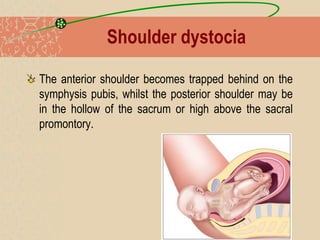
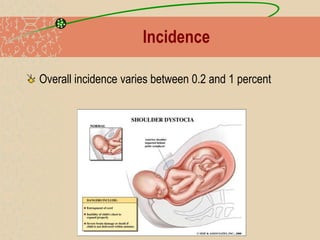
Shoulder dystocia
The anterior shoulder becomes trapped behind on the
symphysis pubis, whilst the posterior shoulder may be
in the hollow of the sacrum or high above the sacral
promontory.
Incidence
Overall incidence varies between 0.2 and 1 percent
Predisposing factors
Fetal macrosomia
Obesity
Diabetes
Midpelvic instrumental delivery
Post maturity
Multiparity
Anencephaly
Fetal ascitis
Warning signs and diagnosis
The delivery may have been uncomplicated initially, but
the head may have advanced slowly and the chin may
have had difficulty in sweeping over the perineum.
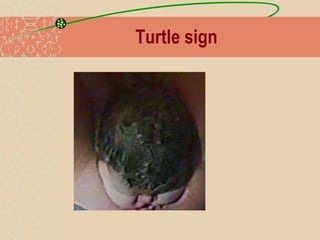
Once the head is delivered it may look as if it is trying to
return into the vagina, which is caused by reverse
traction.
Diagnosed when maneouvers normally used by the
midwife fail to accomplish delivery.
Turtle sign
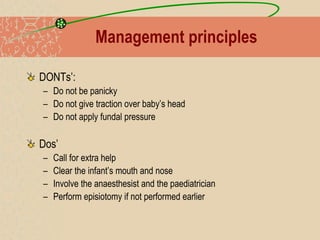
Management principles
DONTs’:
– Do not be panicky
– Do not give traction over baby’s head
– Do not apply fundal pressure
Dos’
– Call for extra help
– Clear the infant’s mouth and nose
– Involve the anaesthesist and the paediatrician
– Perform episiotomy if not performed earlier
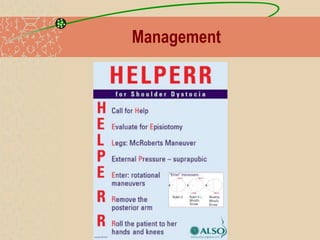
Management
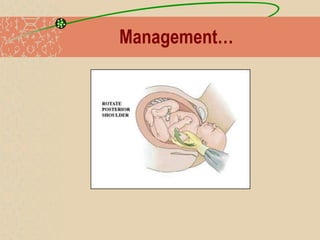
Management…
1. Pre-procedure steps and considerations:
– Shout for help
– Explain procedure
– Follow general principles of basic care and infection
prevention
– Perform episiotomy
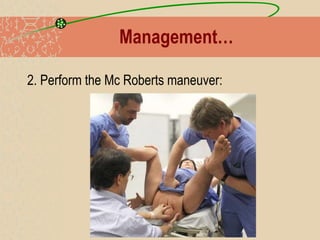
Management…
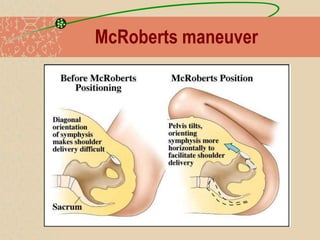
2. Perform the Mc Roberts maneuver:
McRoberts maneuver
Rubin’s Maneuver
3. If the shoulder is still not delivered: insert a hand into
the vagina and apply pressure to the anterior shoulder
in the direction of the baby’s sternum to rotate the
shoulder and decrease the shoulder diameter.
• If the needed, apply pressure to the posterior shoulder
in the direction of the baby’s sternum
Wood’s maneuver
4. If the shoulder is still not delivered despite the above
measures:
• Insert a hand into the vagina
• Grasp the humerus of the posterior arm and keeping
the arm flexed at the elbow, sweep the arm across the
chest, grasp the hand and deliver the entire arm.
• With one hand on each side of the fetal head, apply
firm, continuous traction downward to move the anterior
shoulder under the symphysis pubis
Management…
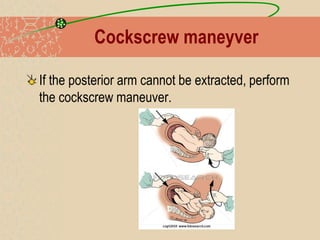
Cockscrew maneyver
If the posterior arm cannot be extracted, perform
the cockscrew maneuver.
Cleidotomy
If all of the measures fail to deliver the anterior
shoulder:
– Another option is to fracture the baby’s anterior
clavicle to decrease the width of the shoulder. This is
done by pressing the anterior clavicle against the
symphysis pubis.
– After birth, facilitate urgent and immediate newborn
care or transfer of the newborn.
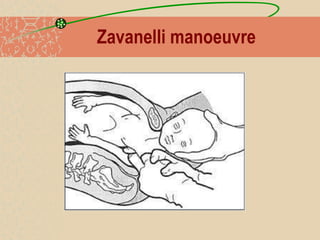
Zavanelli manoeuvre
Post Procedure care
Repair the episiotomy
If needed, provide emotional support to the woman and
family following a traumatic birth and possible death of
the newborn or injury to the baby.
Shoulder dystocia

Shoulder dystocia

  • 1.
  • 2.
    Definition When fetal headis delivered, but shoulders are stuck and cannot be delivered it is known as shoulder dystocia. Failure of the shoulders to traverse the pelvis spontaneously after delivery of the head.
  • 3.
    Shoulder dystocia The anteriorshoulder becomes trapped behind on the symphysis pubis, whilst the posterior shoulder may be in the hollow of the sacrum or high above the sacral promontory.
  • 4.
    Incidence Overall incidence variesbetween 0.2 and 1 percent
  • 5.
    Predisposing factors Fetal macrosomia Obesity Diabetes Midpelvicinstrumental delivery Post maturity Multiparity Anencephaly Fetal ascitis
  • 6.
    Warning signs anddiagnosis The delivery may have been uncomplicated initially, but the head may have advanced slowly and the chin may have had difficulty in sweeping over the perineum. Once the head is delivered it may look as if it is trying to return into the vagina, which is caused by reverse traction. Diagnosed when maneouvers normally used by the midwife fail to accomplish delivery.
  • 7.
  • 8.
    Management principles DONTs’: – Donot be panicky – Do not give traction over baby’s head – Do not apply fundal pressure Dos’ – Call for extra help – Clear the infant’s mouth and nose – Involve the anaesthesist and the paediatrician – Perform episiotomy if not performed earlier
  • 9.
  • 10.
    Management… 1. Pre-procedure stepsand considerations: – Shout for help – Explain procedure – Follow general principles of basic care and infection prevention – Perform episiotomy
  • 11.
    Management… 2. Perform theMc Roberts maneuver:
  • 12.
  • 13.
    Rubin’s Maneuver 3. Ifthe shoulder is still not delivered: insert a hand into the vagina and apply pressure to the anterior shoulder in the direction of the baby’s sternum to rotate the shoulder and decrease the shoulder diameter. • If the needed, apply pressure to the posterior shoulder in the direction of the baby’s sternum
  • 14.
    Wood’s maneuver 4. Ifthe shoulder is still not delivered despite the above measures: • Insert a hand into the vagina • Grasp the humerus of the posterior arm and keeping the arm flexed at the elbow, sweep the arm across the chest, grasp the hand and deliver the entire arm. • With one hand on each side of the fetal head, apply firm, continuous traction downward to move the anterior shoulder under the symphysis pubis
  • 15.
  • 16.
    Cockscrew maneyver If theposterior arm cannot be extracted, perform the cockscrew maneuver.
  • 17.
    Cleidotomy If all ofthe measures fail to deliver the anterior shoulder: – Another option is to fracture the baby’s anterior clavicle to decrease the width of the shoulder. This is done by pressing the anterior clavicle against the symphysis pubis. – After birth, facilitate urgent and immediate newborn care or transfer of the newborn.
  • 18.
  • 19.
    Post Procedure care Repairthe episiotomy If needed, provide emotional support to the woman and family following a traumatic birth and possible death of the newborn or injury to the baby.