Hysteroscopy 
Moderator : Dr. Diana
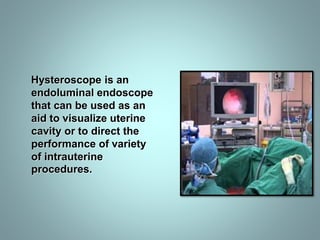
Hysteroscope is an 
endoluminal endoscope 
that can be used as an 
aid to visualize uterine 
cavity or to direct the 
performance of variety 
of intrauterine 
procedures.
Historical aspect 
• 1869: Pantaleon visualize polypoidal tumour in uterus. 
• 1925: Rubin used cystourethroscope to visualize 
uterus; he used water to distend uterus and to wash 
lens. Later he used C02 
• 1960-70 – low viscosity fluids like saline or ringer 
lactate with pressure 50-100mmhg; popularly used in 
diagnostic hysteroscopy. Cheap and easily available. 
• 1971 – Hyson 
- used by Menken 
- 30% dextran in 10% glucose 
( K Y jelly is been used in India as distending media for 
diagnostic hysteroscope)
Instruments 
• Hysterocsope: 
-Telescope : eyepiece, barrel & objective lens. 
- Angle options : 0,12 ,15, 25, 30 & 70 degree. 
- 0 degree provides a panoramic view. 
- angled one improve the view of ostia in an 
abnormally shaped uterine cavity.
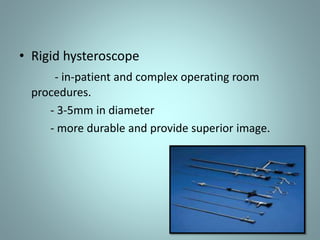
• Rigid hysteroscope 
- in-patient and complex operating room 
procedures. 
- 3-5mm in diameter 
- more durable and provide superior image.
• Flexible hysteroscope 
- most commonly used for office hysteroscopy 
- flexibility; tip deflection of 120-160 degree. 
- irregularly shaped uterus & navigation around 
intrauterine lesions.
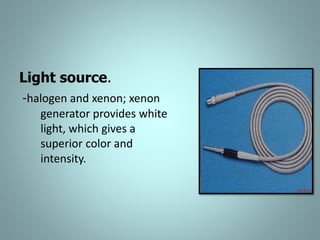
Light source. 
-halogen and xenon; xenon 
generator provides white 
light, which gives a 
superior color and 
intensity.
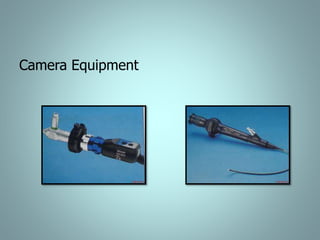
Camera Equipment
Diagnostic sheaths 
-to deliver the distention media 
-fit by means of a watertight seal lock 
- 4 to 5 mm in diameter, with a 1 mm 
clearance between the inner wall and the 
telescope, through which the distention 
media is transmitted.
• Operative sheaths 
- larger diameter - 7 to 10 
- allows space for instillation of medium, for 
the telescope, and for the insertion of 
operating devices.
• Resectoscope 
-three basic electrodes: a ball, 
barrel, and a cutting loop. 
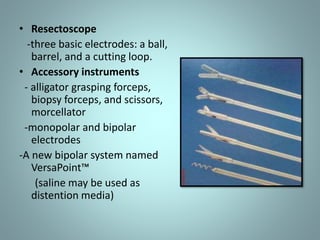
• Accessory instruments 
- alligator grasping forceps, 
biopsy forceps, and scissors, 
morcellator 
-monopolar and bipolar 
electrodes 
-A new bipolar system named 
VersaPoint™ 
(saline may be used as 
distention media)
• DISTENTION MEDIA 
-muscle of uterine walls requires a minimum 
pressure of 40 mm Hg to distend the cavity. 
-types of distention media 
- gaseous 
-liquid - high-viscosity and low-viscosity fluids
• Carbon dioxide 
- colorless gas 
-ideal for office hysteroscopy. 
- given through insufflator 
- it allows entry evaluation of the 
endocervical canal. 
- disadvantages – gas embolism, no 
effective way to remove blood and debris.
• High viscosity fluids 
- Dextran 70 (Hyscon ) 
• Low viscosity fluids with electrolytes 
-normal saline and lactated ringer’s solution 
-easy availability and low cost 
- miscibility with blood hence obscuring the 
vision 
- pulmonary and cerebral edema
• Low viscosity fluids without electrolytes 
-1.5 % glycine is the most commonly used medium. 
-Other non-electrolyte media - 5% glucose and 
sorbitol/mannitol.
Procedure 
Preparation of the patient: 
– Detailed history and complete physical 
examination 
– In proliferative phase of menstrual cycle 
– Informed consent 
– bimanual examination
Therapeutic Hysteroscopy Anesthesia 
• Local - Paracervical block plus fentanyl 100 mcg IV 
or ibuprofen 600 mg with diazepam 5mg po 1hr 
before 
• Spinal – allows monitoring of sensorium with 
respect to hyponatremia 
• General anesthesia with paracervical block
Vasopressin in Paracervical Block 
• Less force (about ½) needed for dilation 
• Less fluid absorbed (about 1/3) 
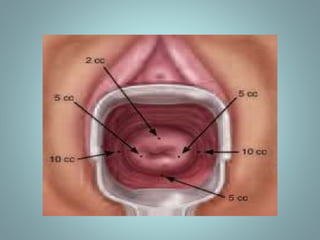
• Ed’s solution= 5U (1/4 ml) vasopressin in 30ml 1% 
chloroprocaine or lidocaine (+3ml NaCO3). Inject 6- 
10ml each side. 
• Alternatively misoprostol (200-400 microgram) can 
be use 12-24 hrs prior.
Indications 
Diagnostic tool: 
- Abnormal uterine bleeding : 
- Premenopausal 
- Postmenopausal 
- Infertility : 
- Intrauterine adhesions (Asherman’s 
syndrome) 
- Submucous fibroids. 
- Endometrial polyps. 
- Uterine malformations( abnormal hsg or 
tvs)
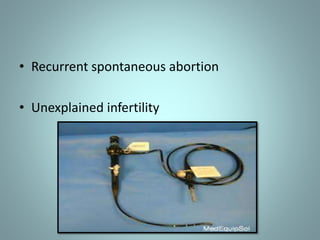
• Recurrent spontaneous abortion 
• Unexplained infertility
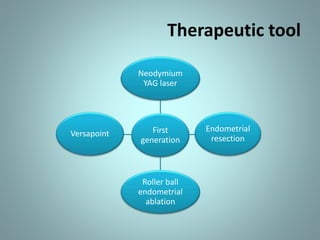
Therapeutic tool 
Neodymium 
YAG laser 
First 
generation 
Endometrial 
resection 
Roller ball 
endometrial 
ablation 
Versapoint
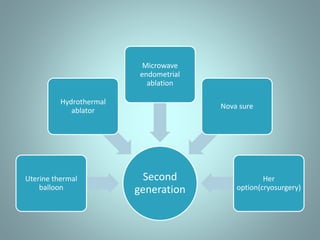
Second 
generation 
Hydrothermal 
Uterine thermal 
balloon 
ablator 
Microwave 
endometrial 
ablation 
Nova sure 
Her 
option(cryosurgery)
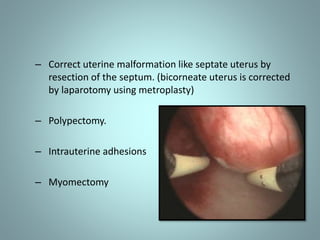
– Correct uterine malformation like septate uterus by 
resection of the septum. (bicorneate uterus is corrected 
by laparotomy using metroplasty) 
– Polypectomy. 
– Intrauterine adhesions 
– Myomectomy
Used as a therapeutic tool 
- Removal of foreign bodies and IUCD. 
- CANNULATION OF FALLOPIAN TUBE 
- to canalize the tube:interstitial 
obstruction secondary to cellular debris and 
tubal spasm. 
- to place intra tubal device for 
sterilization.
• treatment of hemangiomas and arteriovenous 
malformations
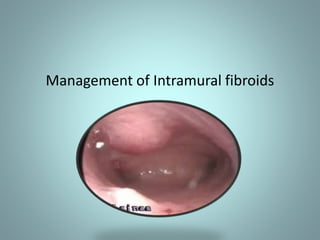
Management of Intramural fibroids
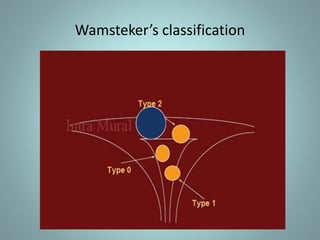
Wamsteker’s classification
Indication 
Mennorhagia 
Infertility?
• Myomas treated hysteroscopically 
- All submucosal myomas: 
( two step procedure are considered) 
- Single Intramural fibroid <5 cm that lie close 
to endometrium
Contraindications 
• Pregnancy. 
• Current or recent pelvic infection. 
• Current vaginitis, cervicitis and 
endometritis. 
• Recent uterine perforation. 
• Active Bleeding.
Complications 
• Intra-operative bleeding 
- increase the pressure of distention media above 
the mean arterial pressure, this compresses the wall 
of the uterus sufficiently to stop bleeding. 
-bleeding vessel can be coagulated with a 3 mm 
ball electrode.
• Bleeding can be controlled by inserting a Foleys 
balloon and inflating it to 3 to 5 ml. The balloon can 
be kept in situ for 6 to 12 hours 
• rare cases when the bleeding is arterial- uterine 
artery embolization or even hysterectomy may be 
needed.
• Delayed postoperative bleeding - associated 
with endometrial slough, chronic endometritis or 
spontaneous expulsion of intramural portion of 
previously resected submucous myoma 
• Uterine perforation
- Complications related to distention media: 
due to CO2 insufflation: 
-Cardiac arrhythmia due to excessive 
absorption. 
-Gas embolism. 
due to fluid: 
- Anaphylactic reaction 
- Pulmonary edema 
- Adult RDS
• Acute hyponatremic state- fluid deficit equal or 
greater than 500 ml should alert a surgeon to a 
likelihood of hyponatremia and hypoosmolality, 
which can furthur lead to cerebral edema an CNS 
abnormality. Close monitoring of inflow and outflow 
and thereby the deficit can avoid these 
complications.
Complications 
- Late onset: 
- Infections, PID 
- Vaginal discharge: common after ablative 
procedures and it is self limiting. 
- Adhesion formation
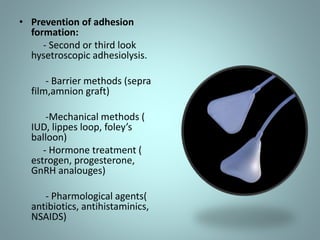
• Prevention of adhesion 
formation: 
- Second or third look 
hysetroscopic adhesiolysis. 
- Barrier methods (sepra 
film,amnion graft) 
-Mechanical methods ( 
IUD, lippes loop, foley’s 
balloon) 
- Hormone treatment ( 
estrogen, progesterone, 
GnRH analouges) 
- Pharmological agents( 
antibiotics, antihistaminics, 
NSAIDS)
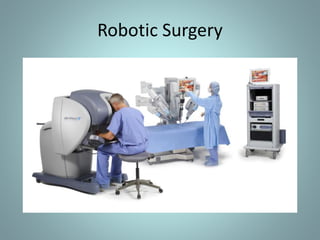
Robotic Surgery
ACOG Committee Opinion 
Number 444 – November 2009 
• “Evidence demonstrates that, in general, vaginal 
hysterectomy is associated with better outcomes and 
fewer complications than laparoscopic and 
abdominal hysterectomy. When it is not feasible to 
perform a vaginal hysterectomy, the surgeon must 
choose between laparoscopic hysterectomy, robot-assisted 
hysterectomy or abdominal hysterectomy.”
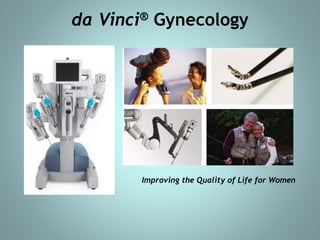
da Vinci® Gynecology 
Improving the Quality of Life for Women
• Gynecologic Conditions 
• da Vinci® Surgical System 
• da Vinci Gynecologic Surgery 
 da Vinci Hysterectomy for Early Stage Gynecologic Cancer 
 da Vinci Hysterectomy for Benign Conditions 
 da Vinci Myomectomy 
 da Vinci Sacrocolpopexy
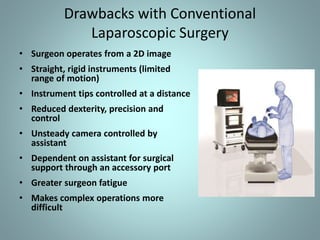
Drawbacks with Conventional 
Laparoscopic Surgery 
• Surgeon operates from a 2D image 
• Straight, rigid instruments (limited 
range of motion) 
• Instrument tips controlled at a distance 
• Reduced dexterity, precision and 
control 
• Unsteady camera controlled by 
assistant 
• Dependent on assistant for surgical 
support through an accessory port 
• Greater surgeon fatigue 
• Makes complex operations more 
difficult
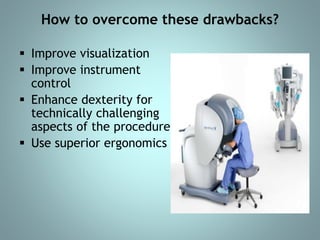
How to overcome these drawbacks? 
 Improve visualization 
 Improve instrument 
control 
 Enhance dexterity for 
technically challenging 
aspects of the procedure 
 Use superior ergonomics
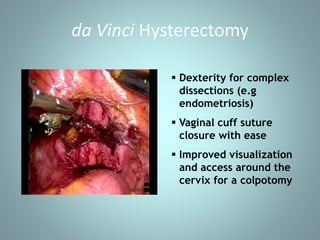
da Vinci Hysterectomy 
 Dexterity for complex 
dissections (e.g 
endometriosis) 
 Vaginal cuff suture 
closure with ease 
 Improved visualization 
and access around the 
cervix for a colpotomy
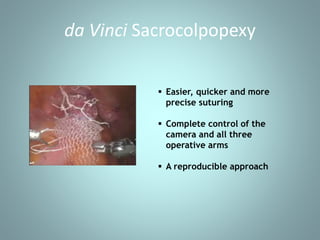
da Vinci Sacrocolpopexy 
 Easier, quicker and more 
precise suturing 
 Complete control of the 
camera and all three 
operative arms 
 A reproducible approach
Hysteroscopy
Hysteroscopy

Hysteroscopy

  • 1.
  • 2.
    Hysteroscope is an endoluminal endoscope that can be used as an aid to visualize uterine cavity or to direct the performance of variety of intrauterine procedures.
  • 3.
    Historical aspect •1869: Pantaleon visualize polypoidal tumour in uterus. • 1925: Rubin used cystourethroscope to visualize uterus; he used water to distend uterus and to wash lens. Later he used C02 • 1960-70 – low viscosity fluids like saline or ringer lactate with pressure 50-100mmhg; popularly used in diagnostic hysteroscopy. Cheap and easily available. • 1971 – Hyson - used by Menken - 30% dextran in 10% glucose ( K Y jelly is been used in India as distending media for diagnostic hysteroscope)
  • 4.
    Instruments • Hysterocsope: -Telescope : eyepiece, barrel & objective lens. - Angle options : 0,12 ,15, 25, 30 & 70 degree. - 0 degree provides a panoramic view. - angled one improve the view of ostia in an abnormally shaped uterine cavity.
  • 5.
    • Rigid hysteroscope - in-patient and complex operating room procedures. - 3-5mm in diameter - more durable and provide superior image.
  • 6.
    • Flexible hysteroscope - most commonly used for office hysteroscopy - flexibility; tip deflection of 120-160 degree. - irregularly shaped uterus & navigation around intrauterine lesions.
  • 7.
    Light source. -halogenand xenon; xenon generator provides white light, which gives a superior color and intensity.
  • 8.
  • 9.
    Diagnostic sheaths -todeliver the distention media -fit by means of a watertight seal lock - 4 to 5 mm in diameter, with a 1 mm clearance between the inner wall and the telescope, through which the distention media is transmitted.
  • 10.
    • Operative sheaths - larger diameter - 7 to 10 - allows space for instillation of medium, for the telescope, and for the insertion of operating devices.
  • 11.
    • Resectoscope -threebasic electrodes: a ball, barrel, and a cutting loop. • Accessory instruments - alligator grasping forceps, biopsy forceps, and scissors, morcellator -monopolar and bipolar electrodes -A new bipolar system named VersaPoint™ (saline may be used as distention media)
  • 12.
    • DISTENTION MEDIA -muscle of uterine walls requires a minimum pressure of 40 mm Hg to distend the cavity. -types of distention media - gaseous -liquid - high-viscosity and low-viscosity fluids
  • 13.
    • Carbon dioxide - colorless gas -ideal for office hysteroscopy. - given through insufflator - it allows entry evaluation of the endocervical canal. - disadvantages – gas embolism, no effective way to remove blood and debris.
  • 14.
    • High viscosityfluids - Dextran 70 (Hyscon ) • Low viscosity fluids with electrolytes -normal saline and lactated ringer’s solution -easy availability and low cost - miscibility with blood hence obscuring the vision - pulmonary and cerebral edema
  • 15.
    • Low viscosityfluids without electrolytes -1.5 % glycine is the most commonly used medium. -Other non-electrolyte media - 5% glucose and sorbitol/mannitol.
  • 16.
    Procedure Preparation ofthe patient: – Detailed history and complete physical examination – In proliferative phase of menstrual cycle – Informed consent – bimanual examination
  • 17.
    Therapeutic Hysteroscopy Anesthesia • Local - Paracervical block plus fentanyl 100 mcg IV or ibuprofen 600 mg with diazepam 5mg po 1hr before • Spinal – allows monitoring of sensorium with respect to hyponatremia • General anesthesia with paracervical block
  • 18.
    Vasopressin in ParacervicalBlock • Less force (about ½) needed for dilation • Less fluid absorbed (about 1/3) • Ed’s solution= 5U (1/4 ml) vasopressin in 30ml 1% chloroprocaine or lidocaine (+3ml NaCO3). Inject 6- 10ml each side. • Alternatively misoprostol (200-400 microgram) can be use 12-24 hrs prior.
  • 20.
    Indications Diagnostic tool: - Abnormal uterine bleeding : - Premenopausal - Postmenopausal - Infertility : - Intrauterine adhesions (Asherman’s syndrome) - Submucous fibroids. - Endometrial polyps. - Uterine malformations( abnormal hsg or tvs)
  • 21.
    • Recurrent spontaneousabortion • Unexplained infertility
  • 22.
    Therapeutic tool Neodymium YAG laser First generation Endometrial resection Roller ball endometrial ablation Versapoint
  • 23.
    Second generation Hydrothermal Uterine thermal balloon ablator Microwave endometrial ablation Nova sure Her option(cryosurgery)
  • 25.
    – Correct uterinemalformation like septate uterus by resection of the septum. (bicorneate uterus is corrected by laparotomy using metroplasty) – Polypectomy. – Intrauterine adhesions – Myomectomy
  • 26.
    Used as atherapeutic tool - Removal of foreign bodies and IUCD. - CANNULATION OF FALLOPIAN TUBE - to canalize the tube:interstitial obstruction secondary to cellular debris and tubal spasm. - to place intra tubal device for sterilization.
  • 27.
    • treatment ofhemangiomas and arteriovenous malformations
  • 29.
  • 30.
  • 31.
  • 37.
    • Myomas treatedhysteroscopically - All submucosal myomas: ( two step procedure are considered) - Single Intramural fibroid <5 cm that lie close to endometrium
  • 41.
    Contraindications • Pregnancy. • Current or recent pelvic infection. • Current vaginitis, cervicitis and endometritis. • Recent uterine perforation. • Active Bleeding.
  • 42.
    Complications • Intra-operativebleeding - increase the pressure of distention media above the mean arterial pressure, this compresses the wall of the uterus sufficiently to stop bleeding. -bleeding vessel can be coagulated with a 3 mm ball electrode.
  • 43.
    • Bleeding canbe controlled by inserting a Foleys balloon and inflating it to 3 to 5 ml. The balloon can be kept in situ for 6 to 12 hours • rare cases when the bleeding is arterial- uterine artery embolization or even hysterectomy may be needed.
  • 44.
    • Delayed postoperativebleeding - associated with endometrial slough, chronic endometritis or spontaneous expulsion of intramural portion of previously resected submucous myoma • Uterine perforation
  • 45.
    - Complications relatedto distention media: due to CO2 insufflation: -Cardiac arrhythmia due to excessive absorption. -Gas embolism. due to fluid: - Anaphylactic reaction - Pulmonary edema - Adult RDS
  • 46.
    • Acute hyponatremicstate- fluid deficit equal or greater than 500 ml should alert a surgeon to a likelihood of hyponatremia and hypoosmolality, which can furthur lead to cerebral edema an CNS abnormality. Close monitoring of inflow and outflow and thereby the deficit can avoid these complications.
  • 47.
    Complications - Lateonset: - Infections, PID - Vaginal discharge: common after ablative procedures and it is self limiting. - Adhesion formation
  • 48.
    • Prevention ofadhesion formation: - Second or third look hysetroscopic adhesiolysis. - Barrier methods (sepra film,amnion graft) -Mechanical methods ( IUD, lippes loop, foley’s balloon) - Hormone treatment ( estrogen, progesterone, GnRH analouges) - Pharmological agents( antibiotics, antihistaminics, NSAIDS)
  • 49.
  • 50.
    ACOG Committee Opinion Number 444 – November 2009 • “Evidence demonstrates that, in general, vaginal hysterectomy is associated with better outcomes and fewer complications than laparoscopic and abdominal hysterectomy. When it is not feasible to perform a vaginal hysterectomy, the surgeon must choose between laparoscopic hysterectomy, robot-assisted hysterectomy or abdominal hysterectomy.”
  • 51.
    da Vinci® Gynecology Improving the Quality of Life for Women
  • 52.
    • Gynecologic Conditions • da Vinci® Surgical System • da Vinci Gynecologic Surgery  da Vinci Hysterectomy for Early Stage Gynecologic Cancer  da Vinci Hysterectomy for Benign Conditions  da Vinci Myomectomy  da Vinci Sacrocolpopexy
  • 53.
    Drawbacks with Conventional Laparoscopic Surgery • Surgeon operates from a 2D image • Straight, rigid instruments (limited range of motion) • Instrument tips controlled at a distance • Reduced dexterity, precision and control • Unsteady camera controlled by assistant • Dependent on assistant for surgical support through an accessory port • Greater surgeon fatigue • Makes complex operations more difficult
  • 54.
    How to overcomethese drawbacks?  Improve visualization  Improve instrument control  Enhance dexterity for technically challenging aspects of the procedure  Use superior ergonomics
  • 55.
    da Vinci Hysterectomy  Dexterity for complex dissections (e.g endometriosis)  Vaginal cuff suture closure with ease  Improved visualization and access around the cervix for a colpotomy
  • 56.
    da Vinci Sacrocolpopexy  Easier, quicker and more precise suturing  Complete control of the camera and all three operative arms  A reproducible approach