CAESAREAN SECTION
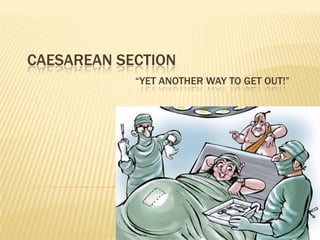
            “YET ANOTHER WAY TO GET OUT!”
WHY CALLED SO??

   According to legend ,julius caesar was born
    by this operation

   It was a fatal operation until beginning of 20th
    century.

   Now the most common operation performed
    worldwide
DEFINITION

   The delivery of a viable fetus through an incision in
    the abdominal wall and uterus.

   Definition does not include removal of fetus from
    abdominal cavity in case of rupture uterus.

   WHO recommends an ideal caesarean rate of 15-
    20%.

   But in most countries it is 15-20%
WHY RATES INCREASED?

 Increase in repeat caesareans.
 Difficult instrumental delivery and vaginal
  breech deliveries
 Increased diagnosis of intrapartum fetal
  distress
 Caesarian on demand

 Identification of risk of mothers and fetuses

 Increase in pregnancies by invitro fertilization
INDICATIONS
   Previous caesarian section

   Dystocia or dysfunctional labour

   Fetal distress

   Breech presentation

   Antepartum haemorrhage

   Maternal problems

   Caesarian section on demand
LSCS
•   Cross matched blood
•   Catheter introduced
•   Antibiotic prophylaxis
•   Heparin as thromboprophylaxis
•   Parts cleansed with antiseptic solution
•   Left lateral position- reduce aortocaval
                          compression.
                           reduce risk of supine
                            hypotension
ANAESTHESIA
•   GA or REGIONAL
•   REGIONAL - Spinal or Epidural
•   Mendelson’s syndrome- GA given as
    emergency- risk of aspiration- chemical
    pneumonitis.
•   To counteract- antacids given during
    labour, oral fluids withheld
•   30 ml 0.3 molar sodium citrate orally -1/2 hr
    before surgery.
•   Sellick’s manoeuvre- endotracheal
    intubation accompained by pressure on
ABDOMINAL INCISIONS
Pfannensteil   incision-MC
 used.
 Transverse  curvilinear incision
  above pubic hairline
 Deepened through s/c tissue upto
  rectus sheath
 Rectus sheath divided
  transversely
Maylard incision
 Option when more exposure is
 needed in transverse incision
 Recti muscles are divided

Midline vertical incision
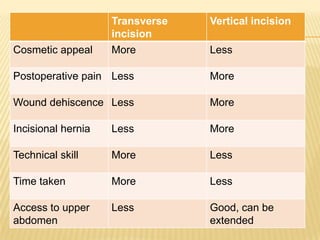
Transverse   Vertical incision
                    incision
Cosmetic appeal     More         Less

Postoperative pain Less          More

Wound dehiscence Less            More

Incisional hernia   Less         More

Technical skill     More         Less

Time taken          More         Less

Access to upper     Less         Good, can be
abdomen                          extended
PROCEDURE
•   Once abdomen opened- dextrorotation of
    uterus corrected
•   Doyen retractor- visualize lower segment
•   Peritoneum over lower segment identified-
    divided transversely- seperated from bladder
    by blunt dissection
•   Small incision in lower segment-extended
    laterally
•   Inadequate space- J shaped or inverted T
    incision
•   Do not injure uterine vessels lying laterally
DELIVERY OF BABY
Cephalic presentation
  Hand slipped into uterine cavity
  Head is levered out gently
  Floating head- use forceps to deliver the
   baby.

  Breech presentation
   feet hooked out first
    rest delivered as vaginal breech
   delivery
Transverse or oblique lie
  corrected to longitudinal lie before
  making uterine incision.


Transverse lie with ruptured
  membranes & undeveloped lower
  segment
     extension of uterine incision
  required
CLOSURE OF UTERINE INCISION
 OXYTOCIN infusion started as soon as
  baby is delivered
 Uterine fundus contracts-placenta and
  membranes extrudes spontaneously-
  removed
 Wipe with moist pad- ensure uterine cavity
  is empty and cervical canal is open
 Uterine edges- held with ALLIS forceps or
  GREEN ARMYTAGE forceps- incision
  closed in 2 layers- continuous sutures
Chromic catgut or polyglactin used


Any bleeding points- controlled with figure-
 of-eight sutures
CLOSURE OF ABDOMEN

•   PERITONEUM- closed or not closed
•   RECTUS SHEATH-non absorbable sutures-
    proline- to reduce wound dehiscence &
    incisional hernia
•   SUBCUTANEOUS TISSUE-closed
•   SKIN- mattress sutures of silk, subcuticcular
    suture or clips
POST OPERATIVE CARE
 Close monitoring for 1st 6-8 hrs
 Parenteral fluids
 Blood transfusion if needed
 Analgesics and sedatives
 Oral fluids
 Early ambulation and deep breathing
  exercises
 Light solid diet n laxatives
 Discharged –day following suture
  removal/if transverse or subcuticular-5th/6th
  day
ADVANTAGES OF LSCS

   Healing better


   Scar rupture minimal
OTHER TYPES OF CS

 1. Low segment vertical incision
 2.Classical CS

 3.Extra peritoneal CS

 4.Caesarean hysterectomy
LOWER SEGMENT VERTICAL INCISION

 Indications:Constriction ring,lower segment
  not formed
 Disadv:
  injury to cervix, vagina,bladder
  increased chance of rupture in next
  pregnancy
CLASSICAL CAESAREAN
Indications
lower segment unapproachable
CA cervix
Anterior placenta praevia with prev caesarian
Transverse lie with ruptured membranes
Conjoint twins
Disadvantages
Difficult healing
Scar rupture
General peritonitis
EXTRAPERITONIAL CAESAREAN
 Severe infection
 Extraperitoneal approach

 Space of Retzius
CAESAREAN HYSTERECTOMY
Indications
Severe atonic PPH
Placenta accreta,increta,percreta
Sepsis
Multiple large myomas
CA cervix
COMPLICATIONS OF CAESAREAN SECTION
INTRAOPERATIVE COMPLICATIONS
  Primary haemorrhage


   Injury to internal organs

   Injury to the baby

   Difficulty in delivery of the head

   Anaesthetic complications
PRIMARY HAEMORRHAGE

 Atonic-
  oxytocin 20units in 500ml
  ergometrine0.25mg im or iv
  prostaglandin F2 alpha 250micgram im and
  intramurally
  PGE1 200micgram rectally
 Traumatic-ligation of concerned vessels

 Placenta accreta
POSTOPERATIVE COMPLICATIONS
 Paralytic ileus
 Respiratory complications
 Infections
 Peritonitis
 Pelvic abscess
 Pelvic thrombophlebitis
 Deep vein thrombosis and pulmonary
  embolism
 Wound dehiscence
LATE SEQUELAE
 Secondary PPH
 Incisional hernia

 Scar endometriosis

 Vesico-vaginal fistula

 Scar rupture in the next pregnancy

 Placenta praevia and placenta accreta

 Bladder injury

Caesarean section

  • 1.
    CAESAREAN SECTION “YET ANOTHER WAY TO GET OUT!”
  • 2.
    WHY CALLED SO??  According to legend ,julius caesar was born by this operation  It was a fatal operation until beginning of 20th century.  Now the most common operation performed worldwide
  • 3.
    DEFINITION  The delivery of a viable fetus through an incision in the abdominal wall and uterus.  Definition does not include removal of fetus from abdominal cavity in case of rupture uterus.  WHO recommends an ideal caesarean rate of 15- 20%.  But in most countries it is 15-20%
  • 4.
    WHY RATES INCREASED? Increase in repeat caesareans.  Difficult instrumental delivery and vaginal breech deliveries  Increased diagnosis of intrapartum fetal distress  Caesarian on demand  Identification of risk of mothers and fetuses  Increase in pregnancies by invitro fertilization
  • 5.
    INDICATIONS  Previous caesarian section  Dystocia or dysfunctional labour  Fetal distress  Breech presentation  Antepartum haemorrhage  Maternal problems  Caesarian section on demand
  • 6.
  • 7.
    Cross matched blood • Catheter introduced • Antibiotic prophylaxis • Heparin as thromboprophylaxis • Parts cleansed with antiseptic solution • Left lateral position- reduce aortocaval compression. reduce risk of supine hypotension
  • 8.
    ANAESTHESIA • GA or REGIONAL • REGIONAL - Spinal or Epidural • Mendelson’s syndrome- GA given as emergency- risk of aspiration- chemical pneumonitis. • To counteract- antacids given during labour, oral fluids withheld • 30 ml 0.3 molar sodium citrate orally -1/2 hr before surgery. • Sellick’s manoeuvre- endotracheal intubation accompained by pressure on
  • 9.
    ABDOMINAL INCISIONS Pfannensteil incision-MC used. Transverse curvilinear incision above pubic hairline Deepened through s/c tissue upto rectus sheath Rectus sheath divided transversely
  • 10.
    Maylard incision Optionwhen more exposure is needed in transverse incision Recti muscles are divided Midline vertical incision
  • 11.
    Transverse Vertical incision incision Cosmetic appeal More Less Postoperative pain Less More Wound dehiscence Less More Incisional hernia Less More Technical skill More Less Time taken More Less Access to upper Less Good, can be abdomen extended
  • 12.
    PROCEDURE • Once abdomen opened- dextrorotation of uterus corrected • Doyen retractor- visualize lower segment • Peritoneum over lower segment identified- divided transversely- seperated from bladder by blunt dissection • Small incision in lower segment-extended laterally • Inadequate space- J shaped or inverted T incision • Do not injure uterine vessels lying laterally
  • 13.
    DELIVERY OF BABY Cephalicpresentation Hand slipped into uterine cavity Head is levered out gently Floating head- use forceps to deliver the baby. Breech presentation feet hooked out first rest delivered as vaginal breech delivery
  • 14.
    Transverse or obliquelie corrected to longitudinal lie before making uterine incision. Transverse lie with ruptured membranes & undeveloped lower segment extension of uterine incision required
  • 15.
    CLOSURE OF UTERINEINCISION  OXYTOCIN infusion started as soon as baby is delivered  Uterine fundus contracts-placenta and membranes extrudes spontaneously- removed  Wipe with moist pad- ensure uterine cavity is empty and cervical canal is open  Uterine edges- held with ALLIS forceps or GREEN ARMYTAGE forceps- incision closed in 2 layers- continuous sutures
  • 16.
    Chromic catgut orpolyglactin used Any bleeding points- controlled with figure- of-eight sutures
  • 17.
    CLOSURE OF ABDOMEN • PERITONEUM- closed or not closed • RECTUS SHEATH-non absorbable sutures- proline- to reduce wound dehiscence & incisional hernia • SUBCUTANEOUS TISSUE-closed • SKIN- mattress sutures of silk, subcuticcular suture or clips
  • 18.
  • 19.
     Close monitoringfor 1st 6-8 hrs  Parenteral fluids  Blood transfusion if needed  Analgesics and sedatives  Oral fluids  Early ambulation and deep breathing exercises  Light solid diet n laxatives  Discharged –day following suture removal/if transverse or subcuticular-5th/6th day
  • 20.
    ADVANTAGES OF LSCS  Healing better  Scar rupture minimal
  • 21.
    OTHER TYPES OFCS  1. Low segment vertical incision  2.Classical CS  3.Extra peritoneal CS  4.Caesarean hysterectomy
  • 22.
    LOWER SEGMENT VERTICALINCISION  Indications:Constriction ring,lower segment not formed  Disadv: injury to cervix, vagina,bladder increased chance of rupture in next pregnancy
  • 23.
    CLASSICAL CAESAREAN Indications lower segmentunapproachable CA cervix Anterior placenta praevia with prev caesarian Transverse lie with ruptured membranes Conjoint twins Disadvantages Difficult healing Scar rupture General peritonitis
  • 24.
    EXTRAPERITONIAL CAESAREAN  Severeinfection  Extraperitoneal approach  Space of Retzius
  • 25.
    CAESAREAN HYSTERECTOMY Indications Severe atonicPPH Placenta accreta,increta,percreta Sepsis Multiple large myomas CA cervix
  • 26.
  • 27.
    INTRAOPERATIVE COMPLICATIONS Primary haemorrhage  Injury to internal organs  Injury to the baby  Difficulty in delivery of the head  Anaesthetic complications
  • 28.
    PRIMARY HAEMORRHAGE  Atonic- oxytocin 20units in 500ml ergometrine0.25mg im or iv prostaglandin F2 alpha 250micgram im and intramurally PGE1 200micgram rectally  Traumatic-ligation of concerned vessels  Placenta accreta
  • 29.
    POSTOPERATIVE COMPLICATIONS  Paralyticileus  Respiratory complications  Infections  Peritonitis  Pelvic abscess  Pelvic thrombophlebitis  Deep vein thrombosis and pulmonary embolism  Wound dehiscence
  • 30.
    LATE SEQUELAE  SecondaryPPH  Incisional hernia  Scar endometriosis  Vesico-vaginal fistula  Scar rupture in the next pregnancy  Placenta praevia and placenta accreta  Bladder injury