MOOD
BY : NUR HANISAH BINTI ZAINOREN
DISORDERS
EMOTIONS CAN BE DESCRIBED
AS TWO MAIN TYPES
MOOD
A sustained and pervasive emotional attitude which colours the whole
psychic life
AFFECT
A short-lived emotional response to an idea or an event
(what people observe)
Mood: internal amp
Affect: speaker
Classification of mood disorders:
1. Manic episode
2. Depressive episode
3. Bipolar mood (affective) disorder
4. Recurrent depressive disorder
5. Persistent mood disorder
6. Other mood disorders
MANIC EPISODE
• Life-time risk: 0.8-1.0%
• Tends to occur in episodes
lasting usually 3-4 months
 followed by complete
clinical recovery  future
episodes
(manic/depressive/mixed)
Characterised by the following features :
Elevated, expansive or irritable mood
Psychomotor activity
Speech and thought
Goal-directed activity
Other features
Absence of underlying organic cause
(which should last for at least 1 week and cause
disruption in occupational & social activities)
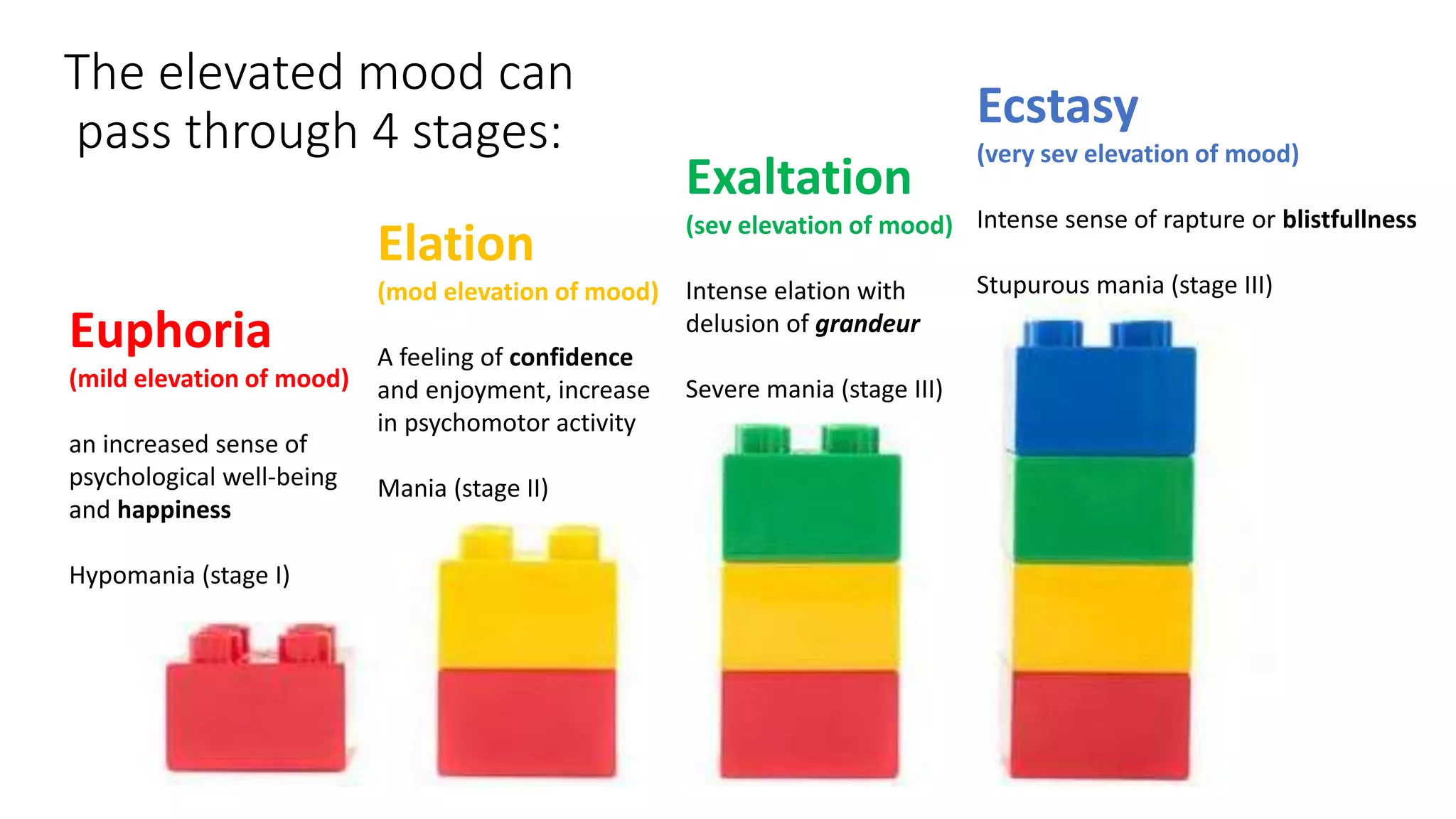
The elevated mood can
pass through 4 stages:
Euphoria
(mild elevation of mood)
an increased sense of
psychological well-being
and happiness
Hypomania (stage I)
Elation
(mod elevation of mood)
A feeling of confidence
and enjoyment, increase
in psychomotor activity
Mania (stage II)
Exaltation
(sev elevation of mood)
Intense elation with
delusion of grandeur
Severe mania (stage III)
Ecstasy
(very sev elevation of mood)
Intense sense of rapture or blistfullness
Stupurous mania (stage III)
Speech and thought
• More talkative than usual
• Describes thoughts racing in mind
• Develops pressure of speech
• Uses playful language
(joking/teasing)
• Speaks loudly
• Flight of ideas
• Delusion of grandeur
• Delusion of persecution
• Hallucinations, often with
religious content
Since these psychotic
symptoms are in keeping with
the elevated mood state, these
are called mood-congruent
psychotic features
Goal-directed activity
Unusually alert, trying to
do many things at one time
•Hypomania
•the ability to function
becomes much better &
marked increase in
productivity and
creativity
Mania
• Marked increase in activity
with excessive planning
• Marked increase in sociability
even with previously unknown
people
• Poor judgement. Often involve
in high risk activities such as
reckless driving, distributing
money to strangers
• Usually dressed up in gaudy
and flamboyant clothes
Other features:
• Decreased need of sleep
• Increased appetite  later
decreased food intake d/t
overactivity
• Absent insight into illness
• Psychotic features  delusions,
hallucinations (mood
incongruent psychotic features)
DEPRESSIVE EPISODE
• Life time risk of common depression:
• 8-12% (in males)
• 20-26% (in females)
• Life time risk of major depression/
depressive episode is about 8%
Characterised by the following features :
Depressed mood
Depressive ideation / cognition
Psychomotor activity
Physical symptoms
Biological functions
Psychotic features
Suicide
Absence of underlying organic cause
(which should last for at least 2 weeks for a diagnosis to be made)
Depressed mood
• Sadness of mood and loss of interest/pleasure in
almost all activities (pervasive sadness)
• Present throughout the day (persistent sadness)
• Varies from day to day and often unresponsive to
the environmental stimuli
• Results in social w/drawal, decreased ability to
function in occupational and interpersonal areas
and decreased involvement in previously
pleasurable activities
• Severe depression  complete anhedonia
(inability to experience pleasure)
Depressive ideation/cognition
Sadness of mood usually associated with
pessimism, which can result in
3 common types of depressive ideas:
• Hopelessness (no hope in future)
• Helplessness (no help is possible now)
• Worthlessness (feeling of
inadequacy/inferiority)
Depressive ideation/cognition
• Other features:
• Difficulty in thinking/concentrating
• Indecisiveness
• Slowed thinking
• Poor memory
• Lack of initiative and energy
• Thoughts of death
• Suicidal ideas
• Delusion of nihilism
“My world is coming to an end”
“My intestines have rotted away”
Psychomotor activity
• Young patient (<40 years)  retardation is common
• Slowed thinking and activity, decreased energy, monotonous
voice.
• Severe  stuporous (depressive stupor)
• Older patients  agitation is common
• Marked anxiety, restlessness (inability to sit still, hand-wriggling)
• Subjective feeling of unease
• Anxiety is a frequent accompaniment of depression
• Irritability (easy annoyance and frustration in day to day activities)
Physical symptoms
• Multiple physical symptoms (general
aches and pain)
• Complain of reduced energy and easy
fatigability
• Consult a physician instead of
psychiatrist
Biological functions
• Insomnia (or sometimes increased sleep)
• Loss of appetite and weight (or sometimes
hyperphagia and weight gain)
• Loss of sexual drive
• Melancholia (somatic syndrome in ICD-10-DCR)
 signifies higher severity and more biological
nature of disturbance
Psychotic features
• 15-20% of depressed patients have psychotic
features such as delusions, hallucinations, grossly
inappropriate behavior or stupor
• Mood-congruent psychotic features  nihilistic
delusions, delusion of guilt, delusions of poverty,
stupor
• Mood-incongruent psychotic features 
delusions of control
Suicide
• Should always be taken seriously
• Factors increase the risk of suicide
• Presence of marked hopelessness
• Males; age>40; unmarried; divorced/widowed
• Written/verbal communication of suicidal
intention/plan
• Early stages of depression
• Recovering of depression
• Period of 3 months from recovery
BIPOLAR MOOD (OR
AFFECTIVE) DISORDER
Characterized by recurrent episodes of mania and depression
in the same patient at different times
• Earlier known as manic depressive psychosis (MDP)
• This episode can occur in any sequence.
• The current episode in bipolar mood disorder is specified as one of the following (ICD-
10):
• Hypomanic
• Manic without psychotic symptoms
• Manic with psychotic symptoms
• Mild/mod depression
• Severe depression, without psychotic symptoms
• Severe depression, with psychotic symptoms
• Mixed
• In remission
• Further divided into bipolar I & bipolar II disorders
• Bipolar I: Charact. by episodes of severe mania and severe depression
• Bipolar II: Charact. by episodes of hypomania and severe depression
RECURRENT DEPRESSIVE
DISORDER
• Characterized by recurrent (at least 2) depressive episodes (unipolar
depression)
• The current episode in recurrent depressive disorder is specified as
one of the following:
• Mild
• Moderate
• Severe, without psychotic symptoms
• Severe, with psychotic symptoms
• In remission
PERSISTENT MOOD
DISORDER
Characterized by persistent mood symptoms
which last for >2 years (1 year in children)
But not severe enough to be labelled as even
hypomanic or mild depressive episode
• Persistent mild depression  dysthymia
• Persistent instability of mood between mild
depression and mild elation  cyclothymia
OTHER MOOD
DISORDER
• Includes the diagnosis of
mixed affective episode
• Frequently missed diagnosis
clinically
• Full clinical picture of
depression and mania is
present either at the same
time intermixed or alternates
rapidly with each other (rapid
cycling), without a normal
intervening period of euthymia
COURSE AND
PROGNOSIS
• Bipolar mood disorder has an earlier age of onset (3rd decade) than
recurrent depressive (unipolar) disorder.
• Unipolar depression is common in two age groups: late third decade
& 5th – 6th decade
• An average manic episode lasts for 3-4 months while a depressive
episode lasts from 4-6 months
• Unipolar depression usually lasts longer than bipolar depression
• With rapid institution of treatment , the major symptoms of mania
are controlled within 2 weeks and of depression within 6-8 weeks
• Rapid cyclers  patients with bipolar mood disorder of more than 4
episodes/year
• Ultra-rapid cycling  condition when phase of mania and depression
alternate very rapidly (in matter of hours/days)
Prognosis is better than schizophrenia
Good prognostic factor Poor prognostic factor
Acute/abrupt in onset Co-morbid medical disorder, personality disorder or
alcohol dependance
Typical and clinical features Double depression (acute superimposed on chronic or
dysthmia)
Severe depression Catastrophic stress or chronic ongoing stress
Well-adjusted premorbid personality Unfavourable early environment
Good response to treatment Marked hypochondriacal features, or mood
incongruent psychotic features
Poor drug compliance
ETIOLOGY
• Biological theories
• Genetic hypothesis
• Biochemical theories
• Neuroendocrine theories
• Sleep studies
• Brain imaging
• Psychosocial theories
• Psychoanalytic theories
• Cognitive and behavioral theories
• Stress (stressful life events)
DIAGNOSIS
• 1st step: exclude a disorder with known organic cause, e.g. organic
(especially-drug induced) mood disorders and dementia
• 2nd step: to rule out a possibility of acute and transient psychotic disorders,
schizo-affective disorder and schizophrenia
• 3rd step: exclude possibility of other non-organic psychoses such as
delusional disorders
• 4th step: exclude possibility of adjustment disorder with depressed mood,
gen.anxiety disorder, normal grief reaction, obsessive compulsive disorder
(with or without secondary reaction)
• Important to look for comorbid medical and/or psychiatric disorders
(anxiety, alcohol or drug misuse, personality disorder)
MANAGEMENT
Somatic treatment
Antidepressants
• Tx of choice for a vast majority of
depressive episodes
• It may take upto 3 weeks before
any appreciable response may be
noticed
• Before stopping/changing a drug,
the particular drug should be given
in a therapeutically adequate dose
for at least 6 weeks
• Tricyclic antidepressants (TCAs) : Imipramine (75-150mg upto 300mg)
• Amitryptyline is NOT USED due to dry mouth, blurry vision, post. HTN
• Newer antidepressants
• Selective serotonin reuptake inhibitors (SSRIs)  fluoxetine, sertraline,
citalopram
• Serotonin NE reuptake inhibitors (SNRIs)  venlafaxine, duloxetine
• Mirtazapine
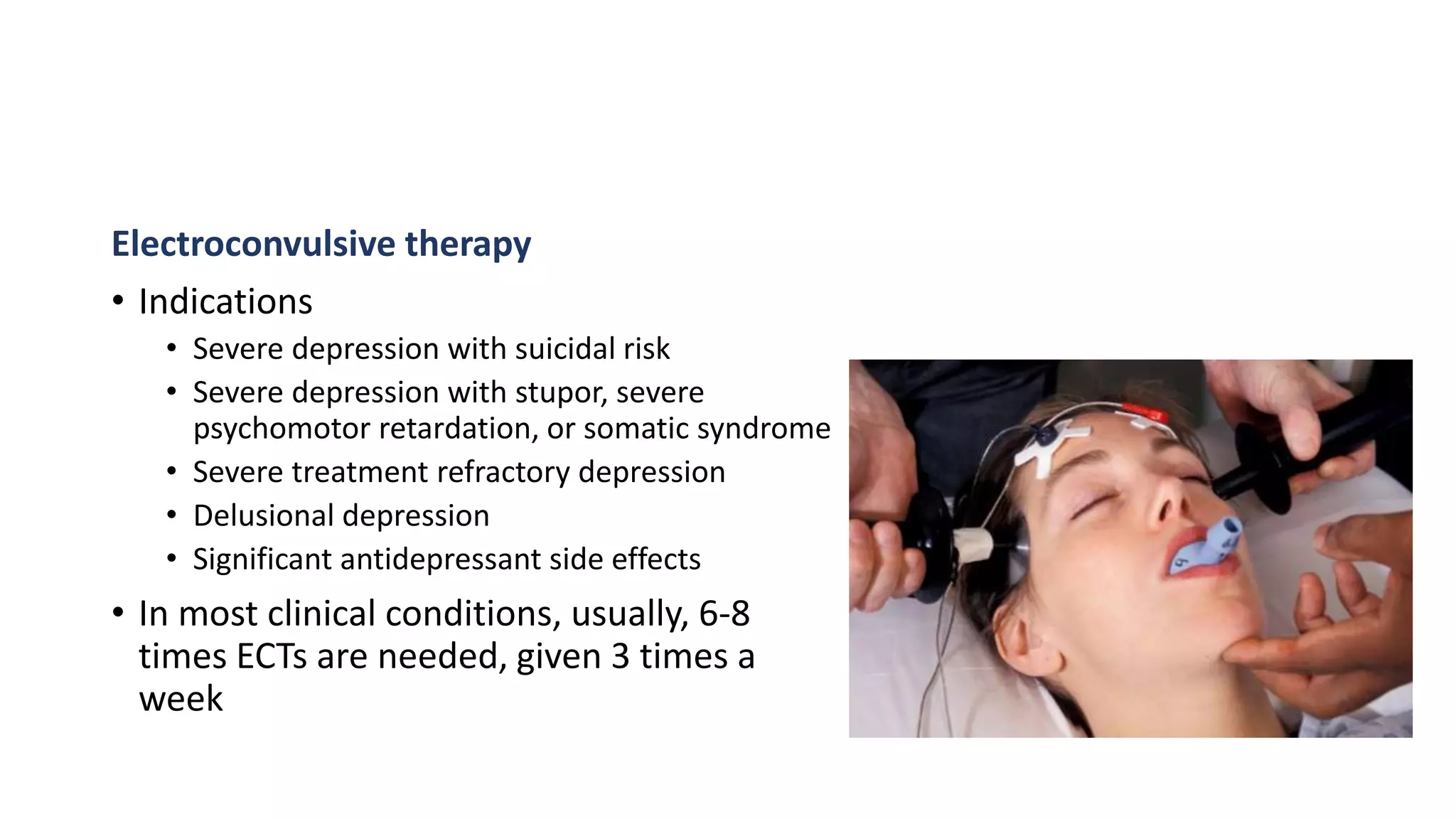
Electroconvulsive therapy
• Indications
• Severe depression with suicidal risk
• Severe depression with stupor, severe
psychomotor retardation, or somatic syndrome
• Severe treatment refractory depression
• Delusional depression
• Significant antidepressant side effects
• In most clinical conditions, usually, 6-8
times ECTs are needed, given 3 times a
week
Lithium
• Drug of choice for tx of manic episode
(acute phase) as well as for prevention of
further episodes in BPD
• 900-1500mg of lithium carbonate/day
• Need to be closely monitored by repeated
blood levels, as the difference between the
therapeutic and lethal blood levels is not
very wide (narrow therapeutic index)
• Therapeutic blood lithium = 0.8-1.2mEq/L
• Prophylactic blood lithium = 0.6-1.2mEq/L
• Blood lithium level of >2.0mEq/L is often asst. with toxicity
• A level >2.5-3.0 mEq/L may be lethal
• The common acute toxic symptoms are neurological
• The common chronic side effects are nephrological and endocrinal
(usually hypothuroidism)
• Most important investigations before starting lithium include
complete GPE, CBC, ECG, urine R/E, RFT, TFT
Antipsychotics
• Important adjunct in the tx of mood disorder
• Commonly used drugs:
• Risperidone
• Olanzapine
• Clonazepine
• Quetiapine*
• Haloperidol
• Aripiprazole*
*safe from metabolic syndrome
agranulocytosis
Other Mood Stabilizers
• Sodium valproate (1000-3000mg/day)
• Carbamazepine (600-1600mg/day)
• Benzodiazepines (Lorazepam/clonazepam) as adjuvants
• Lamotrigine
• T3 and T4 as adjuncts
Psychosocial treatment
• Cognitive behavior therapy
• Interpersonal therapy
• Psychoanalytic psychotherapy
• Behaviour therapy
• Group therapy
• Family & marital therapy
“And do not
kill yourselves.
Surely, Allah is
Most Merciful
to you”
[An-Nisa:29]

MOOD DISORDERS

  • 1.
    MOOD BY : NURHANISAH BINTI ZAINOREN DISORDERS
  • 2.
    EMOTIONS CAN BEDESCRIBED AS TWO MAIN TYPES
  • 3.
    MOOD A sustained andpervasive emotional attitude which colours the whole psychic life
  • 4.
    AFFECT A short-lived emotionalresponse to an idea or an event (what people observe)
  • 5.
  • 6.
    Classification of mooddisorders: 1. Manic episode 2. Depressive episode 3. Bipolar mood (affective) disorder 4. Recurrent depressive disorder 5. Persistent mood disorder 6. Other mood disorders
  • 7.
  • 8.
    • Life-time risk:0.8-1.0% • Tends to occur in episodes lasting usually 3-4 months  followed by complete clinical recovery  future episodes (manic/depressive/mixed)
  • 9.
    Characterised by thefollowing features : Elevated, expansive or irritable mood Psychomotor activity Speech and thought Goal-directed activity Other features Absence of underlying organic cause (which should last for at least 1 week and cause disruption in occupational & social activities)
  • 10.
    The elevated moodcan pass through 4 stages: Euphoria (mild elevation of mood) an increased sense of psychological well-being and happiness Hypomania (stage I) Elation (mod elevation of mood) A feeling of confidence and enjoyment, increase in psychomotor activity Mania (stage II) Exaltation (sev elevation of mood) Intense elation with delusion of grandeur Severe mania (stage III) Ecstasy (very sev elevation of mood) Intense sense of rapture or blistfullness Stupurous mania (stage III)
  • 11.
    Speech and thought •More talkative than usual • Describes thoughts racing in mind • Develops pressure of speech • Uses playful language (joking/teasing) • Speaks loudly • Flight of ideas • Delusion of grandeur • Delusion of persecution • Hallucinations, often with religious content Since these psychotic symptoms are in keeping with the elevated mood state, these are called mood-congruent psychotic features
  • 12.
    Goal-directed activity Unusually alert,trying to do many things at one time
  • 13.
    •Hypomania •the ability tofunction becomes much better & marked increase in productivity and creativity
  • 14.
    Mania • Marked increasein activity with excessive planning • Marked increase in sociability even with previously unknown people • Poor judgement. Often involve in high risk activities such as reckless driving, distributing money to strangers • Usually dressed up in gaudy and flamboyant clothes
  • 15.
    Other features: • Decreasedneed of sleep • Increased appetite  later decreased food intake d/t overactivity • Absent insight into illness • Psychotic features  delusions, hallucinations (mood incongruent psychotic features)
  • 16.
  • 17.
    • Life timerisk of common depression: • 8-12% (in males) • 20-26% (in females) • Life time risk of major depression/ depressive episode is about 8%
  • 18.
    Characterised by thefollowing features : Depressed mood Depressive ideation / cognition Psychomotor activity Physical symptoms Biological functions Psychotic features Suicide Absence of underlying organic cause (which should last for at least 2 weeks for a diagnosis to be made)
  • 19.
    Depressed mood • Sadnessof mood and loss of interest/pleasure in almost all activities (pervasive sadness) • Present throughout the day (persistent sadness) • Varies from day to day and often unresponsive to the environmental stimuli • Results in social w/drawal, decreased ability to function in occupational and interpersonal areas and decreased involvement in previously pleasurable activities • Severe depression  complete anhedonia (inability to experience pleasure)
  • 20.
    Depressive ideation/cognition Sadness ofmood usually associated with pessimism, which can result in 3 common types of depressive ideas: • Hopelessness (no hope in future) • Helplessness (no help is possible now) • Worthlessness (feeling of inadequacy/inferiority)
  • 21.
    Depressive ideation/cognition • Otherfeatures: • Difficulty in thinking/concentrating • Indecisiveness • Slowed thinking • Poor memory • Lack of initiative and energy • Thoughts of death • Suicidal ideas • Delusion of nihilism “My world is coming to an end” “My intestines have rotted away”
  • 22.
    Psychomotor activity • Youngpatient (<40 years)  retardation is common • Slowed thinking and activity, decreased energy, monotonous voice. • Severe  stuporous (depressive stupor) • Older patients  agitation is common • Marked anxiety, restlessness (inability to sit still, hand-wriggling) • Subjective feeling of unease • Anxiety is a frequent accompaniment of depression • Irritability (easy annoyance and frustration in day to day activities)
  • 23.
    Physical symptoms • Multiplephysical symptoms (general aches and pain) • Complain of reduced energy and easy fatigability • Consult a physician instead of psychiatrist
  • 24.
    Biological functions • Insomnia(or sometimes increased sleep) • Loss of appetite and weight (or sometimes hyperphagia and weight gain) • Loss of sexual drive • Melancholia (somatic syndrome in ICD-10-DCR)  signifies higher severity and more biological nature of disturbance
  • 25.
    Psychotic features • 15-20%of depressed patients have psychotic features such as delusions, hallucinations, grossly inappropriate behavior or stupor • Mood-congruent psychotic features  nihilistic delusions, delusion of guilt, delusions of poverty, stupor • Mood-incongruent psychotic features  delusions of control
  • 26.
    Suicide • Should alwaysbe taken seriously • Factors increase the risk of suicide • Presence of marked hopelessness • Males; age>40; unmarried; divorced/widowed • Written/verbal communication of suicidal intention/plan • Early stages of depression • Recovering of depression • Period of 3 months from recovery
  • 27.
  • 28.
    Characterized by recurrentepisodes of mania and depression in the same patient at different times
  • 29.
    • Earlier knownas manic depressive psychosis (MDP) • This episode can occur in any sequence. • The current episode in bipolar mood disorder is specified as one of the following (ICD- 10): • Hypomanic • Manic without psychotic symptoms • Manic with psychotic symptoms • Mild/mod depression • Severe depression, without psychotic symptoms • Severe depression, with psychotic symptoms • Mixed • In remission • Further divided into bipolar I & bipolar II disorders • Bipolar I: Charact. by episodes of severe mania and severe depression • Bipolar II: Charact. by episodes of hypomania and severe depression
  • 30.
  • 31.
    • Characterized byrecurrent (at least 2) depressive episodes (unipolar depression) • The current episode in recurrent depressive disorder is specified as one of the following: • Mild • Moderate • Severe, without psychotic symptoms • Severe, with psychotic symptoms • In remission
  • 32.
  • 33.
    Characterized by persistentmood symptoms which last for >2 years (1 year in children) But not severe enough to be labelled as even hypomanic or mild depressive episode • Persistent mild depression  dysthymia • Persistent instability of mood between mild depression and mild elation  cyclothymia
  • 34.
  • 35.
    • Includes thediagnosis of mixed affective episode • Frequently missed diagnosis clinically • Full clinical picture of depression and mania is present either at the same time intermixed or alternates rapidly with each other (rapid cycling), without a normal intervening period of euthymia
  • 36.
  • 37.
    • Bipolar mooddisorder has an earlier age of onset (3rd decade) than recurrent depressive (unipolar) disorder. • Unipolar depression is common in two age groups: late third decade & 5th – 6th decade • An average manic episode lasts for 3-4 months while a depressive episode lasts from 4-6 months • Unipolar depression usually lasts longer than bipolar depression • With rapid institution of treatment , the major symptoms of mania are controlled within 2 weeks and of depression within 6-8 weeks
  • 38.
    • Rapid cyclers patients with bipolar mood disorder of more than 4 episodes/year • Ultra-rapid cycling  condition when phase of mania and depression alternate very rapidly (in matter of hours/days)
  • 39.
    Prognosis is betterthan schizophrenia Good prognostic factor Poor prognostic factor Acute/abrupt in onset Co-morbid medical disorder, personality disorder or alcohol dependance Typical and clinical features Double depression (acute superimposed on chronic or dysthmia) Severe depression Catastrophic stress or chronic ongoing stress Well-adjusted premorbid personality Unfavourable early environment Good response to treatment Marked hypochondriacal features, or mood incongruent psychotic features Poor drug compliance
  • 40.
  • 41.
    • Biological theories •Genetic hypothesis • Biochemical theories • Neuroendocrine theories • Sleep studies • Brain imaging • Psychosocial theories • Psychoanalytic theories • Cognitive and behavioral theories • Stress (stressful life events)
  • 42.
  • 43.
    • 1st step:exclude a disorder with known organic cause, e.g. organic (especially-drug induced) mood disorders and dementia • 2nd step: to rule out a possibility of acute and transient psychotic disorders, schizo-affective disorder and schizophrenia • 3rd step: exclude possibility of other non-organic psychoses such as delusional disorders • 4th step: exclude possibility of adjustment disorder with depressed mood, gen.anxiety disorder, normal grief reaction, obsessive compulsive disorder (with or without secondary reaction) • Important to look for comorbid medical and/or psychiatric disorders (anxiety, alcohol or drug misuse, personality disorder)
  • 44.
  • 45.
    Somatic treatment Antidepressants • Txof choice for a vast majority of depressive episodes • It may take upto 3 weeks before any appreciable response may be noticed • Before stopping/changing a drug, the particular drug should be given in a therapeutically adequate dose for at least 6 weeks
  • 46.
    • Tricyclic antidepressants(TCAs) : Imipramine (75-150mg upto 300mg) • Amitryptyline is NOT USED due to dry mouth, blurry vision, post. HTN • Newer antidepressants • Selective serotonin reuptake inhibitors (SSRIs)  fluoxetine, sertraline, citalopram • Serotonin NE reuptake inhibitors (SNRIs)  venlafaxine, duloxetine • Mirtazapine
  • 47.
    Electroconvulsive therapy • Indications •Severe depression with suicidal risk • Severe depression with stupor, severe psychomotor retardation, or somatic syndrome • Severe treatment refractory depression • Delusional depression • Significant antidepressant side effects • In most clinical conditions, usually, 6-8 times ECTs are needed, given 3 times a week
  • 48.
    Lithium • Drug ofchoice for tx of manic episode (acute phase) as well as for prevention of further episodes in BPD • 900-1500mg of lithium carbonate/day • Need to be closely monitored by repeated blood levels, as the difference between the therapeutic and lethal blood levels is not very wide (narrow therapeutic index) • Therapeutic blood lithium = 0.8-1.2mEq/L • Prophylactic blood lithium = 0.6-1.2mEq/L
  • 49.
    • Blood lithiumlevel of >2.0mEq/L is often asst. with toxicity • A level >2.5-3.0 mEq/L may be lethal • The common acute toxic symptoms are neurological • The common chronic side effects are nephrological and endocrinal (usually hypothuroidism) • Most important investigations before starting lithium include complete GPE, CBC, ECG, urine R/E, RFT, TFT
  • 50.
    Antipsychotics • Important adjunctin the tx of mood disorder • Commonly used drugs: • Risperidone • Olanzapine • Clonazepine • Quetiapine* • Haloperidol • Aripiprazole* *safe from metabolic syndrome agranulocytosis
  • 51.
    Other Mood Stabilizers •Sodium valproate (1000-3000mg/day) • Carbamazepine (600-1600mg/day) • Benzodiazepines (Lorazepam/clonazepam) as adjuvants • Lamotrigine • T3 and T4 as adjuncts
  • 52.
    Psychosocial treatment • Cognitivebehavior therapy • Interpersonal therapy • Psychoanalytic psychotherapy • Behaviour therapy • Group therapy • Family & marital therapy
  • 53.
    “And do not killyourselves. Surely, Allah is Most Merciful to you” [An-Nisa:29]

Editor's Notes

  • #12 Flight of ideas- rapidly produced speech with abrupt shifts from topic to topic
  • #23 Irritability (easy annoyance and frustration in day to day activities) – example, unusual anger at the noise made by children in the house
  • #26 Mood-congruent psychotic features (nihilistic delusions, delusion of guilt, delusions of poverty, stupor) which are understandable in the light of depressed mood Mood-incongruent psychotic features (delusions of control) which are not directly related to depressive mood
  • #27 Mood-congruent psychotic features (nihilistic delusions, delusion of guilt, delusions of poverty, stupor) which are understandable in the light of depressed mood Mood-incongruent psychotic features (delusions of control) which are not directly related to depressive mood