Preoperative
Learning objectives
• To be able to organize preoperative care and the
operating list
• To understand surgical, medical, and anaesthetic
aspects of assessment
• How to optimize the patient’s condition
• How to take consent
• How to organize an operating list
The preoperative period runs from the time
the patient is admitted to the hospital or
surgicenter to the time that the surgery begins.
4
DEFINITION
PRE-OPERATIVE PLAN
• Gathering & recording concisely all relevant
information
• Planning to minimise risk & maximise benefit for
the patient
• Prepared for adverse events & how to deal with
them
• Communicate with patient & all members of the
team
PATIENT ASSESSMENT
o History taking
o Examination
o Investigations
o Preoperative treatment
o Documentation
o Communication
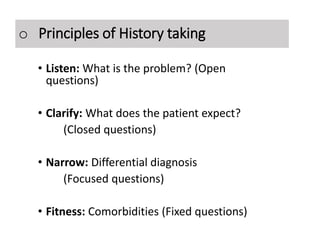
o Principles of History taking
• Listen: What is the problem? (Open
questions)
• Clarify: What does the patient expect?
(Closed questions)
• Narrow: Differential diagnosis
(Focused questions)
• Fitness: Comorbidities (Fixed questions)
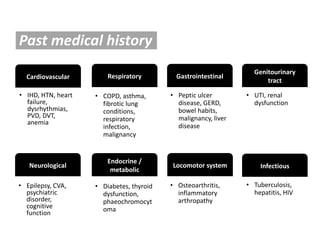
• IHD, HTN, heart
failure,
dysrhythmias,
PVD, DVT,
anemia
Cardiovascular Respiratory
• COPD, asthma,
fibrotic lung
conditions,
respiratory
infection,
malignancy
Gastrointestinal
• Peptic ulcer
disease, GERD,
bowel habits,
malignancy, liver
disease
Genitourinary
tract
• UTI, renal
dysfunction
Neurological
• Epilepsy, CVA,
psychiatric
disorder,
cognitive
function
Endocrine /
metabolic
• Diabetes, thyroid
dysfunction,
phaeochromocyt
oma
Locomotor system
• Osteoarthritis,
inflammatory
arthropathy
Infectious
• Tuberculosis,
hepatitis, HIV
Past medical history
Examination
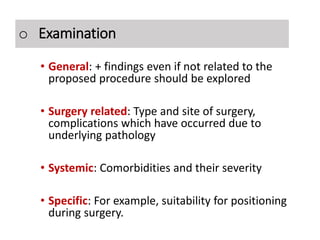
• General: + findings even if not related to the
proposed procedure should be explored
• Surgery related: Type and site of surgery,
complications which have occurred due to
underlying pathology
• Systemic: Comorbidities and their severity
• Specific: For example, suitability for positioning
during surgery.
o Examination
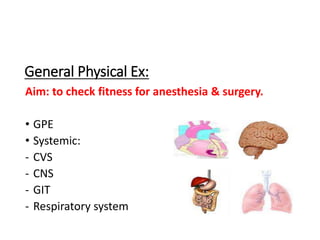
General Physical Ex:
Aim: to check fitness for anesthesia & surgery.
• GPE
• Systemic:
- CVS
- CNS
- GIT
- Respiratory system
Aim: to confirm previous findings & diagnosis, to
determine severity & to gauge extent.
• E.g. in inguinal hernia confirm it’s inguinal not
femoral, reducible or not & whether there are any
signs of bowel obstruction.
Specific Surgical Ex:
Aim: to evaluates the presence & severity of other
problems.
• E.g. Diabetic patient undergoing surgery need
careful examination for sepsis , neuropathy or
microvascular disease
Specific Medical Ex:
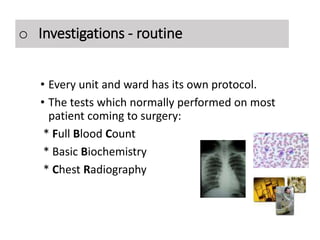
Investigations – Routine
• Every unit and ward has its own protocol.
• The tests which normally performed on most
patient coming to surgery:
* Full Blood Count
* Basic Biochemistry
* Chest Radiography
o Investigations - routine
Investigations – Targeted tests
• Hematology : to exclude anemia, for platelets count
& to assess the amount of blood may be needed
during or after operation.
• Urea, Creatinine & Electrolytes: state of dehydration
& renal insufficiency.
• Liver Function Tests: Alb & Protein guide to
nutritional status & shows any clotting problems.
o Investigations – targeted tests
Investigations – Others
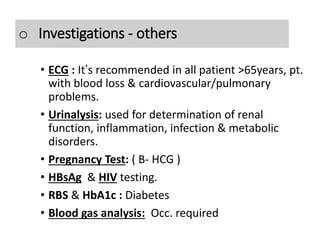
• ECG : It’s recommended in all patient >65years, pt.
with blood loss & cardiovascular/pulmonary
problems.
• Urinalysis: used for determination of renal
function, inflammation, infection & metabolic
disorders.
• Pregnancy Test: ( B- HCG )
• HBsAg & HIV testing.
• RBS & HbA1c : Diabetes
• Blood gas analysis: Occ. required
o Investigations - others
PREOPERATIVE
PROBLEMS
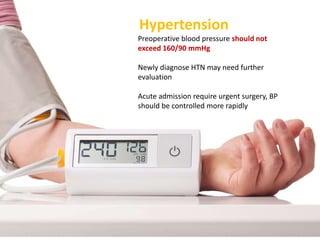
Hypertension
Preoperative blood pressure should not
exceed 160/90 mmHg
Newly diagnose HTN may need further
evaluation
Acute admission require urgent surgery, BP
should be controlled more rapidly
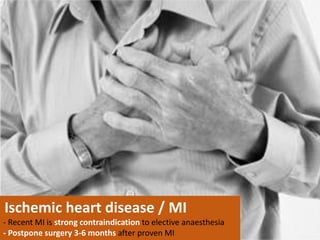
Ischemic heart disease / MI
- Recent MI is strong contraindication to elective anaesthesia
- Postpone surgery 3-6 months after proven MI
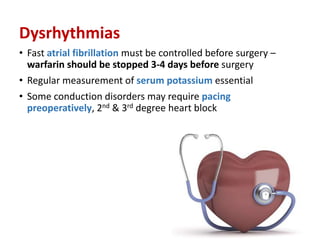
Dysrhythmias
• Fast atrial fibrillation must be controlled before surgery –
warfarin should be stopped 3-4 days before surgery
• Regular measurement of serum potassium essential
• Some conduction disorders may require pacing
preoperatively, 2nd & 3rd degree heart block
Anemia & blood
transfusion
• Preoperative transfusion
considered if Hb < 8g dl
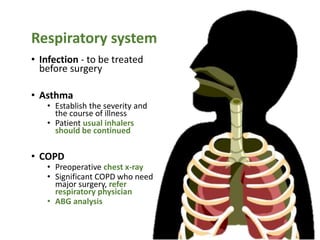
Respiratory system
• Infection - to be treated
before surgery
• Asthma
• Establish the severity and
the course of illness
• Patient usual inhalers
should be continued
• COPD
• Preoperative chest x-ray
• Significant COPD who need
major surgery, refer
respiratory physician
• ABG analysis
Gastrointestinal
disease
• Nil by mouth
before surgery:
- solid (6 hours)
- fluids (2 hours)
Regurgitation risk
• H2 receptor
blockade/PPI, NG
tube to empty
distended stomach
Jaundice
• Secondary
complications:
Impaired clotting,
risk of renal failure
• Prophylactic
antibiotics needed
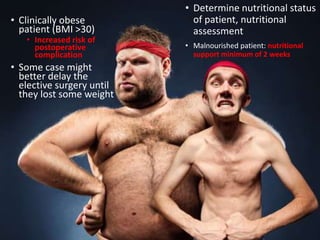
• Determine nutritional status
of patient, nutritional
assessment
• Malnourished patient: nutritional
support minimum of 2 weeks
• Clinically obese
patient (BMI >30)
• Increased risk of
postoperative
complication
• Some case might
better delay the
elective surgery until
they lost some weight
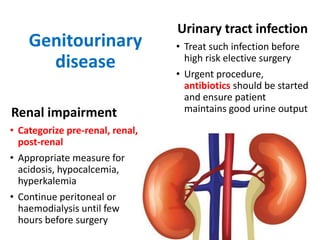
Genitourinary
disease
Renal impairment
• Categorize pre-renal, renal,
post-renal
• Appropriate measure for
acidosis, hypocalcemia,
hyperkalemia
• Continue peritoneal or
haemodialysis until few
hours before surgery
Urinary tract infection
• Treat such infection before
high risk elective surgery
• Urgent procedure,
antibiotics should be started
and ensure patient
maintains good urine output
Metabolic disorder
Diabetes
• Check HbA1c level
• Preoperative risk-reduction strategies (lipid-
lowering agent, diabetic control)
• Minor surgery in non-insulin dependent diabetic
– omitting morning dose, listing early surgery,
restarting treatment
• Significant surgery in insulin dependent –
intravenous insulin infusion require
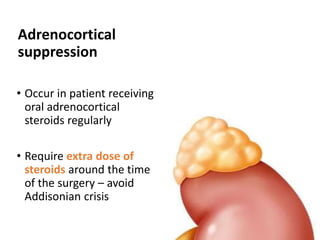
Adrenocortical
suppression
• Occur in patient receiving
oral adrenocortical
steroids regularly
• Require extra dose of
steroids around the time
of the surgery – avoid
Addisonian crisis
Coagulation disorder
Thrombophilia
• Identify the risk factor for thrombosis
 Age
 Obesity
 Trauma or surgery (abdomen, pelvis, lower
limb)
 Reduced mobility > 3days
 Pregnancy
 Drugs ; estrogen, HRT
 Family history of thrombosis
• Prophylaxis in perioperative period
(mechanical/pharmacological)
• HRT should be stopped 6 weeks prior
to surgery
Other disorders
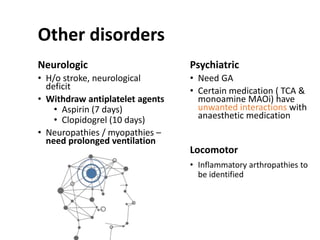
Neurologic
• H/o stroke, neurological
deficit
• Withdraw antiplatelet agents
• Aspirin (7 days)
• Clopidogrel (10 days)
• Neuropathies / myopathies –
need prolonged ventilation
Psychiatric
• Need GA
• Certain medication ( TCA &
monoamine MAOi) have
unwanted interactions with
anaesthetic medication
Locomotor
• Inflammatory arthropathies to
be identified
MANAGEMENT PLAN – KEY POINTS
Provide all information necessary for the
patient to make an informed decision
Use common language
Discuss the options rather than telling the
patient what will be done
Give the patient time to think things over
Encourage to discuss things – trusted person
RISK ASSESSMENT AND
CONSENT
• All life- or limb-threatening complications and all
complications with an incidence of 1% or > should be
discussed with the patient
• Risks: related to comorbidities, anaesthesia, and surgery
• Explain: advantages, side effects, prognosis
• Language: simple, use daily life comparisons to explain risks
• Consents: valid consent is necessary except in life-saving
circumstances
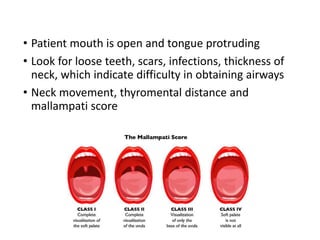
• Patient mouth is open and tongue protruding
• Look for loose teeth, scars, infections, thickness of
neck, which indicate difficulty in obtaining airways
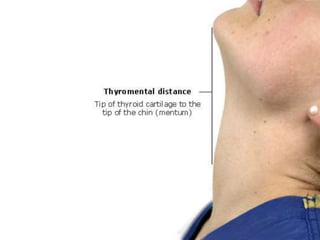
• Neck movement, thyromental distance and
mallampati score
Taking a comprehensive consent
Lead in Introduce yourself and identify the patient
Explore How much does the patient know
Diagnosis Why the operation is being proposed
Treatment Explain wether the treatment proposed is in accordance to protocols
Options Discuss all the options including that of doing nothing
Results Explain likely outcome (pain, mobility, work, diet, and return to normal
activities)
Eventualities For example, the needing to remove the testicle in a hernia operation
Adverse events Myocardial infarction, stroke, embolus, bleeding and specific damage
Sound mind Ask if they have understood
Open question Check if further clarification is needed
Notes Document everything discussed and agreed
(acronym: LED TO REASON)
ARRANGING THE THEATRE LIST
• Date, place, and time of operation should be matched
with availability of the personnel.
• Appropriate equipment and instruments should be made
available.
• Operating list should be distributed as early as possible to
all staff who are involved.
• Prioritized patients.
• Children and diabetic patients
• Life- and limb- threatening surgery
• Cancer patients
REFERENCES
• Bailey and Love’s Short Practice of Surgery, 26th
Edition
THANK YOU

Preoperative Preparations

  • 1.
  • 3.
    Learning objectives • Tobe able to organize preoperative care and the operating list • To understand surgical, medical, and anaesthetic aspects of assessment • How to optimize the patient’s condition • How to take consent • How to organize an operating list
  • 4.
    The preoperative periodruns from the time the patient is admitted to the hospital or surgicenter to the time that the surgery begins. 4 DEFINITION
  • 5.
    PRE-OPERATIVE PLAN • Gathering& recording concisely all relevant information • Planning to minimise risk & maximise benefit for the patient • Prepared for adverse events & how to deal with them • Communicate with patient & all members of the team
  • 6.
    PATIENT ASSESSMENT o Historytaking o Examination o Investigations o Preoperative treatment o Documentation o Communication
  • 7.
    o Principles ofHistory taking • Listen: What is the problem? (Open questions) • Clarify: What does the patient expect? (Closed questions) • Narrow: Differential diagnosis (Focused questions) • Fitness: Comorbidities (Fixed questions)
  • 8.
    • IHD, HTN,heart failure, dysrhythmias, PVD, DVT, anemia Cardiovascular Respiratory • COPD, asthma, fibrotic lung conditions, respiratory infection, malignancy Gastrointestinal • Peptic ulcer disease, GERD, bowel habits, malignancy, liver disease Genitourinary tract • UTI, renal dysfunction Neurological • Epilepsy, CVA, psychiatric disorder, cognitive function Endocrine / metabolic • Diabetes, thyroid dysfunction, phaeochromocyt oma Locomotor system • Osteoarthritis, inflammatory arthropathy Infectious • Tuberculosis, hepatitis, HIV Past medical history
  • 9.
    Examination • General: +findings even if not related to the proposed procedure should be explored • Surgery related: Type and site of surgery, complications which have occurred due to underlying pathology • Systemic: Comorbidities and their severity • Specific: For example, suitability for positioning during surgery. o Examination
  • 10.
    General Physical Ex: Aim:to check fitness for anesthesia & surgery. • GPE • Systemic: - CVS - CNS - GIT - Respiratory system
  • 11.
    Aim: to confirmprevious findings & diagnosis, to determine severity & to gauge extent. • E.g. in inguinal hernia confirm it’s inguinal not femoral, reducible or not & whether there are any signs of bowel obstruction. Specific Surgical Ex:
  • 12.
    Aim: to evaluatesthe presence & severity of other problems. • E.g. Diabetic patient undergoing surgery need careful examination for sepsis , neuropathy or microvascular disease Specific Medical Ex:
  • 13.
    Investigations – Routine •Every unit and ward has its own protocol. • The tests which normally performed on most patient coming to surgery: * Full Blood Count * Basic Biochemistry * Chest Radiography o Investigations - routine
  • 14.
    Investigations – Targetedtests • Hematology : to exclude anemia, for platelets count & to assess the amount of blood may be needed during or after operation. • Urea, Creatinine & Electrolytes: state of dehydration & renal insufficiency. • Liver Function Tests: Alb & Protein guide to nutritional status & shows any clotting problems. o Investigations – targeted tests
  • 15.
    Investigations – Others •ECG : It’s recommended in all patient >65years, pt. with blood loss & cardiovascular/pulmonary problems. • Urinalysis: used for determination of renal function, inflammation, infection & metabolic disorders. • Pregnancy Test: ( B- HCG ) • HBsAg & HIV testing. • RBS & HbA1c : Diabetes • Blood gas analysis: Occ. required o Investigations - others
  • 16.
  • 17.
    Hypertension Preoperative blood pressureshould not exceed 160/90 mmHg Newly diagnose HTN may need further evaluation Acute admission require urgent surgery, BP should be controlled more rapidly
  • 18.
    Ischemic heart disease/ MI - Recent MI is strong contraindication to elective anaesthesia - Postpone surgery 3-6 months after proven MI
  • 19.
    Dysrhythmias • Fast atrialfibrillation must be controlled before surgery – warfarin should be stopped 3-4 days before surgery • Regular measurement of serum potassium essential • Some conduction disorders may require pacing preoperatively, 2nd & 3rd degree heart block
  • 20.
    Anemia & blood transfusion •Preoperative transfusion considered if Hb < 8g dl
  • 21.
    Respiratory system • Infection- to be treated before surgery • Asthma • Establish the severity and the course of illness • Patient usual inhalers should be continued • COPD • Preoperative chest x-ray • Significant COPD who need major surgery, refer respiratory physician • ABG analysis
  • 22.
    Gastrointestinal disease • Nil bymouth before surgery: - solid (6 hours) - fluids (2 hours) Regurgitation risk • H2 receptor blockade/PPI, NG tube to empty distended stomach Jaundice • Secondary complications: Impaired clotting, risk of renal failure • Prophylactic antibiotics needed
  • 23.
    • Determine nutritionalstatus of patient, nutritional assessment • Malnourished patient: nutritional support minimum of 2 weeks • Clinically obese patient (BMI >30) • Increased risk of postoperative complication • Some case might better delay the elective surgery until they lost some weight
  • 24.
    Genitourinary disease Renal impairment • Categorizepre-renal, renal, post-renal • Appropriate measure for acidosis, hypocalcemia, hyperkalemia • Continue peritoneal or haemodialysis until few hours before surgery Urinary tract infection • Treat such infection before high risk elective surgery • Urgent procedure, antibiotics should be started and ensure patient maintains good urine output
  • 25.
    Metabolic disorder Diabetes • CheckHbA1c level • Preoperative risk-reduction strategies (lipid- lowering agent, diabetic control) • Minor surgery in non-insulin dependent diabetic – omitting morning dose, listing early surgery, restarting treatment • Significant surgery in insulin dependent – intravenous insulin infusion require
  • 26.
    Adrenocortical suppression • Occur inpatient receiving oral adrenocortical steroids regularly • Require extra dose of steroids around the time of the surgery – avoid Addisonian crisis
  • 27.
    Coagulation disorder Thrombophilia • Identifythe risk factor for thrombosis  Age  Obesity  Trauma or surgery (abdomen, pelvis, lower limb)  Reduced mobility > 3days  Pregnancy  Drugs ; estrogen, HRT  Family history of thrombosis • Prophylaxis in perioperative period (mechanical/pharmacological) • HRT should be stopped 6 weeks prior to surgery
  • 28.
    Other disorders Neurologic • H/ostroke, neurological deficit • Withdraw antiplatelet agents • Aspirin (7 days) • Clopidogrel (10 days) • Neuropathies / myopathies – need prolonged ventilation Psychiatric • Need GA • Certain medication ( TCA & monoamine MAOi) have unwanted interactions with anaesthetic medication Locomotor • Inflammatory arthropathies to be identified
  • 29.
    MANAGEMENT PLAN –KEY POINTS Provide all information necessary for the patient to make an informed decision Use common language Discuss the options rather than telling the patient what will be done Give the patient time to think things over Encourage to discuss things – trusted person
  • 30.
    RISK ASSESSMENT AND CONSENT •All life- or limb-threatening complications and all complications with an incidence of 1% or > should be discussed with the patient • Risks: related to comorbidities, anaesthesia, and surgery • Explain: advantages, side effects, prognosis • Language: simple, use daily life comparisons to explain risks • Consents: valid consent is necessary except in life-saving circumstances
  • 31.
    • Patient mouthis open and tongue protruding • Look for loose teeth, scars, infections, thickness of neck, which indicate difficulty in obtaining airways • Neck movement, thyromental distance and mallampati score
  • 33.
    Taking a comprehensiveconsent Lead in Introduce yourself and identify the patient Explore How much does the patient know Diagnosis Why the operation is being proposed Treatment Explain wether the treatment proposed is in accordance to protocols Options Discuss all the options including that of doing nothing Results Explain likely outcome (pain, mobility, work, diet, and return to normal activities) Eventualities For example, the needing to remove the testicle in a hernia operation Adverse events Myocardial infarction, stroke, embolus, bleeding and specific damage Sound mind Ask if they have understood Open question Check if further clarification is needed Notes Document everything discussed and agreed (acronym: LED TO REASON)
  • 34.
    ARRANGING THE THEATRELIST • Date, place, and time of operation should be matched with availability of the personnel. • Appropriate equipment and instruments should be made available. • Operating list should be distributed as early as possible to all staff who are involved. • Prioritized patients. • Children and diabetic patients • Life- and limb- threatening surgery • Cancer patients
  • 35.
    REFERENCES • Bailey andLove’s Short Practice of Surgery, 26th Edition
  • 36.

Editor's Notes

  • #5 Talking Points Shock is simply defined as inadequate tissue perfusion. It is also often referred to as hypoperfusion. During a shock state, inadequate amounts of oxygen and glucose are delivered to cells. In other words, the amount of oxygen delivered to the cells is less than the amount required for normal metabolism. In addition, an impaired elimination of carbon dioxide and other waste products occurs. Organs of vital importance, brain, heart, and kidneys can suffer irreversible damage, eventually leading to death. Tissue ischaemic sensitivity: - heart, brain, lung: 4-6 min.- GI tract, liver, kidney: 45-60 min.- muscle, skin: 2-3 hours
  • #25 Nephrotoxic (NSAIDS, aminoglycoside)
  • #31 Valid consent implies that it is given voluntarily by a competent and informed person who is not under duress