Benha University Hospital,
Egypt
ABOUBAKR ELNASHAR
DILATATION & CURETTAGE
Indications
A. Dilatation of the cervix
1.A preliminary to curettage
2.Prior to hysteroscopy
3.As a step of other operations e.g. cervical
amputation or Fothergill repair
ABOUBAKR ELNASHAR
4. Insertion of IUD in stenotic cervix
5. Introduction of intracervical or intrauterine radium
6. Cervical stenosis
7. Spasmodic dysmenorrhea
8. Drainage of pyometra or haematometra
ABOUBAKR ELNASHAR
B. Curettage of the uterine cavity
1.Diagnosis & treatment of abnormal uterine
bleeding
2.Diagnosis of endometrial cancer
3.Diagnosis & treatment of endometrial hyperplasia,
endometrial polypi & submucous myoma
4.To detect ovulation & its defects in infertility
5.Removal of IUCD
ABOUBAKR ELNASHAR
6. Fractional curettage
7. Endocervical curettage
8. In pregnancy:
Abortion: therapeutic, missed, incomplete,
inevitable, septic
Molar pregnancy
Postabortive or postpartum bleeding
ABOUBAKR ELNASHAR
Technique
1.Evacuate the bladder
2.Anesthesia
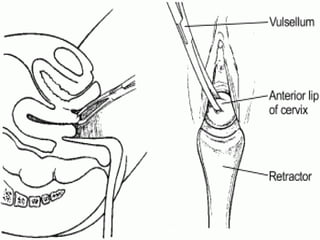
3.Vaginal speculum & grasp the cervix
4.Sounding
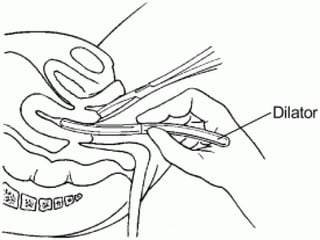
5.Dilate the cervix
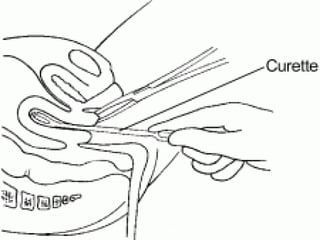
6.Curette
ABOUBAKR ELNASHAR
ABOUBAKR ELNASHAR
ABOUBAKR ELNASHAR
ABOUBAKR ELNASHAR
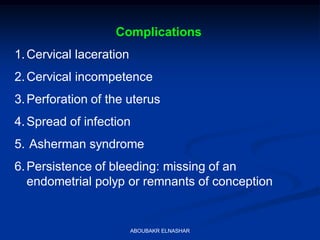
Complications
1.Cervical laceration
2.Cervical incompetence
3.Perforation of the uterus
4.Spread of infection
5. Asherman syndrome
6.Persistence of bleeding: missing of an
endometrial polyp or remnants of conception
ABOUBAKR ELNASHAR
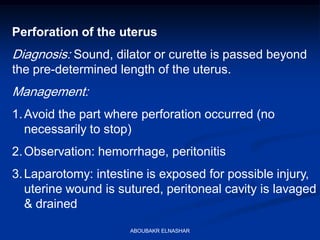
Perforation of the uterus
Diagnosis: Sound, dilator or curette is passed beyond
the pre-determined length of the uterus.
Management:
1.Avoid the part where perforation occurred (no
necessarily to stop)
2.Observation: hemorrhage, peritonitis
3.Laparotomy: intestine is exposed for possible injury,
uterine wound is sutured, peritoneal cavity is lavaged
& drained
ABOUBAKR ELNASHAR
ABOUBAKR ELNASHAR
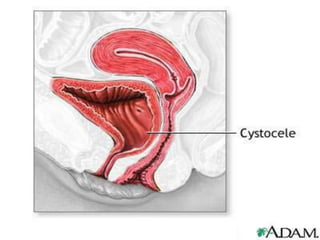
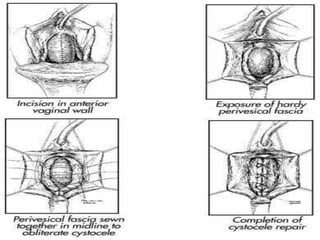
ANTERIOR COLPORRHAPHY
Indications: Cystocele
Steps: 1. Anterior vaginal wall incision
2. The anterior vaginal wall is separated from the
bladder & the bladder is pushed to its normal
position as a pelvic organ
3. Plication of the the pubovesical fascia beneath
the bladder to form a shelf
4. Redundant vaginal wall is removed
5. Vagina is closed in the midline
ABOUBAKR ELNASHAR
ABOUBAKR ELNASHAR
ABOUBAKR ELNASHAR
ABOUBAKR ELNASHAR
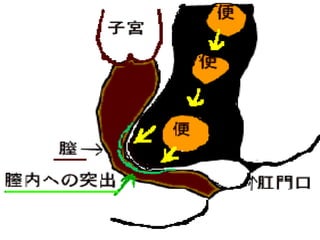
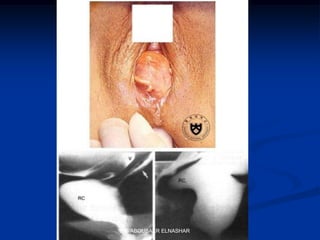
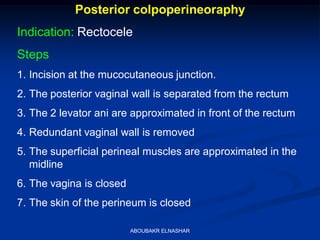
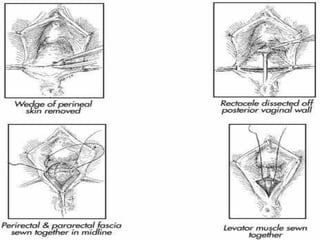
Posterior colpoperineoraphy
Indication: Rectocele
Steps
1. Incision at the mucocutaneous junction.
2. The posterior vaginal wall is separated from the rectum
3. The 2 levator ani are approximated in front of the rectum
4. Redundant vaginal wall is removed
5. The superficial perineal muscles are approximated in the
midline
6. The vagina is closed
7. The skin of the perineum is closed
ABOUBAKR ELNASHAR
ABOUBAKR ELNASHAR
FOTHERGILLS OPERATION
Indication
Combined vaginal & uterine prolapse with
supravaginal elongation of the cervix
Steps
1.Dilatation & curettage: Dilatation to cover the
cervical stump. Curettage to exclude uterine
pathology
2.Anterior colporrhaphy: repair cystocele
ABOUBAKR ELNASHAR
3. Amputation of the cervix: restore the normal
length of the cervix
4. Shortening & approximating of the
Mackenrodt ligaments in front of the cervix:
elevate the uterus & pull the cervix
posteriorly to correct the retroversion
5. Posterior colpoperineoraphy: repair
rectocele & to strengthen the lax pelvic floor
to prevent recurrence
ABOUBAKR ELNASHAR
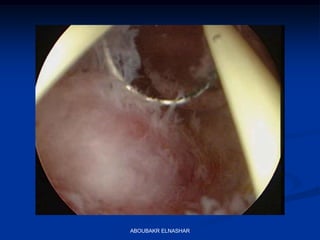
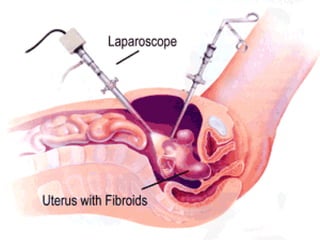
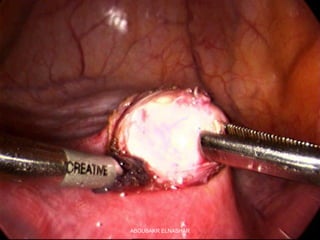
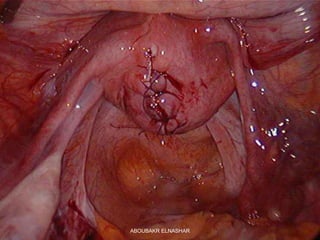
MYOMECTOMY
Indication
Symptomatizing patient who did not complete her
family
Types
1.Abdominal
2.Vaginal
3.Hysteroscopic: submucous <5cm
4.Laparoscopic: Pedunculated subserous
ABOUBAKR ELNASHAR
ABOUBAKR ELNASHAR
ABOUBAKR ELNASHAR
ABOUBAKR ELNASHAR
ABOUBAKR ELNASHAR
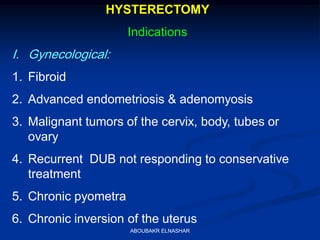
HYSTERECTOMY
Indications
I. Gynecological:
1. Fibroid
2. Advanced endometriosis & adenomyosis
3. Malignant tumors of the cervix, body, tubes or
ovary
4. Recurrent DUB not responding to conservative
treatment
5. Chronic pyometra
6. Chronic inversion of the uterus
ABOUBAKR ELNASHAR
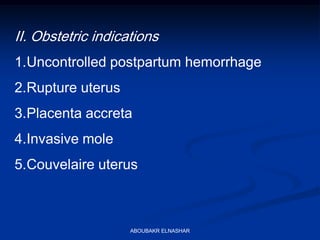
II. Obstetric indications
1.Uncontrolled postpartum hemorrhage
2.Rupture uterus
3.Placenta accreta
4.Invasive mole
5.Couvelaire uterus
ABOUBAKR ELNASHAR
Types
1.Abdominal
2.Vaginal
3.Laparoscopic
ABOUBAKR ELNASHAR
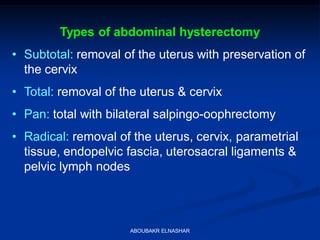
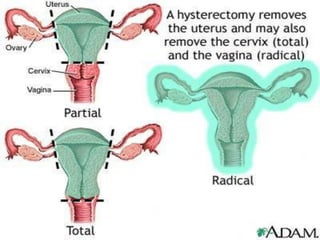
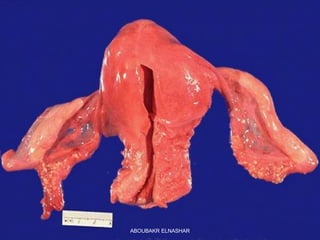
Types of abdominal hysterectomy
• Subtotal: removal of the uterus with preservation of
the cervix
• Total: removal of the uterus & cervix
• Pan: total with bilateral salpingo-oophrectomy
• Radical: removal of the uterus, cervix, parametrial
tissue, endopelvic fascia, uterosacral ligaments &
pelvic lymph nodes
ABOUBAKR ELNASHAR
ABOUBAKR ELNASHAR
ABOUBAKR ELNASHAR
• Cesarean hysterectomy:
• removal of the uterus after C.S e.g. atonic postpartum
hemorhage or placenta accreta.
• Hysterectomy-en-toto: Removal of the uterus with a
contained dead fetus without opening the uterus to
decrease blood loss e.g. couvelaire uterus
ABOUBAKR ELNASHAR
Types
1. Extrafacial:
removal of the uterus with its fascial layer. It is the
operation usually performed
2. Intrafascial:
The outer (endopelvic) fascia is left attached to the
bladder. It is used when it is difficult to dissect the
bladder from front of the cervix e.g. adhesions from
previous CS.
ABOUBAKR ELNASHAR
ABOUBAKR ELNASHAR
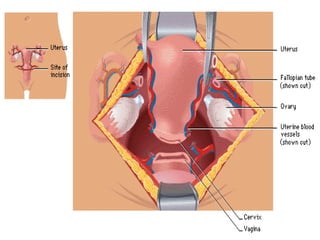
Steps
1. Division & ligation of the round ligaments
2. Division & Ligation of the tubes & ovarian
ligaments if the ovaries will be left, or the infundibulo-
pelvic ligaments if the ovaries will be removed.
3. Incise the peritoneum of the vesicouterine pouch
by extending the incision in the anterior leaf of the
broad ligament, then dissect the bladder downward
ABOUBAKR ELNASHAR
3. Clamp the uterine arteries & divide them
4. Uterosacral ligaments & Mackenrodtks ligaments
are divided & ligated.
5. The vagina is divided from its attachment to the
cervix.
ABOUBAKR ELNASHAR
 Indications
(1) Prophylactic (elective).
Suspected cervical incompetence.
Cerclage at 14 weeks {early miscarriage caused by
other factors}.
(2) Urgent (therapeutic)
Asymptomatic women with sonographic evidence of
cervical shortening and/or funneling
(3) Emergency (salvage) cervical cerclage
ABOUBAKR ELNASHAR
• Indications:
(ACOG, 1996)
1. History compatible with incompetent cervix AND
2. Sonogram demonstrating funneling OR
3. Clinical evidence of extensive obstetric trauma
to cervix
Cerclage
should only be considered when the history of
miscarriage is preceded by spontaneous rupture
of membranes or painless cervical dilatation
(RCOG,2002).
ABOUBAKR ELNASHAR
 Contraindications:
1.Uterine contractions.
2.Uterine bleeding
3.Chorioamnionitis
4.Premature rupture of membranes
5.Fetal anomaly incompatible with life
ABOUBAKR ELNASHAR
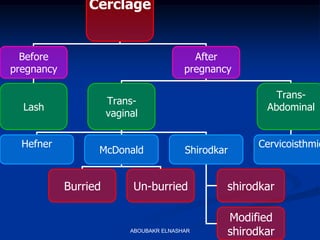
Cerclage
Before
pregnancy
After
pregnancy
Trans-
vaginal
Trans-
AbdominalLash
CervicoisthmicHefner
McDonald Shirodkar
Burried Un-burried shirodkar
Modified
shirodkarABOUBAKR ELNASHAR
ABOUBAKR ELNASHAR
ABOUBAKR ELNASHAR
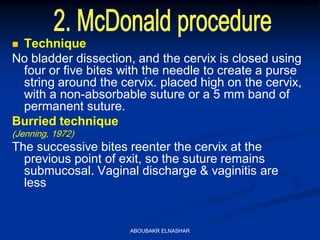
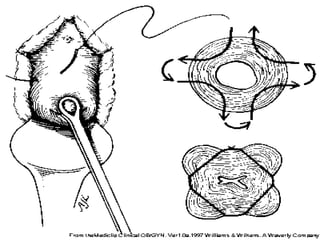
 Technique
No bladder dissection, and the cervix is closed using
four or five bites with the needle to create a purse
string around the cervix. placed high on the cervix,
with a non-absorbable suture or a 5 mm band of
permanent suture.
Burried technique
(Jenning, 1972)
The successive bites reenter the cervix at the
previous point of exit, so the suture remains
submucosal. Vaginal discharge & vaginitis are
less
ABOUBAKR ELNASHAR
ABOUBAKR ELNASHAR
ABOUBAKR ELNASHAR

Operative gynecology

  • 1.
  • 2.
    DILATATION & CURETTAGE Indications A.Dilatation of the cervix 1.A preliminary to curettage 2.Prior to hysteroscopy 3.As a step of other operations e.g. cervical amputation or Fothergill repair ABOUBAKR ELNASHAR
  • 3.
    4. Insertion ofIUD in stenotic cervix 5. Introduction of intracervical or intrauterine radium 6. Cervical stenosis 7. Spasmodic dysmenorrhea 8. Drainage of pyometra or haematometra ABOUBAKR ELNASHAR
  • 4.
    B. Curettage ofthe uterine cavity 1.Diagnosis & treatment of abnormal uterine bleeding 2.Diagnosis of endometrial cancer 3.Diagnosis & treatment of endometrial hyperplasia, endometrial polypi & submucous myoma 4.To detect ovulation & its defects in infertility 5.Removal of IUCD ABOUBAKR ELNASHAR
  • 5.
    6. Fractional curettage 7.Endocervical curettage 8. In pregnancy: Abortion: therapeutic, missed, incomplete, inevitable, septic Molar pregnancy Postabortive or postpartum bleeding ABOUBAKR ELNASHAR
  • 6.
    Technique 1.Evacuate the bladder 2.Anesthesia 3.Vaginalspeculum & grasp the cervix 4.Sounding 5.Dilate the cervix 6.Curette ABOUBAKR ELNASHAR
  • 7.
  • 8.
  • 9.
  • 10.
    Complications 1.Cervical laceration 2.Cervical incompetence 3.Perforationof the uterus 4.Spread of infection 5. Asherman syndrome 6.Persistence of bleeding: missing of an endometrial polyp or remnants of conception ABOUBAKR ELNASHAR
  • 11.
    Perforation of theuterus Diagnosis: Sound, dilator or curette is passed beyond the pre-determined length of the uterus. Management: 1.Avoid the part where perforation occurred (no necessarily to stop) 2.Observation: hemorrhage, peritonitis 3.Laparotomy: intestine is exposed for possible injury, uterine wound is sutured, peritoneal cavity is lavaged & drained ABOUBAKR ELNASHAR
  • 12.
  • 13.
    ANTERIOR COLPORRHAPHY Indications: Cystocele Steps:1. Anterior vaginal wall incision 2. The anterior vaginal wall is separated from the bladder & the bladder is pushed to its normal position as a pelvic organ 3. Plication of the the pubovesical fascia beneath the bladder to form a shelf 4. Redundant vaginal wall is removed 5. Vagina is closed in the midline ABOUBAKR ELNASHAR
  • 14.
  • 15.
  • 16.
  • 17.
    Posterior colpoperineoraphy Indication: Rectocele Steps 1.Incision at the mucocutaneous junction. 2. The posterior vaginal wall is separated from the rectum 3. The 2 levator ani are approximated in front of the rectum 4. Redundant vaginal wall is removed 5. The superficial perineal muscles are approximated in the midline 6. The vagina is closed 7. The skin of the perineum is closed ABOUBAKR ELNASHAR
  • 18.
  • 19.
    FOTHERGILLS OPERATION Indication Combined vaginal& uterine prolapse with supravaginal elongation of the cervix Steps 1.Dilatation & curettage: Dilatation to cover the cervical stump. Curettage to exclude uterine pathology 2.Anterior colporrhaphy: repair cystocele ABOUBAKR ELNASHAR
  • 20.
    3. Amputation ofthe cervix: restore the normal length of the cervix 4. Shortening & approximating of the Mackenrodt ligaments in front of the cervix: elevate the uterus & pull the cervix posteriorly to correct the retroversion 5. Posterior colpoperineoraphy: repair rectocele & to strengthen the lax pelvic floor to prevent recurrence ABOUBAKR ELNASHAR
  • 21.
    MYOMECTOMY Indication Symptomatizing patient whodid not complete her family Types 1.Abdominal 2.Vaginal 3.Hysteroscopic: submucous <5cm 4.Laparoscopic: Pedunculated subserous ABOUBAKR ELNASHAR
  • 22.
  • 23.
  • 24.
  • 25.
  • 26.
    HYSTERECTOMY Indications I. Gynecological: 1. Fibroid 2.Advanced endometriosis & adenomyosis 3. Malignant tumors of the cervix, body, tubes or ovary 4. Recurrent DUB not responding to conservative treatment 5. Chronic pyometra 6. Chronic inversion of the uterus ABOUBAKR ELNASHAR
  • 27.
    II. Obstetric indications 1.Uncontrolledpostpartum hemorrhage 2.Rupture uterus 3.Placenta accreta 4.Invasive mole 5.Couvelaire uterus ABOUBAKR ELNASHAR
  • 28.
  • 29.
    Types of abdominalhysterectomy • Subtotal: removal of the uterus with preservation of the cervix • Total: removal of the uterus & cervix • Pan: total with bilateral salpingo-oophrectomy • Radical: removal of the uterus, cervix, parametrial tissue, endopelvic fascia, uterosacral ligaments & pelvic lymph nodes ABOUBAKR ELNASHAR
  • 30.
  • 31.
  • 32.
    • Cesarean hysterectomy: •removal of the uterus after C.S e.g. atonic postpartum hemorhage or placenta accreta. • Hysterectomy-en-toto: Removal of the uterus with a contained dead fetus without opening the uterus to decrease blood loss e.g. couvelaire uterus ABOUBAKR ELNASHAR
  • 33.
    Types 1. Extrafacial: removal ofthe uterus with its fascial layer. It is the operation usually performed 2. Intrafascial: The outer (endopelvic) fascia is left attached to the bladder. It is used when it is difficult to dissect the bladder from front of the cervix e.g. adhesions from previous CS. ABOUBAKR ELNASHAR
  • 34.
  • 35.
    Steps 1. Division &ligation of the round ligaments 2. Division & Ligation of the tubes & ovarian ligaments if the ovaries will be left, or the infundibulo- pelvic ligaments if the ovaries will be removed. 3. Incise the peritoneum of the vesicouterine pouch by extending the incision in the anterior leaf of the broad ligament, then dissect the bladder downward ABOUBAKR ELNASHAR
  • 36.
    3. Clamp theuterine arteries & divide them 4. Uterosacral ligaments & Mackenrodtks ligaments are divided & ligated. 5. The vagina is divided from its attachment to the cervix. ABOUBAKR ELNASHAR
  • 37.
     Indications (1) Prophylactic(elective). Suspected cervical incompetence. Cerclage at 14 weeks {early miscarriage caused by other factors}. (2) Urgent (therapeutic) Asymptomatic women with sonographic evidence of cervical shortening and/or funneling (3) Emergency (salvage) cervical cerclage ABOUBAKR ELNASHAR
  • 38.
    • Indications: (ACOG, 1996) 1.History compatible with incompetent cervix AND 2. Sonogram demonstrating funneling OR 3. Clinical evidence of extensive obstetric trauma to cervix Cerclage should only be considered when the history of miscarriage is preceded by spontaneous rupture of membranes or painless cervical dilatation (RCOG,2002). ABOUBAKR ELNASHAR
  • 39.
     Contraindications: 1.Uterine contractions. 2.Uterinebleeding 3.Chorioamnionitis 4.Premature rupture of membranes 5.Fetal anomaly incompatible with life ABOUBAKR ELNASHAR
  • 40.
  • 41.
  • 42.
  • 43.
     Technique No bladderdissection, and the cervix is closed using four or five bites with the needle to create a purse string around the cervix. placed high on the cervix, with a non-absorbable suture or a 5 mm band of permanent suture. Burried technique (Jenning, 1972) The successive bites reenter the cervix at the previous point of exit, so the suture remains submucosal. Vaginal discharge & vaginitis are less ABOUBAKR ELNASHAR
  • 44.
  • 45.