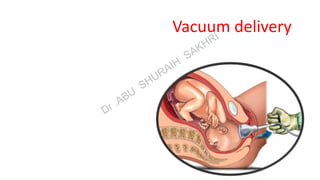
Vacuum delivery
Vacuum Extraction (Ventouse)
• It is an instrumental device designed to assist
delivery by creating a vacuum between it and the
fetal scalp
• In the United states - vacuum extractor
• Europe – Ventouse (French- soft cup)
Historical background
• In 1705, Dr.James Yonge, an English surgeon-
first description of vacuum extraction
• In 1848 -Simpson -bell shaped device called an “air
tractor vacuum extractor”
• In 1953 a metal cup extractor -Malmstrom
Description
• Vacuum extractor is composed of:
• A specially designed cup with a diameter of 3, 4, 5 or 6
cm.
• A rubber tube attaching the cup to a glass bottle with a
screw in between to release the negative pressure.
• A manometer fitted in the mouth of the glass bottle to
declare the negative pressure.
• Another rubber tube connecting the bottle to a suction
piece which may be manual or electronic creating a
negative pressure that should not exceed - 0.8 kg per
cm2.
Types of vacuum extractors
Vacuum extractors are divided on the basis
of the type of cup- -metal
or plastic
1.Metal cup vacuum extractors
2.Soft cup vacuum extractors
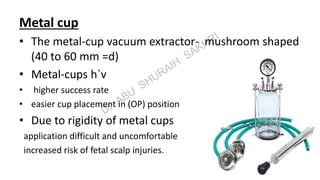
Metal cup
• The metal-cup vacuum extractor- mushroom shaped
(40 to 60 mm =d)
• Metal-cups h`v
• higher success rate
• easier cup placement in (OP) position
• Due to rigidity of metal cups
application difficult and uncomfortable
increased risk of fetal scalp injuries.
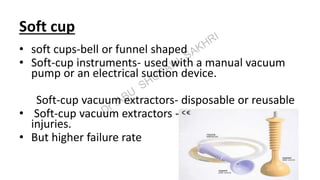
Soft cup
• soft cups-bell or funnel shaped
• Soft-cup instruments- used with a manual vacuum
pump or an electrical suction device.
Soft-cup vacuum extractors- disposable or reusable
• Soft-cup vacuum extractors -fewer neonatal scalp
injuries.
• But higher failure rate
Prerequisites of vacuum extraction
• same as for forceps delivery
• Consent + well informed patient
• Vertex-presentation
• Head -well engaged
• No CPD
• Cervix fully dilated or almost so
• Bladder should be empty
Indications
INDICATED
• Maternal/Fetal distress in 2nd stage
• Prolonged 2nd stage
• Deep transverse arrest or persistent OP
• High vacuum for second twin
Prophylactic
• Preeclampsia
• Vaginal birth after CS
Contraindications
• Suspicion of CPD
• Other presentations than vertex like face
• Premature fetus
• Intact membranes
• Fetal coagulopathy
• Operator inexperience
Application of the cup
• Identification of the flexion point
-situated 3 cm in front of the posterior fontanelle.
-Centre of the cup should be overlying the flexion point.
-This placement promotes flexion ,descent and
autorotation.
• If traction is directed from this point the fetal head is
flexed to the narrowest sub-occipitobregmatic
diameter(9.5 cm).
Precautions-
-The largest cup that can be easily passed is
introduced sideways into the vagina by
pressing it backwards against the perineum.
-Be sure that there is no cervical or vaginal
tissues included in the cup.
Creating the negative pressure
For rigid cups, the negative pressure increased 0.2
kg/cm2 every 2 minutes until - 0.8 kg/cm2 is attained-
This creates an artificial caput (chignon) within the cup.
• With soft cups negative pressure can be increased to 0.8
kg/cm2 over as little as 1 minute
Episiotomy
• An episiotomy may be needed for proper
placement of the cup
• If not, then delay the episiotomy till the head
stretches the perineum or perineum interferes
with the axis of traction
• This will minimize unnecessary blood loss.
Traction
• Traction should be intermittent and co- ordinated
with maternal expulsive efforts and with uterine
contractions.
• Traction should be in line of the pelvic axis and
perpendicular to the plane of the cup
Principles to be kept during traction:
• Direction of pull – should follow curve of carus
• Traction –right angles to cup and counter
pressure with left hand
• Descent should occur with each pull
• Delivery should be within 3 pulls over 15 minutes
• Between contractions, check for fetal HR and
proper application of the cup
Release
• When the head is delivered -vacuum is
reduced as slowly - diminishes the risk of
scalp damage
• The chignon should be explained to the
patient and the relatives
Reapplication of the cup
-If the cup detaches for the first time, reassess
the situation.
If favorable ,then reapply.
-If cup detaches for 2nd time, reassess if vaginal
delivery is safe or move to caesarean section
-CS-if there is inadequate descent and rotation
Failure of vacuum
• failed if-
-fetal head does not advance with each pull
-fetus is undelivered after 3 pulls with no
descent
-cup slips off the head twice at the proper
direction of pull with the maximum negative
pressure.
Advantages of Vacuum over Forceps
-Regional Anesthesia is not required
-The ventouse is not occupying a space beside the head
as forceps.
-Less compression force (0.77 kg/cm2)
compared to forceps (1.3 kg/cm2) -injuries to the head
is less common.
-Less genital tract lacerations.
-It can be applied on non-engaged head.
-Donot require full dilatation of cervix
-less traction force required
-promote autorotation
Complications
Maternal
-Perineal, vaginal ,labial, periurethral and cervical
injuries
-Annular detachment of the cervix when applied
with incompletely dilated cervix
-Traumatic PPH
Complications
Fetal
• Cephalohaematoma.
• Scalp injury
• Subgaleal hematomas
• Intracranial haemorrhage.
• Neonatal jaundice
• Subconjunctival haemorrhage
• Retinal hemorrhage
• Fetal death-asphyxia due to difficult vacuum extraction
THANK YOU

Vacuum delivery

  • 1.
  • 2.
    Vacuum Extraction (Ventouse) •It is an instrumental device designed to assist delivery by creating a vacuum between it and the fetal scalp • In the United states - vacuum extractor • Europe – Ventouse (French- soft cup)
  • 3.
    Historical background • In1705, Dr.James Yonge, an English surgeon- first description of vacuum extraction • In 1848 -Simpson -bell shaped device called an “air tractor vacuum extractor” • In 1953 a metal cup extractor -Malmstrom
  • 4.
    Description • Vacuum extractoris composed of: • A specially designed cup with a diameter of 3, 4, 5 or 6 cm. • A rubber tube attaching the cup to a glass bottle with a screw in between to release the negative pressure. • A manometer fitted in the mouth of the glass bottle to declare the negative pressure. • Another rubber tube connecting the bottle to a suction piece which may be manual or electronic creating a negative pressure that should not exceed - 0.8 kg per cm2.
  • 7.
    Types of vacuumextractors Vacuum extractors are divided on the basis of the type of cup- -metal or plastic 1.Metal cup vacuum extractors 2.Soft cup vacuum extractors
  • 8.
    Metal cup • Themetal-cup vacuum extractor- mushroom shaped (40 to 60 mm =d) • Metal-cups h`v • higher success rate • easier cup placement in (OP) position • Due to rigidity of metal cups application difficult and uncomfortable increased risk of fetal scalp injuries.
  • 9.
    Soft cup • softcups-bell or funnel shaped • Soft-cup instruments- used with a manual vacuum pump or an electrical suction device. Soft-cup vacuum extractors- disposable or reusable • Soft-cup vacuum extractors -fewer neonatal scalp injuries. • But higher failure rate
  • 10.
    Prerequisites of vacuumextraction • same as for forceps delivery • Consent + well informed patient • Vertex-presentation • Head -well engaged • No CPD • Cervix fully dilated or almost so • Bladder should be empty
  • 11.
    Indications INDICATED • Maternal/Fetal distressin 2nd stage • Prolonged 2nd stage • Deep transverse arrest or persistent OP • High vacuum for second twin Prophylactic • Preeclampsia • Vaginal birth after CS
  • 12.
    Contraindications • Suspicion ofCPD • Other presentations than vertex like face • Premature fetus • Intact membranes • Fetal coagulopathy • Operator inexperience
  • 13.
    Application of thecup • Identification of the flexion point -situated 3 cm in front of the posterior fontanelle. -Centre of the cup should be overlying the flexion point. -This placement promotes flexion ,descent and autorotation. • If traction is directed from this point the fetal head is flexed to the narrowest sub-occipitobregmatic diameter(9.5 cm).
  • 16.
    Precautions- -The largest cupthat can be easily passed is introduced sideways into the vagina by pressing it backwards against the perineum. -Be sure that there is no cervical or vaginal tissues included in the cup.
  • 17.
    Creating the negativepressure For rigid cups, the negative pressure increased 0.2 kg/cm2 every 2 minutes until - 0.8 kg/cm2 is attained- This creates an artificial caput (chignon) within the cup. • With soft cups negative pressure can be increased to 0.8 kg/cm2 over as little as 1 minute
  • 18.
    Episiotomy • An episiotomymay be needed for proper placement of the cup • If not, then delay the episiotomy till the head stretches the perineum or perineum interferes with the axis of traction • This will minimize unnecessary blood loss.
  • 19.
    Traction • Traction shouldbe intermittent and co- ordinated with maternal expulsive efforts and with uterine contractions. • Traction should be in line of the pelvic axis and perpendicular to the plane of the cup
  • 20.
    Principles to bekept during traction: • Direction of pull – should follow curve of carus • Traction –right angles to cup and counter pressure with left hand • Descent should occur with each pull • Delivery should be within 3 pulls over 15 minutes • Between contractions, check for fetal HR and proper application of the cup
  • 22.
    Release • When thehead is delivered -vacuum is reduced as slowly - diminishes the risk of scalp damage • The chignon should be explained to the patient and the relatives
  • 23.
    Reapplication of thecup -If the cup detaches for the first time, reassess the situation. If favorable ,then reapply. -If cup detaches for 2nd time, reassess if vaginal delivery is safe or move to caesarean section -CS-if there is inadequate descent and rotation
  • 24.
    Failure of vacuum •failed if- -fetal head does not advance with each pull -fetus is undelivered after 3 pulls with no descent -cup slips off the head twice at the proper direction of pull with the maximum negative pressure.
  • 25.
    Advantages of Vacuumover Forceps -Regional Anesthesia is not required -The ventouse is not occupying a space beside the head as forceps. -Less compression force (0.77 kg/cm2) compared to forceps (1.3 kg/cm2) -injuries to the head is less common. -Less genital tract lacerations. -It can be applied on non-engaged head. -Donot require full dilatation of cervix -less traction force required -promote autorotation
  • 26.
    Complications Maternal -Perineal, vaginal ,labial,periurethral and cervical injuries -Annular detachment of the cervix when applied with incompletely dilated cervix -Traumatic PPH
  • 27.
    Complications Fetal • Cephalohaematoma. • Scalpinjury • Subgaleal hematomas • Intracranial haemorrhage. • Neonatal jaundice • Subconjunctival haemorrhage • Retinal hemorrhage • Fetal death-asphyxia due to difficult vacuum extraction
  • 30.