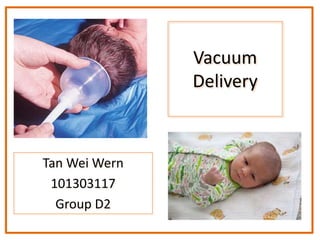
Vacuum
Delivery
Tan Wei Wern
101303117
Group D2
Description
• It is an instrumental device designed to assist
delivery by creating a vacuum (negative
pressure) between itself and the fetal scalp.
Parts
• Suction cup of variable sizes (30, 40, 50, 60
mm). It is either metallic, or soft (made of
silicone.)
• Vacuum generator.
• Traction tubing.
Types
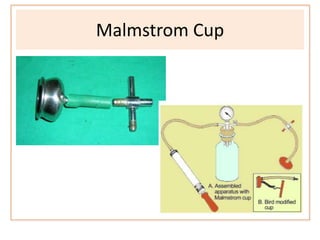
• Malmstrom cup
– A metal cup to its centre attached a metal chain
passed through the rubber tube. The other end of the
chain is attached to a handle for traction.
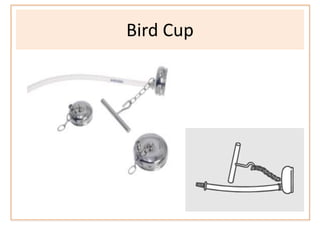
• Bird’s cup
– The suction rubber tube is attached to the periphery
of the cup while the handle of traction is attached by
a separate short metal chain to the centre of the cup.
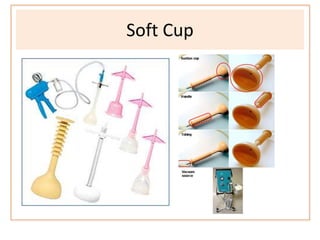
• Soft cup
– It is a bell-shaped 6.5 cm diameter soft cup which is
made of a firm but supple silastic material.
Malmstrom Cup
Bird Cup
Soft Cup
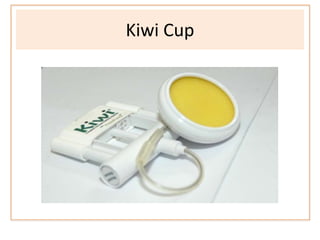
Kiwi Cup
Soft Cup
• Advantage: It produces symmetric, less
cosmetically alarming caput succedaneum and
less scalp abrasions.
• Disadvantage: It slips more than the metal cup
but with less scalp injuries.
Indications
• Maternal distress in 2nd stage of labour.
• Fetal distress in 2nd stage of labour.
• Prolonged 2nd stage.
• To shorten the 2nd stage in VBAC.
• For prophylactic use in mothers with
cardiovascular, respiratory, cerebrovascular
disorders.
Contraindications
• Fetal prematurity
• Non-vertex presentation, malpresentations
• Fetal scalp trauma
• Unengaged head
• Incomplete cervical dilatation
• Active bleeding/suspected fetal coagulation
defects
• Suspected macrosomia
• Cephalopelvic disproportion
Prerequisites
• Bladder must be emptied
• Cervix fully dilated
• No evidence of CPD
• Vertex presentation and not above the station
of +2
• Membranes must be ruptured
Technique
• APPLICATION
– Station of the head and its position is assessed
– Instrument is checked to be in working condition
before application
– Selection of the cup is important
– The cup is introduced after retraction of perineum
with two fingers of the other hand
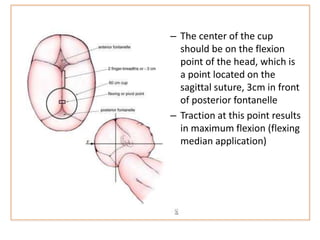
– The center of the cup
should be on the flexion
point of the head, which is
a point located on the
sagittal suture, 3cm in front
of posterior fontanelle
– Traction at this point results
in maximum flexion (flexing
median application)
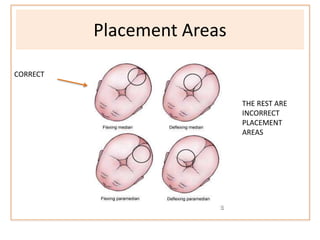
Placement Areas
CORRECT
THE REST ARE
INCORRECT
PLACEMENT
AREAS
Technique
• NEGATIVE PRESSURE
– The vacuum is created gradually after ensuring that no
soft tissue is included in the cup.
– Once the pressure reaches 0.2kg/cm2, it is rechecked
for inclusion of the soft tissue in the cup.
– The negative pressure is then gradually increased to a
maximum of 0.8kg/cm2 to create a chignon (artificial
caput)
– Following this the traction is applied
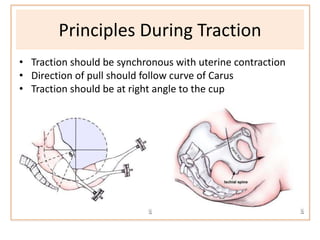
• Traction should be synchronous with uterine contraction
• Direction of pull should follow curve of Carus
• Traction should be at right angle to the cup
Principles During Traction
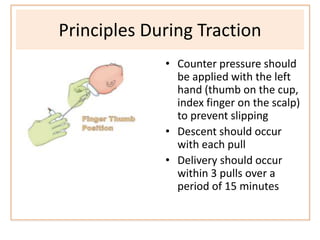
• Counter pressure should
be applied with the left
hand (thumb on the cup,
index finger on the scalp)
to prevent slipping
• Descent should occur
with each pull
• Delivery should occur
within 3 pulls over a
period of 15 minutes
Principles During Traction
• If the cup slips, reevaluate the station and
position of the head and reassess the pelvis
• Reapply only when there is no problem
• If it slips again or descent is not satisfactory, the
procedure should be abandoned
• As soon as baby is delivered, the vacuum
pressure is reduced, and cup is detached
• Delivery is completed in the normal way
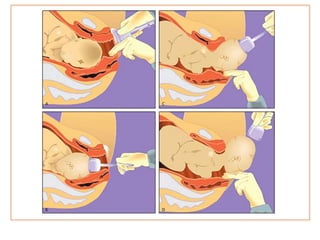
How To Do It
Complications
• MATERNAL
– Soft tissue injuries to the vagina, cervix, perineum
– Annular detachment of cervix
– Traumatic postpartum hemorrhage
• FETUS
– Cephalhematoma
– Intracranial hemorrhage
– Subconjunctival hemorrhage
– Retinal hemorrhage
– Fetal asphyxia
– Neonatal jaundice
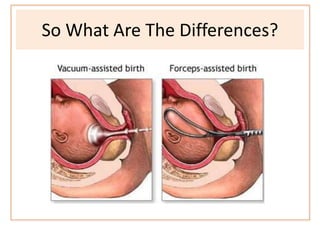
So What Are The Differences?
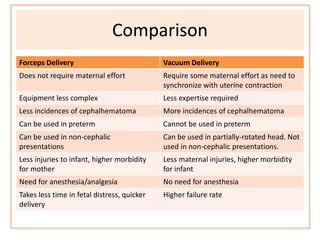
Comparison
Forceps Delivery Vacuum Delivery
Does not require maternal effort Require some maternal effort as need to
synchronize with uterine contraction
Equipment less complex Less expertise required
Less incidences of cephalhematoma More incidences of cephalhematoma
Can be used in preterm Cannot be used in preterm
Can be used in non-cephalic
presentations
Can be used in partially-rotated head. Not
used in non-cephalic presentations.
Less injuries to infant, higher morbidity
for mother
Less maternal injuries, higher morbidity
for infant
Need for anesthesia/analgesia No need for anesthesia
Takes less time in fetal distress, quicker
delivery
Higher failure rate
THANK YOU
• Manual for Practical Obstetrics and
Gynecology, 1st Edition. Dr Somsubhra De, Prof
Dato Dr Sachchithanantham.
Reference

Vacuum Delivery OSCE

  • 1.
  • 2.
    Description • It isan instrumental device designed to assist delivery by creating a vacuum (negative pressure) between itself and the fetal scalp.
  • 3.
    Parts • Suction cupof variable sizes (30, 40, 50, 60 mm). It is either metallic, or soft (made of silicone.) • Vacuum generator. • Traction tubing.
  • 4.
    Types • Malmstrom cup –A metal cup to its centre attached a metal chain passed through the rubber tube. The other end of the chain is attached to a handle for traction. • Bird’s cup – The suction rubber tube is attached to the periphery of the cup while the handle of traction is attached by a separate short metal chain to the centre of the cup. • Soft cup – It is a bell-shaped 6.5 cm diameter soft cup which is made of a firm but supple silastic material.
  • 5.
  • 6.
  • 7.
  • 8.
  • 9.
    Soft Cup • Advantage:It produces symmetric, less cosmetically alarming caput succedaneum and less scalp abrasions. • Disadvantage: It slips more than the metal cup but with less scalp injuries.
  • 10.
    Indications • Maternal distressin 2nd stage of labour. • Fetal distress in 2nd stage of labour. • Prolonged 2nd stage. • To shorten the 2nd stage in VBAC. • For prophylactic use in mothers with cardiovascular, respiratory, cerebrovascular disorders.
  • 11.
    Contraindications • Fetal prematurity •Non-vertex presentation, malpresentations • Fetal scalp trauma • Unengaged head • Incomplete cervical dilatation • Active bleeding/suspected fetal coagulation defects • Suspected macrosomia • Cephalopelvic disproportion
  • 12.
    Prerequisites • Bladder mustbe emptied • Cervix fully dilated • No evidence of CPD • Vertex presentation and not above the station of +2 • Membranes must be ruptured
  • 13.
    Technique • APPLICATION – Stationof the head and its position is assessed – Instrument is checked to be in working condition before application – Selection of the cup is important – The cup is introduced after retraction of perineum with two fingers of the other hand
  • 14.
    – The centerof the cup should be on the flexion point of the head, which is a point located on the sagittal suture, 3cm in front of posterior fontanelle – Traction at this point results in maximum flexion (flexing median application)
  • 15.
    Placement Areas CORRECT THE RESTARE INCORRECT PLACEMENT AREAS
  • 16.
    Technique • NEGATIVE PRESSURE –The vacuum is created gradually after ensuring that no soft tissue is included in the cup. – Once the pressure reaches 0.2kg/cm2, it is rechecked for inclusion of the soft tissue in the cup. – The negative pressure is then gradually increased to a maximum of 0.8kg/cm2 to create a chignon (artificial caput) – Following this the traction is applied
  • 17.
    • Traction shouldbe synchronous with uterine contraction • Direction of pull should follow curve of Carus • Traction should be at right angle to the cup Principles During Traction
  • 18.
    Principles During Traction •Counter pressure should be applied with the left hand (thumb on the cup, index finger on the scalp) to prevent slipping • Descent should occur with each pull • Delivery should occur within 3 pulls over a period of 15 minutes
  • 19.
    Principles During Traction •If the cup slips, reevaluate the station and position of the head and reassess the pelvis • Reapply only when there is no problem • If it slips again or descent is not satisfactory, the procedure should be abandoned • As soon as baby is delivered, the vacuum pressure is reduced, and cup is detached • Delivery is completed in the normal way
  • 21.
  • 22.
    Complications • MATERNAL – Softtissue injuries to the vagina, cervix, perineum – Annular detachment of cervix – Traumatic postpartum hemorrhage • FETUS – Cephalhematoma – Intracranial hemorrhage – Subconjunctival hemorrhage – Retinal hemorrhage – Fetal asphyxia – Neonatal jaundice
  • 23.
    So What AreThe Differences?
  • 24.
    Comparison Forceps Delivery VacuumDelivery Does not require maternal effort Require some maternal effort as need to synchronize with uterine contraction Equipment less complex Less expertise required Less incidences of cephalhematoma More incidences of cephalhematoma Can be used in preterm Cannot be used in preterm Can be used in non-cephalic presentations Can be used in partially-rotated head. Not used in non-cephalic presentations. Less injuries to infant, higher morbidity for mother Less maternal injuries, higher morbidity for infant Need for anesthesia/analgesia No need for anesthesia Takes less time in fetal distress, quicker delivery Higher failure rate
  • 25.
  • 26.
    • Manual forPractical Obstetrics and Gynecology, 1st Edition. Dr Somsubhra De, Prof Dato Dr Sachchithanantham. Reference