GENITAL TRACT INJURIES
PRESENTED BY:
A.SAHAYA MARY
M.Sc NURSING II YR
SCON,SIMATS
INTRODUCTION
The genital tract and the adjacent pelvic organs are subjected
to strain of vaginal delivery either spontaneous or assisted. The
injury is more in areas of inadequate antenatal and intranatal care.
The patients may have full recovery from the injuries but a
substantial number may produce permanent legacies which lead to
major gynecologic problems. The following are some of such
major obstetric legacies. All are dealt in appropriate chapters; only
the severe form of perineal injuries—i.e. old complete perineal
tear will be dealt within this chapter. It has to be borne in mind
that with improved antenatal and intranatal care, majority of the
complications could be prevented. It is thus appropriately
considered that obstetrics is a branch of preventive medicine
OUTLINE
 OLD COMPLETE PERINEAL TEAR
(CPT)
 RAPE VICTIMS
 COITAL INJURIES
 DIRECT TRAUMA
 FOREIGN BODIES
 INSTRUMENTAL INJURIES
OLD COMPLETE PERINEAL
TEAR (CPT)
DEFINITION
Tear of the perineal body involving the sphincter ani
externus with or without involvement of the anorectal
mucosa is called complete perineal tear. It is called old
when passed beyond an arbitrary period of 3 months
following the injury.
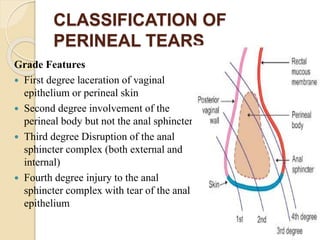
CLASSIFICATION OF
PERINEAL TEARS
Grade Features
 First degree laceration of vaginal
epithelium or perineal skin
 Second degree involvement of the
perineal body but not the anal sphincter
 Third degree Disruption of the anal
sphincter complex (both external and
internal)
 Fourth degree injury to the anal
sphincter complex with tear of the anal
epithelium
ETIOLOGY
♦ Obstetrical ♦ Gynecological
Obstetrical: Perineal injury (3° and 4°) results from
over stretching or sudden stretching of the perineum
during child birth. It is more common when the
perineum is inelastic.
Gynecological: Direct injury on the perineum by fall
may lead to trauma on the perineum to the extent of
CPT.
RISK FACTORS FOR THIRD
DEGREE TEARS
♦ Primigravida
♦ big baby (> 3 kg)
♦ face to pubis delivery
♦ Midline episiotomy
♦ forceps delivery
♦ outlet contraction with narrow pubic arch
♦ shoulder dystocia
♦ Precipitate labor
♦ scar in the perineum
♦ Prolonged second stage
CLINICAL FEATURES
 Inability to hold the flatus and feces.
 Soreness over the perianal region is due to constant
irritation by the stool.
 There is absence of perineum. Vaginal and rectal
mucous membranes are found to be continuous,only
separated by a bridge of fibrous tissue.
 Visible dimple on the skin on either side of the fused
mucosa may be present.
 Palpation : There is absence of the sphincteric grip
evidenced when a finger is introduced into the rectum.
DIAGNOSIS
A rectovaginal fistula situated low down may at
times be confused with complete perineal tear. This is
especially in cases where overlying skin remains intact.
Rectovaginal fistula causes more inconvenience to
the patient than CPT.
TREATMENT:
Preventive Operative
Preventive: Proper conduct in the second stage of labor
taking due care of the perineum when it is likely to be
damaged is the effective step to prevent undue
lacerations.
Operative: The definitive surgery is repair of the anal
sphincter complex (sphincteroplasty) with restoration of
the perineal body (perineorrhaphy).
◦ Preoperative investigations
◦ Preoperative preparations
◦ Principles of surgery (Warren Flap method)
◦ Steps of Operation
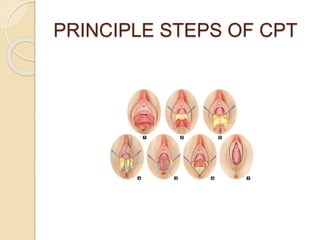
PRINCIPLE STEPS OF CPT
CONT.,
 Special Postoperative Care
 Advice on discharge
 Complications of Repair Operations
COITAL INJURIES
The following are the nature of coital injuries :
●● Minor hemorrhage due to tearing of the hymen or bruising of the
vagina or urethra may occur at defloration. No treatment is usually
required.
●● Severe hemorrhage may occur, if the tear spreads to involve the
vestibule or the region of the clitoris. Lacerations of the anterior
vaginal wall may occur usually following rape.
●● Very rarely, rupture of the vault of the vagina may occur to expose
the peritoneal cavity. This usually occurs in—(a) rape, (b) very young
girls, (c) postmenopausal atrophy and (d) following
vaginal/abdominal hysterectomy. Bowels and omentum may prolapse
through the ruptured vault and cause shock and peritonitis.
Management: Small tears need no treatment; only pressure
application is enough. Larger lacerations have to be repaired. If the
vault has ruptured, it is preferable to perform laparotomy and repair
the vault and to tackle any associated pathology.
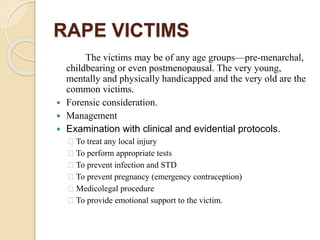
RAPE VICTIMS
The victims may be of any age groups—pre-menarchal,
childbearing or even postmenopausal. The very young,
mentally and physically handicapped and the very old are the
common victims.
 Forensic consideration.
 Management
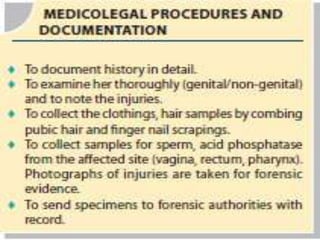
 Examination with clinical and evidential protocols.
To treat any local injury
To perform appropriate tests
To prevent infection and STD
To prevent pregnancy (emergency contraception)
Medicolegal procedure
To provide emotional support to the victim.
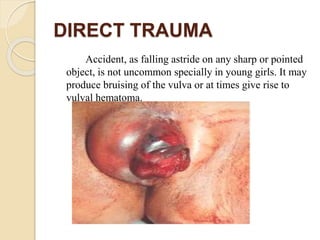
DIRECT TRAUMA
Accident, as falling astride on any sharp or pointed
object, is not uncommon specially in young girls. It may
produce bruising of the vulva or at times give rise to
vulval hematoma.
Management:
Assessment of the general condition and the
nature and extent of the injuries inflicted should be done
first. Small vulval hematoma, if not spreading may be
left alone but if it is a big one or spreading, along with
resuscitative measures, the hematoma is to be tackled
under general anesthesia. This includes scooping of the
blood clots after giving an incision, secure hemostasis
and obliteration of the dead space by interrupted
mattress sutures. In supralevator hematoma or in cases
of suspected gut injuries, laparotomy is indicated and
appropriate measures taken.
FOREIGN BODIES
Various types of foreign bodies may be placed
either in the vagina or uterus and retained for a
prolonged period often unnoticed by the patient. The
articles so placed are either introduced by the patient or
at times by a physician. Such articles are of varying
nature, to mention only a few of them.
Cont.,
In the vagina
◦ •
•
Coins, toys, small stones either introduced out of curiosity by
children or perversion in adults.
◦ •
•
Forgotten menstrual tampon or diaphragm, cervical cap or
condom used as contraceptives.
◦ •
•
Articles introduced to procure abortion.
◦ •
•
Packs, swabs or dressings.
◦ •
•
Forgotten pessary.
In the uterus
◦ •
•
Retained IUCD for a long time.
◦ •
•
Old gauze packs.
◦ •
•
Articles inserted for procuring abortion.
Cont.,
Effects: The effects depend upon the nature of the foreign body,
duration of its existence and amount of tissue damage.
Any material left inside invites infection. This especially
happens in rubber goods, foreign bodies, swabs or gauze packs.
There is foul smelling discharge.
Retained and forgotten pessary may cause vaginitis, sloughing
and ulceration. It may produce vesicovaginal fistula and may be a
precursor of vaginal carcinoma. Prolonged retention of IUD may
cause menorrhagia, irregular bleeding and if left even in
postmenopausal period, may produce pyometra or postmenopausal
bleeding.
Management: Once diagnosed, the foreign body is to be removed. In
children, it may not be easy and it is better to expose the vagina
under general anesthesia using aural or nasal speculum.
INSTRUMENTAL INJURIES
Uterine injury in gynecologic conditions is rather
uncommon compared to pregnant uterus. However,
injuries do happen with all types of instruments used in
cervical dilatation and uterine curettage operation.
Cervical injuries may be inflicted by the vulsellum
or by a dilator especially in nulliparous cervix. There
may be at times brisk hemorrhage. Late sequela
includes cervical incompetency.
Cont.,
Body of the uterus is commonly injured by sound,
dilator or curette or during insertion of IUD. Apart from
inadvertent injuries, the likely susceptible conditions are
:
♦ Small and soft uterus during lactation
♦ Postmenopausal uterus
♦ Infected uterus
♦ Pyometra
♦ Malignancy.
Management:
Once diagnosis is made, the operative procedure is to be stopped.
Further management depends on :
♦ Type of instrument causing injury
♦ Pathology in the uterus
♦ Effect on the patient.
Non-infective/non-malignant
Observation: Pulse and blood pressure are to be observed
periodically and to administer antibiotics.
Evidences of peritonitis are to be looked for.
Laparoscopy can give a good guide for observation or interference.
Cont.,
Interference
♦ Deteriorating general condition
♦ Suspected gut injury
♦ Features of developing peritonitis.
Infective/malignant
♦ In infective uterus, there is chance of spreading
peritonitis. Observation may be done under cover
of antibiotics but if unresponsive, laparotomy is
preferred.
♦ In malignancy or pyometra, laparotomy and
definitive surgery have to be seriously considered.
NURSING
DIAGNOSIS
ANY DOUBTS
THANK YOU

GENITAL TRACT INJURIES.pptx

  • 1.
    GENITAL TRACT INJURIES PRESENTEDBY: A.SAHAYA MARY M.Sc NURSING II YR SCON,SIMATS
  • 2.
    INTRODUCTION The genital tractand the adjacent pelvic organs are subjected to strain of vaginal delivery either spontaneous or assisted. The injury is more in areas of inadequate antenatal and intranatal care. The patients may have full recovery from the injuries but a substantial number may produce permanent legacies which lead to major gynecologic problems. The following are some of such major obstetric legacies. All are dealt in appropriate chapters; only the severe form of perineal injuries—i.e. old complete perineal tear will be dealt within this chapter. It has to be borne in mind that with improved antenatal and intranatal care, majority of the complications could be prevented. It is thus appropriately considered that obstetrics is a branch of preventive medicine
  • 3.
    OUTLINE  OLD COMPLETEPERINEAL TEAR (CPT)  RAPE VICTIMS  COITAL INJURIES  DIRECT TRAUMA  FOREIGN BODIES  INSTRUMENTAL INJURIES
  • 4.
    OLD COMPLETE PERINEAL TEAR(CPT) DEFINITION Tear of the perineal body involving the sphincter ani externus with or without involvement of the anorectal mucosa is called complete perineal tear. It is called old when passed beyond an arbitrary period of 3 months following the injury.
  • 5.
    CLASSIFICATION OF PERINEAL TEARS GradeFeatures  First degree laceration of vaginal epithelium or perineal skin  Second degree involvement of the perineal body but not the anal sphincter  Third degree Disruption of the anal sphincter complex (both external and internal)  Fourth degree injury to the anal sphincter complex with tear of the anal epithelium
  • 6.
    ETIOLOGY ♦ Obstetrical ♦Gynecological Obstetrical: Perineal injury (3° and 4°) results from over stretching or sudden stretching of the perineum during child birth. It is more common when the perineum is inelastic. Gynecological: Direct injury on the perineum by fall may lead to trauma on the perineum to the extent of CPT.
  • 7.
    RISK FACTORS FORTHIRD DEGREE TEARS ♦ Primigravida ♦ big baby (> 3 kg) ♦ face to pubis delivery ♦ Midline episiotomy ♦ forceps delivery ♦ outlet contraction with narrow pubic arch ♦ shoulder dystocia ♦ Precipitate labor ♦ scar in the perineum ♦ Prolonged second stage
  • 8.
    CLINICAL FEATURES  Inabilityto hold the flatus and feces.  Soreness over the perianal region is due to constant irritation by the stool.  There is absence of perineum. Vaginal and rectal mucous membranes are found to be continuous,only separated by a bridge of fibrous tissue.  Visible dimple on the skin on either side of the fused mucosa may be present.  Palpation : There is absence of the sphincteric grip evidenced when a finger is introduced into the rectum.
  • 9.
    DIAGNOSIS A rectovaginal fistulasituated low down may at times be confused with complete perineal tear. This is especially in cases where overlying skin remains intact. Rectovaginal fistula causes more inconvenience to the patient than CPT.
  • 10.
    TREATMENT: Preventive Operative Preventive: Properconduct in the second stage of labor taking due care of the perineum when it is likely to be damaged is the effective step to prevent undue lacerations. Operative: The definitive surgery is repair of the anal sphincter complex (sphincteroplasty) with restoration of the perineal body (perineorrhaphy). ◦ Preoperative investigations ◦ Preoperative preparations ◦ Principles of surgery (Warren Flap method) ◦ Steps of Operation
  • 11.
  • 12.
    CONT.,  Special PostoperativeCare  Advice on discharge  Complications of Repair Operations
  • 13.
    COITAL INJURIES The followingare the nature of coital injuries : ●● Minor hemorrhage due to tearing of the hymen or bruising of the vagina or urethra may occur at defloration. No treatment is usually required. ●● Severe hemorrhage may occur, if the tear spreads to involve the vestibule or the region of the clitoris. Lacerations of the anterior vaginal wall may occur usually following rape. ●● Very rarely, rupture of the vault of the vagina may occur to expose the peritoneal cavity. This usually occurs in—(a) rape, (b) very young girls, (c) postmenopausal atrophy and (d) following vaginal/abdominal hysterectomy. Bowels and omentum may prolapse through the ruptured vault and cause shock and peritonitis. Management: Small tears need no treatment; only pressure application is enough. Larger lacerations have to be repaired. If the vault has ruptured, it is preferable to perform laparotomy and repair the vault and to tackle any associated pathology.
  • 14.
    RAPE VICTIMS The victimsmay be of any age groups—pre-menarchal, childbearing or even postmenopausal. The very young, mentally and physically handicapped and the very old are the common victims.  Forensic consideration.  Management  Examination with clinical and evidential protocols. To treat any local injury To perform appropriate tests To prevent infection and STD To prevent pregnancy (emergency contraception) Medicolegal procedure To provide emotional support to the victim.
  • 16.
    DIRECT TRAUMA Accident, asfalling astride on any sharp or pointed object, is not uncommon specially in young girls. It may produce bruising of the vulva or at times give rise to vulval hematoma.
  • 17.
    Management: Assessment of thegeneral condition and the nature and extent of the injuries inflicted should be done first. Small vulval hematoma, if not spreading may be left alone but if it is a big one or spreading, along with resuscitative measures, the hematoma is to be tackled under general anesthesia. This includes scooping of the blood clots after giving an incision, secure hemostasis and obliteration of the dead space by interrupted mattress sutures. In supralevator hematoma or in cases of suspected gut injuries, laparotomy is indicated and appropriate measures taken.
  • 18.
    FOREIGN BODIES Various typesof foreign bodies may be placed either in the vagina or uterus and retained for a prolonged period often unnoticed by the patient. The articles so placed are either introduced by the patient or at times by a physician. Such articles are of varying nature, to mention only a few of them.
  • 19.
    Cont., In the vagina ◦• • Coins, toys, small stones either introduced out of curiosity by children or perversion in adults. ◦ • • Forgotten menstrual tampon or diaphragm, cervical cap or condom used as contraceptives. ◦ • • Articles introduced to procure abortion. ◦ • • Packs, swabs or dressings. ◦ • • Forgotten pessary. In the uterus ◦ • • Retained IUCD for a long time. ◦ • • Old gauze packs. ◦ • • Articles inserted for procuring abortion.
  • 20.
    Cont., Effects: The effectsdepend upon the nature of the foreign body, duration of its existence and amount of tissue damage. Any material left inside invites infection. This especially happens in rubber goods, foreign bodies, swabs or gauze packs. There is foul smelling discharge. Retained and forgotten pessary may cause vaginitis, sloughing and ulceration. It may produce vesicovaginal fistula and may be a precursor of vaginal carcinoma. Prolonged retention of IUD may cause menorrhagia, irregular bleeding and if left even in postmenopausal period, may produce pyometra or postmenopausal bleeding. Management: Once diagnosed, the foreign body is to be removed. In children, it may not be easy and it is better to expose the vagina under general anesthesia using aural or nasal speculum.
  • 21.
    INSTRUMENTAL INJURIES Uterine injuryin gynecologic conditions is rather uncommon compared to pregnant uterus. However, injuries do happen with all types of instruments used in cervical dilatation and uterine curettage operation. Cervical injuries may be inflicted by the vulsellum or by a dilator especially in nulliparous cervix. There may be at times brisk hemorrhage. Late sequela includes cervical incompetency.
  • 22.
    Cont., Body of theuterus is commonly injured by sound, dilator or curette or during insertion of IUD. Apart from inadvertent injuries, the likely susceptible conditions are : ♦ Small and soft uterus during lactation ♦ Postmenopausal uterus ♦ Infected uterus ♦ Pyometra ♦ Malignancy.
  • 23.
    Management: Once diagnosis ismade, the operative procedure is to be stopped. Further management depends on : ♦ Type of instrument causing injury ♦ Pathology in the uterus ♦ Effect on the patient. Non-infective/non-malignant Observation: Pulse and blood pressure are to be observed periodically and to administer antibiotics. Evidences of peritonitis are to be looked for. Laparoscopy can give a good guide for observation or interference.
  • 24.
    Cont., Interference ♦ Deteriorating generalcondition ♦ Suspected gut injury ♦ Features of developing peritonitis. Infective/malignant ♦ In infective uterus, there is chance of spreading peritonitis. Observation may be done under cover of antibiotics but if unresponsive, laparotomy is preferred. ♦ In malignancy or pyometra, laparotomy and definitive surgery have to be seriously considered.
  • 25.
  • 26.
  • 27.