Prof. M.C.Bansal
 MBBS,MS,MICOG,FICOG
     Professor OBGY
 Ex-Principal & Controller
Jhalawar Medical College &
         Hospital
 Mahatma Gandhi Medical
      College, Jaipur.
   Shock is a critical condition and a life
    threatening medical emergency.
   Shock results from acute , generalised
    , inadequate perfusion of tissues; below that
    needed to deliver the oxygen and nutrients for
    normal function.
   Prompt recognition and management can
    improve maternal and fetal outcome in
    obstetrical shock.
Major causes of shock include –
   1. Hypovoluemic  Hemorrhage(occult /overt) , hyperemesis,
    diarrhoea, diabetic acidosis, peritonitis, burns.

   2. Septicsepsis, endotoxaemia.

   3.Cardiogeniccardiomyopathies , obstructive structural ,
    obstructive non structural , dysrrhythmias, regurgitant lesions.

   4.DistributiveNeurogenic- spinal injury, regional anesthesia,

   5.Anaphylaxis.
Untreated shock progresses through three stages.
 Stage1 Compensated --Fall in BP and cardiac
  output is compensated by adjustment of
  homeostatic mechanism, if cause removed –iv
  fluid therapy it is reversible.
 Stage2 Decompensate--Maximal compensatory
  mechanism are acting but tissue perfusion is
  reduced. Vital organ(cerebral , renal, myocardial)
  function reduced.
 Stage3 Irreversible--Vital organ perfusion badly
  impaired. Acute tubular necrosis , severe
  acidosis, decreased myocardial perfusion and
  contractility  the profound decrease in
  perfusion leads to cellular death & Organ failure.
A high index of suspicion and physical signs of
   inadequate perfusion and oxygenation are the
   basis of initiating prompt treatment.
Initial management does not rely on knowledge
   of the underlying cause.
There are no laboratory tests for shock.
 Basic investigations should be sent
   e.g.Hb,BT,CT,PCV. Blood for grouping and
   cross matching , FB Sugar , routine urine
   analysis.
   Shocked pt requires teamwork--Senior
    anaesthetist , obstetrician , physician and
    hematologist are to be summoned
    immediately.
   Obstetrical units should have established
    protocols for dealing with shock.
   Practice ―FIRE DRILL‖.
   MOET,ALSO training courses for individuals
    and team.
   Active management of shock should start as
    soon as it is suspected or expected aiming for
    prompt restoration of tissue perfusion and
    oxygenation.
Resuscitation follows---ABC
   A Airway--Patent airway is assured and high
    pressure oxygen (15 l/min)using mask/intra tracheal
    intubation and anaesthesia machine.
   B Breathing--Ventilation checked and supported if
    needed .
   C Circulation--1 Insert two wide bore cannulas
                     2 Restore blood volume and
                       reverse hypotension with
                       crystalloids/colloids.
                     3 Initial request for4-6 units of blood
                       should be sent. O Rh negative
                       blood may be transfused
   Monitor the response to therapy - Pulse , BP
    , SPO2 /pulse oxymetry, urine output & its pH .
   Position of patient - Head down and left lateral
    tilt to avoid aortocaval compression which
    may further worsen the hypotension.
   Vasoactive drugs (inotropes and vasopressors)
    are considered if the cause of shock is thought
    to be due to myocardial depression or profound
    vasodilatation.
   These drugs have no part in hypovolumic
    shock.
   Pregnancy produces a hyperdynamic , hypervolaemic
    , maternal circulation.
   This serves the purpose of saving mother against
    haemorrhage to some extent.
   Cardiac output increases by 50% , blood volume by
    45% reaching a peak at 32-34 wks.
   30% loss of fluid may be tolerated without any
    tachycardia.
   Aortocaval compression aggravates the unstability
    seen in haemorrhage.
   In antenatal period , uteroplacental hypoperfusion may
    occur before maternal signs are evident . Adversely
    affects on fetal well-being , can be detected FHR
    abnormalities on cardiotocograph.
   AntenatalRuptured ectopic
    pregnancy, Incomplete abortion, MTP, Uterine
    perforation during evacuation , APH, Uterine
    rupture, Abdominal wall hematoma, Non
    obstetrical intra abdominal bleeding.
   Intra natal uterine rupture.
   Post natal PPH(primary, secondary) Atonic
    , Traumatic, Retained tissue
    , Thrombosis, Acute uterine inversion .
    Nonhaemorrhagic hypovolaemic shock ,Burns
    Hyperemesis gravidorum , Ac. Diarrhoea
   The diagnosis of underlying cause and
    definitive treatment is initiated once
    resuscitation is under way.
   Surgical/ obstetrical--- ectopic
    pregnancy, abortion, uterine perforation
    ,APH, uterine rupture. PPH, inversion of
    uterus.
   A. CELL SALVAGE
    Auto transfusion with salvaged red cells avoids the
    hazards of homologous transfusion. Blood is removed
    from operative site through heparinised suction tubing
    and a filter collecting reservoir and processed by
    washing and centrifugation to remove contaminating
    debris.
   The resulting RBC have a haematocrit of 55-80 % and
    can be returned to patient quickly.
   The risk of amniotic fluid is obviously a concern. Use of
    separate suction for amniotic fluid and leukocyte
    depletion filter has been found in removing fetal
    component from the salvaged blood.
   Disadvantages of salvaged cell transfusion-
   1 Units have capital and maintenance cost.
   2 Staff require training and regular
      CME/workshops to update itself.
   3 Technique is of no use in PPH as faecal and
      urine contamination with blood.
   B.RECOMBINANT ACTIVATED FACTOR VII
   rFVIIa promotes clot formation through its
    action at many stages in clotting cascade. It
    forms a complex with tissue factor a key
    initiator in homeostasis, leading to production
    of small amount of thrombin and activating
    factor V ,VII and platelet aggregation at the site
    of injury. Hence aids inconversion of
    fibrinogen in to fibrin and formation of clot.
   C.PELVIC ARTERIAL EMBOLISATION
   The failure of heart to provide adequate output
    leads to tissue under perfusion.
   Back pressure on lungs leads to Pulmonary edema.
   Pregnancy puts progressive strain on cardiac
    function as pregnancy progresses , the peak being
    between 32-34 wks.
   Pre existing cardiac disease further increases the
    risk.
   Cardiac related death are 2nd most common causes
    of death in pregnancy and commoner than the
    direct leading cause , thromboembolism.
   Early diagnosis of cardiac lesion.
   Surgical correction of operable cardiac lesion
    , before pregnancy is planned.
   Medical control of decompensated cardiac lesion
    by cardiac correction before pregnancy is planned.
   Avoiding Pregnancy/MTP at 6-8 wks if cardiac
    condition is not under control.
   Management of pregnancy in such patients by the
    expert team of cardiologist and obstetrician .
   Initial Rx of shock is similar , further Rx depends
    on cardiac lesionBy the team present in cardiac
    ICU
Definition - A serious allergic reaction that is
  rapid in onset and may result in death.

Aetiology - Pharmacological agents ,insect
 stings, foods , latex may trigger
 ANAPHYLAXIS
Pathophysiology - An exaggerated
  immunological response to antigen to which an
  individual has been previously sensitized. It is
  a type 1 hypersensitivity (IgE mediated)
  response causing breakdown and degradation
  of mast cells and basophils releasing mediators
  (Histamine , Serotonin, Bradikynin ,
  Thromboxane , tryptase and leukotrienes) into
  plasma . These substances cause increased
  mucous membranes secretions , increased
  capillary permeability and leakage , marked
  vasodilatation and bronchospasm.
Symptoms and signs -
1 .Cutaneous -- (80%) flushing , pruritis , urticaria ,
   rhinitis , conjunctival erythema, lacrymation
2.Cardiovascular -- cardiovascular collapse ,
   hypotension, vasodilatation, pale , cold clammy
   skin , nausea , vomiting.
3.Respiratory—airway oedema , stridor ,
   wheezing , dyspnoea , cough , chest/throat
   tightness , hypoxia—confusion , increased
   airway resistance.
Symptoms and signs -
4. Gastrointestinal -
      nausea , vomiting , abdominal pain .
5. C N S -
       Hypotension causes collapse with/without
   unconsciousness , dizziness , incontinence
   , confusion and throbbing headache .
   1. Basic shock management  ABC
   2. Circulatory management
   3. Primary (Special aspect)
        - Stop administration of suspected substance
          and call for help.
       - Subcutaneous 1ml injection of diluted
          Adrenaline (1:1000)
       - Early intra tracheal intubation-airway edema
          will make it problematic later.
        - Supine/trendelenberg position with raised
          legs increases venous return.
        - Start vasopressor drugs and monitor BP.
          Rapid infusion for plasma volume expansion ,
          with crystalloids
   4. Secondary
       - Atropine may be given if significant
         bradycardia.
       - If bronchospasm – nebulise /I V
         Amino/Derriphyllin or Beta 2 agonist such as
         Salbutamol , Inhaled Ipravent may be
         particularly useful for treatment of
         bronchospasm in patients on B-blockers.
       - Antihistamines - IV Chlorpheniramine.
       - Corticosteroids - Effcorlin in I V drip .
         Dexamthesone.
       Referral to critical care unit.
   Immediate - Elevated serum Tryptase ,
    indicates Mast cell degradation . 3 samples of
    blood are taken at 1st,2nd,3rd hr following
    suspected reaction.
   Late - The aim is to identify causative agent.
    Refer to immunologist/allergist for
    investigation.
   Amniotic fluid embolism is a rare , devastating
    condition .
   It is responsible for (8%) of the direct maternal
    deaths .
   It’s incidence is 1 in 80,000 - 120,000 .
    It is characterized by an abrupt cardiovascular
    collapse and coagulopathy during labor or in
    the immediate post partum period.
   Exact mechanism of AFE not clear.
   The process is more similar to anaphylactic shock.
   Amniotic fluid found in the pulmonary circulation
    produces intense pulmonary vasospasm and
    pulmonary hypertension.
   When ventilation perfusion mismatch occurs
    , profound hypoxia ensues.
   Hypoxia may account for 50% maternal deaths in 1st hr
    of its onset.
    Following initial phase there is a phase of
    hemodynamic compromise caused by left ventricular
    failure . Right heart parameters return to normal . This
    mechanism is yet not clear (animal model studies).
   Delivering woman develops acute dyspnoea
    , hypotension ,seizures.
   Tachycardia , tachypnoea .
    cough - blood tinged frothy sputum .
   Cyanosis - circum oral and peripheral .
   Fetal bradycardia as a result of hypoxic insult.
   Uterine atony - PPH . Dark colored blood which
    does not clot  DIC .
   Pulmonary oedema – typical X- Ray changes
    present.
   Cardiac arrest.
   Initial management ABC
   Circulatory management 
   1. Treat hypotension with vasopressors crystalloids
       and Colloids I V transfusions .
   2. Women who survive the initial phase require ICU
       admission and prompt management of DIC and left heart
       failure.
   3. Coagulopathy is treated with fresh frozen plasma,
       cryoprecipitate and platelets as directed by coagulation
       studies .
    4. Activated recombinant factor VIIa has also being used.
    5. Plenty of fresh heparinized blood .
    6. Surgery - Perform emergency caesarean surgery in arrested
        mother who are un responsive ?
   There is no loss in intra vascular volume or
    cardiac function.
   The primary defect is a massive vasodilatation
    leading to relative hypovolaemia , reduced
    perfusion pressure.
   Poor blood flow to tissue  tissue anoxia
    clinical features of shock .
   ABC of initial management.
   Spinal cord injury may produce hypotension
    and shock as a result of sympathetic nervous
    system dysfunction . Loss of sympathetic tone
    causes wide spread vasodilatation.
   Initial management requires ABC , fluid
    resuscitation and vasopressor drugs to
    counteract vasodilatation .
   Atropine may be necessary in high lesions as
    bradycardia may occur due to unopposed
    vagal activity.
1. Shock may occur during any type of anaesthesia or analgesia
for labour or delivery.
2. Shock caused by general anaesthesia is usually due to adverse
drug reaction (anaphylactic type).
3. High spinal block ---it occurs when over dose of local
anaesthetic drug is administered into epidural or subarachnoid
spaces .
   Factors include—
      i . Drug dose is reduced in pregnancy.
      ii . High spinal block may follow excessive spread of drug
      iii . Accidental intrathecal injection of LA intended for
            epidural space. Unrecognised dural puncture, migration
            of epidural catheter in to intrathecal space.
      iv . Hypotension may be aggravated by incorrect positioning ,
            absence of lateral tilt -- aortocaval compression.
   All regional anesthesia techniques produce 
    sympathetic and motor blockade.
    This only becomes problem when it is high and
    extensive
    1. Hypotension – preceded by nausea or not
       feeling well.
    2. Bradycardia – unopposed vagal tone due to
       blockage of cardio acceleratory fibers(T1-T4)
    3. Difficulty in breathing due to paralysis of
       intercostal muscles and diaphragm.
    4. Upper limb neurological signs (C5-T1) tingling of
       fingers and weakness.
   Basic shock managementABC
   Support of cardiovascular system by
    Vasopressors , Inotropes.
   Intra tracheal intubation and ventilation
    support with ventilator.
   Sedatives can be used to reduce the awareness
    once initial resuscitation is achieved.
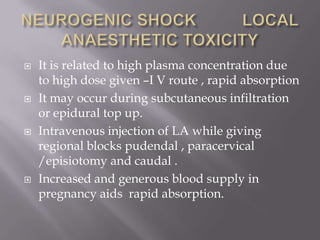
   It is related to high plasma concentration due
    to high dose given –I V route , rapid absorption
   It may occur during subcutaneous infiltration
    or epidural top up.
   Intravenous injection of LA while giving
    regional blocks pudendal , paracervical
    /episiotomy and caudal .
   Increased and generous blood supply in
    pregnancy aids rapid absorption.
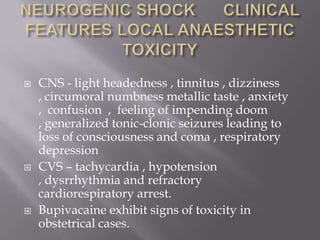
   CNS - light headedness , tinnitus , dizziness
    , circumoral numbness metallic taste , anxiety
    , confusion , feeling of impending doom
    , generalized tonic-clonic seizures leading to
    loss of consciousness and coma , respiratory
    depression
   CVS – tachycardia , hypotension
    , dysrrhythmia and refractory
    cardiorespiratory arrest.
   Bupivacaine exhibit signs of toxicity in
    obstetrical cases.
   Basic shock management ABC
   Special aspects 
    1. Circulation - Advanced life support with external
    cardiac massage and defibrillation . Arrhythmias may
    be resistant to conventional therapy.
    2.Maintain BP – Vasopressors and inotropic drugs
    3.Seizure management – diazepam 5-10 mg I V slowly.
    4.Lipid rescue recent work on animals now seems to be
    important tool of successful therapy (lipid rescue TM
    website).
    5. LSCS to salvage baby.
    6.Use of sedatives - to reduce the risk of awareness.
   It remains a significant cause of maternal
    death. Mortality Rate due to it , is 3% in
    obstetric patients.
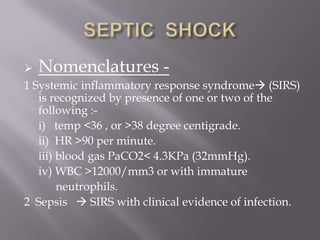
 Nomenclatures -
1 Systemic inflammatory response syndrome (SIRS)
   is recognized by presence of one or two of the
   following :-
   i) temp <36 , or >38 degree centigrade.
   ii) HR >90 per minute.
   iii) blood gas PaCO2< 4.3KPa (32mmHg).
   iv) WBC >12000/mm3 or with immature
        neutrophils.
2 Sepsis  SIRS with clinical evidence of infection.
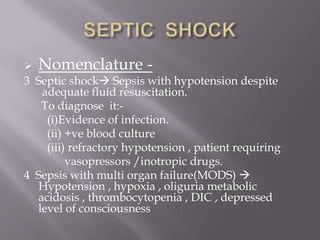
   Nomenclature -
3 Septic shock Sepsis with hypotension despite
   adequate fluid resuscitation.
   To diagnose it:-
    (i)Evidence of infection.
    (ii) +ve blood culture
    (iii) refractory hypotension , patient requiring
         vasopressors /inotropic drugs.
4 Sepsis with multi organ failure(MODS) 
  Hypotension , hypoxia , oliguria metabolic
  acidosis , thrombocytopenia , DIC , depressed
  level of consciousness
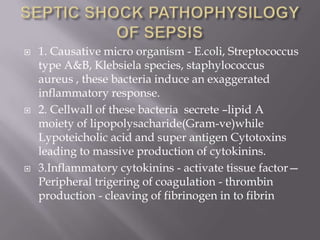
   1. Causative micro organism - E.coli, Streptococcus
    type A&B, Klebsiela species, staphylococcus
    aureus , these bacteria induce an exaggerated
    inflammatory response.
   2. Cellwall of these bacteria secrete –lipid A
    moiety of lipopolysacharide(Gram-ve)while
    Lypoteicholic acid and super antigen Cytotoxins
    leading to massive production of cytokinins.
   3.Inflammatory cytokinins - activate tissue factor—
    Peripheral trigering of coagulation - thrombin
    production - cleaving of fibrinogen in to fibrin
4. Cytokinins – disturb body modulators of
    coagulation /inflammation -- protien C & S , Anti
    thrombin III and tissue factor inhibitor – thus
    worsen Coagulopathy by decreasing fibrinolysis.
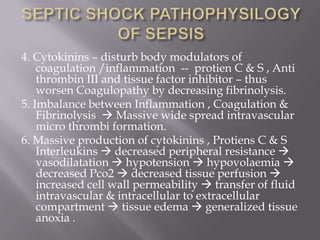
5. Imbalance between Inflammation , Coagulation &
    Fibrinolysis  Massive wide spread intravascular
    micro thrombi formation.
6. Massive production of cytokinins , Protiens C & S
    Interleukins  decreased peripheral resistance 
    vasodilatation  hypotension  hypovolaemia 
    decreased Pco2  decreased tissue perfusion 
    increased cell wall permeability  transfer of fluid
    intravascular & intracellular to extracellular
    compartment  tissue edema  generalized tissue
    anoxia .
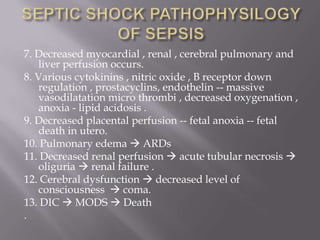
7. Decreased myocardial , renal , cerebral pulmonary and
   liver perfusion occurs.
8. Various cytokinins , nitric oxide , B receptor down
   regulation , prostacyclins, endothelin -- massive
   vasodilatation micro thrombi , decreased oxygenation ,
   anoxia - lipid acidosis .
9. Decreased placental perfusion -- fetal anoxia -- fetal
   death in utero.
10. Pulmonary edema  ARDs
11. Decreased renal perfusion  acute tubular necrosis 
   oliguria  renal failure .
12. Cerebral dysfunction  decreased level of
   consciousness  coma.
13. DIC  MODS  Death
.
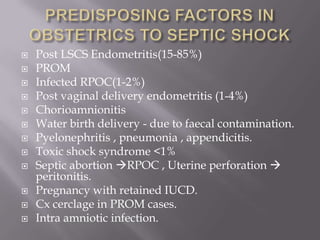
   Post LSCS Endometritis(15-85%)
   PROM
   Infected RPOC(1-2%)
   Post vaginal delivery endometritis (1-4%)
   Chorioamnionitis
   Water birth delivery - due to faecal contamination.
   Pyelonephritis , pneumonia , appendicitis.
   Toxic shock syndrome <1%
   Septic abortion RPOC , Uterine perforation 
    peritonitis.
   Pregnancy with retained IUCD.
   Cx cerclage in PROM cases.
   Intra amniotic infection.
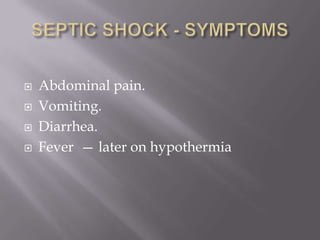
   Abdominal pain.
   Vomiting.
   Diarrhea.
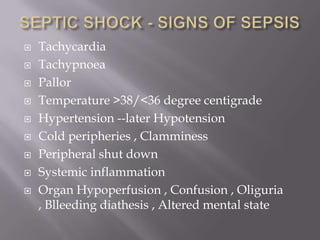
   Fever — later on hypothermia
   Tachycardia
   Tachypnoea
   Pallor
   Temperature >38/<36 degree centigrade
   Hypertension --later Hypotension
   Cold peripheries , Clamminess
   Peripheral shut down
   Systemic inflammation
   Organ Hypoperfusion , Confusion , Oliguria
    , Blleeding diathesis , Altered mental state
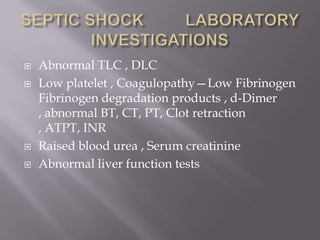
   Abnormal TLC , DLC
   Low platelet , Coagulopathy—Low Fibrinogen
    Fibrinogen degradation products , d-Dimer
    , abnormal BT, CT, PT, Clot retraction
    , ATPT, INR
   Raised blood urea , Serum creatinine
   Abnormal liver function tests
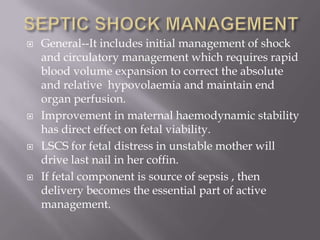
   General--It includes initial management of shock
    and circulatory management which requires rapid
    blood volume expansion to correct the absolute
    and relative hypovolaemia and maintain end
    organ perfusion.
   Improvement in maternal haemodynamic stability
    has direct effect on fetal viability.
   LSCS for fetal distress in unstable mother will
    drive last nail in her coffin.
   If fetal component is source of sepsis , then
    delivery becomes the essential part of active
    management.
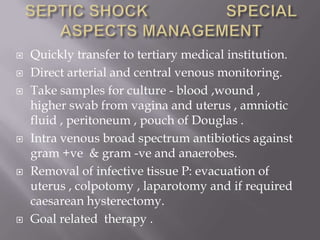
   Quickly transfer to tertiary medical institution.
   Direct arterial and central venous monitoring.
   Take samples for culture - blood ,wound ,
    higher swab from vagina and uterus , amniotic
    fluid , peritoneum , pouch of Douglas .
   Intra venous broad spectrum antibiotics against
    gram +ve & gram -ve and anaerobes.
   Removal of infective tissue P: evacuation of
    uterus , colpotomy , laparotomy and if required
    caesarean hysterectomy.
   Goal related therapy .
   Early goal – directed therapy - modifying the
    initial Rx to achieve mean arterial pressure >65
    mmHg , urine out put >0.5 ml/Kg/hr , CVP 8-12
    mm Hg and normal mixed venous oxygen
    saturation . An effort to reduce end organ damage
    and tissue death . It improves outcome in septic
    patients.
   Insulin therapy - aggressive control of blood sugar
    has been demonstrated to improve outcome in
    septic patients.
   Activated protein C (APC) - Patient with sepsis has
    decreased APC levels. Its administration decreases
    mortality and reduces organ dysfunction.
   Corticosteroid therapy ?-- In un selected septic
    paient it may worsen outcome because of
    secondary infection.
   In critically ill patient there may be relative
    adrenal insufficiency. In septic shock /the
    affected adrenals may not respond to increased
    demand of adrenocorticosteroids. Studies on
    Cortisone therapy in septic shock , have
    different results. Its beneficial effects in
    obstetrical sepsis is unknown.
1 .Shock results from acute , generalized , inadequate perfusion of the
    tissue.

2.Substandard care is still common in its management  patients
    death.

3.Sepsis/ haemorrhage are common in obstetrics.

4.Signs of hypovolaemia develop very late because of physiological
    changes in pregnancy.

5.Teamwork is required for successful treatment.

6.Obstetrical units  Fire drills regularly.

7.Resusctation to maintain tissue perfusion by ABC should be
   initiated as soon as shock is diagnosed.
8.Management of underlying cause is secondary task.

9.All therapy Is directed at optimising maternal condition and fetal
   wellbeing.

Obstetrical shock

  • 1.
    Prof. M.C.Bansal MBBS,MS,MICOG,FICOG Professor OBGY Ex-Principal & Controller Jhalawar Medical College & Hospital Mahatma Gandhi Medical College, Jaipur.
  • 2.
    Shock is a critical condition and a life threatening medical emergency.  Shock results from acute , generalised , inadequate perfusion of tissues; below that needed to deliver the oxygen and nutrients for normal function.  Prompt recognition and management can improve maternal and fetal outcome in obstetrical shock.
  • 3.
    Major causes ofshock include –  1. Hypovoluemic  Hemorrhage(occult /overt) , hyperemesis, diarrhoea, diabetic acidosis, peritonitis, burns.  2. Septicsepsis, endotoxaemia.  3.Cardiogeniccardiomyopathies , obstructive structural , obstructive non structural , dysrrhythmias, regurgitant lesions.  4.DistributiveNeurogenic- spinal injury, regional anesthesia,  5.Anaphylaxis.
  • 4.
    Untreated shock progressesthrough three stages.  Stage1 Compensated --Fall in BP and cardiac output is compensated by adjustment of homeostatic mechanism, if cause removed –iv fluid therapy it is reversible.  Stage2 Decompensate--Maximal compensatory mechanism are acting but tissue perfusion is reduced. Vital organ(cerebral , renal, myocardial) function reduced.  Stage3 Irreversible--Vital organ perfusion badly impaired. Acute tubular necrosis , severe acidosis, decreased myocardial perfusion and contractility  the profound decrease in perfusion leads to cellular death & Organ failure.
  • 5.
    A high indexof suspicion and physical signs of inadequate perfusion and oxygenation are the basis of initiating prompt treatment. Initial management does not rely on knowledge of the underlying cause. There are no laboratory tests for shock. Basic investigations should be sent e.g.Hb,BT,CT,PCV. Blood for grouping and cross matching , FB Sugar , routine urine analysis.
  • 6.
    Shocked pt requires teamwork--Senior anaesthetist , obstetrician , physician and hematologist are to be summoned immediately.  Obstetrical units should have established protocols for dealing with shock.  Practice ―FIRE DRILL‖.  MOET,ALSO training courses for individuals and team.  Active management of shock should start as soon as it is suspected or expected aiming for prompt restoration of tissue perfusion and oxygenation.
  • 7.
    Resuscitation follows---ABC  A Airway--Patent airway is assured and high pressure oxygen (15 l/min)using mask/intra tracheal intubation and anaesthesia machine.  B Breathing--Ventilation checked and supported if needed .  C Circulation--1 Insert two wide bore cannulas 2 Restore blood volume and reverse hypotension with crystalloids/colloids. 3 Initial request for4-6 units of blood should be sent. O Rh negative blood may be transfused
  • 8.
    Monitor the response to therapy - Pulse , BP , SPO2 /pulse oxymetry, urine output & its pH .  Position of patient - Head down and left lateral tilt to avoid aortocaval compression which may further worsen the hypotension.  Vasoactive drugs (inotropes and vasopressors) are considered if the cause of shock is thought to be due to myocardial depression or profound vasodilatation.  These drugs have no part in hypovolumic shock.
  • 9.
    Pregnancy produces a hyperdynamic , hypervolaemic , maternal circulation.  This serves the purpose of saving mother against haemorrhage to some extent.  Cardiac output increases by 50% , blood volume by 45% reaching a peak at 32-34 wks.  30% loss of fluid may be tolerated without any tachycardia.  Aortocaval compression aggravates the unstability seen in haemorrhage.  In antenatal period , uteroplacental hypoperfusion may occur before maternal signs are evident . Adversely affects on fetal well-being , can be detected FHR abnormalities on cardiotocograph.
  • 10.
    AntenatalRuptured ectopic pregnancy, Incomplete abortion, MTP, Uterine perforation during evacuation , APH, Uterine rupture, Abdominal wall hematoma, Non obstetrical intra abdominal bleeding.  Intra natal uterine rupture.  Post natal PPH(primary, secondary) Atonic , Traumatic, Retained tissue , Thrombosis, Acute uterine inversion . Nonhaemorrhagic hypovolaemic shock ,Burns Hyperemesis gravidorum , Ac. Diarrhoea
  • 11.
    The diagnosis of underlying cause and definitive treatment is initiated once resuscitation is under way.  Surgical/ obstetrical--- ectopic pregnancy, abortion, uterine perforation ,APH, uterine rupture. PPH, inversion of uterus.
  • 12.
    A. CELL SALVAGE  Auto transfusion with salvaged red cells avoids the hazards of homologous transfusion. Blood is removed from operative site through heparinised suction tubing and a filter collecting reservoir and processed by washing and centrifugation to remove contaminating debris.  The resulting RBC have a haematocrit of 55-80 % and can be returned to patient quickly.  The risk of amniotic fluid is obviously a concern. Use of separate suction for amniotic fluid and leukocyte depletion filter has been found in removing fetal component from the salvaged blood.
  • 13.
    Disadvantages of salvaged cell transfusion-  1 Units have capital and maintenance cost.  2 Staff require training and regular CME/workshops to update itself.  3 Technique is of no use in PPH as faecal and urine contamination with blood.
  • 14.
    B.RECOMBINANT ACTIVATED FACTOR VII  rFVIIa promotes clot formation through its action at many stages in clotting cascade. It forms a complex with tissue factor a key initiator in homeostasis, leading to production of small amount of thrombin and activating factor V ,VII and platelet aggregation at the site of injury. Hence aids inconversion of fibrinogen in to fibrin and formation of clot.  C.PELVIC ARTERIAL EMBOLISATION
  • 16.
    The failure of heart to provide adequate output leads to tissue under perfusion.  Back pressure on lungs leads to Pulmonary edema.  Pregnancy puts progressive strain on cardiac function as pregnancy progresses , the peak being between 32-34 wks.  Pre existing cardiac disease further increases the risk.  Cardiac related death are 2nd most common causes of death in pregnancy and commoner than the direct leading cause , thromboembolism.
  • 17.
    Early diagnosis of cardiac lesion.  Surgical correction of operable cardiac lesion , before pregnancy is planned.  Medical control of decompensated cardiac lesion by cardiac correction before pregnancy is planned.  Avoiding Pregnancy/MTP at 6-8 wks if cardiac condition is not under control.  Management of pregnancy in such patients by the expert team of cardiologist and obstetrician .  Initial Rx of shock is similar , further Rx depends on cardiac lesionBy the team present in cardiac ICU
  • 19.
    Definition - Aserious allergic reaction that is rapid in onset and may result in death. Aetiology - Pharmacological agents ,insect stings, foods , latex may trigger ANAPHYLAXIS
  • 20.
    Pathophysiology - Anexaggerated immunological response to antigen to which an individual has been previously sensitized. It is a type 1 hypersensitivity (IgE mediated) response causing breakdown and degradation of mast cells and basophils releasing mediators (Histamine , Serotonin, Bradikynin , Thromboxane , tryptase and leukotrienes) into plasma . These substances cause increased mucous membranes secretions , increased capillary permeability and leakage , marked vasodilatation and bronchospasm.
  • 21.
    Symptoms and signs- 1 .Cutaneous -- (80%) flushing , pruritis , urticaria , rhinitis , conjunctival erythema, lacrymation 2.Cardiovascular -- cardiovascular collapse , hypotension, vasodilatation, pale , cold clammy skin , nausea , vomiting. 3.Respiratory—airway oedema , stridor , wheezing , dyspnoea , cough , chest/throat tightness , hypoxia—confusion , increased airway resistance.
  • 22.
    Symptoms and signs- 4. Gastrointestinal - nausea , vomiting , abdominal pain . 5. C N S - Hypotension causes collapse with/without unconsciousness , dizziness , incontinence , confusion and throbbing headache .
  • 23.
    1. Basic shock management  ABC  2. Circulatory management  3. Primary (Special aspect) - Stop administration of suspected substance and call for help. - Subcutaneous 1ml injection of diluted Adrenaline (1:1000) - Early intra tracheal intubation-airway edema will make it problematic later. - Supine/trendelenberg position with raised legs increases venous return. - Start vasopressor drugs and monitor BP. Rapid infusion for plasma volume expansion , with crystalloids
  • 24.
    4. Secondary - Atropine may be given if significant bradycardia. - If bronchospasm – nebulise /I V Amino/Derriphyllin or Beta 2 agonist such as Salbutamol , Inhaled Ipravent may be particularly useful for treatment of bronchospasm in patients on B-blockers. - Antihistamines - IV Chlorpheniramine. - Corticosteroids - Effcorlin in I V drip . Dexamthesone. Referral to critical care unit.
  • 25.
    Immediate - Elevated serum Tryptase , indicates Mast cell degradation . 3 samples of blood are taken at 1st,2nd,3rd hr following suspected reaction.  Late - The aim is to identify causative agent. Refer to immunologist/allergist for investigation.
  • 27.
    Amniotic fluid embolism is a rare , devastating condition .  It is responsible for (8%) of the direct maternal deaths .  It’s incidence is 1 in 80,000 - 120,000 .  It is characterized by an abrupt cardiovascular collapse and coagulopathy during labor or in the immediate post partum period.
  • 28.
    Exact mechanism of AFE not clear.  The process is more similar to anaphylactic shock.  Amniotic fluid found in the pulmonary circulation produces intense pulmonary vasospasm and pulmonary hypertension.  When ventilation perfusion mismatch occurs , profound hypoxia ensues.  Hypoxia may account for 50% maternal deaths in 1st hr of its onset.  Following initial phase there is a phase of hemodynamic compromise caused by left ventricular failure . Right heart parameters return to normal . This mechanism is yet not clear (animal model studies).
  • 29.
    Delivering woman develops acute dyspnoea , hypotension ,seizures.  Tachycardia , tachypnoea .  cough - blood tinged frothy sputum .  Cyanosis - circum oral and peripheral .  Fetal bradycardia as a result of hypoxic insult.  Uterine atony - PPH . Dark colored blood which does not clot  DIC .  Pulmonary oedema – typical X- Ray changes present.  Cardiac arrest.
  • 30.
    Initial management ABC  Circulatory management   1. Treat hypotension with vasopressors crystalloids and Colloids I V transfusions .  2. Women who survive the initial phase require ICU admission and prompt management of DIC and left heart failure.  3. Coagulopathy is treated with fresh frozen plasma, cryoprecipitate and platelets as directed by coagulation studies .  4. Activated recombinant factor VIIa has also being used.  5. Plenty of fresh heparinized blood .  6. Surgery - Perform emergency caesarean surgery in arrested mother who are un responsive ?
  • 32.
    There is no loss in intra vascular volume or cardiac function.  The primary defect is a massive vasodilatation leading to relative hypovolaemia , reduced perfusion pressure.  Poor blood flow to tissue  tissue anoxia clinical features of shock .  ABC of initial management.
  • 34.
    Spinal cord injury may produce hypotension and shock as a result of sympathetic nervous system dysfunction . Loss of sympathetic tone causes wide spread vasodilatation.  Initial management requires ABC , fluid resuscitation and vasopressor drugs to counteract vasodilatation .  Atropine may be necessary in high lesions as bradycardia may occur due to unopposed vagal activity.
  • 35.
    1. Shock mayoccur during any type of anaesthesia or analgesia for labour or delivery. 2. Shock caused by general anaesthesia is usually due to adverse drug reaction (anaphylactic type). 3. High spinal block ---it occurs when over dose of local anaesthetic drug is administered into epidural or subarachnoid spaces . Factors include— i . Drug dose is reduced in pregnancy. ii . High spinal block may follow excessive spread of drug iii . Accidental intrathecal injection of LA intended for epidural space. Unrecognised dural puncture, migration of epidural catheter in to intrathecal space. iv . Hypotension may be aggravated by incorrect positioning , absence of lateral tilt -- aortocaval compression.
  • 36.
    All regional anesthesia techniques produce  sympathetic and motor blockade. This only becomes problem when it is high and extensive 1. Hypotension – preceded by nausea or not feeling well. 2. Bradycardia – unopposed vagal tone due to blockage of cardio acceleratory fibers(T1-T4) 3. Difficulty in breathing due to paralysis of intercostal muscles and diaphragm. 4. Upper limb neurological signs (C5-T1) tingling of fingers and weakness.
  • 37.
    Basic shock managementABC  Support of cardiovascular system by Vasopressors , Inotropes.  Intra tracheal intubation and ventilation support with ventilator.  Sedatives can be used to reduce the awareness once initial resuscitation is achieved.
  • 38.
    It is related to high plasma concentration due to high dose given –I V route , rapid absorption  It may occur during subcutaneous infiltration or epidural top up.  Intravenous injection of LA while giving regional blocks pudendal , paracervical /episiotomy and caudal .  Increased and generous blood supply in pregnancy aids rapid absorption.
  • 39.
    CNS - light headedness , tinnitus , dizziness , circumoral numbness metallic taste , anxiety , confusion , feeling of impending doom , generalized tonic-clonic seizures leading to loss of consciousness and coma , respiratory depression  CVS – tachycardia , hypotension , dysrrhythmia and refractory cardiorespiratory arrest.  Bupivacaine exhibit signs of toxicity in obstetrical cases.
  • 40.
    Basic shock management ABC  Special aspects  1. Circulation - Advanced life support with external cardiac massage and defibrillation . Arrhythmias may be resistant to conventional therapy. 2.Maintain BP – Vasopressors and inotropic drugs 3.Seizure management – diazepam 5-10 mg I V slowly. 4.Lipid rescue recent work on animals now seems to be important tool of successful therapy (lipid rescue TM website). 5. LSCS to salvage baby. 6.Use of sedatives - to reduce the risk of awareness.
  • 42.
    It remains a significant cause of maternal death. Mortality Rate due to it , is 3% in obstetric patients.
  • 43.
     Nomenclatures - 1Systemic inflammatory response syndrome (SIRS) is recognized by presence of one or two of the following :- i) temp <36 , or >38 degree centigrade. ii) HR >90 per minute. iii) blood gas PaCO2< 4.3KPa (32mmHg). iv) WBC >12000/mm3 or with immature neutrophils. 2 Sepsis  SIRS with clinical evidence of infection.
  • 44.
    Nomenclature - 3 Septic shock Sepsis with hypotension despite adequate fluid resuscitation. To diagnose it:- (i)Evidence of infection. (ii) +ve blood culture (iii) refractory hypotension , patient requiring vasopressors /inotropic drugs. 4 Sepsis with multi organ failure(MODS)  Hypotension , hypoxia , oliguria metabolic acidosis , thrombocytopenia , DIC , depressed level of consciousness
  • 45.
    1. Causative micro organism - E.coli, Streptococcus type A&B, Klebsiela species, staphylococcus aureus , these bacteria induce an exaggerated inflammatory response.  2. Cellwall of these bacteria secrete –lipid A moiety of lipopolysacharide(Gram-ve)while Lypoteicholic acid and super antigen Cytotoxins leading to massive production of cytokinins.  3.Inflammatory cytokinins - activate tissue factor— Peripheral trigering of coagulation - thrombin production - cleaving of fibrinogen in to fibrin
  • 46.
    4. Cytokinins –disturb body modulators of coagulation /inflammation -- protien C & S , Anti thrombin III and tissue factor inhibitor – thus worsen Coagulopathy by decreasing fibrinolysis. 5. Imbalance between Inflammation , Coagulation & Fibrinolysis  Massive wide spread intravascular micro thrombi formation. 6. Massive production of cytokinins , Protiens C & S Interleukins  decreased peripheral resistance  vasodilatation  hypotension  hypovolaemia  decreased Pco2  decreased tissue perfusion  increased cell wall permeability  transfer of fluid intravascular & intracellular to extracellular compartment  tissue edema  generalized tissue anoxia .
  • 47.
    7. Decreased myocardial, renal , cerebral pulmonary and liver perfusion occurs. 8. Various cytokinins , nitric oxide , B receptor down regulation , prostacyclins, endothelin -- massive vasodilatation micro thrombi , decreased oxygenation , anoxia - lipid acidosis . 9. Decreased placental perfusion -- fetal anoxia -- fetal death in utero. 10. Pulmonary edema  ARDs 11. Decreased renal perfusion  acute tubular necrosis  oliguria  renal failure . 12. Cerebral dysfunction  decreased level of consciousness  coma. 13. DIC  MODS  Death .
  • 48.
    Post LSCS Endometritis(15-85%)  PROM  Infected RPOC(1-2%)  Post vaginal delivery endometritis (1-4%)  Chorioamnionitis  Water birth delivery - due to faecal contamination.  Pyelonephritis , pneumonia , appendicitis.  Toxic shock syndrome <1%  Septic abortion RPOC , Uterine perforation  peritonitis.  Pregnancy with retained IUCD.  Cx cerclage in PROM cases.  Intra amniotic infection.
  • 49.
    Abdominal pain.  Vomiting.  Diarrhea.  Fever — later on hypothermia
  • 50.
    Tachycardia  Tachypnoea  Pallor  Temperature >38/<36 degree centigrade  Hypertension --later Hypotension  Cold peripheries , Clamminess  Peripheral shut down  Systemic inflammation  Organ Hypoperfusion , Confusion , Oliguria , Blleeding diathesis , Altered mental state
  • 51.
    Abnormal TLC , DLC  Low platelet , Coagulopathy—Low Fibrinogen Fibrinogen degradation products , d-Dimer , abnormal BT, CT, PT, Clot retraction , ATPT, INR  Raised blood urea , Serum creatinine  Abnormal liver function tests
  • 52.
    General--It includes initial management of shock and circulatory management which requires rapid blood volume expansion to correct the absolute and relative hypovolaemia and maintain end organ perfusion.  Improvement in maternal haemodynamic stability has direct effect on fetal viability.  LSCS for fetal distress in unstable mother will drive last nail in her coffin.  If fetal component is source of sepsis , then delivery becomes the essential part of active management.
  • 53.
    Quickly transfer to tertiary medical institution.  Direct arterial and central venous monitoring.  Take samples for culture - blood ,wound , higher swab from vagina and uterus , amniotic fluid , peritoneum , pouch of Douglas .  Intra venous broad spectrum antibiotics against gram +ve & gram -ve and anaerobes.  Removal of infective tissue P: evacuation of uterus , colpotomy , laparotomy and if required caesarean hysterectomy.  Goal related therapy .
  • 54.
    Early goal – directed therapy - modifying the initial Rx to achieve mean arterial pressure >65 mmHg , urine out put >0.5 ml/Kg/hr , CVP 8-12 mm Hg and normal mixed venous oxygen saturation . An effort to reduce end organ damage and tissue death . It improves outcome in septic patients.  Insulin therapy - aggressive control of blood sugar has been demonstrated to improve outcome in septic patients.  Activated protein C (APC) - Patient with sepsis has decreased APC levels. Its administration decreases mortality and reduces organ dysfunction.
  • 55.
    Corticosteroid therapy ?-- In un selected septic paient it may worsen outcome because of secondary infection.  In critically ill patient there may be relative adrenal insufficiency. In septic shock /the affected adrenals may not respond to increased demand of adrenocorticosteroids. Studies on Cortisone therapy in septic shock , have different results. Its beneficial effects in obstetrical sepsis is unknown.
  • 56.
    1 .Shock resultsfrom acute , generalized , inadequate perfusion of the tissue. 2.Substandard care is still common in its management  patients death. 3.Sepsis/ haemorrhage are common in obstetrics. 4.Signs of hypovolaemia develop very late because of physiological changes in pregnancy. 5.Teamwork is required for successful treatment. 6.Obstetrical units  Fire drills regularly. 7.Resusctation to maintain tissue perfusion by ABC should be initiated as soon as shock is diagnosed. 8.Management of underlying cause is secondary task. 9.All therapy Is directed at optimising maternal condition and fetal wellbeing.