OPEN PNEUMOTHORAX
DEPARTMENT OF SURGERY
Presented by :- DEEPALI AGRAWAL
Roll No.- 27
MBBS FINAL PART - II
CONTENTS
•INTRODUCTION
•INCIDENCE
•CAUSES
•PATHOPHYSIOLOGY
•SIGNS AND SYMPTOMS
•DIAGNOSIS
•MANAGEMENT
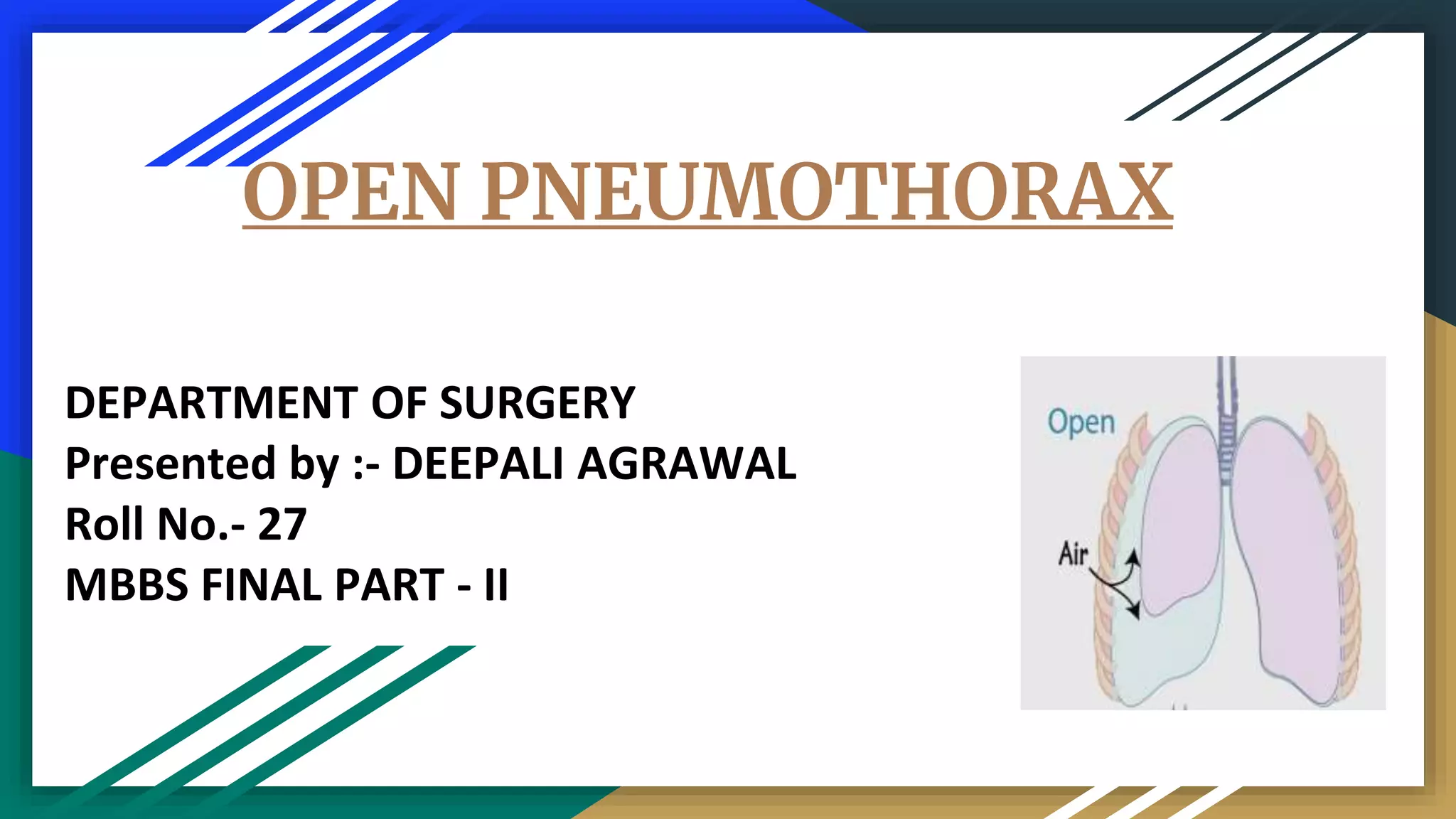
● Occurs due to a large open defect in the thorax (>3cm),
leading to immediate equilibration between intrathoracic
and atmospheric pressure.
● There is direct communication between the pleura and
the atmosphere.
● Also known as sucking chest wound.
INTRODUCTION
When wound is > ⅔ tracheal diameter:
● Inspiration pulls air through the wound into the
pleural space.
● Air does not flow through the trachea into the
lungs.
•Air accumulated in hemithorax with each
respiration, leading to profound hypoventilation on
the affected side and hypoxia.
INCIDENCE
It is estimated that open pneumothorax occurs in 80% of all
penetrating chest wounds with stab wounds being more
common than gunshot wounds.
● Trauma
-Blunt
-Penetrating
● Iatrogenic
-Transtracheal aspiration
-Lung biopsy
-Tube thoracostomy
CAUSES
Air enters pleural cavity through
open,sucking chest wound.
Negative pleural pressure is lost
permitting collapse of ipsilateral
lung and reducing venous return
to heart. Mediastenum shifts,
compressing opposite lung.
As chest wall contracts and diaphragm rises, air is
expelled from pleural cavity via wound. Mediastinum
shifts to affected side and mediastinal flutter further
impairs venous return by distortion of venae cavae.
SIGNS & SYMPTOMS
● Sudden chest pain
● Shortness of breath
● Rapid and shallow breathing
● Tachycardia
● Hypoxia
•Clinical diagnosis should be made during primary survey.
•INSPECTION - Wound seen that appears to be 'sucking' air (sometimes audible)
into the chest cavity during inspiration and may produce bubbling blood during
expiration.
-Rapid shallow breathing which worsens as lung expansion
decreases.
•PALPATION - Trail Sign-mediastinum shifted to the opposite side.
•PERCUSSION - Hyper resonance.
•AUSCULTATION - Poor air entry detected in the affected hemithorax.
DIAGNOSIS
RADIOLOGICAL DIAGNOSIS
● Computerized tomography (CT)
● Chest X-ray
● Ultrasound - more useful than a chest X-ray.
If a patient is very unstable with a suspected open pneumothorax,
treatment is typically initiated before imaging is used to confirm the
diagnosis.
MANAGEMENT
INITIAL MANAGEMENT
•Provide the patient with high flow oxygen via a face mask.
•Control any visible bleeding by direct pressure.
•Apply sterile non porous oclussive plastic dressing over the
wound.
- Prevents air from entering the wound during inhalation
- Allows air to escape through wound during exhalation.
Tapped on three sides to act as flutter type valve.
- Prevents conversion to tension pneumothorax
DEFINITIVE MANAGEMENT
● Inserting a needle or chest tube between the ribs
to remove excess air.
● High incidence of underlying injuries require
surgery.
COMPLICATIONS
● Respiratory failure
● Cardiac arrest
● Pneumopericardium
● Pneumoperitoneum
● Hemothorax
● Bronchopulmonary fistula
● Damage to neurovascular bundle during tube thoracostomy
● Pain and skin infection at site of tube thoracotomy
THANK YOU

Open pneumothorax

  • 1.
    OPEN PNEUMOTHORAX DEPARTMENT OFSURGERY Presented by :- DEEPALI AGRAWAL Roll No.- 27 MBBS FINAL PART - II
  • 2.
  • 3.
    ● Occurs dueto a large open defect in the thorax (>3cm), leading to immediate equilibration between intrathoracic and atmospheric pressure. ● There is direct communication between the pleura and the atmosphere. ● Also known as sucking chest wound. INTRODUCTION
  • 4.
    When wound is> ⅔ tracheal diameter: ● Inspiration pulls air through the wound into the pleural space. ● Air does not flow through the trachea into the lungs. •Air accumulated in hemithorax with each respiration, leading to profound hypoventilation on the affected side and hypoxia.
  • 6.
    INCIDENCE It is estimatedthat open pneumothorax occurs in 80% of all penetrating chest wounds with stab wounds being more common than gunshot wounds.
  • 7.
    ● Trauma -Blunt -Penetrating ● Iatrogenic -Transtrachealaspiration -Lung biopsy -Tube thoracostomy CAUSES
  • 8.
    Air enters pleuralcavity through open,sucking chest wound. Negative pleural pressure is lost permitting collapse of ipsilateral lung and reducing venous return to heart. Mediastenum shifts, compressing opposite lung. As chest wall contracts and diaphragm rises, air is expelled from pleural cavity via wound. Mediastinum shifts to affected side and mediastinal flutter further impairs venous return by distortion of venae cavae.
  • 9.
    SIGNS & SYMPTOMS ●Sudden chest pain ● Shortness of breath ● Rapid and shallow breathing ● Tachycardia ● Hypoxia
  • 10.
    •Clinical diagnosis shouldbe made during primary survey. •INSPECTION - Wound seen that appears to be 'sucking' air (sometimes audible) into the chest cavity during inspiration and may produce bubbling blood during expiration. -Rapid shallow breathing which worsens as lung expansion decreases. •PALPATION - Trail Sign-mediastinum shifted to the opposite side. •PERCUSSION - Hyper resonance. •AUSCULTATION - Poor air entry detected in the affected hemithorax. DIAGNOSIS
  • 11.
    RADIOLOGICAL DIAGNOSIS ● Computerizedtomography (CT) ● Chest X-ray ● Ultrasound - more useful than a chest X-ray. If a patient is very unstable with a suspected open pneumothorax, treatment is typically initiated before imaging is used to confirm the diagnosis.
  • 12.
    MANAGEMENT INITIAL MANAGEMENT •Provide thepatient with high flow oxygen via a face mask. •Control any visible bleeding by direct pressure.
  • 13.
    •Apply sterile nonporous oclussive plastic dressing over the wound. - Prevents air from entering the wound during inhalation - Allows air to escape through wound during exhalation. Tapped on three sides to act as flutter type valve. - Prevents conversion to tension pneumothorax
  • 15.
    DEFINITIVE MANAGEMENT ● Insertinga needle or chest tube between the ribs to remove excess air. ● High incidence of underlying injuries require surgery.
  • 16.
    COMPLICATIONS ● Respiratory failure ●Cardiac arrest ● Pneumopericardium ● Pneumoperitoneum ● Hemothorax ● Bronchopulmonary fistula ● Damage to neurovascular bundle during tube thoracostomy ● Pain and skin infection at site of tube thoracotomy
  • 17.