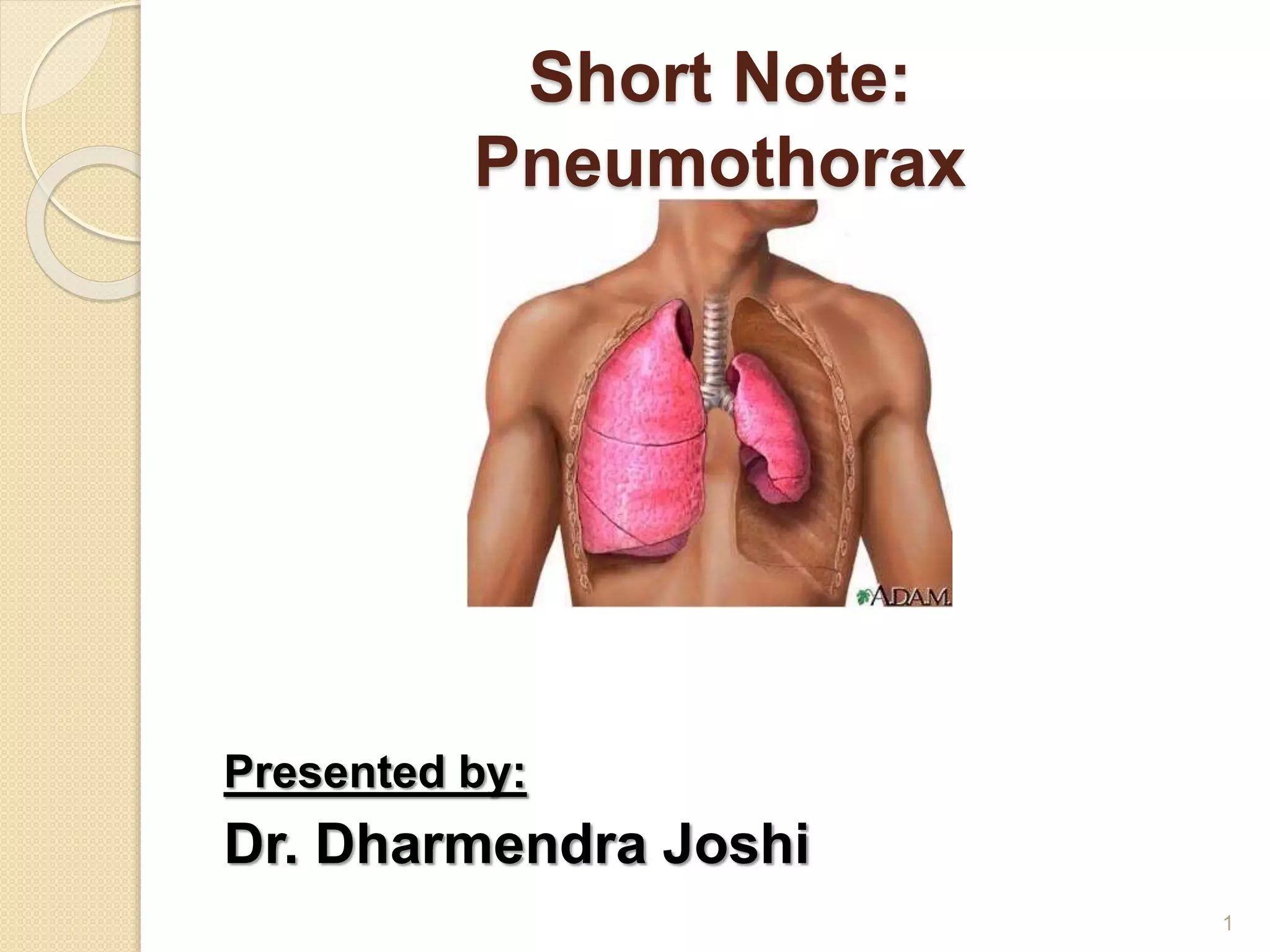
Short Note:
Pneumothorax
Presented by:
Dr. Dharmendra Joshi
1
Introduction:
๏‚— Laennec described the clinical picture of
Pneumothorax in 1819.
๏‚— The modern description of primary
spontaneous pneumothorax occurring in
otherwise healthy people was provided
by Kjaergard in 1932.
๏‚— Primary pneumothorax remains a
significant global problem.
๏‚— Incidence is 18-28/100,000 per year for
men and 1.2-6/100,000 per year for
women.
2
Definition:
๏‚ง Pneumothorax is defined as
presence of air or gas in the
pleural space
(OR)
๏‚ง Presence of air outside the lung,
within the pleural space.
3
Mechanism:
๏‚— In normal people, the pressure in
pleural space is negative during the
entire respiratory cycle.
๏‚— Two opposite forces result in negative
pressure in pleural space.
(outward pull of the chest wall and
elastic recoil of the lung)
๏‚— The negative pressure will
be disappeared if any communication
develops .
4
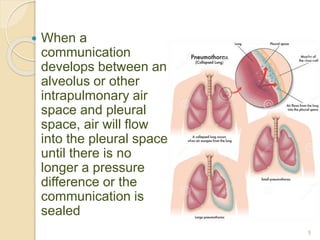
๏‚— When a
communication
develops between an
alveolus or other
intrapulmonary air
space and pleural
space, air will flow
into the pleural space
until there is no
longer a pressure
difference or the
communication is
sealed
5
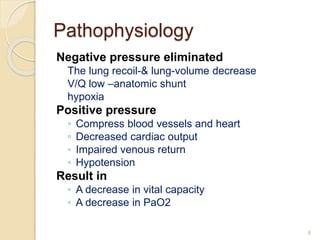
Pathophysiology
Negative pressure eliminated
The lung recoil-& lung-volume decrease
V/Q low โ€“anatomic shunt
hypoxia
Positive pressure
โ—ฆ Compress blood vessels and heart
โ—ฆ Decreased cardiac output
โ—ฆ Impaired venous return
โ—ฆ Hypotension
Result in
โ—ฆ A decrease in vital capacity
โ—ฆ A decrease in PaO2
6
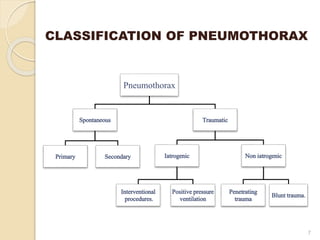
CLASSIFICATION OF PNEUMOTHORAX
7
Pneumothorax
Spontaneous
Primary Secondary
Traumatic
Iatrogenic
Interventional
procedures.
Positive pressure
ventilation
Non iatrogenic
Penetrating
trauma
Blunt trauma.
8
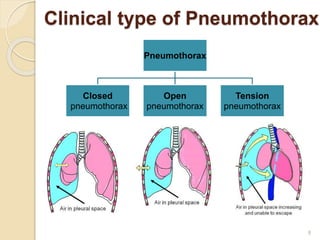
Clinical type of Pneumothorax
Pneumothorax
Closed
pneumothorax
Open
pneumothorax
Tension
pneumothorax
Clinical manifestation:
๏ƒ˜Dyspnea
๏ƒ˜Chest pain ( pleuritic)
Uncommon manifestation:
๏ถCough
๏ถHemoptysis
๏ถOrthopnea
๏ถCyanosis
๏ถMod tachycardia
9
Clinical manifestation
๏‚— Tension pneumothorax
โ—ฆ Distressed with rapid labored respiration
โ—ฆ Cyanosis
โ—ฆ Marked tachycardia
๏‚— Patient who suddenly deteriorate
clinically,
be suspected in the patient with
โ—ฆ Mechanical ventilation
โ—ฆ Cardiopulmonary resuscitation
10
Physical examination:
โ—ฆ Depend on size of pneumothorax
โ—ฆ The vital signs usually normal
โ—ฆ Unilateral Chest movements
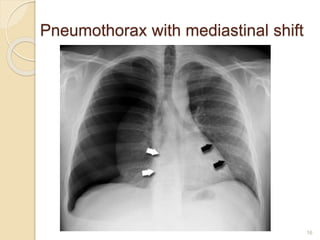
โ—ฆ The trachea may be shifted toward the
contralateral side if the pneumothorax is
large
โ—ฆ Tactile fremitus is absent
โ—ฆ The percussion note is hyper-resonant
โ—ฆ The breath sounds are reduced or absent
on the affected side
โ—ฆ The lower edge of the liver may be shifted
inferiorly with a right-side pneumothorax
11
Lab investigations
and Diagnosis
12
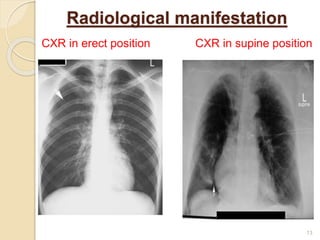
Radiological manifestation
CXR in erect position CXR in supine position
13
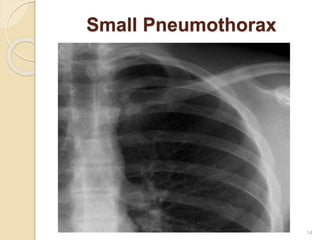
Small Pneumothorax
14
15
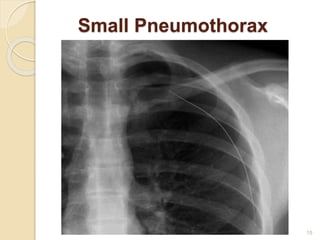
Small Pneumothorax
16
Pneumothorax with mediastinal shift
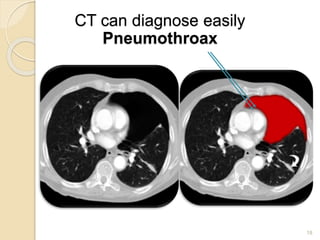
CT scanning
๏ƒ˜It is recommended in difficult cases
such as patients in whom the lungs
are obscured by overlying surgical
emphysema
๏ƒ˜To differentiate a pneumothorax from
suspected bulla in complex cystic lung
disease
17
18
CT can diagnose easily
Pneumothroax
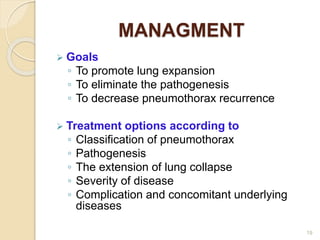
MANAGMENT
๏ƒ˜ Goals
โ—ฆ To promote lung expansion
โ—ฆ To eliminate the pathogenesis
โ—ฆ To decrease pneumothorax recurrence
๏ƒ˜ Treatment options according to
โ—ฆ Classification of pneumothorax
โ—ฆ Pathogenesis
โ—ฆ The extension of lung collapse
โ—ฆ Severity of disease
โ—ฆ Complication and concomitant underlying
diseases
19
20
21
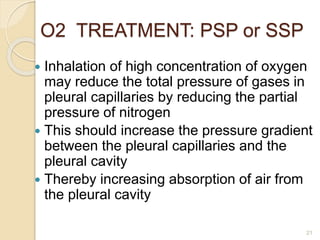
๏‚— Inhalation of high concentration of oxygen
may reduce the total pressure of gases in
pleural capillaries by reducing the partial
pressure of nitrogen
๏‚— This should increase the pressure gradient
between the pleural capillaries and the
pleural cavity
๏‚— Thereby increasing absorption of air from
the pleural cavity
O2 TREATMENT: PSP or SSP
22
๏‚— The rate of resolution/re-absorption of
spontaneous pneumothorax is 1.25 โ€“
1.8% of volume of hemi thorax every 24
hours
๏‚— The addition of high flow oxygen
therapy has been shown to result in a
4-fold increase in the rate of
pneumothorax reabsorption during the
periods of oxygen supplementation
23
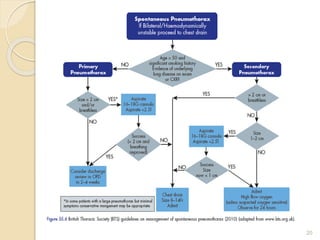
Simple aspiration
๏‚— Simple aspiration is recommended as first line
treatment for all PSP requiring intervention
๏‚— Simple aspiration is less likely to succeed in
secondary pneumothoraces and in this situation,
is only recommended as an initial treatment in
small (<2 cm) pneumothoraces in minimally
breathless patients under the age of 50 years
๏‚— Patients with secondary pneumothoraces
treated successfully with simple aspiration
should be admitted to hospital and observed for
at least 24 hours before discharge
24
๏‚— Repeated aspiration is reasonable for
primary pneumothorax when the first
aspiration has been unsuccessful
๏‚— A volume of < 2.5 L has been aspirated on
the first attempt
๏‚— The aspiration can be used by needle or
catheter
Catheter aspiration
Intercostal tube drainage
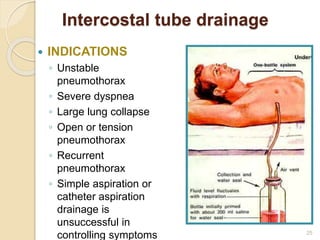
๏‚— INDICATIONS
โ—ฆ Unstable
pneumothorax
โ—ฆ Severe dyspnea
โ—ฆ Large lung collapse
โ—ฆ Open or tension
pneumothorax
โ—ฆ Recurrent
pneumothorax
โ—ฆ Simple aspiration or
catheter aspiration
drainage is
unsuccessful in
controlling symptoms 25
26
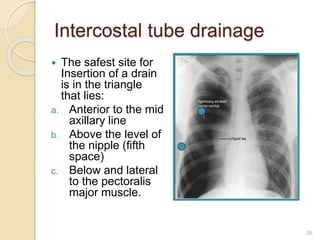
๏‚— The safest site for
Insertion of a drain
is in the triangle
that lies:
a. Anterior to the mid
axillary line
b. Above the level of
the nipple (fifth
space)
c. Below and lateral
to the pectoralis
major muscle.
Intercostal tube drainage
27
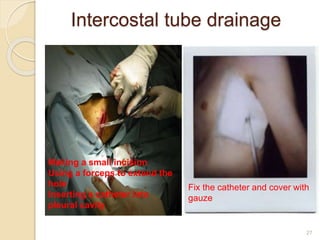
Intercostal tube drainage
Fix the catheter and cover with
gauze
Making a small incision
Using a forceps to extend the
hole
Inserting a catheter into
pleural cavity
28
Observation of drainage
๏‚— No bubble released:
โ—ฆ The lung re-expansion
โ—ฆ The chest tube is obstructed by secretion or blood clot
โ—ฆ The chest tube shift to chest wall, the hole of the chest
tube is located in the chest wall
๏‚— If the lung re-expand, the chest tube may be removed
24 hours after re-expansion.
๏‚— Otherwise, the chest tube will be inserted again or
regulated the position.
29
Surgical treatment
๏‚— Indications
โ—ฆ No response to medical treatment
โ—ฆ Persist air leak
โ—ฆ Haemopneumothorax
โ—ฆ Bilateral pneumothoraces
โ—ฆ Recurrent pneumothorax
โ—ฆ Tension pneumothorax failed to drainage
โ—ฆ Thicken pleura makes lung unable to re-
expansion
โ—ฆ Multiple blebs or bullae
Definitive Management of
Pneumothorax
PLEURECTOMY AND
PLEURODESIS
๏‚— Surgery for pneumothorax can be performed by
video-assisted thoracoscopic surgery (VATS) or as
an open procedure (thoracotomy).
๏‚— The object of the exercise is three-fold:
โ€ข to deal with any leaks from the lung;
โ€ข to search for and obliterate any blebs and bullae
(Bullectomy);
โ€ข to make the visceral pleura adherent to the parietal
pleura so that any subsequent leaks are contained
and the lung cannot completely collapse.
30
Pleural adhesion is achieved in
one of three ways:
โ€ข Pleurectomy: systematically strip the
parietal pleura from the chest wall.
โ€ข Pleural abrasion: a scourer is used to
scrape off the slick surface of the
parietal pleura.
โ€ข Chemical pleurodesis: usually talc is
used and is insufflated into the chest
cavity.
31
32
Complications of Pneumothorax
๏‚— Pyopneumothorax
๏‚— Hydropneumothorax.
๏‚— Hemopneumotorax
๏‚— Mediastinal and subcutaneous
emphysema
Recurrence:
The best estimates of recurrence rates
are:
๏‚— โ€ข of patients who experience a first event,
only about one-third experience
recurrence;
๏‚— โ€ข of those who have a second episode,
about one-half go on to experience a
third episode;
๏‚— โ€ข those who have had three episodes will
probably go on to have repeated
recurrences.
33
Thank You!!!
34

Pneumothorax by DJ

  • 1.
  • 2.
    Introduction: ๏‚— Laennec describedthe clinical picture of Pneumothorax in 1819. ๏‚— The modern description of primary spontaneous pneumothorax occurring in otherwise healthy people was provided by Kjaergard in 1932. ๏‚— Primary pneumothorax remains a significant global problem. ๏‚— Incidence is 18-28/100,000 per year for men and 1.2-6/100,000 per year for women. 2
  • 3.
    Definition: ๏‚ง Pneumothorax isdefined as presence of air or gas in the pleural space (OR) ๏‚ง Presence of air outside the lung, within the pleural space. 3
  • 4.
    Mechanism: ๏‚— In normalpeople, the pressure in pleural space is negative during the entire respiratory cycle. ๏‚— Two opposite forces result in negative pressure in pleural space. (outward pull of the chest wall and elastic recoil of the lung) ๏‚— The negative pressure will be disappeared if any communication develops . 4
  • 5.
    ๏‚— When a communication developsbetween an alveolus or other intrapulmonary air space and pleural space, air will flow into the pleural space until there is no longer a pressure difference or the communication is sealed 5
  • 6.
    Pathophysiology Negative pressure eliminated Thelung recoil-& lung-volume decrease V/Q low โ€“anatomic shunt hypoxia Positive pressure โ—ฆ Compress blood vessels and heart โ—ฆ Decreased cardiac output โ—ฆ Impaired venous return โ—ฆ Hypotension Result in โ—ฆ A decrease in vital capacity โ—ฆ A decrease in PaO2 6
  • 7.
    CLASSIFICATION OF PNEUMOTHORAX 7 Pneumothorax Spontaneous PrimarySecondary Traumatic Iatrogenic Interventional procedures. Positive pressure ventilation Non iatrogenic Penetrating trauma Blunt trauma.
  • 8.
    8 Clinical type ofPneumothorax Pneumothorax Closed pneumothorax Open pneumothorax Tension pneumothorax
  • 9.
    Clinical manifestation: ๏ƒ˜Dyspnea ๏ƒ˜Chest pain( pleuritic) Uncommon manifestation: ๏ถCough ๏ถHemoptysis ๏ถOrthopnea ๏ถCyanosis ๏ถMod tachycardia 9
  • 10.
    Clinical manifestation ๏‚— Tensionpneumothorax โ—ฆ Distressed with rapid labored respiration โ—ฆ Cyanosis โ—ฆ Marked tachycardia ๏‚— Patient who suddenly deteriorate clinically, be suspected in the patient with โ—ฆ Mechanical ventilation โ—ฆ Cardiopulmonary resuscitation 10
  • 11.
    Physical examination: โ—ฆ Dependon size of pneumothorax โ—ฆ The vital signs usually normal โ—ฆ Unilateral Chest movements โ—ฆ The trachea may be shifted toward the contralateral side if the pneumothorax is large โ—ฆ Tactile fremitus is absent โ—ฆ The percussion note is hyper-resonant โ—ฆ The breath sounds are reduced or absent on the affected side โ—ฆ The lower edge of the liver may be shifted inferiorly with a right-side pneumothorax 11
  • 12.
  • 13.
    Radiological manifestation CXR inerect position CXR in supine position 13
  • 14.
  • 15.
  • 16.
  • 17.
    CT scanning ๏ƒ˜It isrecommended in difficult cases such as patients in whom the lungs are obscured by overlying surgical emphysema ๏ƒ˜To differentiate a pneumothorax from suspected bulla in complex cystic lung disease 17
  • 18.
    18 CT can diagnoseeasily Pneumothroax
  • 19.
    MANAGMENT ๏ƒ˜ Goals โ—ฆ Topromote lung expansion โ—ฆ To eliminate the pathogenesis โ—ฆ To decrease pneumothorax recurrence ๏ƒ˜ Treatment options according to โ—ฆ Classification of pneumothorax โ—ฆ Pathogenesis โ—ฆ The extension of lung collapse โ—ฆ Severity of disease โ—ฆ Complication and concomitant underlying diseases 19
  • 20.
  • 21.
    21 ๏‚— Inhalation ofhigh concentration of oxygen may reduce the total pressure of gases in pleural capillaries by reducing the partial pressure of nitrogen ๏‚— This should increase the pressure gradient between the pleural capillaries and the pleural cavity ๏‚— Thereby increasing absorption of air from the pleural cavity O2 TREATMENT: PSP or SSP
  • 22.
    22 ๏‚— The rateof resolution/re-absorption of spontaneous pneumothorax is 1.25 โ€“ 1.8% of volume of hemi thorax every 24 hours ๏‚— The addition of high flow oxygen therapy has been shown to result in a 4-fold increase in the rate of pneumothorax reabsorption during the periods of oxygen supplementation
  • 23.
    23 Simple aspiration ๏‚— Simpleaspiration is recommended as first line treatment for all PSP requiring intervention ๏‚— Simple aspiration is less likely to succeed in secondary pneumothoraces and in this situation, is only recommended as an initial treatment in small (<2 cm) pneumothoraces in minimally breathless patients under the age of 50 years ๏‚— Patients with secondary pneumothoraces treated successfully with simple aspiration should be admitted to hospital and observed for at least 24 hours before discharge
  • 24.
    24 ๏‚— Repeated aspirationis reasonable for primary pneumothorax when the first aspiration has been unsuccessful ๏‚— A volume of < 2.5 L has been aspirated on the first attempt ๏‚— The aspiration can be used by needle or catheter Catheter aspiration
  • 25.
    Intercostal tube drainage ๏‚—INDICATIONS โ—ฆ Unstable pneumothorax โ—ฆ Severe dyspnea โ—ฆ Large lung collapse โ—ฆ Open or tension pneumothorax โ—ฆ Recurrent pneumothorax โ—ฆ Simple aspiration or catheter aspiration drainage is unsuccessful in controlling symptoms 25
  • 26.
    26 ๏‚— The safestsite for Insertion of a drain is in the triangle that lies: a. Anterior to the mid axillary line b. Above the level of the nipple (fifth space) c. Below and lateral to the pectoralis major muscle. Intercostal tube drainage
  • 27.
    27 Intercostal tube drainage Fixthe catheter and cover with gauze Making a small incision Using a forceps to extend the hole Inserting a catheter into pleural cavity
  • 28.
    28 Observation of drainage ๏‚—No bubble released: โ—ฆ The lung re-expansion โ—ฆ The chest tube is obstructed by secretion or blood clot โ—ฆ The chest tube shift to chest wall, the hole of the chest tube is located in the chest wall ๏‚— If the lung re-expand, the chest tube may be removed 24 hours after re-expansion. ๏‚— Otherwise, the chest tube will be inserted again or regulated the position.
  • 29.
    29 Surgical treatment ๏‚— Indications โ—ฆNo response to medical treatment โ—ฆ Persist air leak โ—ฆ Haemopneumothorax โ—ฆ Bilateral pneumothoraces โ—ฆ Recurrent pneumothorax โ—ฆ Tension pneumothorax failed to drainage โ—ฆ Thicken pleura makes lung unable to re- expansion โ—ฆ Multiple blebs or bullae
  • 30.
    Definitive Management of Pneumothorax PLEURECTOMYAND PLEURODESIS ๏‚— Surgery for pneumothorax can be performed by video-assisted thoracoscopic surgery (VATS) or as an open procedure (thoracotomy). ๏‚— The object of the exercise is three-fold: โ€ข to deal with any leaks from the lung; โ€ข to search for and obliterate any blebs and bullae (Bullectomy); โ€ข to make the visceral pleura adherent to the parietal pleura so that any subsequent leaks are contained and the lung cannot completely collapse. 30
  • 31.
    Pleural adhesion isachieved in one of three ways: โ€ข Pleurectomy: systematically strip the parietal pleura from the chest wall. โ€ข Pleural abrasion: a scourer is used to scrape off the slick surface of the parietal pleura. โ€ข Chemical pleurodesis: usually talc is used and is insufflated into the chest cavity. 31
  • 32.
    32 Complications of Pneumothorax ๏‚—Pyopneumothorax ๏‚— Hydropneumothorax. ๏‚— Hemopneumotorax ๏‚— Mediastinal and subcutaneous emphysema
  • 33.
    Recurrence: The best estimatesof recurrence rates are: ๏‚— โ€ข of patients who experience a first event, only about one-third experience recurrence; ๏‚— โ€ข of those who have a second episode, about one-half go on to experience a third episode; ๏‚— โ€ข those who have had three episodes will probably go on to have repeated recurrences. 33
  • 34.