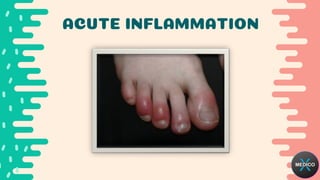
ACUTE INFLAMMATION
INFLAMMATION
 Definition – Inflammation is a response of vascularized
connective tissue to infections and damaged tissues that
brings cells and molecules of host defense from the
circulation to the sites where they are needed ,in order to
elimante the offending agents.
 It is a protective response that is essential for survival.
 Inflammation involve2 basic process -:
1. Early –inflammatory response
2. later -repair
CAUSE OF INFLAMMATION
1.INFECTION-
 It is most common and medically important causes of
inflammation.
2. TISSUENECROSIS-
Caused by various agents such as –
 Ischemia
 Physical Agents
 Chemical agents
3. IMMUNOLOGICAL AGENTS
Cell mediated
Antigen-antibody reaction
4. INERT MATERIALS
SIGNS OF INFLAMMATION
TYPES OF INFLAMMATION
ACUTE
INFLAMMATORY
RESPONSE
• Vascular events
• Cellular events
VASCULAR EVENTS;
HAEMODYNAMIC
CHANGES
ALTERED VASCULAR
PERMEABILITY
HAEMODYNAMIC CHANGES;
Transient
vasoconstriction
of arterioles
Persistent
progressive
vasodilation
Increased
hydrostatic
pressure
Stasis of
microcirculation
Leucocytic
margination
TRIPLE RESPONSE
ALTEREDVASCULAR
PERMEABILITY
StarliNg hypothesis;
FORCES CAUSING
OUTWARD
MOVEMENT
• Intravascular
hydrostatic pressure
• Colloid osmotic
pressure of interstitial
fluid
FORCES CAUSING
INWARD
MOVEMENT
• Intravascular colloid
osmotic pressure
• Hydrostatic pressure
of interstitial fluid
Fluid exchange between blood &
extracellular fluid;
Mechanism of
vascular leakage;
Cellular Events;
It includes:
Recruitmentof leucocytes
Activation to recognize the microbe
Phagocytose and clearing of offending agent.
Discussed under-
Exudation of leucocytes
Phagocytosis
EXUDATION OF LEUCOCYTES;
1. CHANGES IN THE FLOW OF BLOOD
2. ROLLING AND ADHESION
3. TRANSMIGRATION
4. CHEMOTAXIS
CHANGES IN FLOW OF
BLOOD;
VASODIALATATION
SLOWING AND STASIS OF BLOOD
WIDENING OF CENTRAL STREAM OF
CELLS
NARROWING OF CELL
FREE LAYER OF PLASMA
REDISTRIBUTION OF CELLS
ROLLING AND ADHESION;
MEDIATORS:
SELECTINS
 P-SELECTIN
 E-SELECTIN
 L-SELECTIN
INTEGRINS
TRANSMIGRATION;
• MOVEMENT OF NEUTROPHILL
• ALONG ENDOTHELIAL CELLS
• CYTOPLASMIC PSUDOPODS OF
• NEUTROPHILLS
• NEUTROPHILL LODGE B/W ENDOTHELIAL
• CELL AND BASEMENT MEMBRANE
• MONOCYTES AND MACROPHAGES APPEARS
• ESCAPE OF RBC’s
Chemotaxis;
Movement of leucocytes toward the direction of
chemical molecules or factors
Chemoattractants are of two
types
Exogenous agents
Endogenous agents
 Leucotrienes
 Complement system
 Cytokines
 kallikrein
Mechanism of chemotaxis;
binding of
Chemoattractant
Release of
effector
molecules
Increase of
cytosolic calcuim
Cytoskeltal
changes
Phagocytosis;
 process of cellular engulfment of solid
particles of solid particulate material
 Two main type of cells are involved
• Polymorphonuclear neutrophils
• Macrophages
 Production of proteolytic enzymes
 Steps of phagocytosis
o Recognition and attachment
o Engulfment
o Killing and degradation
Recognition and
attachment;
 Expression of cell surface
receptors on macrophages
 Coating of microorganisms
 Opsonisation
o IgG opsonin
o C3b opsonin
o Collectin
Engulfment;
Cytoplasmic
pseudopods
formation
Phagosome is
internalise
KILLING & DEGRADATION;
Mechanisms involved
A. Intracellular mechanisms
B. Extracellular mechanisms
Intracellular
mechanism;
Reactive oxygen species
Nitric oxide
Lysosomal granules
Extracellular mechanisms;
Activated leucocytes
Neutrophill extracellular traps
Immune mechanisms
Mediators Of Acute
Inflammation
These are endogenous,
Chemical substances
which mediate the
process of acute
inflammation.
Properties Of these
mediators
Injurious agents
Dead & damaged tissues
Presence of other mediators
01; Release in response to stimuli.
SECONDARY MEDIATORS
AntagonizeOR Agonize
The action of prior
mediators
Cell derived mediators
Synthesized in Liver
Plasma
Protein
derivative
Presynthesized/stored in
granules
Freshly synthesis
within cell
Require
activation
02; release of mediators
03; Their actions on targets
Can act on
differenttargets
Similar actions or
differentactions
On different
targets
1
2
3
04; Range of actions
 Chemotaxis
 Fever
 Pain
 Tissuedamage
 Increased vascularpermiability
 vasodialation
05; Mediators have short life span
Rapidlymetabolized by-
Enzymatic
inactivation
Antioxidants
Regulatory
proteins
Decay
spontaneously
Mediators of inflammation;
CELL DERIVED MEDIATORES;
Vasoactive
amines
Lysosomal
components
Arachidonic acid
metabolites
Cytokines
Free radicals& NO
Platelet
activating
factors
Preformed/stored Freshly formed
Vasoactive amines;
• Histamine;
Source- mastcell, bronchus, platelets.
Functions,
Degranulations.
• Serotonine (5-HT);
Source-
enterochromaffin cell, platelets
Functions.
• Neuropeptides;
SubstanceP,
Neurokinins A,
Vasoactiveintestinal peptide(VIP),
Somatostatin.
Lysosomal components;
• Granules of neutrophils
a) Primarygranules - functionallyactiveenzymes,
b) Secondarygranules –alkalinephosphatase,
c) Tertiarygranules –gelatin & acid hydrolases,
• Granules of monocytes & tissue macrophase,
a) Acid proteases,
b) Collagenase,
c) Elastase,
d) Plasminogen activator
Arachidonic acid metabolites
via cyclooxygenase pathway
Arachidonic acid metabolites
via lipooxygenase pathway
Cytokines;
• Interleukins;
Active in acute inflammation – IL-1 & IL-6,
Active in chronic inflammation – IL-12 7 IL-17,
Chemokine for acute inflammation – IL-8.
• Tumor necrosis factor (TNF-α);
hepatic production of acute phase proteins,
Systemic features (fever, shock, anorexia)
• Interferons;
Activation of macrophages & NK cells
Stimulates secretion of IGs by B cell
Role in differentiation of T cells
Nitric oxide [NO];
L- arginine NO
Guanylate cyclase Inhibits Calcium channel
cGMP
Smooth muscle relaxation
vasodilation
NOS
eNOS iNOS nNOS
PLASMA PROTEIN DERIVED;
The kinin system
The clotting
system
The fibrinolytic system
The
complement
system
PATHWAY OF KININ SYSTEM;
Factor XII
Factor XIIa
Prekallikrein activator
Plasma Prekallikrein kallikrein
kininogen BRADYKININ
Endothelium damage& exposure
of collagen fibres
Smooth muscle
contraction
Vasodilation
Increased vascular
permeability
pain
PATHWAY OF THE CLOTTING SYSTEM;
FDPs
fibrinopeptides
Increased vascular
permeability
Chemotaxis for
leukocytes
Anticoagulant
activity
THE FIBRINOLYTIC SYSTEM;
Plasminogen activator
(kallilrein, XIIa, leucocytes, endothelium)
Plasminogen Plasmin
Activation ofXII C3 fibrin
bradykinin C3a
Fibrin degradation
products
Complement system;
• Responsiblefor immunity,
• 10-20 % of plasma proteins,
• C1 to C9 complementprotein with multiplesubunits,
C3
C3a
C3b
C5
C5a
C5b
Anaphylatoxins
Opsonisation
Anaphylatoxins,
chemotaxis
MAC formation
• Classical pathway
• Lectin pathway
• Alternatepathway
Complement pathway;
Classical pathway;
Associated with IgG & IgM antibodies
Alternate pathway;
Associated with IgA, endotoxinsand venoms
C1 Activated C1
C4 / C2 C4b2a
C3 break down
C3a C3b
C4b2a3b C5 breakdown
C5a C5b
C3 + factor B
C3bBb
C6/7/8/9
C5b-9 complex
Membrane attacking complex
INTERRELATIONSHIP AMONG
DIFFERENT SYSTEM;
INFLAMMATORY CELLS;
GIANT CELLS;
• Giant cells are formed by fusion of variouscells.
 Large in size.
 Contain multiple nuclei.
 phenotype depends upon the characterof cell from which
giant cell is derived.
Normally seen in
o Megakaryocytes in BM
o Syncytiotrophoblast in placenta
Types of giant cells;
1. Macrophagederived giant cells
Langhan’s GC
Foreign body GC
Touton GC
Aschoff GC
2. Epidermal cell derived giant cells
Tzanck GC
Multinucleated epidermal GC
ACUTE INFLAMMATION -FACTORS
DETERMINING VARIATION IN
RESPONSE, MORPHOLOGIC
PATTERN, SYSTEMIC EFFECTS
AND OUTCOMES
FACTOR DETERMINING VARIATION
IN RESPONSE –
 Variation in response is based on host and etiologic agent.
 ACUTE INFLAMMATIUON: Exception-
 CHRONIC INFLAMMATION:Exception-
Typhoid
fever
acute
inflammation
Lymphocytic
infilteration
Osteomyelitis
chronic
inflammation
neutrophilic
infiltration
FACTOR INVOLVING THE ORGANISM;
1.Type of injury and infection
2. Virulence
3.Dose
4.Portal entry
5.Product of organism
FACTOR INVOLVING HOST;
1.Systemic disease
2.Immune status of host
3.Congenital neutrophil defect
4.Leukopenia
5.Site or type of tissue
6.Local host factor
MORPHOLOGICAL PATTERN OF ACUTE
INFLAMMATION;
1.CLASSIFICATION OF INFLAMMATORY REACTION-
A.DURATION-:
Acute –short duration ,early response
Chronic-long duration,delayed response
B.TYPE OF EXUDATE-:
1.SEROUS –when the fluid exudate resembles serum or
is watery.
2.FIBRINOUS-when the fibrin content of the fluid
exudate is high.
3.PURULENT- when the formation of pus as seen in
infection withpyogenic bacteria.
4.HAEMORRHAGIC- when there is vascular damage.
5.CATARRHAL- when epithelium produces increased
secretion of mucus.
C.ANATOMICAL LOCATION OF INJURY
Eg. Solid tissue and organ(hepatitis)
Epithelium lined surface(colitis)
serous cavity (pleuritis,pericaditis)
2.PSEUDOMEMBRANOUS INFLAMMATION
 It is inflammatory response of mucous surface (oral,
respiratory) to toxin of diphtheria or irritant gas.
3.ULCER – it is local defect on surface of an organ produce
by inflammation .
 long standing ulcer associated with fibroblastic
proliferation and scarring.
4.CELLULITIS- it is diffuse inflammation of soft tissue.
5.BACTERIAL INFECTION OF BLOOD-
 Bacteraemia
 Septicaemia
 Pyaemia- it is a type of sepsis that leads to widespread
abscess of a metastatic nature.
6.SUPPURATION(ABSCESS FORMATION)
Acute bacterial infection
Neutrophillic infiltration in inflammed tissue
Tissue necrosis
Cavity is formed
Abscess formation
(SUPPURATION)
Abscess
Formation
SYSTEMIC EFFECT OF ACUTE INFLAMMATION;
1.FEVER
2.LEUCOCYTOSIS
3.ACUTE PHASE REACTANTS-
 A variety of acute phase reactant protein are released in plasma in
response to tissue trauma and infection.
 APRs includes the following –
a) cellular protection factor,
b) Coagulation protein,
c) Transport protein,
d) Immune agent,
e) Stress protein,
f) Antioxidant.
4.LYMPHANGITIS
5. SEPTIC SHOCK
OUTCOME OF ACUTE INFLAMMATION;
1.RESOLUTION- it means complete return to normal
tissue following acute inflammation.
Eg. resolution in lobar pneumonia
2.FIBROUS HEALING-
Superficial injury in More extensive tissue injury
acute inflammation causing destructive loss of tissue
Repaired by regeneration Repaired by healing with fibrosis
3. SUPPURATION- when the pyogenic bacteria causing
acute inflammation result in sever necrosis,
progress to suppuration.
4.CHRONIC INFLAMMATION- recurrent acute
inflammation may progress to chronic inflammationin
which the processes of inflammation repair proceedside by
side.
Acute inflammation - Pathology #X_patho

Acute inflammation - Pathology #X_patho

  • 1.
  • 2.
    INFLAMMATION  Definition –Inflammation is a response of vascularized connective tissue to infections and damaged tissues that brings cells and molecules of host defense from the circulation to the sites where they are needed ,in order to elimante the offending agents.  It is a protective response that is essential for survival.  Inflammation involve2 basic process -: 1. Early –inflammatory response 2. later -repair
  • 3.
    CAUSE OF INFLAMMATION 1.INFECTION- It is most common and medically important causes of inflammation. 2. TISSUENECROSIS- Caused by various agents such as –  Ischemia  Physical Agents  Chemical agents 3. IMMUNOLOGICAL AGENTS Cell mediated Antigen-antibody reaction 4. INERT MATERIALS
  • 4.
  • 5.
  • 6.
  • 7.
  • 8.
  • 9.
  • 10.
  • 11.
    StarliNg hypothesis; FORCES CAUSING OUTWARD MOVEMENT •Intravascular hydrostatic pressure • Colloid osmotic pressure of interstitial fluid FORCES CAUSING INWARD MOVEMENT • Intravascular colloid osmotic pressure • Hydrostatic pressure of interstitial fluid
  • 12.
    Fluid exchange betweenblood & extracellular fluid;
  • 13.
  • 14.
    Cellular Events; It includes: Recruitmentofleucocytes Activation to recognize the microbe Phagocytose and clearing of offending agent. Discussed under- Exudation of leucocytes Phagocytosis
  • 15.
    EXUDATION OF LEUCOCYTES; 1.CHANGES IN THE FLOW OF BLOOD 2. ROLLING AND ADHESION 3. TRANSMIGRATION 4. CHEMOTAXIS
  • 16.
    CHANGES IN FLOWOF BLOOD; VASODIALATATION SLOWING AND STASIS OF BLOOD WIDENING OF CENTRAL STREAM OF CELLS NARROWING OF CELL FREE LAYER OF PLASMA REDISTRIBUTION OF CELLS
  • 17.
    ROLLING AND ADHESION; MEDIATORS: SELECTINS P-SELECTIN  E-SELECTIN  L-SELECTIN INTEGRINS
  • 18.
    TRANSMIGRATION; • MOVEMENT OFNEUTROPHILL • ALONG ENDOTHELIAL CELLS • CYTOPLASMIC PSUDOPODS OF • NEUTROPHILLS • NEUTROPHILL LODGE B/W ENDOTHELIAL • CELL AND BASEMENT MEMBRANE • MONOCYTES AND MACROPHAGES APPEARS • ESCAPE OF RBC’s
  • 19.
    Chemotaxis; Movement of leucocytestoward the direction of chemical molecules or factors Chemoattractants are of two types Exogenous agents Endogenous agents  Leucotrienes  Complement system  Cytokines  kallikrein
  • 20.
    Mechanism of chemotaxis; bindingof Chemoattractant Release of effector molecules Increase of cytosolic calcuim Cytoskeltal changes
  • 21.
    Phagocytosis;  process ofcellular engulfment of solid particles of solid particulate material  Two main type of cells are involved • Polymorphonuclear neutrophils • Macrophages  Production of proteolytic enzymes  Steps of phagocytosis o Recognition and attachment o Engulfment o Killing and degradation
  • 22.
    Recognition and attachment;  Expressionof cell surface receptors on macrophages  Coating of microorganisms  Opsonisation o IgG opsonin o C3b opsonin o Collectin
  • 23.
  • 24.
    KILLING & DEGRADATION; Mechanismsinvolved A. Intracellular mechanisms B. Extracellular mechanisms
  • 25.
  • 26.
  • 27.
  • 28.
  • 29.
    These are endogenous, Chemicalsubstances which mediate the process of acute inflammation.
  • 30.
    Properties Of these mediators Injuriousagents Dead & damaged tissues Presence of other mediators 01; Release in response to stimuli. SECONDARY MEDIATORS AntagonizeOR Agonize The action of prior mediators
  • 31.
    Cell derived mediators Synthesizedin Liver Plasma Protein derivative Presynthesized/stored in granules Freshly synthesis within cell Require activation 02; release of mediators
  • 32.
    03; Their actionson targets Can act on differenttargets Similar actions or differentactions On different targets 1 2 3
  • 33.
    04; Range ofactions  Chemotaxis  Fever  Pain  Tissuedamage  Increased vascularpermiability  vasodialation
  • 34.
    05; Mediators haveshort life span Rapidlymetabolized by- Enzymatic inactivation Antioxidants Regulatory proteins Decay spontaneously
  • 35.
  • 36.
    CELL DERIVED MEDIATORES; Vasoactive amines Lysosomal components Arachidonicacid metabolites Cytokines Free radicals& NO Platelet activating factors Preformed/stored Freshly formed
  • 37.
    Vasoactive amines; • Histamine; Source-mastcell, bronchus, platelets. Functions, Degranulations. • Serotonine (5-HT); Source- enterochromaffin cell, platelets Functions. • Neuropeptides; SubstanceP, Neurokinins A, Vasoactiveintestinal peptide(VIP), Somatostatin.
  • 38.
    Lysosomal components; • Granulesof neutrophils a) Primarygranules - functionallyactiveenzymes, b) Secondarygranules –alkalinephosphatase, c) Tertiarygranules –gelatin & acid hydrolases, • Granules of monocytes & tissue macrophase, a) Acid proteases, b) Collagenase, c) Elastase, d) Plasminogen activator
  • 39.
    Arachidonic acid metabolites viacyclooxygenase pathway
  • 40.
    Arachidonic acid metabolites vialipooxygenase pathway
  • 41.
    Cytokines; • Interleukins; Active inacute inflammation – IL-1 & IL-6, Active in chronic inflammation – IL-12 7 IL-17, Chemokine for acute inflammation – IL-8. • Tumor necrosis factor (TNF-α); hepatic production of acute phase proteins, Systemic features (fever, shock, anorexia) • Interferons; Activation of macrophages & NK cells Stimulates secretion of IGs by B cell Role in differentiation of T cells
  • 42.
    Nitric oxide [NO]; L-arginine NO Guanylate cyclase Inhibits Calcium channel cGMP Smooth muscle relaxation vasodilation NOS eNOS iNOS nNOS
  • 43.
    PLASMA PROTEIN DERIVED; Thekinin system The clotting system The fibrinolytic system The complement system
  • 44.
    PATHWAY OF KININSYSTEM; Factor XII Factor XIIa Prekallikrein activator Plasma Prekallikrein kallikrein kininogen BRADYKININ Endothelium damage& exposure of collagen fibres Smooth muscle contraction Vasodilation Increased vascular permeability pain
  • 45.
    PATHWAY OF THECLOTTING SYSTEM; FDPs fibrinopeptides Increased vascular permeability Chemotaxis for leukocytes Anticoagulant activity
  • 46.
    THE FIBRINOLYTIC SYSTEM; Plasminogenactivator (kallilrein, XIIa, leucocytes, endothelium) Plasminogen Plasmin Activation ofXII C3 fibrin bradykinin C3a Fibrin degradation products
  • 47.
    Complement system; • Responsibleforimmunity, • 10-20 % of plasma proteins, • C1 to C9 complementprotein with multiplesubunits, C3 C3a C3b C5 C5a C5b Anaphylatoxins Opsonisation Anaphylatoxins, chemotaxis MAC formation • Classical pathway • Lectin pathway • Alternatepathway
  • 48.
    Complement pathway; Classical pathway; Associatedwith IgG & IgM antibodies Alternate pathway; Associated with IgA, endotoxinsand venoms C1 Activated C1 C4 / C2 C4b2a C3 break down C3a C3b C4b2a3b C5 breakdown C5a C5b C3 + factor B C3bBb C6/7/8/9 C5b-9 complex Membrane attacking complex
  • 49.
  • 50.
  • 51.
    GIANT CELLS; • Giantcells are formed by fusion of variouscells.  Large in size.  Contain multiple nuclei.  phenotype depends upon the characterof cell from which giant cell is derived. Normally seen in o Megakaryocytes in BM o Syncytiotrophoblast in placenta
  • 52.
    Types of giantcells; 1. Macrophagederived giant cells Langhan’s GC Foreign body GC Touton GC Aschoff GC 2. Epidermal cell derived giant cells Tzanck GC Multinucleated epidermal GC
  • 53.
    ACUTE INFLAMMATION -FACTORS DETERMININGVARIATION IN RESPONSE, MORPHOLOGIC PATTERN, SYSTEMIC EFFECTS AND OUTCOMES
  • 54.
    FACTOR DETERMINING VARIATION INRESPONSE –  Variation in response is based on host and etiologic agent.  ACUTE INFLAMMATIUON: Exception-  CHRONIC INFLAMMATION:Exception- Typhoid fever acute inflammation Lymphocytic infilteration Osteomyelitis chronic inflammation neutrophilic infiltration
  • 55.
    FACTOR INVOLVING THEORGANISM; 1.Type of injury and infection 2. Virulence 3.Dose 4.Portal entry 5.Product of organism
  • 56.
    FACTOR INVOLVING HOST; 1.Systemicdisease 2.Immune status of host 3.Congenital neutrophil defect 4.Leukopenia 5.Site or type of tissue 6.Local host factor
  • 57.
    MORPHOLOGICAL PATTERN OFACUTE INFLAMMATION; 1.CLASSIFICATION OF INFLAMMATORY REACTION- A.DURATION-: Acute –short duration ,early response Chronic-long duration,delayed response B.TYPE OF EXUDATE-: 1.SEROUS –when the fluid exudate resembles serum or is watery. 2.FIBRINOUS-when the fibrin content of the fluid exudate is high.
  • 58.
    3.PURULENT- when theformation of pus as seen in infection withpyogenic bacteria. 4.HAEMORRHAGIC- when there is vascular damage. 5.CATARRHAL- when epithelium produces increased secretion of mucus. C.ANATOMICAL LOCATION OF INJURY Eg. Solid tissue and organ(hepatitis) Epithelium lined surface(colitis) serous cavity (pleuritis,pericaditis)
  • 59.
    2.PSEUDOMEMBRANOUS INFLAMMATION  Itis inflammatory response of mucous surface (oral, respiratory) to toxin of diphtheria or irritant gas. 3.ULCER – it is local defect on surface of an organ produce by inflammation .  long standing ulcer associated with fibroblastic proliferation and scarring. 4.CELLULITIS- it is diffuse inflammation of soft tissue. 5.BACTERIAL INFECTION OF BLOOD-  Bacteraemia  Septicaemia  Pyaemia- it is a type of sepsis that leads to widespread abscess of a metastatic nature.
  • 60.
    6.SUPPURATION(ABSCESS FORMATION) Acute bacterialinfection Neutrophillic infiltration in inflammed tissue Tissue necrosis Cavity is formed Abscess formation (SUPPURATION)
  • 61.
  • 62.
    SYSTEMIC EFFECT OFACUTE INFLAMMATION; 1.FEVER 2.LEUCOCYTOSIS 3.ACUTE PHASE REACTANTS-  A variety of acute phase reactant protein are released in plasma in response to tissue trauma and infection.  APRs includes the following – a) cellular protection factor, b) Coagulation protein, c) Transport protein, d) Immune agent, e) Stress protein, f) Antioxidant. 4.LYMPHANGITIS 5. SEPTIC SHOCK
  • 63.
    OUTCOME OF ACUTEINFLAMMATION; 1.RESOLUTION- it means complete return to normal tissue following acute inflammation. Eg. resolution in lobar pneumonia 2.FIBROUS HEALING- Superficial injury in More extensive tissue injury acute inflammation causing destructive loss of tissue Repaired by regeneration Repaired by healing with fibrosis
  • 64.
    3. SUPPURATION- whenthe pyogenic bacteria causing acute inflammation result in sever necrosis, progress to suppuration. 4.CHRONIC INFLAMMATION- recurrent acute inflammation may progress to chronic inflammationin which the processes of inflammation repair proceedside by side.