Management
of
Preterm Labour
Sunil Kumar Daha
 Obstetrics : All issues, physiological and pathological, related to pregnancy
and child bearing.
 Gynaecology: All diseases of the female, and specific to the female, not
related to pregnancy. While these may occur in the gravid lady, they are neither a
cause nor effect of pregnancy. E.g. A fibroid or ovarian cyst present in a female who
is carrying a foetus.
As such, the treatment of Infertility, and all forms of contraception, also fall in gynaecology. Obstetrics is used only
when the uterus or an ectopic site is gravid, and continues till the end of puerperium, which is six weeks from the
delivery of the placenta.
: When the labor starts before 37th completed weeks (< 259 days)
counting from the first day of the last menstrual period.
Preterm Birth : defined as delivery before 37 completed weeks.
Early preterm, Those before 36/7 weeks are labeled
Late preterm; Those occurring between 34 and 36 completed weeks.
Preterm Labor
Small for gestational age; Newborns whose birthweight is usually < 10th
percentile for gestational age.
Large for gestational age; Newborns whose birthweight is > 90th
percentile for gestational age.
Appropriate for gestational age; Newborns whose weight is between the
10th and 90th percentiles.
Low birthweight Neonates weighing 1500 to 2500 g;
Very low birthweight Neonates weighing between 500 and 1500 g; and
Extremely low birthweight Neonates weighing between 500 and 1000 g.
Etiology:
It is multifactorial
High risk factors
1.History
2.Complication in present pregnancy
3.Iatrogenic
4.Idiopathic
History
1. Previous history of induced/ spontaneous abortion/
Preterm delivery
2. Pregnancy followed by assisted reproductive techniques
3. Asymptomatic bacteriuria/ Recurrent UTI
4. Smoking habit
5. Low socio-economic and nutritional status
6. Maternal stress
Complication in present pregnancy
Maternal:
1.Preeclampsia
2. Antepartum hemorrhage
3. Premature rupture of membrane
4. Polyhydramnios
5. Cervical incompetency
6. Malformation of uterus
7. Acute fever
8. Acute appendicitis
9. Toxoplasmosis
10.Abdominal operation
Complication in present pregnancy
Maternal:
8. Hypertennsion
9. Nephritis
10. Diabetes
11. Low BMI
12. Genital tract infections
13. Bacterial vaginosis
14. B Hemolytic streptococcus
15. Bacteriodes
16. Chlamydia
Complication in present pregnancy
Fetal Complications:
1. Multiple pregnancy
2. Congenital malformation
3. Intrauterine death
Placental complication
1. Infraction
2. Thrombosis
3. Placenta previa
4. Abruption
Iatrogenic:
1. Indicted preterm delivery due to medical or obstetric
complication
Idiopathic:
1. Premature effacement of the cervix
2. Early engagement of head
Etiopathogenesis of preterm labor:
↑ CRH Choriodecidual bacterial colonization Pathologic uterine enlargement↑ ↑
↑ Cortisol ↑ TNF, ↑ IL-1,6,8 (Polyhydramnios, Multiple pregnancy)
↑ Mechanical strength
↑ IL -8
↑ Gap junction and PG sythatase
Chorion, amnion, and decidua
↑ PGE2, F2alpha, ↑TXA2, ↑Leukotrienes, ↑ PG dehydrogenase, ↑ Proteases, ↑ Collagenase,
↑Leukocyte elastase
↑Myometrial contraction, ↑Cerviacal ripening, ↑Cervical insufficiency
Preterm Labour and delivery
Predictors of preterm labor
Clinical predictors:
(i) Multiple pregnancy;
(ii) History of preterm birth;
(iii) Presence of genital tract infection;
(iv) Symptoms of PTL
Biophysical predictors:
(i) Uterine contractions (UC) > 4/hr;
(ii) Bishop score > 4;
(iii) Cervical length (TVS) < 25 mm.
Biochemical predictors:
(i) Fetal fibronectin (fFN) in cervico vaginal discharge
(ii) Others IL-6, IL-8, TNF-a.
 Fibronectin
Diagnosis
Preterm labor is primarily diagnosed by symptoms and
physical examination.
Diagnosis
Symptoms
1. Uterine contractions,
(Irregular, Nonrhythmical, and either painful or painless
( at least one in every 10 min))
2. Pelvic pressure
3. Menstrual-like cramps
4. Watery vaginal discharge
5. Lower back pain
Diagnosis
Cervical Change
• Dilatation: ≥ 2 cm
• Effacement: 80 % of the cervix
• Length of cervix (measured by TVS) ≤ 2.5 cm
• Funelling of the internal OS
Management
1. To prevent preterm onset of labor, if possible
2. To arrest preterm labor
3. Appropriate management of labor
4. Effective neonatal care
Prevention of preterm labor
Risk of delivery of LBW baby against risk to fetus and mother
Adopt following guidelines:
1. Primary care is aimed to reduce incidence of preterm labor by
reducing high risk factors
2. Secondary care: Screening test for early detection and
prophylactic treatment (Tocolytics)
3. Tertiary care: Aimed to reduce perinatal morbidity and mortality
after diagnosis (corticosteroids)
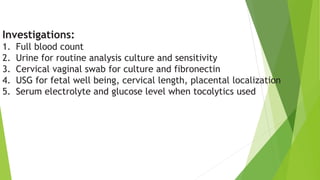
Investigations:
1. Full blood count
2. Urine for routine analysis culture and sensitivity
3. Cervical vaginal swab for culture and fibronectin
4. USG for fetal well being, cervical length, placental localization
5. Serum electrolyte and glucose level when tocolytics used
Measures to arrest preterm labor
• Bed rest in left lateral position
• Adequate hydration
• Prophylactic cervical circlage: Women with prior preterm
birth and short cervix in present pregnancy
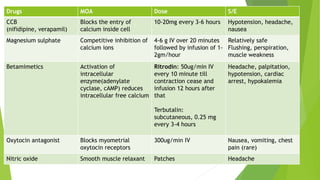
• Tocolytics: Inihibit uterinc contraction
Commonly used: prostaglandin synthetase inhibitors, magnesium
sulphate, calcium channel blockers, oxytocin receptor antagonists, NO
Drugs MOA Dose S/E
CCB
(nifidipine, verapamil)
Blocks the entry of
calcium inside cell
10-20mg every 3-6 hours Hypotension, headache,
nausea
Magnesium sulphate Competitive inhibition of
calcium ions
4-6 g IV over 20 minutes
followed by infusion of 1-
2gm/hour
Relatively safe
Flushing, perspiration,
muscle weakness
Betamimetics Activation of
intracellular
enzyme(adenylate
cyclase, cAMP) reduces
intracellular free calcium
Ritrodin: 50ug/min IV
every 10 minute till
contraction cease and
infusion 12 hours after
that
Terbutalin:
subcutaneous, 0.25 mg
every 3-4 hours
Headache, palpitation,
hypotension, cardiac
arrest, hypokalemia
Oxytocin antagonist Blocks myometrial
oxytocin receptors
300ug/min IV Nausea, vomiting, chest
pain (rare)
Nitric oxide Smooth muscle relaxant Patches Headache
Principles of management
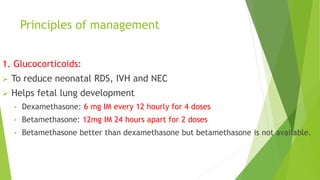
1. Glucocorticoids:
 To reduce neonatal RDS, IVH and NEC
 Helps fetal lung development
• Dexamethasone: 6 mg IM every 12 hourly for 4 doses
• Betamethasone: 12mg IM 24 hours apart for 2 doses
• Betamethasone better than dexamethasone but betamethasone is not available.
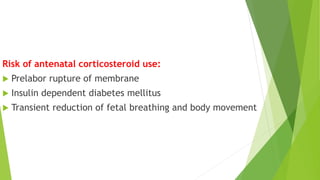
Risk of antenatal corticosteroid use:
 Prelabor rupture of membrane
 Insulin dependent diabetes mellitus
 Transient reduction of fetal breathing and body movement
2. Antenatal transfer of the mother with fetus in
utero to a center equipped with NICU
3. Tocolytics drugs to the mother for short period
unless contraindicated
 Commonly used: prostaglandin synthetase
inhibitors, magnesium sulphate, calcium channel
blockers, oxytocin receptor antagonists, NO
4. Antibiotics to prevent neonatal infection with Group B Streptococcus :
• 18 hour after leaking
• Crystalline penicillin (Penicilin G)
• 5 million unit, IV, one dose at the onset of labour
• 2.5 million unit, IV, every 4 hourly till delivery.
Short-term therapy
 :It is commonly employed with success.
 The objectives:
(1)To delay delivery for at least 48 hours for glucocorticoid therapy to the mother to
enhance fetal lung maturation;
(2) In utero transfer of the patient to a unit with an advanced NICU.
 Contraindications:
A. Maternal: Uncontrolled diabetes, thyrotoxicosis, severe hypertension, cardiac disease, hemorrhage in
pregnancy, e.g. placenta previa or abruption.
B. Fetal: Fetal distress, fetal death, congenital malformation, pregnancy beyond 34 weeks.
C. Others: Rupture of membranes, chorioamnionitis, cervical dilatation more than 4 cm.
First stage Second stage
• The patient is put to bed to prevent
early rupture of membranes.
• To ensure adequate fetal oxygenation
by giving oxygen to the mother by
mask.
• Epidural analgesia is of choice.
• Labor should be carefully monitored.
• Cesarian delivery is done for obstetric
reasons.
• NICU
• The birth should be gentle and slow to
avoid rapid compression and
decompression of the head
• Episiotomy may be done to minimize head
compression if there is perineal resistance
• The cord is to be clamped immediately at
birth to prevent hypervolemia and
hyperbilirubinemia
• To shift the baby to neonatal intensive care
unit.
Principals in management of preterm labor are:
To prevent birth asphyxia and development of RDS
To prevent birth trauma. Duration of labor is usually short.
Cesarean Section:
• Routine CS not recommended.
• Only for Preterm fetuses before 34 weeks presented by breech.
• Lower segment vertical/ J shaped incision made to minimize trauma during delivery.
Prognosis:
• Preterm labor and delivery of low birth weight baby results in high perinatal
mortality and morbidity.
• If NICU care given, survival rate is more than 90% for (1000g- 1500g).
 Cunningham et.al., Williams OBSTETRICS, 24E, McGraw-Hill Education,
2014,
 DC Dutta’s textbook of Obstetrics
References
Thank you