Uterine
Rupture
(the most dramatic serious obstetric
Emergency)
Muhammad M Al Hennawy
Consultant Obstetrician & Gynacologist
Ras ElBar Central Hospital , Dumyat , Egypt
Definition
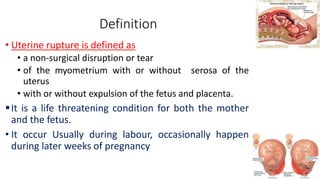
• Uterine rupture is defined as
• a non-surgical disruption or tear
• of the myometrium with or without serosa of the
uterus
• with or without expulsion of the fetus and placenta.
It is a life threatening condition for both the mother
and the fetus.
• It occur Usually during labour, occasionally happen
during later weeks of pregnancy
Incidence Of Uterus Rupture
0.05% for all pregnancies
0.8% after previous lower segment caesarean section(LSCS)
>5% after classical caesarean section
Scar dehiscence has an incidence of 0.6% in pregnancies with
previous C/S and has a more favorable outcome for both mother and
fetus than does uterine rupture
Etiology
Scarred Uterus Rupture: History of cesarean section , hysterotomy , myomectomy
, excision of a uterine septum, metroplasty , previous perforation of uterus (D&C,
hysteroscopy, forceps delivery)
•Unscarred Uterus Rupture: Traumatic/ iatrogenic rupture
Surgical intervention
o Internal version
o Forceps delivery
o Forcible dilatation(cervical tear)
o Manual removal of placenta
o Destructive operations.
Medical intervention
o Uterine hyper-stimulation (oxytocin with
pitocin induction or augmentation of
labor)
Spontaneous rupture
• Feto-pelvic disproportion
• Congenital uterine anomalies
• Soft tissue obstruction
Types
A- Scarred Uterus Rupture
• Uterine scar dehiscence: herniation of intact amniotic membrane
into an existing uterine scar ( when there is separation of previous scar
with intact peritoneum)
• Uterine scar rupture: separation of scar along entire length often
with involvement of the amniotic membranes
B- Unscarred Uterus Rupture
• Complete Uterine rupture: total disruption of the wall of the pregnant
uterus with or without extrusion of its content ( when uterine cavity
communicate directly with peritoneal cavity )
• Incomplete Uterine rupture: partial disruption of the wall of the
pregnant uterus without extrusion of its content ( uterine cavity is separated
from peritoneal cavity by visceral peritoneum or broad ligament )
Rupture of the Scarred Uterus Due to Previous CS
• 1.9% absolute uterine rupture rate in Previous classic cesarean delivery or inverted
T, or J incision who either presented in advanced labor or refused repeat cesarean
delivery.
• symptomatic uterine rupture in women undergoing a TOLAC with a low vertical
cesarean scar Compared to women with low transverse cesarean scars, these data
suggest no significantly increased risk of uterine rupture or adverse maternal and
perinatal outcomes.
• no association was found between an unknown uterine scar and the risk of uterine
rupture;
• the spontaneous rupture rate among women with a single cesarean
delivery scar who underwent scheduled repeat cesarean delivery without
a TOL was 0.16%.
• the uterine rupture rate among 10,789 women with a single previous cesarean
delivery who labored spontaneously during a subsequent singleton pregnancy
was 0.52%.
Rupture of the Scarred Uterus Due to Previous CS
• Previous cesarean delivery with subsequent augmentation of labor
the rate of uterine rupture with oxytocin augmentation was 0.9% (52 of 6,009
cases) versus 0.4% without oxytocin use.
• Previous cesarean delivery with subsequent induction of labor
maternal and neonatal outcomes following induction of labor (4,038 women)
and spontaneous labor (13,374 women) in women who previously underwent
cesarean section, Rossi and Prefumo reported a lower incidence of vaginal
delivery with induced labor but higher rates of uterine rupture/dehiscence,
repeat cesarean section, and postpartum hemorrhage.
• Use of prostaglandins for cervical ripening and induction of labor
after previous cesarean delivery no uterine ruptures among 227 patients
who underwent induction with prostaglandins alone
Rupture of the Scarred Uterus Due to Previous CS
• Previous cesarean delivery with previous successful vaginal delivery in
women with no prior vaginal delivery who underwent a TOLAC, there was an
increased risk of uterine rupture with induction versus spontaneous labor (1.5% vs
0.8%, P =0.02). In contrast, no statistically significant difference was shown for
women with a prior vaginal delivery who underwent spontaneous TOLAC compared
with labor induction (0.6% vs 0.4%, P =0.42).
• Previous cesarean delivery with subsequent successful VBACs an
increased uterine rupture rate of 1.4% (1 per 73) in failed VBAC attempts that
required a repeat cesarean section in labor.
• Inter-delivery interval the combination of a short inter-delivery
interval of ≤24 months and a single-layer hysterotomy closure was associated
with a uterine rupture rate of 5.6%.
• One-layer versus 2-layer hysterotomy closure single-layer closure was
linked to an increased rate of uterine rupture (odds ratio [OR] 2.69; 95%
confidence interval [CI] 1.37–5.28). The authors concluded that single-
layer closure should be avoided in women who contemplate future VBAC
delivery
Rupture of the Scarred Uterus Due to Previous CS
• Multiple prior cesarean deliveries
ACOG recommendation was subsequently revised in an updated 2010 guideline to
suggest that women with two previous low transverse cesarean deliveries may be
considered candidates for TOLAC regardless of their prior vaginal delivery status.
• Maternal age
The rate of uterine rupture in women older than 30 years (1.4%) versus younger
women (0.5%) differed significantly
• Multiple gestation
• VBAC with twin gestations report similar rates of uterine rupture for twin and
singleton gestations.
• Fetal macrosomia no difference between the rates of uterine rupture for women
with neonates weighing ≥4000 gm versus < 4000 gm
• Gestation beyond 40 week
• ACOG 2010 VBAC guidelines suggest that although the chance of success may be
lower for a vaginal delivery in more advanced gestations, gestational age beyond 40
weeks alone should not preclude a TOLAC.
Weak Cesarean Scar
• One layer cs
• Locked Suture
• Infection
• Suture material
• Upper segment or T or J incisions
Classification of Uterine Rupture
• Classification by etiology
oScarred Uterus Rupture: Previous caesarean scar or myomectomy
oUnscarred Uterus Rupture
• Classification by Pathogenesis
oSpontaneous - Histochemical etiology of uterine rupture - occurs without
any function of uterus - Example: (i) Anatomy anomaly (ii) Dystrophy
diseases (connective tissue autoimmune disease, Inflammatory disease of
uterus)
oVoluntary - result of hyperfunction of uterus - Example: (i) Disproportion
between sizes of presenting part and maternal pelvis (malpresentation) (ii)
Extra doses of uterotonic drugs
• Classification by Layers of Uterus involved in Rupture
oComplete rupture : commonly spontaneous
oIncomplete rupture : commonly traumatic.
Classification of Uterine Rupture
• Classification by Location of Rupture
oLower segment rupture
oRupture of corpus/fundus of uterus
• Classification by time
oDuring pregnancy
oDuring Labour
• Classification by Carelessness or Negligence?
ocarelessness of the patient
onegligence of the doctor.
The Most Common Site Of Ruptured Uterus
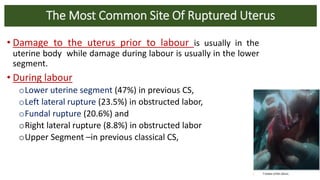
• Damage to the uterus prior to labour is usually in the
uterine body while damage during labour is usually in the lower
segment.
• During labour
oLower uterine segment (47%) in previous CS,
oLeft lateral rupture (23.5%) in obstructed labor,
oFundal rupture (20.6%) and
oRight lateral rupture (8.8%) in obstructed labor
oUpper Segment –in previous classical CS,
Golden Rule
Uterine rupture
• should be first ruled out in all pregnant women presented with
acute abdominal pain regardless of their gestational age.
Signs of Threatened Uterine Rupture
Signs that occur just during the labor
• Excessive uterine activity. Uterine contractions are very fast and painful
• Overdistended Lower uterine segment, thinned and painful at palpation
• Edematous cervical os margins due to compression which may extends to
the vagina and the perineum
• Difficult Urination due to compression of the bladder and urethra between
the bony pelvis and the fetal head
• Some bloody discharge maybe presented (depends)
• Pathological contractile Bandl’s ring is presented
Signs of Uterine Rupture During Pregnancy
Typically
oAcute abdominal pain
oFeatures of shock & intra-abdominal hemorrhage
oEasily palpable fetal parts
oAbsent fetal heart sound
oContracted uterus felt on one site
Atypically
oIncomplete rupture producing localized abdominal pain & tenderness
oFrank signs of hemorrhage & shock develop slowly
oIt may confuse with accidental hemorrhage
Early Pregnancy Uterine Rupture
• The most common cause of uterine rupture is dehiscence of a previous
Caesarian section scar
• Rupture at the site of a previous uterine scar may occur with few warning
signs because the scar is relatively avascular
• It is a rare and potentially life threatening event which incidence is
increasing given the actual high cesarean section rate.
• Clinical signs of this condition are nonspecific and must be distinguished
from other acute abdominal emergencies and other obstetric events.
• Cesarean scar pregnancy must be considered as a major risk factor leading
to early uterine rupture.
Signs of Uterine Rupture During Labour
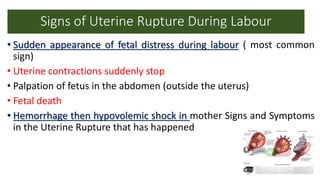
• Sudden appearance of fetal distress during labour ( most common
sign)
• Uterine contractions suddenly stop
• Palpation of fetus in the abdomen (outside the uterus)
• Fetal death
• Hemorrhage then hypovolemic shock in mother Signs and Symptoms
in the Uterine Rupture that has happened
Investigations
• CTG
• Fetal distress (as evidence by abnormalities in fetal heart rate)
• Diminished baseline uterine pressure
• Loss of uterine contractility
• Radiographic features
• US
• MRI
• Intrauterine pressure catheters
Ultrasonography
• It is probably the safest and most useful imaging technique during
pregnancy
•Before rupture: a uterine wall thinner than 2 mm, as determined
with ultrasonography performed within 1 week of delivery,
significantly increased the risk of uterine rupture. Positive and
negative predictive values were 73.9% and 100%, respectively.
• A French study suggests that a uterine wall thickness of greater than
4.5 mm has negative predictive value of 100% but unfortunately the
positive predictive value of thickness less than 3.5 mm is poor at
only 11.8%
Ultrasonography
•After rupture
Reported sonographic signs of uterine rupture include:
Identification of the protruding portion of the amniotic sac
Endometrial or myometrial defect ( an anterior hypo-
/anechogenic line corresponding to the uterine tear)
Bulky empty uterus with gas bubbles
The fetus and placenta in the abdominal cavity
Extra-uterine hematoma
Hemoperitoneum or free fluid
MRI
• It allows clear visualization of the uterine wall;
• therefore, it helps to diagnose both ante-partum uterine
rupture in patients with indeterminate ultrasound evidence,
• showing the tear itself and other uterine wall defects including
uterine dehiscence (separation of the myometrium with
preservation of the overlying peritoneum and internal fetal
membranes) and
• uterine sacculation (uterine wall ballooning because of a
functional weakening of the myometrium)
Intrauterine Pressure Catheters
• They are sometimes used but may fail to show loss of uterine
tone or
• Loss of contractile patterns following uterine rupture.
Differential Diagnosis
Abruptio Placentae (Similar presentation)
Hepatic Rupture in severe pre eclampsia (Look for
other signs of pre-eclampsia)
Chorioamnionitis (Look for fever, PROM, Tender uterus)
Treatments of Threatening Uterine Rupture
•Treatments of Uterine Rupture Whenever a threatening
uterus rupture is seen,
• immediate Caesarian section must be done!
Managements of Uterine Rupture
Intensive resuscitation
• Correct hypovolemia from:
Hemorrhage Sepsis Dehydration
• Intravenous broad spectrum antibiotics:
Cephalosporin + Metronidazole combination
• Monitor to ensure adequate fluid and blood replacement
• Blood volume expansion may worsen the bleeding from damaged
vessel.
So the laparotomy should not be delay, once patient
condition has improved
Emergency exploratory laparotomy with cesarean delivery
• Several studies have shown that delivery of the fetus within 10-37
minutes of uterine rupture is necessary to prevent serious fetal
morbidity and mortality.
Types of surgical treatment depends on Type of uterine rupture :
• Extent of uterine rupture
• Degree of hemorrhage
• High parity
• Edges of rupture are ragged and irregular
• General condition of the mother
• Mother's desire for future childbearing.
Emergency exploratory laparotomy with cesarean delivery
• Surgery
• Repair of uterus without tubal ligation
• Repair of uterus with tubal ligation
• Removal of uterus (hysterectomy), Total or Sub-total
• in cases of lateral rupture involving lower uterine segment and
uterine artery where hemorrhage and hematoma obscure the
operative field, ligation of the ipsilateral hypogastric artery to stop
bleeding may be needed.
Conservative surgical management
• Involving uterine repair should be reserved for women who have
the following findings:
Desire for future childbearing
Low transverse uterine rupture
No extension of the tear to the broad ligament, cervix, or
paracolpos
Easily controllable uterine hemorrhage
Good general condition
No clinical or laboratory evidence of an evolving coagulopathy
Surgical Management
• Hysterectomy should be considered the treatment of choice
when intractable uterine bleeding occurs or when the
uterine rupture sites are multiple, longitudinal, or low lying.
Complications
• Postoperative infection.
• Damage to ureter.
• Amniotic fluid embolus.
• Massive maternal hemorrhage
• Disseminated intravascular coagulation (DIC).
• Pituitary failure
Outcome
•Death from uterine rupture is not uncommon.
•Mortality appears to be higher in women who have an
unscarred uterus and when the rupture occurs outside the
hospital.
•Overall mortality: 15.9%
•Perinatal morbidity rate associated with uterine rupture ranges
from 8-56%
Preventive measures
Antenatal care
• High risk cases
• Oxytocics
• Previous caesarean section
• Augmentation of labour
NOTE!!!
During trial of scar watch out for…….
Fetal heart abnormalities
Maternal tachycardia
Vague abdominal pain in between contractions
Suprapubic tenderness
Vaginal bleeding
Bladder tenesmus
Counselling for future pregnancies
• If tubal ligation was not performed at the time of laparotomy, explain
the increased risk of rupture with subsequent pregnancies, and
discuss the option of permanent contraception
• If the defect is confined to the lower segment the risk of rupture in a
subsequent pregnancy is similar to that of someone with a previous
caesarean section
• If there are extensive tears involving the upper segment, future
pregnancy may be contraindicated
• Women with a history of uterine rupture should have a planned
elective caesarean section (37 to 38 weeks’ gestation) in their next
pregnancy
Conclusion
• Uterine rupture is a rare but often catastrophic obstetric complication with
an overall incidence of (0.07%). pregnancies
• In modern industrialized countries, the uterine rupture rate during
pregnancy for a woman with a normal, unscarred uterus is (0.012%).
pregnancies
• The vast majority of uterine ruptures occur in women who have uterine
scars, most of which are the result of previous cesarean deliveries.
• A single cesarean scar increases the overall rupture rate to 0.5%, with the
rate for women with 2 or more cesarean scars increasing to 2%.
• Other subgroups of women who are at increased risk for uterine rupture
are those who have a previous single-layer hysterotomy closure, a short
inter-pregnancy interval after a previous cesarean delivery, a congenital
uterine anomaly,
Conclusion
• Macrosomic fetus, prostaglandin exposure, and a failed previous trial of a
vaginal delivery.
• Surgical intervention after uterine rupture in less than 10-37 minutes is
essential to minimize the risk of permanent perinatal injury to the fetus.
• However, delivery within this time cannot always prevent severe hypoxia
and metabolic acidosis in the fetus or serious neonatal consequences.
• The most consistent early indicator of uterine rupture is the onset of a
prolonged, persistent, and profound fetal bradycardia.
• Other signs and symptoms of uterine rupture, such as abdominal pain,
abnormal progress in labor, and vaginal bleeding, are less consistent and
less valuable than bradycardia in establishing the appropriate diagnosis.
Conclusion
• The general guideline that labor-and-delivery suites should be able to start
cesarean delivery within 20-30 minutes of a diagnosis of fetal distress is of
minimal utility with respect to uterine rupture.
• In the case of fetal or placental extrusion through the uterine wall,
irreversible fetal damage can be expected before that time; therefore, such
a recommendation is of limited value in preventing major fetal and neonatal
complications.
• However, action within this time may aid in preventing maternal
exsanguination and maternal death, as long as proper supportive and
resuscitation methods are available before definitive surgical intervention
can be successfully initiated.
Rupture uterus

Rupture uterus

  • 1.
    Uterine Rupture (the most dramaticserious obstetric Emergency) Muhammad M Al Hennawy Consultant Obstetrician & Gynacologist Ras ElBar Central Hospital , Dumyat , Egypt
  • 2.
    Definition • Uterine ruptureis defined as • a non-surgical disruption or tear • of the myometrium with or without serosa of the uterus • with or without expulsion of the fetus and placenta. It is a life threatening condition for both the mother and the fetus. • It occur Usually during labour, occasionally happen during later weeks of pregnancy
  • 3.
    Incidence Of UterusRupture 0.05% for all pregnancies 0.8% after previous lower segment caesarean section(LSCS) >5% after classical caesarean section Scar dehiscence has an incidence of 0.6% in pregnancies with previous C/S and has a more favorable outcome for both mother and fetus than does uterine rupture
  • 4.
    Etiology Scarred Uterus Rupture:History of cesarean section , hysterotomy , myomectomy , excision of a uterine septum, metroplasty , previous perforation of uterus (D&C, hysteroscopy, forceps delivery) •Unscarred Uterus Rupture: Traumatic/ iatrogenic rupture Surgical intervention o Internal version o Forceps delivery o Forcible dilatation(cervical tear) o Manual removal of placenta o Destructive operations. Medical intervention o Uterine hyper-stimulation (oxytocin with pitocin induction or augmentation of labor) Spontaneous rupture • Feto-pelvic disproportion • Congenital uterine anomalies • Soft tissue obstruction
  • 5.
    Types A- Scarred UterusRupture • Uterine scar dehiscence: herniation of intact amniotic membrane into an existing uterine scar ( when there is separation of previous scar with intact peritoneum) • Uterine scar rupture: separation of scar along entire length often with involvement of the amniotic membranes B- Unscarred Uterus Rupture • Complete Uterine rupture: total disruption of the wall of the pregnant uterus with or without extrusion of its content ( when uterine cavity communicate directly with peritoneal cavity ) • Incomplete Uterine rupture: partial disruption of the wall of the pregnant uterus without extrusion of its content ( uterine cavity is separated from peritoneal cavity by visceral peritoneum or broad ligament )
  • 6.
    Rupture of theScarred Uterus Due to Previous CS • 1.9% absolute uterine rupture rate in Previous classic cesarean delivery or inverted T, or J incision who either presented in advanced labor or refused repeat cesarean delivery. • symptomatic uterine rupture in women undergoing a TOLAC with a low vertical cesarean scar Compared to women with low transverse cesarean scars, these data suggest no significantly increased risk of uterine rupture or adverse maternal and perinatal outcomes. • no association was found between an unknown uterine scar and the risk of uterine rupture; • the spontaneous rupture rate among women with a single cesarean delivery scar who underwent scheduled repeat cesarean delivery without a TOL was 0.16%. • the uterine rupture rate among 10,789 women with a single previous cesarean delivery who labored spontaneously during a subsequent singleton pregnancy was 0.52%.
  • 7.
    Rupture of theScarred Uterus Due to Previous CS • Previous cesarean delivery with subsequent augmentation of labor the rate of uterine rupture with oxytocin augmentation was 0.9% (52 of 6,009 cases) versus 0.4% without oxytocin use. • Previous cesarean delivery with subsequent induction of labor maternal and neonatal outcomes following induction of labor (4,038 women) and spontaneous labor (13,374 women) in women who previously underwent cesarean section, Rossi and Prefumo reported a lower incidence of vaginal delivery with induced labor but higher rates of uterine rupture/dehiscence, repeat cesarean section, and postpartum hemorrhage. • Use of prostaglandins for cervical ripening and induction of labor after previous cesarean delivery no uterine ruptures among 227 patients who underwent induction with prostaglandins alone
  • 8.
    Rupture of theScarred Uterus Due to Previous CS • Previous cesarean delivery with previous successful vaginal delivery in women with no prior vaginal delivery who underwent a TOLAC, there was an increased risk of uterine rupture with induction versus spontaneous labor (1.5% vs 0.8%, P =0.02). In contrast, no statistically significant difference was shown for women with a prior vaginal delivery who underwent spontaneous TOLAC compared with labor induction (0.6% vs 0.4%, P =0.42). • Previous cesarean delivery with subsequent successful VBACs an increased uterine rupture rate of 1.4% (1 per 73) in failed VBAC attempts that required a repeat cesarean section in labor. • Inter-delivery interval the combination of a short inter-delivery interval of ≤24 months and a single-layer hysterotomy closure was associated with a uterine rupture rate of 5.6%. • One-layer versus 2-layer hysterotomy closure single-layer closure was linked to an increased rate of uterine rupture (odds ratio [OR] 2.69; 95% confidence interval [CI] 1.37–5.28). The authors concluded that single- layer closure should be avoided in women who contemplate future VBAC delivery
  • 9.
    Rupture of theScarred Uterus Due to Previous CS • Multiple prior cesarean deliveries ACOG recommendation was subsequently revised in an updated 2010 guideline to suggest that women with two previous low transverse cesarean deliveries may be considered candidates for TOLAC regardless of their prior vaginal delivery status. • Maternal age The rate of uterine rupture in women older than 30 years (1.4%) versus younger women (0.5%) differed significantly • Multiple gestation • VBAC with twin gestations report similar rates of uterine rupture for twin and singleton gestations. • Fetal macrosomia no difference between the rates of uterine rupture for women with neonates weighing ≥4000 gm versus < 4000 gm • Gestation beyond 40 week • ACOG 2010 VBAC guidelines suggest that although the chance of success may be lower for a vaginal delivery in more advanced gestations, gestational age beyond 40 weeks alone should not preclude a TOLAC.
  • 10.
    Weak Cesarean Scar •One layer cs • Locked Suture • Infection • Suture material • Upper segment or T or J incisions
  • 11.
    Classification of UterineRupture • Classification by etiology oScarred Uterus Rupture: Previous caesarean scar or myomectomy oUnscarred Uterus Rupture • Classification by Pathogenesis oSpontaneous - Histochemical etiology of uterine rupture - occurs without any function of uterus - Example: (i) Anatomy anomaly (ii) Dystrophy diseases (connective tissue autoimmune disease, Inflammatory disease of uterus) oVoluntary - result of hyperfunction of uterus - Example: (i) Disproportion between sizes of presenting part and maternal pelvis (malpresentation) (ii) Extra doses of uterotonic drugs • Classification by Layers of Uterus involved in Rupture oComplete rupture : commonly spontaneous oIncomplete rupture : commonly traumatic.
  • 12.
    Classification of UterineRupture • Classification by Location of Rupture oLower segment rupture oRupture of corpus/fundus of uterus • Classification by time oDuring pregnancy oDuring Labour • Classification by Carelessness or Negligence? ocarelessness of the patient onegligence of the doctor.
  • 13.
    The Most CommonSite Of Ruptured Uterus • Damage to the uterus prior to labour is usually in the uterine body while damage during labour is usually in the lower segment. • During labour oLower uterine segment (47%) in previous CS, oLeft lateral rupture (23.5%) in obstructed labor, oFundal rupture (20.6%) and oRight lateral rupture (8.8%) in obstructed labor oUpper Segment –in previous classical CS,
  • 14.
    Golden Rule Uterine rupture •should be first ruled out in all pregnant women presented with acute abdominal pain regardless of their gestational age.
  • 15.
    Signs of ThreatenedUterine Rupture Signs that occur just during the labor • Excessive uterine activity. Uterine contractions are very fast and painful • Overdistended Lower uterine segment, thinned and painful at palpation • Edematous cervical os margins due to compression which may extends to the vagina and the perineum • Difficult Urination due to compression of the bladder and urethra between the bony pelvis and the fetal head • Some bloody discharge maybe presented (depends) • Pathological contractile Bandl’s ring is presented
  • 16.
    Signs of UterineRupture During Pregnancy Typically oAcute abdominal pain oFeatures of shock & intra-abdominal hemorrhage oEasily palpable fetal parts oAbsent fetal heart sound oContracted uterus felt on one site Atypically oIncomplete rupture producing localized abdominal pain & tenderness oFrank signs of hemorrhage & shock develop slowly oIt may confuse with accidental hemorrhage
  • 17.
    Early Pregnancy UterineRupture • The most common cause of uterine rupture is dehiscence of a previous Caesarian section scar • Rupture at the site of a previous uterine scar may occur with few warning signs because the scar is relatively avascular • It is a rare and potentially life threatening event which incidence is increasing given the actual high cesarean section rate. • Clinical signs of this condition are nonspecific and must be distinguished from other acute abdominal emergencies and other obstetric events. • Cesarean scar pregnancy must be considered as a major risk factor leading to early uterine rupture.
  • 18.
    Signs of UterineRupture During Labour • Sudden appearance of fetal distress during labour ( most common sign) • Uterine contractions suddenly stop • Palpation of fetus in the abdomen (outside the uterus) • Fetal death • Hemorrhage then hypovolemic shock in mother Signs and Symptoms in the Uterine Rupture that has happened
  • 19.
    Investigations • CTG • Fetaldistress (as evidence by abnormalities in fetal heart rate) • Diminished baseline uterine pressure • Loss of uterine contractility • Radiographic features • US • MRI • Intrauterine pressure catheters
  • 20.
    Ultrasonography • It isprobably the safest and most useful imaging technique during pregnancy •Before rupture: a uterine wall thinner than 2 mm, as determined with ultrasonography performed within 1 week of delivery, significantly increased the risk of uterine rupture. Positive and negative predictive values were 73.9% and 100%, respectively. • A French study suggests that a uterine wall thickness of greater than 4.5 mm has negative predictive value of 100% but unfortunately the positive predictive value of thickness less than 3.5 mm is poor at only 11.8%
  • 21.
    Ultrasonography •After rupture Reported sonographicsigns of uterine rupture include: Identification of the protruding portion of the amniotic sac Endometrial or myometrial defect ( an anterior hypo- /anechogenic line corresponding to the uterine tear) Bulky empty uterus with gas bubbles The fetus and placenta in the abdominal cavity Extra-uterine hematoma Hemoperitoneum or free fluid
  • 22.
    MRI • It allowsclear visualization of the uterine wall; • therefore, it helps to diagnose both ante-partum uterine rupture in patients with indeterminate ultrasound evidence, • showing the tear itself and other uterine wall defects including uterine dehiscence (separation of the myometrium with preservation of the overlying peritoneum and internal fetal membranes) and • uterine sacculation (uterine wall ballooning because of a functional weakening of the myometrium)
  • 23.
    Intrauterine Pressure Catheters •They are sometimes used but may fail to show loss of uterine tone or • Loss of contractile patterns following uterine rupture.
  • 24.
    Differential Diagnosis Abruptio Placentae(Similar presentation) Hepatic Rupture in severe pre eclampsia (Look for other signs of pre-eclampsia) Chorioamnionitis (Look for fever, PROM, Tender uterus)
  • 25.
    Treatments of ThreateningUterine Rupture •Treatments of Uterine Rupture Whenever a threatening uterus rupture is seen, • immediate Caesarian section must be done!
  • 26.
  • 27.
    Intensive resuscitation • Correcthypovolemia from: Hemorrhage Sepsis Dehydration • Intravenous broad spectrum antibiotics: Cephalosporin + Metronidazole combination • Monitor to ensure adequate fluid and blood replacement • Blood volume expansion may worsen the bleeding from damaged vessel. So the laparotomy should not be delay, once patient condition has improved
  • 28.
    Emergency exploratory laparotomywith cesarean delivery • Several studies have shown that delivery of the fetus within 10-37 minutes of uterine rupture is necessary to prevent serious fetal morbidity and mortality. Types of surgical treatment depends on Type of uterine rupture : • Extent of uterine rupture • Degree of hemorrhage • High parity • Edges of rupture are ragged and irregular • General condition of the mother • Mother's desire for future childbearing.
  • 29.
    Emergency exploratory laparotomywith cesarean delivery • Surgery • Repair of uterus without tubal ligation • Repair of uterus with tubal ligation • Removal of uterus (hysterectomy), Total or Sub-total • in cases of lateral rupture involving lower uterine segment and uterine artery where hemorrhage and hematoma obscure the operative field, ligation of the ipsilateral hypogastric artery to stop bleeding may be needed.
  • 30.
    Conservative surgical management •Involving uterine repair should be reserved for women who have the following findings: Desire for future childbearing Low transverse uterine rupture No extension of the tear to the broad ligament, cervix, or paracolpos Easily controllable uterine hemorrhage Good general condition No clinical or laboratory evidence of an evolving coagulopathy
  • 31.
    Surgical Management • Hysterectomyshould be considered the treatment of choice when intractable uterine bleeding occurs or when the uterine rupture sites are multiple, longitudinal, or low lying.
  • 32.
    Complications • Postoperative infection. •Damage to ureter. • Amniotic fluid embolus. • Massive maternal hemorrhage • Disseminated intravascular coagulation (DIC). • Pituitary failure
  • 33.
    Outcome •Death from uterinerupture is not uncommon. •Mortality appears to be higher in women who have an unscarred uterus and when the rupture occurs outside the hospital. •Overall mortality: 15.9% •Perinatal morbidity rate associated with uterine rupture ranges from 8-56%
  • 34.
    Preventive measures Antenatal care •High risk cases • Oxytocics • Previous caesarean section • Augmentation of labour NOTE!!! During trial of scar watch out for……. Fetal heart abnormalities Maternal tachycardia Vague abdominal pain in between contractions Suprapubic tenderness Vaginal bleeding Bladder tenesmus
  • 35.
    Counselling for futurepregnancies • If tubal ligation was not performed at the time of laparotomy, explain the increased risk of rupture with subsequent pregnancies, and discuss the option of permanent contraception • If the defect is confined to the lower segment the risk of rupture in a subsequent pregnancy is similar to that of someone with a previous caesarean section • If there are extensive tears involving the upper segment, future pregnancy may be contraindicated • Women with a history of uterine rupture should have a planned elective caesarean section (37 to 38 weeks’ gestation) in their next pregnancy
  • 36.
    Conclusion • Uterine ruptureis a rare but often catastrophic obstetric complication with an overall incidence of (0.07%). pregnancies • In modern industrialized countries, the uterine rupture rate during pregnancy for a woman with a normal, unscarred uterus is (0.012%). pregnancies • The vast majority of uterine ruptures occur in women who have uterine scars, most of which are the result of previous cesarean deliveries. • A single cesarean scar increases the overall rupture rate to 0.5%, with the rate for women with 2 or more cesarean scars increasing to 2%. • Other subgroups of women who are at increased risk for uterine rupture are those who have a previous single-layer hysterotomy closure, a short inter-pregnancy interval after a previous cesarean delivery, a congenital uterine anomaly,
  • 37.
    Conclusion • Macrosomic fetus,prostaglandin exposure, and a failed previous trial of a vaginal delivery. • Surgical intervention after uterine rupture in less than 10-37 minutes is essential to minimize the risk of permanent perinatal injury to the fetus. • However, delivery within this time cannot always prevent severe hypoxia and metabolic acidosis in the fetus or serious neonatal consequences. • The most consistent early indicator of uterine rupture is the onset of a prolonged, persistent, and profound fetal bradycardia. • Other signs and symptoms of uterine rupture, such as abdominal pain, abnormal progress in labor, and vaginal bleeding, are less consistent and less valuable than bradycardia in establishing the appropriate diagnosis.
  • 38.
    Conclusion • The generalguideline that labor-and-delivery suites should be able to start cesarean delivery within 20-30 minutes of a diagnosis of fetal distress is of minimal utility with respect to uterine rupture. • In the case of fetal or placental extrusion through the uterine wall, irreversible fetal damage can be expected before that time; therefore, such a recommendation is of limited value in preventing major fetal and neonatal complications. • However, action within this time may aid in preventing maternal exsanguination and maternal death, as long as proper supportive and resuscitation methods are available before definitive surgical intervention can be successfully initiated.