ANTENATAL CLINIC
      PROTOCOL
           Prof. M.C. Bansal
        MBBS.,MS. FICOG ., MICOG.
     Ex . Principal & controller
    Jhalawar Medical College &
              Hospital &
M.G.M.C & Hospital . Sitapura ., Jaipur
                    .
Ante Natal Clinic--
            Protocol
1.  It helps in early identification of complications of
  pregnancy in time and their management.
2. Ensures healthy outcomes for the mother and
  her baby.
3. Provides opportunity to council regarding
  immunization, diet supplementation during
  pregnancy and lactating period, motivation for
  breast feeding and contraception , patient
  education about mother craft.
When and how frequent
 patient should come for
        check up?
• Registration: -As early as pregnancy is
   suspected /diagnosed.
• At least 4 Antenatal Visits during all 3 trimesters.
• 1st ANC ---in first trimester i.e. first 12 weeks of
   pregnancy.
   2nd ANC –between 14-26 weeks.
   3rd ANC –between 28 and 34 weeks .
   4th ANC—between 36 weeks and term.
  Ideally ANC visit once a month till 28 weeks , then
   every fortnight in 28-34 weeks and once a week
   after wards till delivery.
First ANC Visit

• Pregnancy Detection by clinical examination
  /urinary pregnancy test.
• ANC Registration ,filling the ANC card and safe
  motherhood booklet of every pregnant women
  after patient interrogation , detailed menstrual ,
  LMP , Obstetrical , personal, family history & any
  pre-existing medical/surgical diseases and their
  drug therapy.
First Visit-
Clinical Examination-
   General Examination-
   Height, weight , calculate BMI , pallor, edema,
   B.P., jaundice , lymph node enlargement ,
   cyanosis , clubbing or koilonychia etc.
   Systemic -
   CVS , Respiratory , locomotive
   Obstetrical---Per abdominal if gravid uterus is
   palpable above symphysis pubis , PS & PV when
   indicated.
First visit-
Investigations-
•     Hb gm %
•     CVC
•     Urine Examination—Albumin ,Sugar ,
   Microscopic.
•    ABO Rh Grouping—if Rh negative husband’s
   ABO Rh grouping .
•     VDRL
•     HIV counseling and screening.
•     HBsAg
•     Random Blood Glucose.
•     USG / TVS Not as routine but only when
   indicate on obstetrical grounds.
Information for
    Pregnant woman and
         her family
• Encourage institutional delivery ,Ensure delivery
  by qualified , trained ,experienced labour room
  nurse or resident doctor.
• Explain entitlement under JSY.
• Identify nearest PHC / FRU for delivery.
• Early identification of high risk / BOH pregnancy
  to be attended in district hospital or medical
  college hospital.
• Pre-identification of referral , transport and blood
  donor.
• Insist upon regular ANC visits.
Therapeutic --Advise
• Tab. Folic Acid 5mg once a day.
• Inj. T. T0x0id 0.5ml –1st dose ; 2nd dose to be
  repeated after 6 weeks,
• Avoid self medication.
• For any illness / symptom consult your
  obstetrician before exposing yourself to any
  scanning , drugs, chemicals.
• Eat small amount of food at 4-6 times. Avoid
  preserved food, synthetic drinks, smoking ,
  alcohol.
• Consume plenty of fresh fruits and
  vegetables.
• Take rest in left lateral side for 2hrs after mid
  day meal and 8 hrs at night.
• For troublesome nausea & vomiting -Take anti
  emetic tab as per advise of the obstetrician.
• Decide to continue / discontinue any
  medication which patient is taking for pre
  pregnancy diseases like asthma , epilepsy ,
  heart disease, renal hypertension, obesity,
  liver disease. cancer etc.
• Stress to maintain dental , oral , whole body &
  private parts hygiene.
• Avoid taking Pica- like clay , lime , chalk etc.
• Avoid exposure to insecticides , fertilizers &
  industrial chemical fumes at the work site.
Subsequent visits
• On every visit - Ask for any complain.
• Record all findings of physical examination-
  Weight , anemia ,edema, B.P.
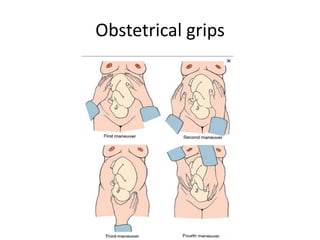
• Abdominal Examination---Height of uterus ,
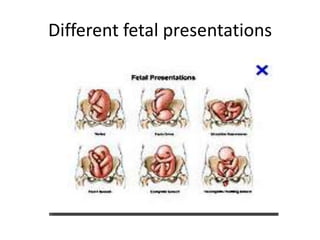
  do all grips and note down Presentation ,
  Position, Free floating /Fixed or engaged
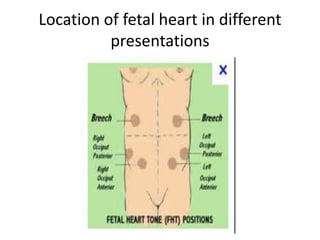
  presenting part , foetal movements ,foetal
  heart ( rate and rhythm ) any uterine irritability
  , uterine tenseness , tenderness , any over
  distension of uterus to early detection of
  pleural pregnancy / poly hydramnios. Do
  Breast examination.
• Correlate and compare your physical findings
  with previous records and reports.
Fundal height at different gestational
               period
Measurement of distance between upper limit
 of uterus and superior border of symphysis
                   pubis
Fundal grip
Umbilical grip
Obstetrical grips
Location of fetal heart in different
          presentations
Different fetal presentations
Subsequent Visits-
•  Investigations- Repeat Hb ., Urine –albumin
  and sugar.
• Blood Sugar at 28 and 34-36 weeks to
  diagnose gestational / pre diabetic mother.
• USG---- 18weeks to rule out / confirm any
  congenital anomaly. Correlate its findings with
  physical examination and previous USG.
• Repeat USG as and when indicated or at 34-
  36 weeks. Color Doppler as and when
    required.
Subsequent Visits-
• 2nd dose of T. Toxoid.
• Start Iron 100 mg + folic acid tab every day
  after 14 weeks or when nausea & vomiting
  stops , continue till term .
• Tab. Calcium Citrate 1200 mg / day.
• Protein supplementation
Subsequent Visit-
• When to report to hospital-
  Any Bleeding PV, watery discharge PV , pain
   abdomen, fever , unable to feel fetal
   movements , yellow coloration of eyes or urine
   , swelling of feet, headache, pain in
   epigastrium , fits , unconsciousness , fainting
   attacks , excessive vomits or loose motions
   etc.
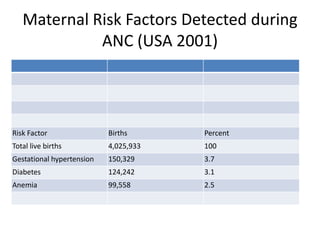
Maternal Risk Factors Detected during
             ANC (USA 2001)


Risk Factor                Births      Percent
Total live births          4,025,933   100
Gestational hypertension   150,329     3.7
Diabetes                   124,242     3.1
Anemia                     99,558      2.5
Maternal Risk Factors Detected
            During ANC ( USA 2001)

                           20,698   0.5
Cardiac Disease

 Renal Disease             12,251   0,3

Incompetent Os             11.251   0,3

Hydramnios/oligohydramnios 54,694   1.4
Lung disease              48,246    1.2
Genital herpes            33,560    0.8
Chronic hypertension      32,232    0.8
D (Rh) sensitization      26,933    0.7
Thank You

Ante natal clinic - protocol

  • 1.
    ANTENATAL CLINIC PROTOCOL Prof. M.C. Bansal MBBS.,MS. FICOG ., MICOG. Ex . Principal & controller Jhalawar Medical College & Hospital & M.G.M.C & Hospital . Sitapura ., Jaipur .
  • 2.
    Ante Natal Clinic-- Protocol 1. It helps in early identification of complications of pregnancy in time and their management. 2. Ensures healthy outcomes for the mother and her baby. 3. Provides opportunity to council regarding immunization, diet supplementation during pregnancy and lactating period, motivation for breast feeding and contraception , patient education about mother craft.
  • 3.
    When and howfrequent patient should come for check up? • Registration: -As early as pregnancy is suspected /diagnosed. • At least 4 Antenatal Visits during all 3 trimesters. • 1st ANC ---in first trimester i.e. first 12 weeks of pregnancy. 2nd ANC –between 14-26 weeks. 3rd ANC –between 28 and 34 weeks . 4th ANC—between 36 weeks and term. Ideally ANC visit once a month till 28 weeks , then every fortnight in 28-34 weeks and once a week after wards till delivery.
  • 4.
    First ANC Visit •Pregnancy Detection by clinical examination /urinary pregnancy test. • ANC Registration ,filling the ANC card and safe motherhood booklet of every pregnant women after patient interrogation , detailed menstrual , LMP , Obstetrical , personal, family history & any pre-existing medical/surgical diseases and their drug therapy.
  • 5.
    First Visit- Clinical Examination- General Examination- Height, weight , calculate BMI , pallor, edema, B.P., jaundice , lymph node enlargement , cyanosis , clubbing or koilonychia etc. Systemic - CVS , Respiratory , locomotive Obstetrical---Per abdominal if gravid uterus is palpable above symphysis pubis , PS & PV when indicated.
  • 6.
    First visit- Investigations- • Hb gm % • CVC • Urine Examination—Albumin ,Sugar , Microscopic. • ABO Rh Grouping—if Rh negative husband’s ABO Rh grouping . • VDRL • HIV counseling and screening. • HBsAg • Random Blood Glucose. • USG / TVS Not as routine but only when indicate on obstetrical grounds.
  • 7.
    Information for Pregnant woman and her family • Encourage institutional delivery ,Ensure delivery by qualified , trained ,experienced labour room nurse or resident doctor. • Explain entitlement under JSY. • Identify nearest PHC / FRU for delivery. • Early identification of high risk / BOH pregnancy to be attended in district hospital or medical college hospital. • Pre-identification of referral , transport and blood donor. • Insist upon regular ANC visits.
  • 8.
    Therapeutic --Advise • Tab.Folic Acid 5mg once a day. • Inj. T. T0x0id 0.5ml –1st dose ; 2nd dose to be repeated after 6 weeks, • Avoid self medication. • For any illness / symptom consult your obstetrician before exposing yourself to any scanning , drugs, chemicals. • Eat small amount of food at 4-6 times. Avoid preserved food, synthetic drinks, smoking , alcohol. • Consume plenty of fresh fruits and vegetables. • Take rest in left lateral side for 2hrs after mid day meal and 8 hrs at night. • For troublesome nausea & vomiting -Take anti emetic tab as per advise of the obstetrician.
  • 9.
    • Decide tocontinue / discontinue any medication which patient is taking for pre pregnancy diseases like asthma , epilepsy , heart disease, renal hypertension, obesity, liver disease. cancer etc. • Stress to maintain dental , oral , whole body & private parts hygiene. • Avoid taking Pica- like clay , lime , chalk etc. • Avoid exposure to insecticides , fertilizers & industrial chemical fumes at the work site.
  • 10.
    Subsequent visits • Onevery visit - Ask for any complain. • Record all findings of physical examination- Weight , anemia ,edema, B.P. • Abdominal Examination---Height of uterus , do all grips and note down Presentation , Position, Free floating /Fixed or engaged presenting part , foetal movements ,foetal heart ( rate and rhythm ) any uterine irritability , uterine tenseness , tenderness , any over distension of uterus to early detection of pleural pregnancy / poly hydramnios. Do Breast examination. • Correlate and compare your physical findings with previous records and reports.
  • 11.
    Fundal height atdifferent gestational period
  • 12.
    Measurement of distancebetween upper limit of uterus and superior border of symphysis pubis
  • 13.
  • 14.
  • 15.
  • 16.
    Location of fetalheart in different presentations
  • 17.
  • 18.
    Subsequent Visits- • Investigations- Repeat Hb ., Urine –albumin and sugar. • Blood Sugar at 28 and 34-36 weeks to diagnose gestational / pre diabetic mother. • USG---- 18weeks to rule out / confirm any congenital anomaly. Correlate its findings with physical examination and previous USG. • Repeat USG as and when indicated or at 34- 36 weeks. Color Doppler as and when required.
  • 19.
    Subsequent Visits- • 2nddose of T. Toxoid. • Start Iron 100 mg + folic acid tab every day after 14 weeks or when nausea & vomiting stops , continue till term . • Tab. Calcium Citrate 1200 mg / day. • Protein supplementation
  • 20.
    Subsequent Visit- • Whento report to hospital- Any Bleeding PV, watery discharge PV , pain abdomen, fever , unable to feel fetal movements , yellow coloration of eyes or urine , swelling of feet, headache, pain in epigastrium , fits , unconsciousness , fainting attacks , excessive vomits or loose motions etc.
  • 22.
    Maternal Risk FactorsDetected during ANC (USA 2001) Risk Factor Births Percent Total live births 4,025,933 100 Gestational hypertension 150,329 3.7 Diabetes 124,242 3.1 Anemia 99,558 2.5
  • 23.
    Maternal Risk FactorsDetected During ANC ( USA 2001) 20,698 0.5 Cardiac Disease Renal Disease 12,251 0,3 Incompetent Os 11.251 0,3 Hydramnios/oligohydramnios 54,694 1.4 Lung disease 48,246 1.2 Genital herpes 33,560 0.8 Chronic hypertension 32,232 0.8 D (Rh) sensitization 26,933 0.7
  • 24.