• Vacuum Delivery/ ventouse/vacuum
extractor
Sunil Kumar Daha
“Instrumental device designed to assist delivery by
applying traction to a suction cup attached to the
fetal scalp”
• Any condition threatened to mother or fetus that is
likely to be relieved by delivery
• Fetus of atleast 34 weeks
Introduction
 Maternal indication
1. Maternal distress, exhaustion after a long, painful labor, due
to inefficient uterine contractions.
2. Prolonged second stage of labor
( Nulliparous: >3hrs with regional analgesia
>2hrs without regional analgesia
Parous: >2hrs with regional analgesia
>1 hr without regional analgesia)
1. Maternal medical disorders such as heart disease,
hypertensive disorders and moderate to severe anemia.
2. Previous cesarean section or genital prolapse repair.
3. Intrapartum infection, certain neurological conditions.
 Fetal indication
1. Prolapse of umbilical cord
2. Premature separation of placenta
3. Non reassuring fetal heart rate pattern
4. Fetal distress
5. Non rotated heads or occipitotransverse positions
6. Occipitoposterior position
 Contraindication
• Operator inexperience
• Inability to assess fetal position
• Suspicion of cephalopelvic disproportion
• Fetal coagulopathy
• Preterm babies (<34 weeks) due to risk of fetal
intraventricular hemorrhage
• Macrosomia (≥4 kg)
• Soft tissues obstruction in the pelvis
• Breach presentation and face presentation
Instrumentation
Components:
• a suction cup with four sizes(30mm, 40mm,
50mm, 60mm)
– Metal cup
– Soft cup
– Silastic cup
– Rigid plastic cup
• vacuum pump,
• traction tubing
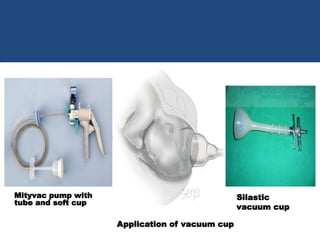
Mityvac pump with
tube and soft cup
Silastic
vacuum cup
Application of vacuum cup
Technique
• The woman's bladder should be empty (via
voiding or catheterization).
• The patient is placed in the lithotomy position.
• Vaginal examination to check pelvic capacity,
cervical dilatation, presentation, position, station
and degree of flexion of head and that the
membranes are ruptured
• Determination of flexion point
Continue….
• Proper cup placement over flexion point
• Exclude maternal soft tissue entrapment by
palpation
• Vacuum creation by increasing the suction in
increments of 0.2 kg/cm2 every 2 mins until 0.8
kg/cm2
• A check is made using the fingers round the cup
to ensure that no cervical or vaginal tissue is
trapped inside the cup
Continue….
• The pressure is gradually raised at the rate of
0.1kg/cm2 per minute until the effective vacuum
of 0.8kg/cm2 is achieved in about 10 minutes
time
• The scalp is sucked into the cup and an artificial
caput succedaneum is produced, which
dissapears withinn few hours.
• Instrument handle is grasped, and initiation of
traction
Continue….
• Traction is initiated by using a two-handed
technique, i.e the fingers of one hand are placed
against the suction cup, while the other hand
grasps the handle of the instrument
• Traction must be at right angle to the cup
• Traction directed initially downward then
progressively extended upward as head emerge
Continue….
• Traction should be synchronous with the uterine
contractions; released in between the contractions.
• Once head is extracted, vacuum pressure is
relieved; cup is removed; vaginal delivery followed
Continue….
• The total time from the application until delivery
should not exceed 20 minutes
• If >20 minutes, the risk of fetal scalp trauma and
intracranial damage increases
• Many pulls to achieve progress should not be
done
• The operator should be wiling to abandon the
procedure if it does not proceed easily or if the
cup dislodges >3 times
Summary
• Ask for help, Address the patient, Anesthesia
• Bladder empty
• Cervix fully dilated
• Determine fetal position and think shoulder
dystocia
• Extractor and resuscitation equipment ready
• Flexion point – apply cup
• Gentle traction in the proper axis
• Halt traction when the contraction is over, halt
the procedure if it is not progressing normally
Fetal Complications
• Scalp laceration and bruising
• Subglial hematoma, Cephalohematoma
• Intracranial hemorrhage, intraventricular and cerebral
hemorrhages
• Retinal and sub-conjunctival hemorrhages
• Neonatal jaundice
• Clavicular fracture, Shoulder dystocia
• Injury to CVI, CVII nerves, Erb palsy
• Hypoxia, particularly when extraction has taken a long
time and has been difficult
• Fetal death
Maternal Complications
• Soft tissues injuries such as cervical tears,
annular detachment of the cervix, vaginal tears,
perineal lacerations and tears, extension of
episiotomy, vaginal wall and perineal
hematomas.
• Traumatic postpartum hemorrhages
• Infection
• Genital prolapse
Management
• To assess the effect on the mother and the fetus
• To start a Ringer’s solution drip and to arrange for
blood transfusion, if required
• To exclude rupture of the uterus
• To assess if procedure is to be abandoned and
consider delivery by cesarean section
• Laparotomy should be done in a case with
rupture of uterus.
• To administer parenteral antibiotic
• Cunningham et.al., Williams OBSTETRICS, 24E,
McGraw-Hill Education, 2014,
• DC Dutta’s textbook of Obstetrics
References
Thank you

Vacuum Delivery

  • 1.
    • Vacuum Delivery/ventouse/vacuum extractor Sunil Kumar Daha
  • 2.
    “Instrumental device designedto assist delivery by applying traction to a suction cup attached to the fetal scalp” • Any condition threatened to mother or fetus that is likely to be relieved by delivery • Fetus of atleast 34 weeks Introduction
  • 3.
     Maternal indication 1.Maternal distress, exhaustion after a long, painful labor, due to inefficient uterine contractions. 2. Prolonged second stage of labor ( Nulliparous: >3hrs with regional analgesia >2hrs without regional analgesia Parous: >2hrs with regional analgesia >1 hr without regional analgesia) 1. Maternal medical disorders such as heart disease, hypertensive disorders and moderate to severe anemia. 2. Previous cesarean section or genital prolapse repair. 3. Intrapartum infection, certain neurological conditions.
  • 4.
     Fetal indication 1.Prolapse of umbilical cord 2. Premature separation of placenta 3. Non reassuring fetal heart rate pattern 4. Fetal distress 5. Non rotated heads or occipitotransverse positions 6. Occipitoposterior position
  • 5.
     Contraindication • Operatorinexperience • Inability to assess fetal position • Suspicion of cephalopelvic disproportion • Fetal coagulopathy • Preterm babies (<34 weeks) due to risk of fetal intraventricular hemorrhage • Macrosomia (≥4 kg) • Soft tissues obstruction in the pelvis • Breach presentation and face presentation
  • 6.
    Instrumentation Components: • a suctioncup with four sizes(30mm, 40mm, 50mm, 60mm) – Metal cup – Soft cup – Silastic cup – Rigid plastic cup • vacuum pump, • traction tubing
  • 7.
    Mityvac pump with tubeand soft cup Silastic vacuum cup Application of vacuum cup
  • 8.
    Technique • The woman'sbladder should be empty (via voiding or catheterization). • The patient is placed in the lithotomy position. • Vaginal examination to check pelvic capacity, cervical dilatation, presentation, position, station and degree of flexion of head and that the membranes are ruptured • Determination of flexion point
  • 10.
    Continue…. • Proper cupplacement over flexion point • Exclude maternal soft tissue entrapment by palpation • Vacuum creation by increasing the suction in increments of 0.2 kg/cm2 every 2 mins until 0.8 kg/cm2 • A check is made using the fingers round the cup to ensure that no cervical or vaginal tissue is trapped inside the cup
  • 11.
    Continue…. • The pressureis gradually raised at the rate of 0.1kg/cm2 per minute until the effective vacuum of 0.8kg/cm2 is achieved in about 10 minutes time • The scalp is sucked into the cup and an artificial caput succedaneum is produced, which dissapears withinn few hours. • Instrument handle is grasped, and initiation of traction
  • 12.
    Continue…. • Traction isinitiated by using a two-handed technique, i.e the fingers of one hand are placed against the suction cup, while the other hand grasps the handle of the instrument • Traction must be at right angle to the cup • Traction directed initially downward then progressively extended upward as head emerge
  • 13.
    Continue…. • Traction shouldbe synchronous with the uterine contractions; released in between the contractions. • Once head is extracted, vacuum pressure is relieved; cup is removed; vaginal delivery followed
  • 14.
    Continue…. • The totaltime from the application until delivery should not exceed 20 minutes • If >20 minutes, the risk of fetal scalp trauma and intracranial damage increases • Many pulls to achieve progress should not be done • The operator should be wiling to abandon the procedure if it does not proceed easily or if the cup dislodges >3 times
  • 15.
    Summary • Ask forhelp, Address the patient, Anesthesia • Bladder empty • Cervix fully dilated • Determine fetal position and think shoulder dystocia • Extractor and resuscitation equipment ready • Flexion point – apply cup • Gentle traction in the proper axis • Halt traction when the contraction is over, halt the procedure if it is not progressing normally
  • 16.
    Fetal Complications • Scalplaceration and bruising • Subglial hematoma, Cephalohematoma • Intracranial hemorrhage, intraventricular and cerebral hemorrhages • Retinal and sub-conjunctival hemorrhages • Neonatal jaundice • Clavicular fracture, Shoulder dystocia • Injury to CVI, CVII nerves, Erb palsy • Hypoxia, particularly when extraction has taken a long time and has been difficult • Fetal death
  • 17.
    Maternal Complications • Softtissues injuries such as cervical tears, annular detachment of the cervix, vaginal tears, perineal lacerations and tears, extension of episiotomy, vaginal wall and perineal hematomas. • Traumatic postpartum hemorrhages • Infection • Genital prolapse
  • 18.
    Management • To assessthe effect on the mother and the fetus • To start a Ringer’s solution drip and to arrange for blood transfusion, if required • To exclude rupture of the uterus • To assess if procedure is to be abandoned and consider delivery by cesarean section • Laparotomy should be done in a case with rupture of uterus. • To administer parenteral antibiotic
  • 19.
    • Cunningham et.al.,Williams OBSTETRICS, 24E, McGraw-Hill Education, 2014, • DC Dutta’s textbook of Obstetrics References
  • 20.

Editor's Notes

  • #11 Flexion point: found along the sagittal suture 3cm infront of PF and 6cm from AF