Breech Presentationwww.freelivedoctor.com
BREECH PRESENTATIONDefinition-It is a longitudinal lie in which the buttocks is the presenting part with or without the lower limbs.Incidence-3.5% of term singleton deliveries and about 25% of cases before 30 weeks of gestation as most cases undergo spontaneous cephalic version up to term.www.freelivedoctor.com
AetiologyIn general, the foetus is adapted to the pyriform shape of the uterus with the larger buttock in the fundus and smaller head in the lower uterine segment.Any factor that interferes with this adaptation, allows free mobility or prevents spontaneous version, can be considered a cause for breech presentation as:www.freelivedoctor.com
Aetiology*Prematurity:> relatively small foetal size,> relatively excess amniotic fluid, and>more globular shape of the uterus.* Multiple pregnancy: one or both will present by the breech to adapt with the relatively small room.www.freelivedoctor.com
Aetiology* Poly-and oligohydramnios.* Hydrocephalus.* Intrauterine foetal death.* Bicornuate and septate uterus.* Uterine and pelvic tumours.* Placenta praevia.www.freelivedoctor.com
TypesComplete breech: > The feet present beside the buttocks as both knees and hips are flexed.>More common in multipara.www.freelivedoctor.com
Types.Incomplete breecha.Frank breech:>It is breech with extended legs where the knees are extended while the hips are flexed.>More common in primigravidab.Footling presentation:>The hip and knee joints are extended on one or both sides.>More common in preterm singleton breeches.www.freelivedoctor.com
Types.Incomplete breech:c.Knee presentation:>The hip is partially extended and the knee is flexed on one or both sides.www.freelivedoctor.com
Positions * Left sacro-anterior.            * Right sacro-anterior. * Right sacro-posterior.            * Left sacro-posterior. * Left and right sacro- transverse (lateral). * Direct sacro-anterior and posterior.www.freelivedoctor.com
Sacro-anterior positions are more common than sacro-posterior as in the first the concavity of the foetal front fits into the convexity of the maternal spines.www.freelivedoctor.com
DiagnosisDuring pregnancyInspection* Inspection:>A transverse groove may be seen above the umbilicus in sacro-anterior corresponds to the neck.> If the patient is thin, the head may be seen as a localised bulge in one hypochondrium.www.freelivedoctor.com
Diagnosis* Palpation:>Fundal grip: the head is felt as a smooth, hard, round ballottable mass which is often tender.> Umbilical grip: the back is identified and a depression corresponds to the neck may be felt.> First pelvic grip: the breech is felt as a smooth, soft mass continuous with the back. Trial to do ballottement to the breech shows that the movement is transmitted to the whole trunk.www.freelivedoctor.com
Diagnosis* Auscultation:    >  FHS is heard above the level of the umbilicus. However in frank breech it may be heard at or below the level of the umbilicus.www.freelivedoctor.com
DiagnosisUltrasonography: > It is used for the following:> To confirm the diagnosis.> To detect the type of breech.> To detect gestational age and foetal weight:  Different measures can be taken to determine the foetal weight as the biparietal diameter with chest or abdominal circumference using a special equation.> To exclude hyperextension of the head.> To exclude congenital anomalies.> Diagnosis of unsuspected twins.www.freelivedoctor.com
DiagnosisDuring LabourIn addition to the previous findings, vaginal examination reveals: * The 3 bony landmarks of breech namely 2 ischialtuberosities and tip of the sacrum.* The feet are felt beside the buttocks in complete breech.* Fresh meconium may be found on the examining fingers. * Male genitalia may be felt.www.freelivedoctor.com
Mechanism of LabourDelivery of the buttocks* The engagement diameter is the bitrochanteric diameter 10 cm which enters the pelvis in one of the oblique diameters.* The anterior buttock meets the pelvic floor first so it rotates 1/8 circle anteriorly.* The anterior buttock hinges below the symphysis and the posterior buttock is delivered first by lateral flexion of the spines followed by the anterior buttock.* External rotation occurs so that the sacrum comes anteriorly.www.freelivedoctor.com
Mechanism of LabourDelivery of the shoulders* The shoulders enter the same oblique diameter with the biacromial diameter 12 cm (between the acromial processes of the scapulae).* The anterior shoulder meets the pelvic floor first, rotates 1/8 circle anteriorly, hinges under the symphysis, then the posterior shoulder is delivered first followed by the anterior shoulder.www.freelivedoctor.com
Mechanism of Labour* The head enters the pelvis in the opposite oblique diameter.* The occiput rotates 1/8 circle anteriorly, in case of sacro- anterior position and 3/8 circle anteriorly in case of sacro- posterior position.* Rarely, the occiput rotates posteriorly and this should be prevented by the obstetrician.www.freelivedoctor.com
The head is delivered by movement of flexion in:* Direct occipito-posterior (face to pubis).* Face mento-anterior.* The after coming head in breech presentation.www.freelivedoctor.com
Management of Breech PresentationExternal Cephalic VersionIt regains its importance after increased rate of caesarean sections nowadays.Timing: After the 32nd weeks up to the 37th week and some authors extend it to the early labour as long as the membranes are intact and there is no contraindications.www.freelivedoctor.com
Management of Breech PresentationVersion is not done earlier because:* Spontaneous version is liable to occur.* Return to breech presentation is liable to occur.* If labour occurs the foetus will have a lesser chance for survival.www.freelivedoctor.com
Management of Breech PresentationVersion is difficult after 37th weeks due to:* Larger foetal size.* Relatively less liquor.* More irritability of the uterus.www.freelivedoctor.com
Management of Breech PresentationCauses of failure* Large sized foetus. * Oligo- or polyhydramnios. * Short umbilical cord. * Uterine anomalies as bicornuate or septate uterus.* Irritable uterus. Tocolytic drugs may be started 15 minutes before the procedure to overcome this.*Obesity* Rigid abdominal wall.  * Frank breech because the legs act as a splint.www.freelivedoctor.com
Caesarean SectionIndications:a. Large foetus i.e. > 3.75 kg estimated by ultrasound.b.Pretermfoetus but estimated weight is still more than 1.25 kg.c.Footling or complete breech: as the presenting irregular part is not well fitting with the lower uterine segment leading to;> Less reflex stimulation of uterine contractions.> Susceptibility to cord prolapse.> Early bearing down as the foot passes through partially dilated cervix and reaches the perineum.www.freelivedoctor.com
Caesarean SectionIndicationsd. Hyperextended head: diagnosed by ultrasound or X-ray.e. Contracted pelvis: of any degree. f. Uterine dysfunction.www.freelivedoctor.com
Caesarean SectionIndications:g.Complicated pregnancy with: > Hypertension. > Diabetes mellitus.        > Placenta praevia. > Pre - labour rupture of membranes for = 12 hours.> Post-term.> Intrauterine growth retardation. > Placental insufficiency.www.freelivedoctor.com
Caesarean SectionIndications h. Primigravidas: breech in primigravida equals caesarean section in opinion of most obstetricians as the maternal passages were not tested for delivery before.www.freelivedoctor.com
Vaginal DeliveryPrerequisites:* Frank breech.* Estimated foetal weight not more than 3.75 kg.* Gestational age: 36-42 weeks.* Flexed head. * Adequate pelvis.* Normal progress of labour by using the partogram.* Uncomplicated pregnancy.* Multiparas.* An experienced obstetrician.* In case of intrauterine foetal death.www.freelivedoctor.com
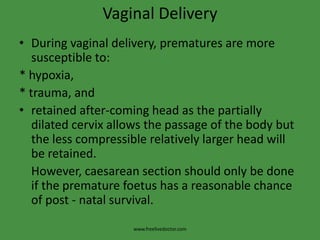
Vaginal DeliveryDuring vaginal delivery, prematures are more susceptible to:* hypoxia,* trauma, andretained after-coming head as the partially dilated cervix allows the passage of the body but the less compressible relatively larger head will be retained.    However, caesarean section should only be done if the premature foetus has a reasonable chance of post - natal survival.www.freelivedoctor.com
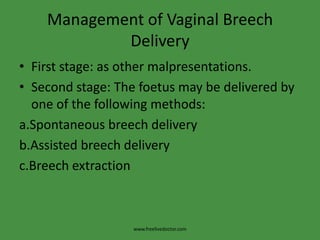
Management of Vaginal Breech DeliveryFirst stage: as other malpresentations.Second stage: The foetus may be delivered by one of the following methods:a.Spontaneous breech deliveryb.Assisted breech deliveryc.Breech extractionwww.freelivedoctor.com
Complicated Breech Deliverywww.freelivedoctor.com
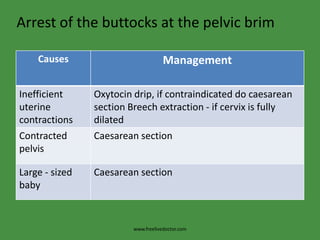
Arrest of the buttocks at the pelvic brimwww.freelivedoctor.com
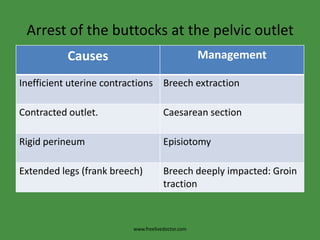
Arrest of the buttocks at the pelvic outletwww.freelivedoctor.com
Complications of Breech DeliveryMaternal:>Prolonged labour with maternal distress> Obstructed labour with its sequelae may occur as in    impacted breech with extended legs.> Laceration especially perineal.>Postpartum haemorrhage due to prolonged labour and   lacerations.> Puerperal sepsis.www.freelivedoctor.com
Complications of Breech DeliveryFoetalComplications:Foetal mortality due toa.Intracranialhaemorrhageb. Fracture dislocation of the cervical spinesc. Asphyxia www.freelivedoctor.com

Breech presentation

  • 1.
  • 2.
    BREECH PRESENTATIONDefinition-It isa longitudinal lie in which the buttocks is the presenting part with or without the lower limbs.Incidence-3.5% of term singleton deliveries and about 25% of cases before 30 weeks of gestation as most cases undergo spontaneous cephalic version up to term.www.freelivedoctor.com
  • 3.
    AetiologyIn general, thefoetus is adapted to the pyriform shape of the uterus with the larger buttock in the fundus and smaller head in the lower uterine segment.Any factor that interferes with this adaptation, allows free mobility or prevents spontaneous version, can be considered a cause for breech presentation as:www.freelivedoctor.com
  • 4.
    Aetiology*Prematurity:> relatively smallfoetal size,> relatively excess amniotic fluid, and>more globular shape of the uterus.* Multiple pregnancy: one or both will present by the breech to adapt with the relatively small room.www.freelivedoctor.com
  • 5.
    Aetiology* Poly-and oligohydramnios.*Hydrocephalus.* Intrauterine foetal death.* Bicornuate and septate uterus.* Uterine and pelvic tumours.* Placenta praevia.www.freelivedoctor.com
  • 6.
    TypesComplete breech: >The feet present beside the buttocks as both knees and hips are flexed.>More common in multipara.www.freelivedoctor.com
  • 7.
    Types.Incomplete breecha.Frank breech:>Itis breech with extended legs where the knees are extended while the hips are flexed.>More common in primigravidab.Footling presentation:>The hip and knee joints are extended on one or both sides.>More common in preterm singleton breeches.www.freelivedoctor.com
  • 8.
    Types.Incomplete breech:c.Knee presentation:>Thehip is partially extended and the knee is flexed on one or both sides.www.freelivedoctor.com
  • 9.
    Positions * Leftsacro-anterior. * Right sacro-anterior. * Right sacro-posterior. * Left sacro-posterior. * Left and right sacro- transverse (lateral). * Direct sacro-anterior and posterior.www.freelivedoctor.com
  • 10.
    Sacro-anterior positions aremore common than sacro-posterior as in the first the concavity of the foetal front fits into the convexity of the maternal spines.www.freelivedoctor.com
  • 11.
    DiagnosisDuring pregnancyInspection* Inspection:>Atransverse groove may be seen above the umbilicus in sacro-anterior corresponds to the neck.> If the patient is thin, the head may be seen as a localised bulge in one hypochondrium.www.freelivedoctor.com
  • 12.
    Diagnosis* Palpation:>Fundal grip:the head is felt as a smooth, hard, round ballottable mass which is often tender.> Umbilical grip: the back is identified and a depression corresponds to the neck may be felt.> First pelvic grip: the breech is felt as a smooth, soft mass continuous with the back. Trial to do ballottement to the breech shows that the movement is transmitted to the whole trunk.www.freelivedoctor.com
  • 13.
    Diagnosis* Auscultation: > FHS is heard above the level of the umbilicus. However in frank breech it may be heard at or below the level of the umbilicus.www.freelivedoctor.com
  • 14.
    DiagnosisUltrasonography: > Itis used for the following:> To confirm the diagnosis.> To detect the type of breech.> To detect gestational age and foetal weight: Different measures can be taken to determine the foetal weight as the biparietal diameter with chest or abdominal circumference using a special equation.> To exclude hyperextension of the head.> To exclude congenital anomalies.> Diagnosis of unsuspected twins.www.freelivedoctor.com
  • 15.
    DiagnosisDuring LabourIn additionto the previous findings, vaginal examination reveals: * The 3 bony landmarks of breech namely 2 ischialtuberosities and tip of the sacrum.* The feet are felt beside the buttocks in complete breech.* Fresh meconium may be found on the examining fingers. * Male genitalia may be felt.www.freelivedoctor.com
  • 16.
    Mechanism of LabourDeliveryof the buttocks* The engagement diameter is the bitrochanteric diameter 10 cm which enters the pelvis in one of the oblique diameters.* The anterior buttock meets the pelvic floor first so it rotates 1/8 circle anteriorly.* The anterior buttock hinges below the symphysis and the posterior buttock is delivered first by lateral flexion of the spines followed by the anterior buttock.* External rotation occurs so that the sacrum comes anteriorly.www.freelivedoctor.com
  • 17.
    Mechanism of LabourDeliveryof the shoulders* The shoulders enter the same oblique diameter with the biacromial diameter 12 cm (between the acromial processes of the scapulae).* The anterior shoulder meets the pelvic floor first, rotates 1/8 circle anteriorly, hinges under the symphysis, then the posterior shoulder is delivered first followed by the anterior shoulder.www.freelivedoctor.com
  • 18.
    Mechanism of Labour*The head enters the pelvis in the opposite oblique diameter.* The occiput rotates 1/8 circle anteriorly, in case of sacro- anterior position and 3/8 circle anteriorly in case of sacro- posterior position.* Rarely, the occiput rotates posteriorly and this should be prevented by the obstetrician.www.freelivedoctor.com
  • 19.
    The head isdelivered by movement of flexion in:* Direct occipito-posterior (face to pubis).* Face mento-anterior.* The after coming head in breech presentation.www.freelivedoctor.com
  • 20.
    Management of BreechPresentationExternal Cephalic VersionIt regains its importance after increased rate of caesarean sections nowadays.Timing: After the 32nd weeks up to the 37th week and some authors extend it to the early labour as long as the membranes are intact and there is no contraindications.www.freelivedoctor.com
  • 21.
    Management of BreechPresentationVersion is not done earlier because:* Spontaneous version is liable to occur.* Return to breech presentation is liable to occur.* If labour occurs the foetus will have a lesser chance for survival.www.freelivedoctor.com
  • 22.
    Management of BreechPresentationVersion is difficult after 37th weeks due to:* Larger foetal size.* Relatively less liquor.* More irritability of the uterus.www.freelivedoctor.com
  • 23.
    Management of BreechPresentationCauses of failure* Large sized foetus. * Oligo- or polyhydramnios. * Short umbilical cord. * Uterine anomalies as bicornuate or septate uterus.* Irritable uterus. Tocolytic drugs may be started 15 minutes before the procedure to overcome this.*Obesity* Rigid abdominal wall. * Frank breech because the legs act as a splint.www.freelivedoctor.com
  • 24.
    Caesarean SectionIndications:a. Largefoetus i.e. > 3.75 kg estimated by ultrasound.b.Pretermfoetus but estimated weight is still more than 1.25 kg.c.Footling or complete breech: as the presenting irregular part is not well fitting with the lower uterine segment leading to;> Less reflex stimulation of uterine contractions.> Susceptibility to cord prolapse.> Early bearing down as the foot passes through partially dilated cervix and reaches the perineum.www.freelivedoctor.com
  • 25.
    Caesarean SectionIndicationsd. Hyperextendedhead: diagnosed by ultrasound or X-ray.e. Contracted pelvis: of any degree. f. Uterine dysfunction.www.freelivedoctor.com
  • 26.
    Caesarean SectionIndications:g.Complicated pregnancywith: > Hypertension. > Diabetes mellitus. > Placenta praevia. > Pre - labour rupture of membranes for = 12 hours.> Post-term.> Intrauterine growth retardation. > Placental insufficiency.www.freelivedoctor.com
  • 27.
    Caesarean SectionIndications h.Primigravidas: breech in primigravida equals caesarean section in opinion of most obstetricians as the maternal passages were not tested for delivery before.www.freelivedoctor.com
  • 28.
    Vaginal DeliveryPrerequisites:* Frankbreech.* Estimated foetal weight not more than 3.75 kg.* Gestational age: 36-42 weeks.* Flexed head. * Adequate pelvis.* Normal progress of labour by using the partogram.* Uncomplicated pregnancy.* Multiparas.* An experienced obstetrician.* In case of intrauterine foetal death.www.freelivedoctor.com
  • 29.
    Vaginal DeliveryDuring vaginaldelivery, prematures are more susceptible to:* hypoxia,* trauma, andretained after-coming head as the partially dilated cervix allows the passage of the body but the less compressible relatively larger head will be retained. However, caesarean section should only be done if the premature foetus has a reasonable chance of post - natal survival.www.freelivedoctor.com
  • 30.
    Management of VaginalBreech DeliveryFirst stage: as other malpresentations.Second stage: The foetus may be delivered by one of the following methods:a.Spontaneous breech deliveryb.Assisted breech deliveryc.Breech extractionwww.freelivedoctor.com
  • 31.
  • 32.
    Arrest of thebuttocks at the pelvic brimwww.freelivedoctor.com
  • 33.
    Arrest of thebuttocks at the pelvic outletwww.freelivedoctor.com
  • 34.
    Complications of BreechDeliveryMaternal:>Prolonged labour with maternal distress> Obstructed labour with its sequelae may occur as in impacted breech with extended legs.> Laceration especially perineal.>Postpartum haemorrhage due to prolonged labour and lacerations.> Puerperal sepsis.www.freelivedoctor.com
  • 35.
    Complications of BreechDeliveryFoetalComplications:Foetal mortality due toa.Intracranialhaemorrhageb. Fracture dislocation of the cervical spinesc. Asphyxia www.freelivedoctor.com