Retinitis Pigmentosa : A Brief
Nawat Watanachai
August 2016
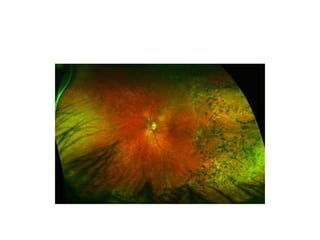
Retinitis Pigmentosa
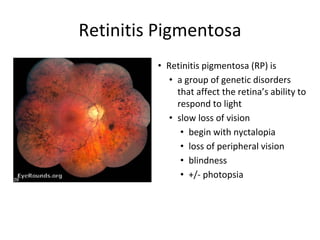
• Retinitis pigmentosa (RP) is
• a group of genetic disorders
that affect the retina’s ability to
respond to light
• slow loss of vision
• begin with nyctalopia
• loss of peripheral vision
• blindness
• +/- photopsia
characteristics
• hereditary
• rate of progression and degree of visual loss varies from person to person
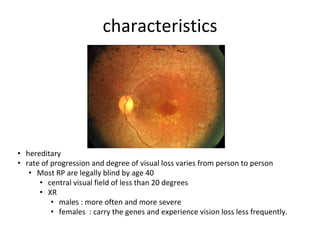
• Most RP are legally blind by age 40
• central visual field of less than 20 degrees
• XR
• males : more often and more severe
• females : carry the genes and experience vision loss less frequently.
Eye Tests
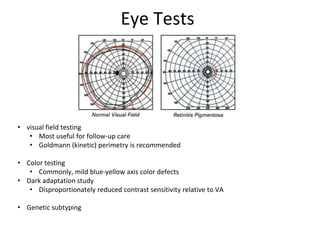
• visual field testing
• Most useful for follow-up care
• Goldmann (kinetic) perimetry is recommended
• Color testing
• Commonly, mild blue-yellow axis color defects
• Dark adaptation study
• Disproportionately reduced contrast sensitivity relative to VA
• Genetic subtyping
Eye Tests
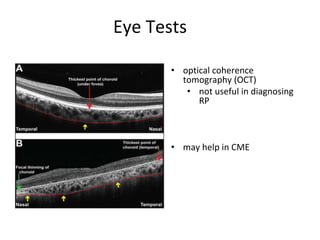
• optical coherence
tomography (OCT)
• not useful in diagnosing
RP
• may help in CME
Eye Tests
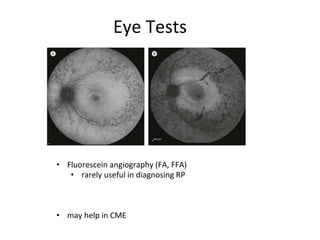
• Fluorescein angiography (FA, FFA)
• rarely useful in diagnosing RP
• may help in CME
Eye Tests
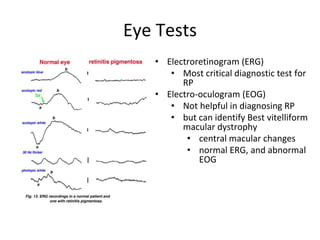
• Electroretinogram (ERG)
• Most critical diagnostic test for
RP
• Electro-oculogram (EOG)
• Not helpful in diagnosing RP
• but can identify Best vitelliform
macular dystrophy
• central macular changes
• normal ERG, and abnormal
EOG
Systemic diseases that related to RP
• hearing loss and RP
• Usher syndrome
• Waardenburg syndrome
• Alport syndrome
• Refsum disease
• Kearns-Sayre syndrome
• External ophthalmoplegia, lid ptosis, heart block, and pigmentary retinopathy
• Abetalipoproteinemia
• Fat malabsorption, fat-soluble vitamin deficiencies, spinocerebellar degeneration, and
pigmentary retinal degeneration
• Mucopolysaccharidoses
• Hurler syndrome, Scheie syndrome, Sanfilippo syndrome
• Bardet-Biedl syndrome
• Polydactyly, truncal obesity, kidney dysfunction, short stature, and pigmentary retinopathy
• Neuronal ceroid lipofuscinosis
• Dementia, seizures, and pigmentary retinopathy
• infantile form is known as Jansky-Bielschowsky disease
• juvenile form is Vogt-Spielmeyer-Batten disease
• adult form is Kufs syndrome
management : medical
• Acetazolamide
• Macular edema (Fishman et al and Cox et al)
• oral acetazolamide helps
• Topical acetazolamide less helps
• Adverse effects:
• fatigue, renal stones
• loss of appetite, hand tingling
• electrolyte imbalance, anemia
• steroid for macular edema
• may be useful but has not been well studied
management : medical
• Pharmacotherapy?
• Fat-soluble vitamins
• vitamin A, C, E
• Ca-channel blockers
• iltiazem
• Carbonic anhydrase inhibitors
• acetazolamide, methazolamide
• Docosahexaenoic acid (DHA)
• Lutein, Zeaxanthin
• medications with potential adverse effects in RP:
• Isotretinoin (Accutane)
• Sildenafil (Viagra)
• High-dose vitamin E
management : surgical
• cataract
• cataract extraction
• Retina
• retinal implant
• gene therapy
• stem cell therapy
• others : RPE transplantation, surgical growth factors
placement
retinal prosthesis
• ARGUS II prosthesis : U of southern california
• Alpha IMS
• Microsystem-based visual prosthesis (MIVP)
• spiral cuff electrode around the optic nerve
• implantable miniature telescope
• Harvard/MIT retinal implant
• artificial silicon retina (ASR)
• Photovoltaic retinal prosthesis
• Bionic vision australia
• dobelle eye
• intracortical visual prosthesis
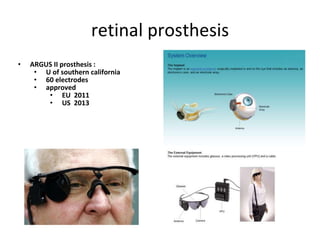
retinal prosthesis
• ARGUS II prosthesis :
• U of southern california
• 60 electrodes
• approved
• EU 2011
• US 2013
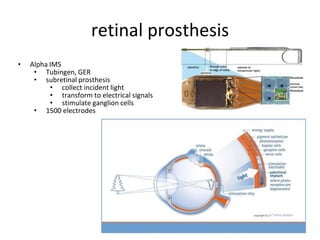
retinal prosthesis
• Alpha IMS
• Tubingen, GER
• subretinal prosthesis
• collect incident light
• transform to electrical signals
• stimulate ganglion cells
• 1500 electrodes
retinal prosthesis
• Alpha IMS
gene therapy
• under investigation
• to replace the defective protein by using DNA vector (eg, adenovirus, lentivirus)
• Gene therapy was successful in providing the missing protein to a dog with Leger congenital
amaurosis (LCA)
• adeno-associated virus (AAV)
• Briard dog with RPE65 mutations after treatment had 20% of its RPE cells express the
functional protein, thereby allowing the dog to see
• also effective in a mouse model of Leber congenital amaurosis
• Trials have also begun for RP, although currently only for MERTK gene mutation
• problems : wide heterogeneity of defects in RP
• Jacobson et al found that gene therapy is acceptably safe and effective in the extrafoveal retina for
LCA caused by RPE65 mutations; however, no benefit and some risk was noted in treating the fovea.
Age-dependent effects were not evident.[18]
• It is not known which, if any, of the RP forms will show reversibility (even with a nondestructive
reinsertion of the appropriate gene in the appropriate locus with appropriate regulation).
stem cells
• Cell transplantation to treat retinal disease (including cells derived from stem cells)
• to replace damaged RPE or photoreceptor cells
• adult bone marrow–derived stem cells and embryonic stem cells
• 2011, Advanced Cell Technology (ACT)
• human trial of a stem-cell–derived therapy
• for ARMD, Stargardt disease
• stem cells were differentiated into cells with an RPE phenotype
• PPV
• injected under the retina
• Initial results demonstrated safety and a trend toward visual improvement in 18 patients
over 3-12 months
• RPE cell transplants (not derived from stem cells)
• placed into the subretinal space to rescue photoreceptors in animal models of RP
Nw2016 retinitis pigmentosa

Nw2016 retinitis pigmentosa

  • 1.
    Retinitis Pigmentosa :A Brief Nawat Watanachai August 2016
  • 2.
    Retinitis Pigmentosa • Retinitispigmentosa (RP) is • a group of genetic disorders that affect the retina’s ability to respond to light • slow loss of vision • begin with nyctalopia • loss of peripheral vision • blindness • +/- photopsia
  • 3.
    characteristics • hereditary • rateof progression and degree of visual loss varies from person to person • Most RP are legally blind by age 40 • central visual field of less than 20 degrees • XR • males : more often and more severe • females : carry the genes and experience vision loss less frequently.
  • 4.
    Eye Tests • visualfield testing • Most useful for follow-up care • Goldmann (kinetic) perimetry is recommended • Color testing • Commonly, mild blue-yellow axis color defects • Dark adaptation study • Disproportionately reduced contrast sensitivity relative to VA • Genetic subtyping
  • 5.
    Eye Tests • opticalcoherence tomography (OCT) • not useful in diagnosing RP • may help in CME
  • 6.
    Eye Tests • Fluoresceinangiography (FA, FFA) • rarely useful in diagnosing RP • may help in CME
  • 7.
    Eye Tests • Electroretinogram(ERG) • Most critical diagnostic test for RP • Electro-oculogram (EOG) • Not helpful in diagnosing RP • but can identify Best vitelliform macular dystrophy • central macular changes • normal ERG, and abnormal EOG
  • 8.
    Systemic diseases thatrelated to RP • hearing loss and RP • Usher syndrome • Waardenburg syndrome • Alport syndrome • Refsum disease • Kearns-Sayre syndrome • External ophthalmoplegia, lid ptosis, heart block, and pigmentary retinopathy • Abetalipoproteinemia • Fat malabsorption, fat-soluble vitamin deficiencies, spinocerebellar degeneration, and pigmentary retinal degeneration • Mucopolysaccharidoses • Hurler syndrome, Scheie syndrome, Sanfilippo syndrome • Bardet-Biedl syndrome • Polydactyly, truncal obesity, kidney dysfunction, short stature, and pigmentary retinopathy • Neuronal ceroid lipofuscinosis • Dementia, seizures, and pigmentary retinopathy • infantile form is known as Jansky-Bielschowsky disease • juvenile form is Vogt-Spielmeyer-Batten disease • adult form is Kufs syndrome
  • 9.
    management : medical •Acetazolamide • Macular edema (Fishman et al and Cox et al) • oral acetazolamide helps • Topical acetazolamide less helps • Adverse effects: • fatigue, renal stones • loss of appetite, hand tingling • electrolyte imbalance, anemia • steroid for macular edema • may be useful but has not been well studied
  • 10.
    management : medical •Pharmacotherapy? • Fat-soluble vitamins • vitamin A, C, E • Ca-channel blockers • iltiazem • Carbonic anhydrase inhibitors • acetazolamide, methazolamide • Docosahexaenoic acid (DHA) • Lutein, Zeaxanthin • medications with potential adverse effects in RP: • Isotretinoin (Accutane) • Sildenafil (Viagra) • High-dose vitamin E
  • 11.
    management : surgical •cataract • cataract extraction • Retina • retinal implant • gene therapy • stem cell therapy • others : RPE transplantation, surgical growth factors placement
  • 12.
    retinal prosthesis • ARGUSII prosthesis : U of southern california • Alpha IMS • Microsystem-based visual prosthesis (MIVP) • spiral cuff electrode around the optic nerve • implantable miniature telescope • Harvard/MIT retinal implant • artificial silicon retina (ASR) • Photovoltaic retinal prosthesis • Bionic vision australia • dobelle eye • intracortical visual prosthesis
  • 13.
    retinal prosthesis • ARGUSII prosthesis : • U of southern california • 60 electrodes • approved • EU 2011 • US 2013
  • 14.
    retinal prosthesis • AlphaIMS • Tubingen, GER • subretinal prosthesis • collect incident light • transform to electrical signals • stimulate ganglion cells • 1500 electrodes
  • 15.
  • 16.
    gene therapy • underinvestigation • to replace the defective protein by using DNA vector (eg, adenovirus, lentivirus) • Gene therapy was successful in providing the missing protein to a dog with Leger congenital amaurosis (LCA) • adeno-associated virus (AAV) • Briard dog with RPE65 mutations after treatment had 20% of its RPE cells express the functional protein, thereby allowing the dog to see • also effective in a mouse model of Leber congenital amaurosis • Trials have also begun for RP, although currently only for MERTK gene mutation • problems : wide heterogeneity of defects in RP • Jacobson et al found that gene therapy is acceptably safe and effective in the extrafoveal retina for LCA caused by RPE65 mutations; however, no benefit and some risk was noted in treating the fovea. Age-dependent effects were not evident.[18] • It is not known which, if any, of the RP forms will show reversibility (even with a nondestructive reinsertion of the appropriate gene in the appropriate locus with appropriate regulation).
  • 17.
    stem cells • Celltransplantation to treat retinal disease (including cells derived from stem cells) • to replace damaged RPE or photoreceptor cells • adult bone marrow–derived stem cells and embryonic stem cells • 2011, Advanced Cell Technology (ACT) • human trial of a stem-cell–derived therapy • for ARMD, Stargardt disease • stem cells were differentiated into cells with an RPE phenotype • PPV • injected under the retina • Initial results demonstrated safety and a trend toward visual improvement in 18 patients over 3-12 months • RPE cell transplants (not derived from stem cells) • placed into the subretinal space to rescue photoreceptors in animal models of RP