Fundamental laser ophthalmology
5 November 2012
Mallawee Charatcharungkiat, MD
Instructor Nawat Watanachai, MD
Outline
• Principle
– Laser physics
– Properties of laser light
• Monochromaticity
• Directionality
• Coherence
– Laser interferometer
– OCT
• Polarization
• Intensity
– Laser system
– Laser interactions and its
clinical use
– Photocoagulation
• Basic
• Choice of wavelength
• Photocoagulation mechanism
• Practical aspect
• Clinical use
– TSCPC
– ECP
– LTP
– LPI
– Laser suture lysis
– Photodisruption
• Nd:YAG capsulotomy
• Femtosecond laser
– Photochemical
• Photodynamic therapy
– Photoablation
• Excimer laser
Outline
• Principle
– Laser physics
– Properties of laser light
• Monochromaticity
• Directionality
• Coherence
– Laser interferometer
– OCT
• Polarization
• Intensity
– Laser system
– Laser interactions and its
clinical use
– Photocoagulation
• Basic
• Choice of wavelength
• Photocoagulation mechanism
• Practical aspect
• Clinical use
– TSCPC
– ECP
– LTP
– LPI
– Laser suture lysis
– Photodisruption
• Nd:YAG capsulotomy
• Femtosecond laser
– Photochemical
• Photodynamic therapy
– Photoablation
• Excimer laser
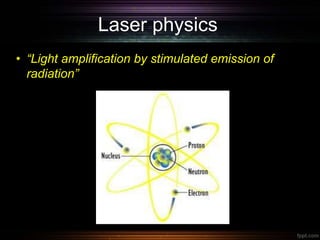
Laser physics
• “Light amplification by stimulated emission of
radiation”
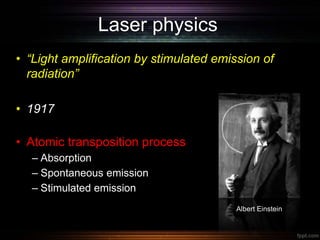
Laser physics
• “Light amplification by stimulated emission of
radiation”
• 1917
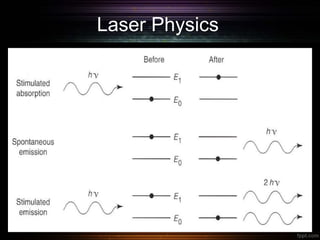
• Atomic transposition process
– Absorption
– Spontaneous emission
– Stimulated emission
Albert Einstein
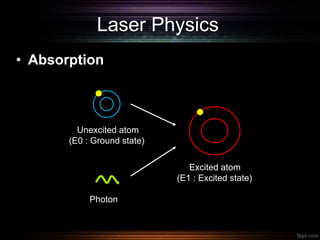
Laser Physics
• Absorption
Unexcited atom
(E0 : Ground state)
Photon
Excited atom
(E1 : Excited state)
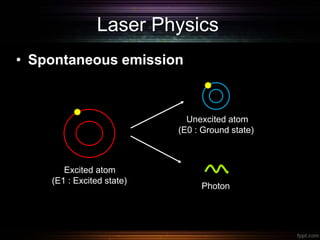
Laser Physics
• Spontaneous emission
Unexcited atom
(E0 : Ground state)
Photon
Excited atom
(E1 : Excited state)
Laser Physics
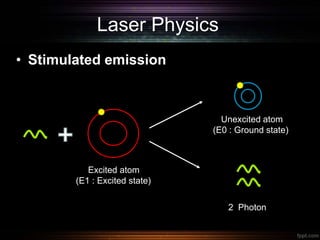
• Stimulated emission
Unexcited atom
(E0 : Ground state)
2 Photon
Excited atom
(E1 : Excited state)
Laser Physics
Laser Physics
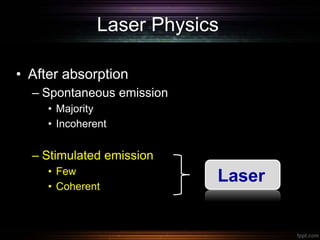
• After absorption
– Spontaneous emission
• Majority
• Incoherent
– Stimulated emission
• Few
• Coherent Laser
Laser
Laser Physics
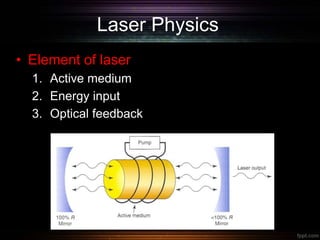
• Element of laser
1. Active medium
2. Energy input
3. Optical feedback
Laser Physics
• Element of laser
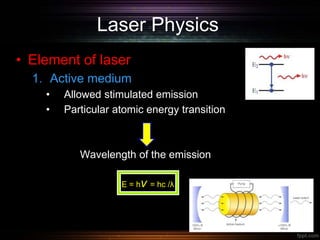
1. Active medium
• Allowed stimulated emission
• Particular atomic energy transition
Wavelength of the emission
E = hv = hc /λ
Laser Physics
• Element of laser
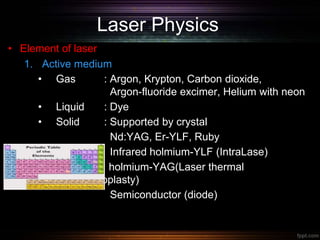
1. Active medium
• Gas : Argon, Krypton, Carbon dioxide,
Argon-fluoride excimer, Helium with neon
• Liquid : Dye
• Solid : Supported by crystal
Nd:YAG, Er-YLF, Ruby
Infrared holmium-YLF (IntraLase)
holmium-YAG(Laser thermal
keratoplasty)
Semiconductor (diode)
Laser Physics
• Element of laser
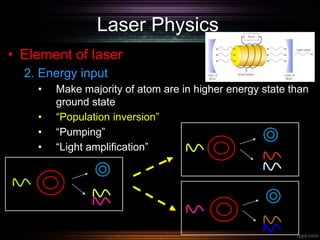
2. Energy input
• Make majority of atom are in higher energy state than
ground state
• “Population inversion”
• “Pumping”
• “Light amplification”
Laser Physics
• Element of laser
2. Energy input
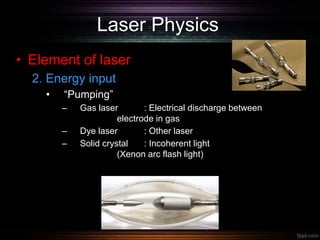
• “Pumping”
– Gas laser : Electrical discharge between
electrode in gas
– Dye laser : Other laser
– Solid crystal : Incoherent light
(Xenon arc flash light)
Laser Physics
• Element of laser
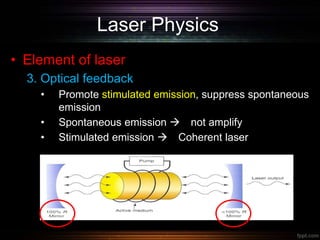
3. Optical feedback
• Promote stimulated emission, suppress spontaneous
emission
• Spontaneous emission  not amplify
• Stimulated emission  Coherent laser
Outline
• Principle
– Laser physics
– Properties of laser light
• Monochromaticity
• Directionality
• Coherence
– Laser interferometer
– OCT
• Polarization
• Intensity
– Laser system
– Laser interactions and its
clinical use
– Photocoagulation
• Basic
• Choice of wavelength
• Photocoagulation mechanism
• Practical aspect
• Clinical use
– TSCPC
– ECP
– LTP
– LPI
– Laser suture lysis
– Photodisruption
• Nd:YAG capsulotomy
• Femtosecond laser
– Photochemical
• Photodynamic therapy
– Photoablation
• Excimer laser
Properties of laser
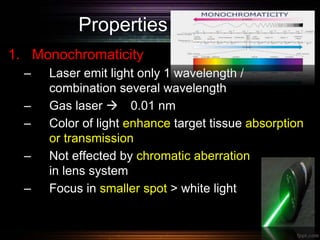
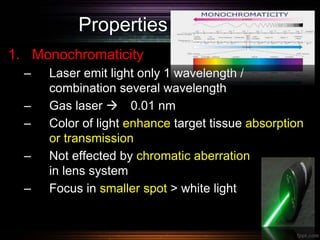
1. Monochromaticity
– Laser emit light only 1 wavelength /
combination several wavelength
– Gas laser  0.01 nm
– Color of light enhance target tissue absorption
or transmission
– Not effected by chromatic aberration
in lens system
– Focus in smaller spot > white light
Properties of laser
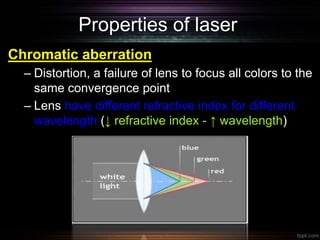
Chromatic aberration
– Distortion, a failure of lens to focus all colors to the
same convergence point
– Lens have different refractive index for different
wavelength (↓ refractive index - ↑ wavelength)
Properties of laser
1. Monochromaticity
– Laser emit light only 1 wavelength /
combination several wavelength
– Gas laser  0.01 nm
– Color of light enhance target tissue absorption
or transmission
– Not effected by chromatic aberration
in lens system
– Focus in smaller spot > white light
Properties of laser
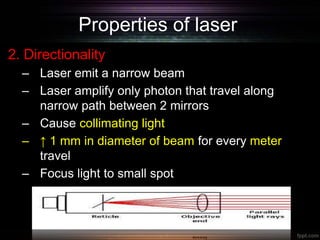
2. Directionality
– Laser emit a narrow beam
– Laser amplify only photon that travel along
narrow path between 2 mirrors
– Cause collimating light
– ↑ 1 mm in diameter of beam for every meter
travel
– Focus light to small spot
Properties of laser
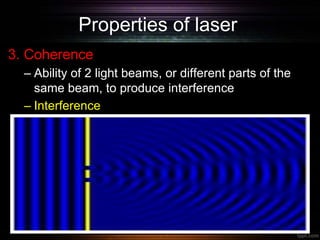
3. Coherence
– Ability of 2 light beams, or different parts of the
same beam, to produce interference
– Interference
Properties of laser
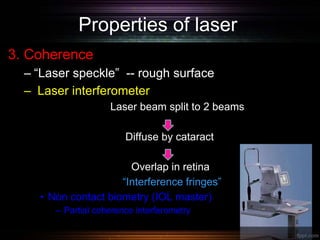
3. Coherence
– “Laser speckle” -- rough surface
– Laser interferometer
Laser beam split to 2 beams
Diffuse by cataract
Overlap in retina
“Interference fringes”
• Non contact biometry (IOL master)
– Partial coherence interferometry
Properties of laser
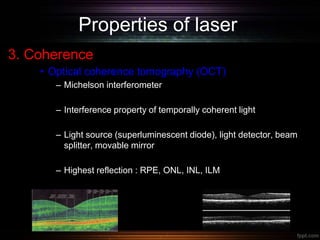
3. Coherence
• Optical coherence tomography (OCT)
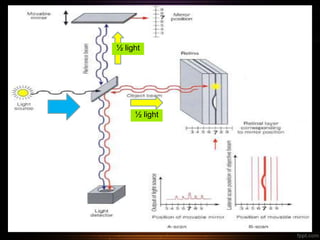
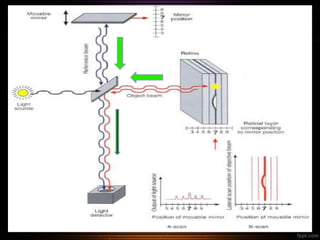
– Michelson interferometer
– Interference property of temporally coherent light
– Light source (superluminescent diode), light detector, beam
splitter, movable mirror
– Highest reflection : RPE, ONL, INL, ILM
Properties of laser
3. Coherence
• OCT
½ light
½ light
Properties of laser
3. Coherence
• OCT
Properties of laser
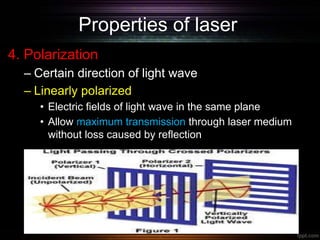
4. Polarization
– Certain direction of light wave
– Linearly polarized
• Electric fields of light wave in the same plane
• Allow maximum transmission through laser medium
without loss caused by reflection
Properties of laser
5. Intensity
– Power in a beam of given angular size
– Most important property
– “Brightness”
• Intensity / unit area
Properties of laser
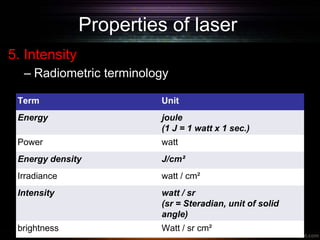
5. Intensity
– Radiometric terminology
Term Unit
Energy joule
(1 J = 1 watt x 1 sec.)
Power watt
Energy density J/cm²
Irradiance watt / cm²
Intensity watt / sr
(sr = Steradian, unit of solid
angle)
brightness Watt / sr cm²
Properties of laser
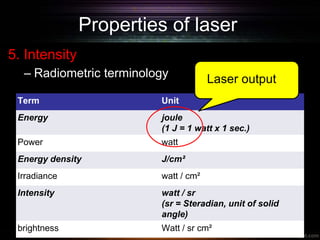
5. Intensity
– Radiometric terminology
Term Unit
Energy joule
(1 J = 1 watt x 1 sec.)
Power watt
Energy density J/cm²
Irradiance watt / cm²
Intensity watt / sr
(sr = Steradian, unit of solid
angle)
brightness Watt / sr cm²
Laser output
Properties of laser
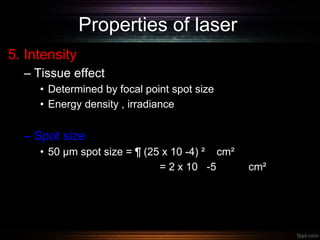
5. Intensity
– Tissue effect
• Determined by focal point spot size
• Energy density , irradiance
– Spot size
• 50 µm spot size = ¶ (25 x 10 -4) ² cm²
= 2 x 10 -5 cm²
Properties of laser
5. Intensity
– Continuous laser
• Argon, Krypton  watts
– Pulsed laser
• Nd:YAG  joules
• Average, peak power
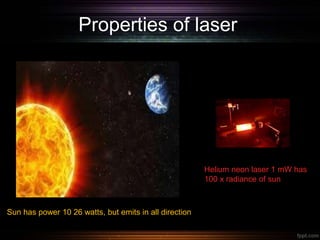
Properties of laser
Sun has power 10 26 watts, but emits in all direction
Helium neon laser 1 mW has
100 x radiance of sun
Outline
• Principle
– Laser physics
– Properties of laser light
• Monochromaticity
• Directionality
• Coherence
– Laser interferometer
– OCT
• Polarization
• Intensity
– Laser system
– Laser interactions and its
clinical use
– Photocoagulation
• Basic
• Choice of wavelength
• Photocoagulation mechanism
• Practical aspect
• Clinical use
– TSCPC
– ECP
– LTP
– LPI
– Laser suture lysis
– Photodisruption
• Nd:YAG capsulotomy
• Femtosecond laser
– Photochemical
• Photodynamic therapy
– Photoablation
• Excimer laser
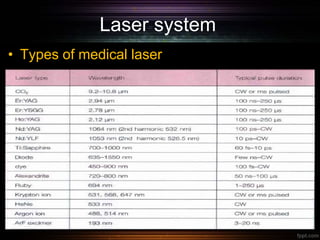
Laser system
• Types of medical laser
Laser system
• Types of medical laser
– CO2 (λ = 9.2-10.8 µm)
• Gas laser
• Nonophthalmic surgery : Gynecology, ENT
• Absorbed by water
– Er:YAG (λ = 2.94 µm)
• Solid laser
• Strongest absorption by water  shallow penetration
depth  low vaporization, small collateral damage
Laser system
• Types of medical laser
– Nd:YAG (λ = 1064 µm)
• Important ophthalmic laser
• Low absorption and scatting  deep penetration
– Argon/Krypton (λ = 488,515,568,647 nm)
• Gas laser
• Retinal photocoagulation in the past
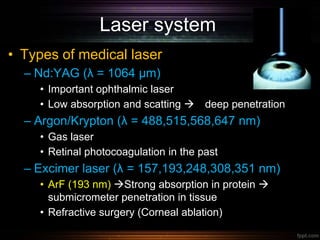
– Excimer laser (λ = 157,193,248,308,351 nm)
• ArF (193 nm) Strong absorption in protein 
submicrometer penetration in tissue
• Refractive surgery (Corneal ablation)
Laser system
• Contact lens
– Aberration
• Focal spot size of laser beam is limited by diffraction
and aberration
• ↑ central aberration  ↑ focal spot size
• Photocoagulation  Flat contact lens to control
aberration
– Magnify spot size on retina
– Increase view of field
Outline
• Principle
– Laser physics
– Properties of laser light
• Monochromaticity
• Directionality
• Coherence
– Laser interferometer
– OCT
• Polarization
• Intensity
– Laser system
– Laser interactions and its
clinical use
– Photocoagulation
• Basic
• Choice of wavelength
• Photocoagulation mechanism
• Practical aspect
• Clinical use
– TSCPC
– ECP
– LTP
– LPI
– Laser suture lysis
– Photodisruption
• Nd:YAG capsulotomy
• Femtosecond laser
– Photochemical
• Photodynamic therapy
– Photoablation
• Excimer laser
Outline
• Principle
– Laser physics
– Properties of laser light
• Monochromaticity
• Directionality
• Coherence
– Laser interferometer
– OCT
• Polarization
• Intensity
– Laser system
– Laser interactions and its
clinical use
– Photocoagulation
• Basic
• Choice of wavelength
• Photocoagulation mechanism
• Practical aspect
• Clinical use
– TSCPC
– ECP
– LTP
– LPI
– Laser suture lysis
– Photodisruption
• Nd:YAG capsulotomy
• Femtosecond laser
– Photochemical
• Photodynamic therapy
– Photoablation
• Excimer laser
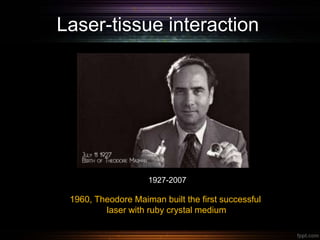
Laser-tissue interaction
1960, Theodore Maiman built the first successful
laser with ruby crystal medium
1927-2007
Laser-tissue interaction
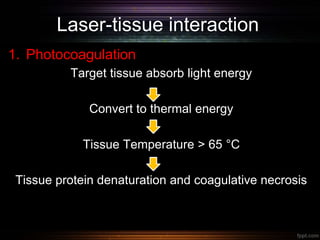
1. Photocoagulation
Target tissue absorb light energy
Convert to thermal energy
Tissue Temperature > 65 °C
Tissue protein denaturation and coagulative necrosis
Laser-tissue interaction
1. Photocoagulation
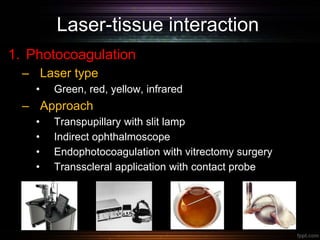
– Laser type
• Green, red, yellow, infrared
– Approach
• Transpupillary with slit lamp
• Indirect ophthalmoscope
• Endophotocoagulation with vitrectomy surgery
• Transscleral application with contact probe
Laser-tissue interaction
1. Photocoagulation
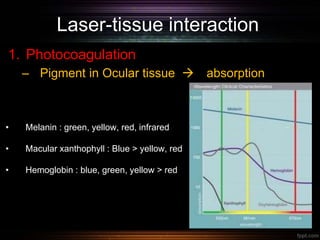
– Pigment in Ocular tissue  absorption
• Melanin : green, yellow, red, infrared
• Macular xanthophyll : Blue > yellow, red
• Hemoglobin : blue, green, yellow > red
Outline
• Principle
– Laser physics
– Properties of laser light
• Monochromaticity
• Directionality
• Coherence
– Laser interferometer
– OCT
• Polarization
• Intensity
– Laser system
– Laser interactions and its
clinical use
– Photocoagulation
• Basic
• Choice of wavelength
• Photocoagulation mechanism
• Practical aspect
• Clinical use
– TSCPC
– ECP
– LTP
– LPI
– Laser suture lysis
– Photodisruption
• Nd:YAG capsulotomy
• Femtosecond laser
– Photochemical
• Photodynamic therapy
– Photoablation
• Excimer laser
Laser-tissue interaction
1. Photocoagulation
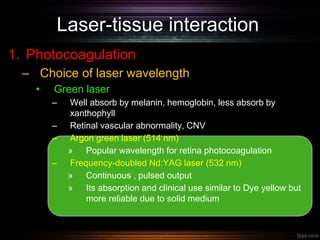
– Choice of laser wavelength
• Green laser
– Well absorb by melanin, hemoglobin, less absorb by
xanthophyll
– Retinal vascular abnormality, CNV
– Argon green laser (514 nm)
» Popular wavelength for retina photocoagulation
– Frequency-doubled Nd:YAG laser (532 nm)
» Continuous , pulsed output
» Its absorption and clinical use similar to Dye yellow but
more reliable due to solid medium
Laser-tissue interaction
1. Photocoagulation
– Choice of laser wavelength
• Red laser
– Good penetrate through cataract, VH than other laser
– Less absorb by xanthophyll
– CNV near fovea
– Deep burn  discomfort
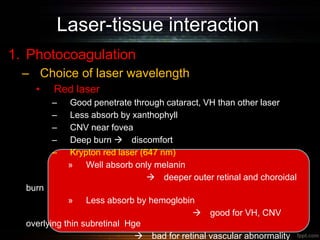
– Krypton red laser (647 nm)
» Well absorb only melanin
 deeper outer retinal and choroidal
burn
» Less absorb by hemoglobin
 good for VH, CNV
overlying thin subretinal Hge
 bad for retinal vascular abnormality
Laser-tissue interaction
1. Photocoagulation
– Choice of laser wavelength
• Infrared laser
– Similar to red laser
– Deeper penetrate through tissue
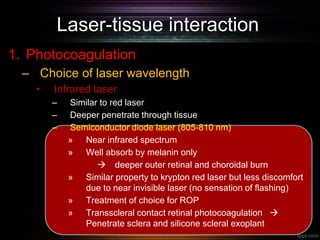
– Semiconductor diode laser (805-810 nm)
» Near infrared spectrum
» Well absorb by melanin only
 deeper outer retinal and choroidal burn
» Similar property to krypton red laser but less discomfort
due to near invisible laser (no sensation of flashing)
» Treatment of choice for ROP
» Transscleral contact retinal photocoagulation 
Penetrate sclera and silicone scleral exoplant
Laser-tissue interaction
1. Photocoagulation
– Choice of laser wavelength
• Yellow laser
– Penetrate through cataract
– Less absorb by xanthophyll
– Destroy vascular structure with little damage to adjacent
tissue
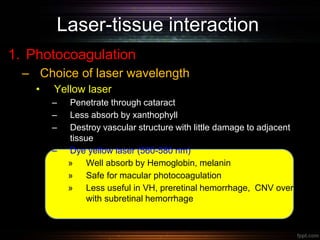
– Dye yellow laser (560-580 nm)
» Well absorb by Hemoglobin, melanin
» Safe for macular photocoagulation
» Less useful in VH, preretinal hemorrhage, CNV overlying
with subretinal hemorrhage
Outline
• Principle
– Laser physics
– Properties of laser light
• Monochromaticity
• Directionality
• Coherence
– Laser interferometer
– OCT
• Polarization
• Intensity
– Laser system
– Laser interactions and its
clinical use
– Photocoagulation
• Basic
• Choice of wavelength
• Photocoagulation mechanism
• Practical aspect
• Clinical use
– TSCPC
– ECP
– LTP
– LPI
– Laser suture lysis
– Photodisruption
• Nd:YAG capsulotomy
• Femtosecond laser
– Photochemical
• Photodynamic therapy
– Photoablation
• Excimer laser
Laser-tissue interaction
1. Photocoagulation
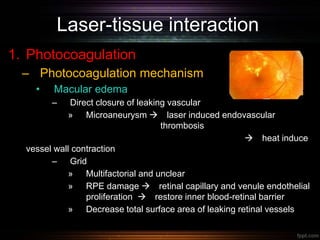
– Photocoagulation mechanism
• Macular edema
– Direct closure of leaking vascular
» Microaneurysm  laser induced endovascular
thrombosis
 heat induce
vessel wall contraction
– Grid
» Multifactorial and unclear
» RPE damage  retinal capillary and venule endothelial
proliferation  restore inner blood-retinal barrier
» Decrease total surface area of leaking retinal vessels
Laser-tissue interaction
1. Photocoagulation
– Photocoagulation mechanism
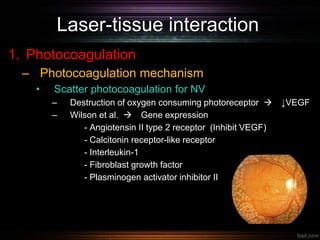
• Scatter photocoagulation for NV
– Destruction of oxygen consuming photoreceptor  ↓VEGF
– Wilson et al.  Gene expression
- Angiotensin II type 2 receptor (Inhibit VEGF)
- Calcitonin receptor-like receptor
- Interleukin-1
- Fibroblast growth factor
- Plasminogen activator inhibitor II
Laser-tissue interaction
1. Photocoagulation
– Photocoagulation mechanism
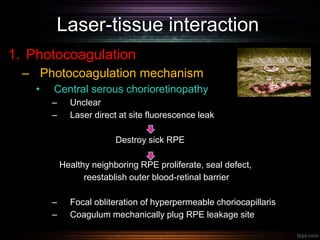
• Central serous chorioretinopathy
– Unclear
– Laser direct at site fluorescence leak
Destroy sick RPE
Healthy neighboring RPE proliferate, seal defect,
reestablish outer blood-retinal barrier
– Focal obliteration of hyperpermeable choriocapillaris
– Coagulum mechanically plug RPE leakage site
Laser-tissue interaction
1. Photocoagulation
– Photocoagulation mechanism
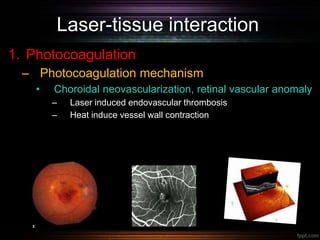
• Choroidal neovascularization, retinal vascular anomaly
– Laser induced endovascular thrombosis
– Heat induce vessel wall contraction
Laser-tissue interaction
1. Photocoagulation
– Photocoagulation mechanism
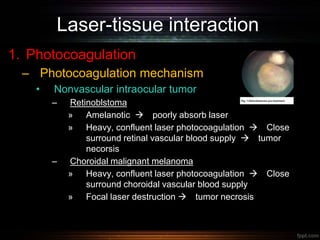
• Nonvascular intraocular tumor
– Retinoblstoma
» Amelanotic  poorly absorb laser
» Heavy, confluent laser photocoagulation  Close
surround retinal vascular blood supply  tumor
necorsis
– Choroidal malignant melanoma
» Heavy, confluent laser photocoagulation  Close
surround choroidal vascular blood supply
» Focal laser destruction  tumor necrosis
Laser-tissue interaction
1. Photocoagulation
– Photocoagulation mechanism
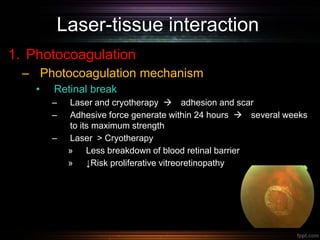
• Retinal break
– Laser and cryotherapy  adhesion and scar
– Adhesive force generate within 24 hours  several weeks
to its maximum strength
– Laser > Cryotherapy
» Less breakdown of blood retinal barrier
» ↓Risk proliferative vitreoretinopathy
Outline
• Principle
– Laser physics
– Properties of laser light
• Monochromaticity
• Directionality
• Coherence
– Laser interferometer
– OCT
• Polarization
• Intensity
– Laser system
– Laser interactions and its
clinical use
– Photocoagulation
• Basic
• Choice of wavelength
• Photocoagulation mechanism
• Practical aspect
• Clinical use
– TSCPC
– ECP
– LTP
– LPI
– Laser suture lysis
– Photodisruption
• Nd:YAG capsulotomy
• Femtosecond laser
– Photochemical
• Photodynamic therapy
– Photoablation
• Excimer laser
Laser-tissue interaction
1. Photocoagulation
– Practical aspect
1. Lens
• Lesion location, patient anatomy, desired field of view,
image magnification, working distance
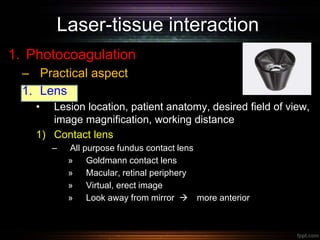
1) Contact lens
– All purpose fundus contact lens
» Goldmann contact lens
» Macular, retinal periphery
» Virtual, erect image
» Look away from mirror  more anterior
Laser-tissue interaction
1. Photocoagulation
1) Contact lens
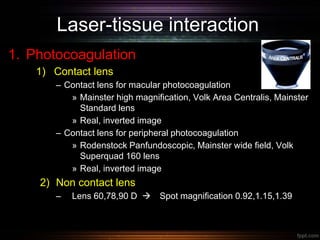
– Contact lens for macular photocoagulation
» Mainster high magnification, Volk Area Centralis, Mainster
Standard lens
» Real, inverted image
– Contact lens for peripheral photocoagulation
» Rodenstock Panfundoscopic, Mainster wide field, Volk
Superquad 160 lens
» Real, inverted image
2) Non contact lens
– Lens 60,78,90 D  Spot magnification 0.92,1.15,1.39
Laser-tissue interaction
1. Photocoagulation
– Practical aspect
2. Laser setting
• Slit lamp magnification
• Wavelength selection
– Retinal vascular lesion
» Argon green, Nd:YAG green, Dye yellow
– CNV
» Argon green, Nd:YAG green, Dye yellow, Dye red, Krypton
red, Diode
– Scatter photocoagulation
» Argon green **
» Red, Diode  Cataract, VH
Laser-tissue interaction
1. Photocoagulation
– Practical aspect
2. Laser setting
• Spot size
– Macular photocoagulation = 50-200 µm
– Peripheral photocoagulation = 200-1000 µm
– Shorter wavelength  higher intraocular scattering 
Larger, less focused retinal burn
Laser-tissue interaction
1. Photocoagulation
– Practical aspect
2. Laser setting
• Power, Duration
– Burn intensity
• Burn intensity
Light Barely visible retinal blanching CSC, Grid
Mild Faint white
Moderate Dirty white Scatter PRP, RB
Heavy Dense white Choroidal melanoma
Burn intensity α (Burn duration)(Power)
Spot size
Laser-tissue interaction
1. Photocoagulation
– Practical aspect
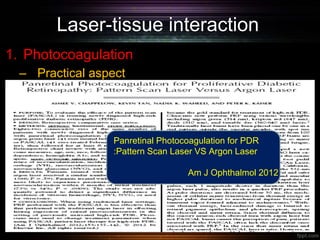
Panretinal Photocoagulation for PDR
:Pattern Scan Laser VS Argon Laser
Am J Ophthalmol 2012
Background
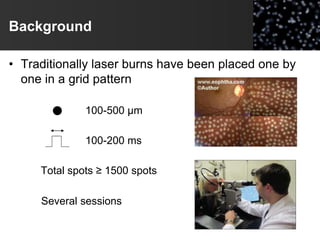
• Traditionally laser burns have been placed one by
one in a grid pattern
100-500 µm
100-200 ms
Total spots ≥ 1500 spots
Several sessions
Background
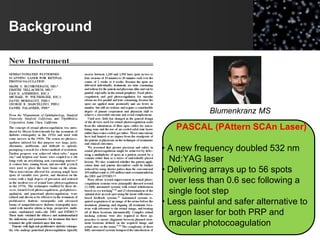
Blumenkranz MS
PASCAL (PAttern SCAn Laser)
• A new frequency doubled 532 nm
Nd:YAG laser
• Delivering arrays up to 56 spots
over less than 0.6 sec following a
single foot step
• Less painful and safer alternative to
argon laser for both PRP and
macular photocoagulation
Background
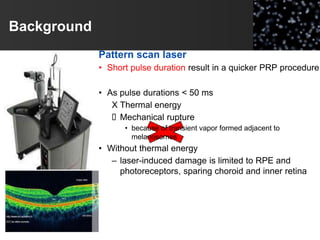
Pattern scan laser
• Short pulse duration result in a quicker PRP procedure
• As pulse durations < 50 ms
X Thermal energy
 Mechanical rupture
• because of transient vapor formed adjacent to
melanosomes
• Without thermal energy
– laser-induced damage is limited to RPE and
photoreceptors, sparing choroid and inner retina
Background
Pattern scan laser
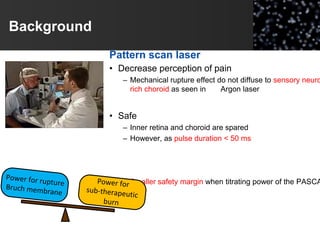
• Decrease perception of pain
– Mechanical rupture effect do not diffuse to sensory neuro
rich choroid as seen in Argon laser
• Safe
– Inner retina and choroid are spared
– However, as pulse duration < 50 ms
– Smaller safety margin when titrating power of the PASCA
Background
• However, they are not aware of any study that has
compared clinical outcomes for the 2 lasers when treating
high-risk PDR
• This retrospective comparative study evaluates efficacy
between PASCAL and traditional argon laser in treating
newly diagnosed high-risk PDR
Methods : Procedure
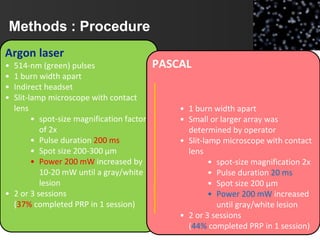
Argon laser
• 514-nm (green) pulses
• 1 burn width apart
• Indirect headset
• Slit-lamp microscope with contact
lens
• spot-size magnification factor
of 2x
• Pulse duration 200 ms
• Spot size 200-300 µm
• Power 200 mW increased by
10-20 mW until a gray/white
lesion
• 2 or 3 sessions
(37% completed PRP in 1 session)
PASCAL
• 1 burn width apart
• Small or larger array was
determined by operator
• Slit-lamp microscope with contact
lens
• spot-size magnification 2x
• Pulse duration 20 ms
• Spot size 200 µm
• Power 200 mW increased
until gray/white lesion
• 2 or 3 sessions
(44% completed PRP in 1 session)
Discussion
• PASCAL has greater speed and comfort
• When both lasers were applied with similar number and
size of laser spots in similar patients
– PASCAL treatment was less effective in inducing regression
and preventing recurrence of NV in high-risk PDR
• Inherent difference in properties of PASCAL and argon
lasers
– Limits efficacy of PASCAL when used in context of traditional
argon laser treatment parameters
Discussion
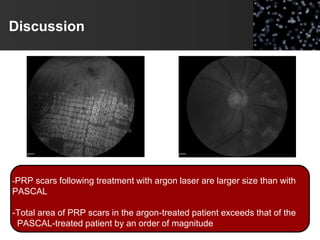
-PRP scars following treatment with argon laser are larger size than with
PASCAL
-Total area of PRP scars in the argon-treated patient exceeds that of the
PASCAL-treated patient by an order of magnitude
Discussion
• Increasing rate of recurrence NV experienced in the
PASCAL-treated patients
– Given equivalent number of treatment spots, PASCAL created smaller
total burn area results in a significant decrease in efficacy compared to
Argon laser
– Either additional lesions or larger spot sizes may be required to
achieve comparable efficacy with PASCAL
Conclusion
• PRP with PASCAL less effective than traditional
argon green laser in high-risk PDR to achieving
treatment goals when using traditional argon
green laser parameters
• Increasing number, spot size, or duration of laser
burns may improve efficacy of PASCAL as
measured by rates of regression and recurrence
NV
Outline
• Principle
– Laser physics
– Properties of laser light
• Monochromaticity
• Directionality
• Coherence
– Laser interferometer
– OCT
• Polarization
• Intensity
– Laser system
– Laser interactions and its
clinical use
– Photocoagulation
• Basic
• Choice of wavelength
• Photocoagulation mechanism
• Practical aspect
• Clinical use
– TSCPC
– ECP
– LTP
– LPI
– Laser suture lysis
– Photodisruption
• Nd:YAG capsulotomy
• Femtosecond laser
– Photochemical
• Photodynamic therapy
– Photoablation
• Excimer laser
Laser-tissue interaction
1. Photocoagulation
– Clinical use
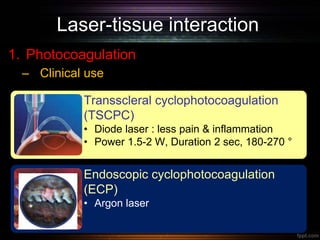
Transscleral cyclophotocoagulation
(TSCPC)
• Diode laser : less pain & inflammation
• Power 1.5-2 W, Duration 2 sec, 180-270 °
Endoscopic cyclophotocoagulation
(ECP)
• Argon laser
Laser-tissue interaction
1. Photocoagulation
– Clinical use
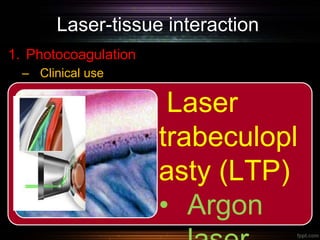
Laser
trabeculopl
asty (LTP)
• Argon
Laser-tissue interaction
1. Photocoagulation
– Clinical use
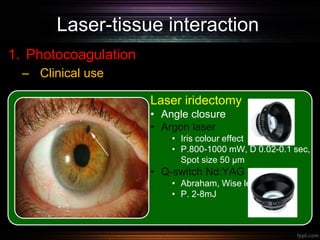
Laser iridectomy
• Angle closure
• Argon laser
• Iris colour effect
• P.800-1000 mW, D 0.02-0.1 sec,
Spot size 50 µm
• Q-switch Nd:YAG laser
• Abraham, Wise lens
• P. 2-8mJ
Laser-tissue interaction
1. Photocoagulation
– Clinical use
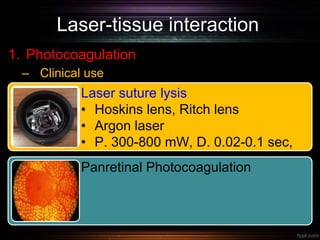
Laser suture lysis
• Hoskins lens, Ritch lens
• Argon laser
• P. 300-800 mW, D. 0.02-0.1 sec,
Spot size 50-100 µm
Panretinal Photocoagulation
Laser-tissue interaction
1. Photocoagulation
– Clinical use
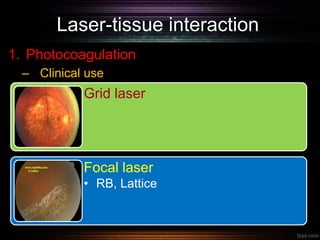
Grid laser
Focal laser
• RB, Lattice
Outline
• Principle
– Laser physics
– Properties of laser light
• Monochromaticity
• Directionality
• Coherence
– Laser interferometer
– OCT
• Polarization
• Intensity
– Laser system
– Laser interactions and its
clinical use
– Photocoagulation
• Basic
• Choice of wavelength
• Photocoagulation mechanism
• Practical aspect
• Clinical use
– TSCPC
– ECP
– LTP
– LPI
– Laser suture lysis
– Photodisruption
• Nd:YAG capsulotomy
• Femtosecond laser
– Photochemical
• Photodynamic therapy
– Photoablation
• Excimer laser
Laser-tissue interaction
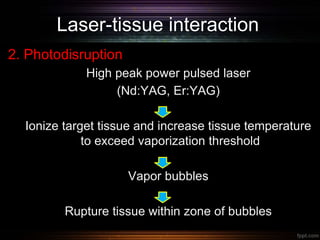
2. Photodisruption
High peak power pulsed laser
(Nd:YAG, Er:YAG)
Ionize target tissue and increase tissue temperature
to exceed vaporization threshold
Vapor bubbles
Rupture tissue within zone of bubbles
Laser-tissue interaction
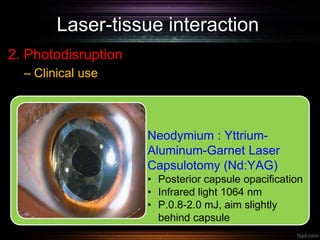
2. Photodisruption
– Clinical use
Neodymium : Yttrium-
Aluminum-Garnet Laser
Capsulotomy (Nd:YAG)
• Posterior capsule opacification
• Infrared light 1064 nm
• P.0.8-2.0 mJ, aim slightly
behind capsule
Laser-tissue interaction
2. Photodisruption
– Clinical use
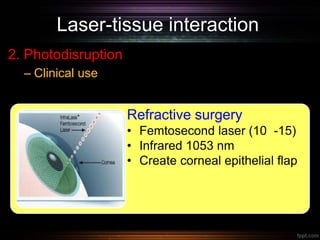
Refractive surgery
• Femtosecond laser (10 -15)
• Infrared 1053 nm
• Create corneal epithelial flap
Outline
• Principle
– Laser physics
– Properties of laser light
• Monochromaticity
• Directionality
• Coherence
– Laser interferometer
– OCT
• Polarization
• Intensity
– Laser system
– Laser interactions and its
clinical use
– Photocoagulation
• Basic
• Choice of wavelength
• Photocoagulation mechanism
• Practical aspect
• Clinical use
– TSCPC
– ECP
– LTP
– LPI
– Laser suture lysis
– Photodisruption
• Nd:YAG capsulotomy
• Femtosecond laser
– Photochemical
• Photodynamic therapy
– Photoablation
• Excimer laser
Laser-tissue interaction
3. Photochemical
– Nonthermal light induce chemical reaction
• Photosynthesis in plants
• Phototransduction in photoreceptor
• Photodynamic therapy (PDT)
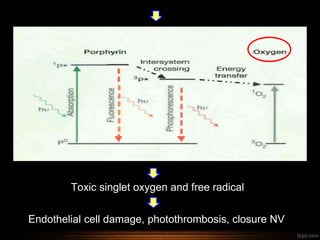
Laser-tissue interaction
3. Photochemical
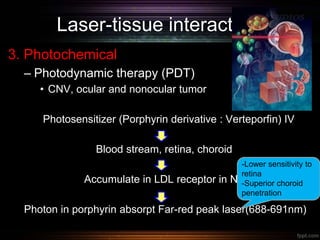
– Photodynamic therapy (PDT)
• CNV, ocular and nonocular tumor
Photosensitizer (Porphyrin derivative : Verteporfin) IV
Blood stream, retina, choroid
Accumulate in LDL receptor in NV
Photon in porphyrin absorpt Far-red peak laser(688-691nm)
-Lower sensitivity to
retina
-Superior choroid
penetration
Toxic singlet oxygen and free radical
Endothelial cell damage, photothrombosis, closure NV
Outline
• Principle
– Laser physics
– Properties of laser light
• Monochromaticity
• Directionality
• Coherence
– Laser interferometer
– OCT
• Polarization
• Intensity
– Laser system
– Laser interactions and its
clinical use
– Photocoagulation
• Basic
• Choice of wavelength
• Photocoagulation mechanism
• Practical aspect
• Clinical use
– TSCPC
– ECP
– LTP
– LPI
– Laser suture lysis
– Photodisruption
• Nd:YAG capsulotomy
• Femtosecond laser
– Photochemical
• Photodynamic therapy
– Photoablation
• Excimer laser
Laser-tissue interaction
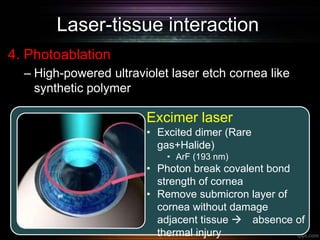
4. Photoablation
– High-powered ultraviolet laser etch cornea like
synthetic polymer
Excimer laser
• Excited dimer (Rare
gas+Halide)
• ArF (193 nm)
• Photon break covalent bond
strength of cornea
• Remove submicron layer of
cornea without damage
adjacent tissue  absence of
thermal injury
Outline
• Principle
– Laser physics
– Properties of laser light
• Monochromaticity
• Directionality
• Coherence
– Laser interferometer
– OCT
• Polarization
• Intensity
– Laser system
– Laser interactions and its
clinical use
– Photocoagulation
• Basic
• Choice of wavelength
• Photocoagulation mechanism
• Practical aspect
• Clinical use
– TSCPC
– ECP
– LTP
– LPI
– Laser suture lysis
– Photodisruption
• Nd:YAG capsulotomy
• Femtosecond laser
– Photochemical
• Photodynamic therapy
– Photoablation
• Excimer laser
Reference
• Daniel Palanker, Mark S. Blumenkranz, John J. Weiter. Chapter 21 Retinal
laser therapy : Biophysical basis and application. Retina. Forth edition.
Elsevier Mosby
• Steven M. Bloom, MD, Alexander J. Brucker, MD. Laser surgery of the
posterior segment. Second edition. Philadelphia: Lippincott-Raven; 1997.
• American academy of ophthalmology : section 12 Retina and vitreous,
Basic and clinical science course, 2010-2011
• American academy of ophthalmology : section 10 Glaucoma, Basic and
clinical science course, 2010-2011
• Antonia M. Joussen, Thomas W. Gardner, Bernd Kirchhof, Stephen J.
Ryan. Retinal vascular disease. New York: Springer
• Aimee V. Chappelow, Kevin Tan, Nadia K. Waheed, Peter K. Kaiser.
Panretinal photocoagulation for proliferative diabetic retinopathy : Pattern
scan laser versus Argon laser. Am J Ophthalmol 2012;153:137-142
"The important thing is not to stop
questioning.
Curiosity has its own reason for
existing."
Albert Einstein
Thank you

Nw2014 laser fundamenal01

  • 1.
    Fundamental laser ophthalmology 5November 2012 Mallawee Charatcharungkiat, MD Instructor Nawat Watanachai, MD
  • 2.
    Outline • Principle – Laserphysics – Properties of laser light • Monochromaticity • Directionality • Coherence – Laser interferometer – OCT • Polarization • Intensity – Laser system – Laser interactions and its clinical use – Photocoagulation • Basic • Choice of wavelength • Photocoagulation mechanism • Practical aspect • Clinical use – TSCPC – ECP – LTP – LPI – Laser suture lysis – Photodisruption • Nd:YAG capsulotomy • Femtosecond laser – Photochemical • Photodynamic therapy – Photoablation • Excimer laser
  • 3.
    Outline • Principle – Laserphysics – Properties of laser light • Monochromaticity • Directionality • Coherence – Laser interferometer – OCT • Polarization • Intensity – Laser system – Laser interactions and its clinical use – Photocoagulation • Basic • Choice of wavelength • Photocoagulation mechanism • Practical aspect • Clinical use – TSCPC – ECP – LTP – LPI – Laser suture lysis – Photodisruption • Nd:YAG capsulotomy • Femtosecond laser – Photochemical • Photodynamic therapy – Photoablation • Excimer laser
  • 4.
    Laser physics • “Lightamplification by stimulated emission of radiation”
  • 5.
    Laser physics • “Lightamplification by stimulated emission of radiation” • 1917 • Atomic transposition process – Absorption – Spontaneous emission – Stimulated emission Albert Einstein
  • 6.
    Laser Physics • Absorption Unexcitedatom (E0 : Ground state) Photon Excited atom (E1 : Excited state)
  • 7.
    Laser Physics • Spontaneousemission Unexcited atom (E0 : Ground state) Photon Excited atom (E1 : Excited state)
  • 8.
    Laser Physics • Stimulatedemission Unexcited atom (E0 : Ground state) 2 Photon Excited atom (E1 : Excited state)
  • 9.
  • 10.
    Laser Physics • Afterabsorption – Spontaneous emission • Majority • Incoherent – Stimulated emission • Few • Coherent Laser Laser
  • 11.
    Laser Physics • Elementof laser 1. Active medium 2. Energy input 3. Optical feedback
  • 12.
    Laser Physics • Elementof laser 1. Active medium • Allowed stimulated emission • Particular atomic energy transition Wavelength of the emission E = hv = hc /λ
  • 13.
    Laser Physics • Elementof laser 1. Active medium • Gas : Argon, Krypton, Carbon dioxide, Argon-fluoride excimer, Helium with neon • Liquid : Dye • Solid : Supported by crystal Nd:YAG, Er-YLF, Ruby Infrared holmium-YLF (IntraLase) holmium-YAG(Laser thermal keratoplasty) Semiconductor (diode)
  • 14.
    Laser Physics • Elementof laser 2. Energy input • Make majority of atom are in higher energy state than ground state • “Population inversion” • “Pumping” • “Light amplification”
  • 15.
    Laser Physics • Elementof laser 2. Energy input • “Pumping” – Gas laser : Electrical discharge between electrode in gas – Dye laser : Other laser – Solid crystal : Incoherent light (Xenon arc flash light)
  • 16.
    Laser Physics • Elementof laser 3. Optical feedback • Promote stimulated emission, suppress spontaneous emission • Spontaneous emission  not amplify • Stimulated emission  Coherent laser
  • 17.
    Outline • Principle – Laserphysics – Properties of laser light • Monochromaticity • Directionality • Coherence – Laser interferometer – OCT • Polarization • Intensity – Laser system – Laser interactions and its clinical use – Photocoagulation • Basic • Choice of wavelength • Photocoagulation mechanism • Practical aspect • Clinical use – TSCPC – ECP – LTP – LPI – Laser suture lysis – Photodisruption • Nd:YAG capsulotomy • Femtosecond laser – Photochemical • Photodynamic therapy – Photoablation • Excimer laser
  • 18.
    Properties of laser 1.Monochromaticity – Laser emit light only 1 wavelength / combination several wavelength – Gas laser  0.01 nm – Color of light enhance target tissue absorption or transmission – Not effected by chromatic aberration in lens system – Focus in smaller spot > white light
  • 19.
    Properties of laser Chromaticaberration – Distortion, a failure of lens to focus all colors to the same convergence point – Lens have different refractive index for different wavelength (↓ refractive index - ↑ wavelength)
  • 20.
    Properties of laser 1.Monochromaticity – Laser emit light only 1 wavelength / combination several wavelength – Gas laser  0.01 nm – Color of light enhance target tissue absorption or transmission – Not effected by chromatic aberration in lens system – Focus in smaller spot > white light
  • 21.
    Properties of laser 2.Directionality – Laser emit a narrow beam – Laser amplify only photon that travel along narrow path between 2 mirrors – Cause collimating light – ↑ 1 mm in diameter of beam for every meter travel – Focus light to small spot
  • 22.
    Properties of laser 3.Coherence – Ability of 2 light beams, or different parts of the same beam, to produce interference – Interference
  • 23.
    Properties of laser 3.Coherence – “Laser speckle” -- rough surface – Laser interferometer Laser beam split to 2 beams Diffuse by cataract Overlap in retina “Interference fringes” • Non contact biometry (IOL master) – Partial coherence interferometry
  • 24.
    Properties of laser 3.Coherence • Optical coherence tomography (OCT) – Michelson interferometer – Interference property of temporally coherent light – Light source (superluminescent diode), light detector, beam splitter, movable mirror – Highest reflection : RPE, ONL, INL, ILM
  • 25.
    Properties of laser 3.Coherence • OCT ½ light ½ light
  • 26.
    Properties of laser 3.Coherence • OCT
  • 27.
    Properties of laser 4.Polarization – Certain direction of light wave – Linearly polarized • Electric fields of light wave in the same plane • Allow maximum transmission through laser medium without loss caused by reflection
  • 28.
    Properties of laser 5.Intensity – Power in a beam of given angular size – Most important property – “Brightness” • Intensity / unit area
  • 29.
    Properties of laser 5.Intensity – Radiometric terminology Term Unit Energy joule (1 J = 1 watt x 1 sec.) Power watt Energy density J/cm² Irradiance watt / cm² Intensity watt / sr (sr = Steradian, unit of solid angle) brightness Watt / sr cm²
  • 30.
    Properties of laser 5.Intensity – Radiometric terminology Term Unit Energy joule (1 J = 1 watt x 1 sec.) Power watt Energy density J/cm² Irradiance watt / cm² Intensity watt / sr (sr = Steradian, unit of solid angle) brightness Watt / sr cm² Laser output
  • 31.
    Properties of laser 5.Intensity – Tissue effect • Determined by focal point spot size • Energy density , irradiance – Spot size • 50 µm spot size = ¶ (25 x 10 -4) ² cm² = 2 x 10 -5 cm²
  • 32.
    Properties of laser 5.Intensity – Continuous laser • Argon, Krypton  watts – Pulsed laser • Nd:YAG  joules • Average, peak power
  • 33.
    Properties of laser Sunhas power 10 26 watts, but emits in all direction Helium neon laser 1 mW has 100 x radiance of sun
  • 34.
    Outline • Principle – Laserphysics – Properties of laser light • Monochromaticity • Directionality • Coherence – Laser interferometer – OCT • Polarization • Intensity – Laser system – Laser interactions and its clinical use – Photocoagulation • Basic • Choice of wavelength • Photocoagulation mechanism • Practical aspect • Clinical use – TSCPC – ECP – LTP – LPI – Laser suture lysis – Photodisruption • Nd:YAG capsulotomy • Femtosecond laser – Photochemical • Photodynamic therapy – Photoablation • Excimer laser
  • 35.
    Laser system • Typesof medical laser
  • 36.
    Laser system • Typesof medical laser – CO2 (λ = 9.2-10.8 µm) • Gas laser • Nonophthalmic surgery : Gynecology, ENT • Absorbed by water – Er:YAG (λ = 2.94 µm) • Solid laser • Strongest absorption by water  shallow penetration depth  low vaporization, small collateral damage
  • 37.
    Laser system • Typesof medical laser – Nd:YAG (λ = 1064 µm) • Important ophthalmic laser • Low absorption and scatting  deep penetration – Argon/Krypton (λ = 488,515,568,647 nm) • Gas laser • Retinal photocoagulation in the past – Excimer laser (λ = 157,193,248,308,351 nm) • ArF (193 nm) Strong absorption in protein  submicrometer penetration in tissue • Refractive surgery (Corneal ablation)
  • 38.
    Laser system • Contactlens – Aberration • Focal spot size of laser beam is limited by diffraction and aberration • ↑ central aberration  ↑ focal spot size • Photocoagulation  Flat contact lens to control aberration – Magnify spot size on retina – Increase view of field
  • 39.
    Outline • Principle – Laserphysics – Properties of laser light • Monochromaticity • Directionality • Coherence – Laser interferometer – OCT • Polarization • Intensity – Laser system – Laser interactions and its clinical use – Photocoagulation • Basic • Choice of wavelength • Photocoagulation mechanism • Practical aspect • Clinical use – TSCPC – ECP – LTP – LPI – Laser suture lysis – Photodisruption • Nd:YAG capsulotomy • Femtosecond laser – Photochemical • Photodynamic therapy – Photoablation • Excimer laser
  • 40.
    Outline • Principle – Laserphysics – Properties of laser light • Monochromaticity • Directionality • Coherence – Laser interferometer – OCT • Polarization • Intensity – Laser system – Laser interactions and its clinical use – Photocoagulation • Basic • Choice of wavelength • Photocoagulation mechanism • Practical aspect • Clinical use – TSCPC – ECP – LTP – LPI – Laser suture lysis – Photodisruption • Nd:YAG capsulotomy • Femtosecond laser – Photochemical • Photodynamic therapy – Photoablation • Excimer laser
  • 41.
    Laser-tissue interaction 1960, TheodoreMaiman built the first successful laser with ruby crystal medium 1927-2007
  • 42.
    Laser-tissue interaction 1. Photocoagulation Targettissue absorb light energy Convert to thermal energy Tissue Temperature > 65 °C Tissue protein denaturation and coagulative necrosis
  • 43.
    Laser-tissue interaction 1. Photocoagulation –Laser type • Green, red, yellow, infrared – Approach • Transpupillary with slit lamp • Indirect ophthalmoscope • Endophotocoagulation with vitrectomy surgery • Transscleral application with contact probe
  • 44.
    Laser-tissue interaction 1. Photocoagulation –Pigment in Ocular tissue  absorption • Melanin : green, yellow, red, infrared • Macular xanthophyll : Blue > yellow, red • Hemoglobin : blue, green, yellow > red
  • 45.
    Outline • Principle – Laserphysics – Properties of laser light • Monochromaticity • Directionality • Coherence – Laser interferometer – OCT • Polarization • Intensity – Laser system – Laser interactions and its clinical use – Photocoagulation • Basic • Choice of wavelength • Photocoagulation mechanism • Practical aspect • Clinical use – TSCPC – ECP – LTP – LPI – Laser suture lysis – Photodisruption • Nd:YAG capsulotomy • Femtosecond laser – Photochemical • Photodynamic therapy – Photoablation • Excimer laser
  • 46.
    Laser-tissue interaction 1. Photocoagulation –Choice of laser wavelength • Green laser – Well absorb by melanin, hemoglobin, less absorb by xanthophyll – Retinal vascular abnormality, CNV – Argon green laser (514 nm) » Popular wavelength for retina photocoagulation – Frequency-doubled Nd:YAG laser (532 nm) » Continuous , pulsed output » Its absorption and clinical use similar to Dye yellow but more reliable due to solid medium
  • 47.
    Laser-tissue interaction 1. Photocoagulation –Choice of laser wavelength • Red laser – Good penetrate through cataract, VH than other laser – Less absorb by xanthophyll – CNV near fovea – Deep burn  discomfort – Krypton red laser (647 nm) » Well absorb only melanin  deeper outer retinal and choroidal burn » Less absorb by hemoglobin  good for VH, CNV overlying thin subretinal Hge  bad for retinal vascular abnormality
  • 48.
    Laser-tissue interaction 1. Photocoagulation –Choice of laser wavelength • Infrared laser – Similar to red laser – Deeper penetrate through tissue – Semiconductor diode laser (805-810 nm) » Near infrared spectrum » Well absorb by melanin only  deeper outer retinal and choroidal burn » Similar property to krypton red laser but less discomfort due to near invisible laser (no sensation of flashing) » Treatment of choice for ROP » Transscleral contact retinal photocoagulation  Penetrate sclera and silicone scleral exoplant
  • 49.
    Laser-tissue interaction 1. Photocoagulation –Choice of laser wavelength • Yellow laser – Penetrate through cataract – Less absorb by xanthophyll – Destroy vascular structure with little damage to adjacent tissue – Dye yellow laser (560-580 nm) » Well absorb by Hemoglobin, melanin » Safe for macular photocoagulation » Less useful in VH, preretinal hemorrhage, CNV overlying with subretinal hemorrhage
  • 50.
    Outline • Principle – Laserphysics – Properties of laser light • Monochromaticity • Directionality • Coherence – Laser interferometer – OCT • Polarization • Intensity – Laser system – Laser interactions and its clinical use – Photocoagulation • Basic • Choice of wavelength • Photocoagulation mechanism • Practical aspect • Clinical use – TSCPC – ECP – LTP – LPI – Laser suture lysis – Photodisruption • Nd:YAG capsulotomy • Femtosecond laser – Photochemical • Photodynamic therapy – Photoablation • Excimer laser
  • 51.
    Laser-tissue interaction 1. Photocoagulation –Photocoagulation mechanism • Macular edema – Direct closure of leaking vascular » Microaneurysm  laser induced endovascular thrombosis  heat induce vessel wall contraction – Grid » Multifactorial and unclear » RPE damage  retinal capillary and venule endothelial proliferation  restore inner blood-retinal barrier » Decrease total surface area of leaking retinal vessels
  • 52.
    Laser-tissue interaction 1. Photocoagulation –Photocoagulation mechanism • Scatter photocoagulation for NV – Destruction of oxygen consuming photoreceptor  ↓VEGF – Wilson et al.  Gene expression - Angiotensin II type 2 receptor (Inhibit VEGF) - Calcitonin receptor-like receptor - Interleukin-1 - Fibroblast growth factor - Plasminogen activator inhibitor II
  • 53.
    Laser-tissue interaction 1. Photocoagulation –Photocoagulation mechanism • Central serous chorioretinopathy – Unclear – Laser direct at site fluorescence leak Destroy sick RPE Healthy neighboring RPE proliferate, seal defect, reestablish outer blood-retinal barrier – Focal obliteration of hyperpermeable choriocapillaris – Coagulum mechanically plug RPE leakage site
  • 54.
    Laser-tissue interaction 1. Photocoagulation –Photocoagulation mechanism • Choroidal neovascularization, retinal vascular anomaly – Laser induced endovascular thrombosis – Heat induce vessel wall contraction
  • 55.
    Laser-tissue interaction 1. Photocoagulation –Photocoagulation mechanism • Nonvascular intraocular tumor – Retinoblstoma » Amelanotic  poorly absorb laser » Heavy, confluent laser photocoagulation  Close surround retinal vascular blood supply  tumor necorsis – Choroidal malignant melanoma » Heavy, confluent laser photocoagulation  Close surround choroidal vascular blood supply » Focal laser destruction  tumor necrosis
  • 56.
    Laser-tissue interaction 1. Photocoagulation –Photocoagulation mechanism • Retinal break – Laser and cryotherapy  adhesion and scar – Adhesive force generate within 24 hours  several weeks to its maximum strength – Laser > Cryotherapy » Less breakdown of blood retinal barrier » ↓Risk proliferative vitreoretinopathy
  • 57.
    Outline • Principle – Laserphysics – Properties of laser light • Monochromaticity • Directionality • Coherence – Laser interferometer – OCT • Polarization • Intensity – Laser system – Laser interactions and its clinical use – Photocoagulation • Basic • Choice of wavelength • Photocoagulation mechanism • Practical aspect • Clinical use – TSCPC – ECP – LTP – LPI – Laser suture lysis – Photodisruption • Nd:YAG capsulotomy • Femtosecond laser – Photochemical • Photodynamic therapy – Photoablation • Excimer laser
  • 58.
    Laser-tissue interaction 1. Photocoagulation –Practical aspect 1. Lens • Lesion location, patient anatomy, desired field of view, image magnification, working distance 1) Contact lens – All purpose fundus contact lens » Goldmann contact lens » Macular, retinal periphery » Virtual, erect image » Look away from mirror  more anterior
  • 59.
    Laser-tissue interaction 1. Photocoagulation 1)Contact lens – Contact lens for macular photocoagulation » Mainster high magnification, Volk Area Centralis, Mainster Standard lens » Real, inverted image – Contact lens for peripheral photocoagulation » Rodenstock Panfundoscopic, Mainster wide field, Volk Superquad 160 lens » Real, inverted image 2) Non contact lens – Lens 60,78,90 D  Spot magnification 0.92,1.15,1.39
  • 60.
    Laser-tissue interaction 1. Photocoagulation –Practical aspect 2. Laser setting • Slit lamp magnification • Wavelength selection – Retinal vascular lesion » Argon green, Nd:YAG green, Dye yellow – CNV » Argon green, Nd:YAG green, Dye yellow, Dye red, Krypton red, Diode – Scatter photocoagulation » Argon green ** » Red, Diode  Cataract, VH
  • 61.
    Laser-tissue interaction 1. Photocoagulation –Practical aspect 2. Laser setting • Spot size – Macular photocoagulation = 50-200 µm – Peripheral photocoagulation = 200-1000 µm – Shorter wavelength  higher intraocular scattering  Larger, less focused retinal burn
  • 62.
    Laser-tissue interaction 1. Photocoagulation –Practical aspect 2. Laser setting • Power, Duration – Burn intensity • Burn intensity Light Barely visible retinal blanching CSC, Grid Mild Faint white Moderate Dirty white Scatter PRP, RB Heavy Dense white Choroidal melanoma Burn intensity α (Burn duration)(Power) Spot size
  • 63.
    Laser-tissue interaction 1. Photocoagulation –Practical aspect Panretinal Photocoagulation for PDR :Pattern Scan Laser VS Argon Laser Am J Ophthalmol 2012
  • 64.
    Background • Traditionally laserburns have been placed one by one in a grid pattern 100-500 µm 100-200 ms Total spots ≥ 1500 spots Several sessions
  • 65.
    Background Blumenkranz MS PASCAL (PAtternSCAn Laser) • A new frequency doubled 532 nm Nd:YAG laser • Delivering arrays up to 56 spots over less than 0.6 sec following a single foot step • Less painful and safer alternative to argon laser for both PRP and macular photocoagulation
  • 66.
    Background Pattern scan laser •Short pulse duration result in a quicker PRP procedure • As pulse durations < 50 ms X Thermal energy  Mechanical rupture • because of transient vapor formed adjacent to melanosomes • Without thermal energy – laser-induced damage is limited to RPE and photoreceptors, sparing choroid and inner retina
  • 67.
    Background Pattern scan laser •Decrease perception of pain – Mechanical rupture effect do not diffuse to sensory neuro rich choroid as seen in Argon laser • Safe – Inner retina and choroid are spared – However, as pulse duration < 50 ms – Smaller safety margin when titrating power of the PASCA
  • 68.
    Background • However, theyare not aware of any study that has compared clinical outcomes for the 2 lasers when treating high-risk PDR • This retrospective comparative study evaluates efficacy between PASCAL and traditional argon laser in treating newly diagnosed high-risk PDR
  • 69.
    Methods : Procedure Argonlaser • 514-nm (green) pulses • 1 burn width apart • Indirect headset • Slit-lamp microscope with contact lens • spot-size magnification factor of 2x • Pulse duration 200 ms • Spot size 200-300 µm • Power 200 mW increased by 10-20 mW until a gray/white lesion • 2 or 3 sessions (37% completed PRP in 1 session) PASCAL • 1 burn width apart • Small or larger array was determined by operator • Slit-lamp microscope with contact lens • spot-size magnification 2x • Pulse duration 20 ms • Spot size 200 µm • Power 200 mW increased until gray/white lesion • 2 or 3 sessions (44% completed PRP in 1 session)
  • 70.
    Discussion • PASCAL hasgreater speed and comfort • When both lasers were applied with similar number and size of laser spots in similar patients – PASCAL treatment was less effective in inducing regression and preventing recurrence of NV in high-risk PDR • Inherent difference in properties of PASCAL and argon lasers – Limits efficacy of PASCAL when used in context of traditional argon laser treatment parameters
  • 71.
    Discussion -PRP scars followingtreatment with argon laser are larger size than with PASCAL -Total area of PRP scars in the argon-treated patient exceeds that of the PASCAL-treated patient by an order of magnitude
  • 72.
    Discussion • Increasing rateof recurrence NV experienced in the PASCAL-treated patients – Given equivalent number of treatment spots, PASCAL created smaller total burn area results in a significant decrease in efficacy compared to Argon laser – Either additional lesions or larger spot sizes may be required to achieve comparable efficacy with PASCAL
  • 73.
    Conclusion • PRP withPASCAL less effective than traditional argon green laser in high-risk PDR to achieving treatment goals when using traditional argon green laser parameters • Increasing number, spot size, or duration of laser burns may improve efficacy of PASCAL as measured by rates of regression and recurrence NV
  • 74.
    Outline • Principle – Laserphysics – Properties of laser light • Monochromaticity • Directionality • Coherence – Laser interferometer – OCT • Polarization • Intensity – Laser system – Laser interactions and its clinical use – Photocoagulation • Basic • Choice of wavelength • Photocoagulation mechanism • Practical aspect • Clinical use – TSCPC – ECP – LTP – LPI – Laser suture lysis – Photodisruption • Nd:YAG capsulotomy • Femtosecond laser – Photochemical • Photodynamic therapy – Photoablation • Excimer laser
  • 75.
    Laser-tissue interaction 1. Photocoagulation –Clinical use Transscleral cyclophotocoagulation (TSCPC) • Diode laser : less pain & inflammation • Power 1.5-2 W, Duration 2 sec, 180-270 ° Endoscopic cyclophotocoagulation (ECP) • Argon laser
  • 76.
    Laser-tissue interaction 1. Photocoagulation –Clinical use Laser trabeculopl asty (LTP) • Argon
  • 77.
    Laser-tissue interaction 1. Photocoagulation –Clinical use Laser iridectomy • Angle closure • Argon laser • Iris colour effect • P.800-1000 mW, D 0.02-0.1 sec, Spot size 50 µm • Q-switch Nd:YAG laser • Abraham, Wise lens • P. 2-8mJ
  • 78.
    Laser-tissue interaction 1. Photocoagulation –Clinical use Laser suture lysis • Hoskins lens, Ritch lens • Argon laser • P. 300-800 mW, D. 0.02-0.1 sec, Spot size 50-100 µm Panretinal Photocoagulation
  • 79.
    Laser-tissue interaction 1. Photocoagulation –Clinical use Grid laser Focal laser • RB, Lattice
  • 80.
    Outline • Principle – Laserphysics – Properties of laser light • Monochromaticity • Directionality • Coherence – Laser interferometer – OCT • Polarization • Intensity – Laser system – Laser interactions and its clinical use – Photocoagulation • Basic • Choice of wavelength • Photocoagulation mechanism • Practical aspect • Clinical use – TSCPC – ECP – LTP – LPI – Laser suture lysis – Photodisruption • Nd:YAG capsulotomy • Femtosecond laser – Photochemical • Photodynamic therapy – Photoablation • Excimer laser
  • 81.
    Laser-tissue interaction 2. Photodisruption Highpeak power pulsed laser (Nd:YAG, Er:YAG) Ionize target tissue and increase tissue temperature to exceed vaporization threshold Vapor bubbles Rupture tissue within zone of bubbles
  • 82.
    Laser-tissue interaction 2. Photodisruption –Clinical use Neodymium : Yttrium- Aluminum-Garnet Laser Capsulotomy (Nd:YAG) • Posterior capsule opacification • Infrared light 1064 nm • P.0.8-2.0 mJ, aim slightly behind capsule
  • 83.
    Laser-tissue interaction 2. Photodisruption –Clinical use Refractive surgery • Femtosecond laser (10 -15) • Infrared 1053 nm • Create corneal epithelial flap
  • 84.
    Outline • Principle – Laserphysics – Properties of laser light • Monochromaticity • Directionality • Coherence – Laser interferometer – OCT • Polarization • Intensity – Laser system – Laser interactions and its clinical use – Photocoagulation • Basic • Choice of wavelength • Photocoagulation mechanism • Practical aspect • Clinical use – TSCPC – ECP – LTP – LPI – Laser suture lysis – Photodisruption • Nd:YAG capsulotomy • Femtosecond laser – Photochemical • Photodynamic therapy – Photoablation • Excimer laser
  • 85.
    Laser-tissue interaction 3. Photochemical –Nonthermal light induce chemical reaction • Photosynthesis in plants • Phototransduction in photoreceptor • Photodynamic therapy (PDT)
  • 86.
    Laser-tissue interaction 3. Photochemical –Photodynamic therapy (PDT) • CNV, ocular and nonocular tumor Photosensitizer (Porphyrin derivative : Verteporfin) IV Blood stream, retina, choroid Accumulate in LDL receptor in NV Photon in porphyrin absorpt Far-red peak laser(688-691nm) -Lower sensitivity to retina -Superior choroid penetration
  • 87.
    Toxic singlet oxygenand free radical Endothelial cell damage, photothrombosis, closure NV
  • 88.
    Outline • Principle – Laserphysics – Properties of laser light • Monochromaticity • Directionality • Coherence – Laser interferometer – OCT • Polarization • Intensity – Laser system – Laser interactions and its clinical use – Photocoagulation • Basic • Choice of wavelength • Photocoagulation mechanism • Practical aspect • Clinical use – TSCPC – ECP – LTP – LPI – Laser suture lysis – Photodisruption • Nd:YAG capsulotomy • Femtosecond laser – Photochemical • Photodynamic therapy – Photoablation • Excimer laser
  • 89.
    Laser-tissue interaction 4. Photoablation –High-powered ultraviolet laser etch cornea like synthetic polymer Excimer laser • Excited dimer (Rare gas+Halide) • ArF (193 nm) • Photon break covalent bond strength of cornea • Remove submicron layer of cornea without damage adjacent tissue  absence of thermal injury
  • 90.
    Outline • Principle – Laserphysics – Properties of laser light • Monochromaticity • Directionality • Coherence – Laser interferometer – OCT • Polarization • Intensity – Laser system – Laser interactions and its clinical use – Photocoagulation • Basic • Choice of wavelength • Photocoagulation mechanism • Practical aspect • Clinical use – TSCPC – ECP – LTP – LPI – Laser suture lysis – Photodisruption • Nd:YAG capsulotomy • Femtosecond laser – Photochemical • Photodynamic therapy – Photoablation • Excimer laser
  • 91.
    Reference • Daniel Palanker,Mark S. Blumenkranz, John J. Weiter. Chapter 21 Retinal laser therapy : Biophysical basis and application. Retina. Forth edition. Elsevier Mosby • Steven M. Bloom, MD, Alexander J. Brucker, MD. Laser surgery of the posterior segment. Second edition. Philadelphia: Lippincott-Raven; 1997. • American academy of ophthalmology : section 12 Retina and vitreous, Basic and clinical science course, 2010-2011 • American academy of ophthalmology : section 10 Glaucoma, Basic and clinical science course, 2010-2011 • Antonia M. Joussen, Thomas W. Gardner, Bernd Kirchhof, Stephen J. Ryan. Retinal vascular disease. New York: Springer • Aimee V. Chappelow, Kevin Tan, Nadia K. Waheed, Peter K. Kaiser. Panretinal photocoagulation for proliferative diabetic retinopathy : Pattern scan laser versus Argon laser. Am J Ophthalmol 2012;153:137-142
  • 92.
    "The important thingis not to stop questioning. Curiosity has its own reason for existing." Albert Einstein
  • 93.