Mayuri Mohite
1st Year B.Optometry
STURM’S CONOID
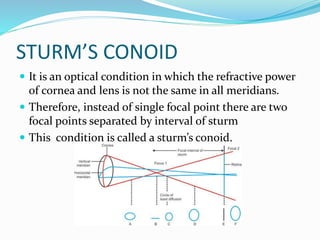
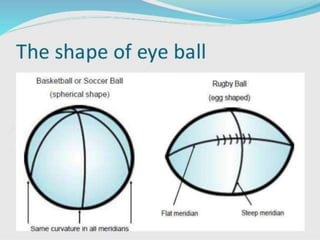
 It is an optical condition in which the refractive power
of cornea and lens is not the same in all meridians.
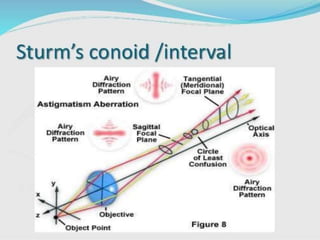
 Therefore, instead of single focal point there are two
focal points separated by interval of sturm
 This condition is called a sturm’s conoid.
Cont..
 At point A – the vertical rays are converging more
than the horizontal rays, so the section here is
horizontal oval
 At point B – (first focus) the vertical rays have come to
a focus while the horizontal rays are still converging
therefore it forms a horizontal line.
 At point C – the vertical rays are diverging and their
divergence is less than the convergence of the
horizontal rays, so a horizontal oval is formed here.
Cont..
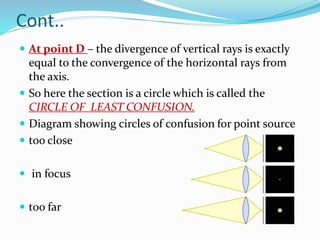
 At point D – the divergence of vertical rays is exactly
equal to the convergence of the horizontal rays from
the axis.
 So here the section is a circle which is called the
CIRCLE OF LEAST CONFUSION.
 Diagram showing circles of confusion for point source
 too close
 in focus
 too far
Cont..
 At point E– the divergence of vertical rays is more
than the convergence of horizontal rays, so the section
here is a vertical oval.
 At point F – (second focus) the horizontal rays have
come to a focus while the vertical rays are divergent.
Therefore a vertical line is formed.
 Beyond F (at point G) – both horizontal and vertical
rays are diverging and so the section will always be a
vertical oval.

Sturm's Conoid

  • 1.
  • 2.
    STURM’S CONOID  Itis an optical condition in which the refractive power of cornea and lens is not the same in all meridians.  Therefore, instead of single focal point there are two focal points separated by interval of sturm  This condition is called a sturm’s conoid.
  • 5.
    Cont..  At pointA – the vertical rays are converging more than the horizontal rays, so the section here is horizontal oval  At point B – (first focus) the vertical rays have come to a focus while the horizontal rays are still converging therefore it forms a horizontal line.  At point C – the vertical rays are diverging and their divergence is less than the convergence of the horizontal rays, so a horizontal oval is formed here.
  • 6.
    Cont..  At pointD – the divergence of vertical rays is exactly equal to the convergence of the horizontal rays from the axis.  So here the section is a circle which is called the CIRCLE OF LEAST CONFUSION.  Diagram showing circles of confusion for point source  too close  in focus  too far
  • 7.
    Cont..  At pointE– the divergence of vertical rays is more than the convergence of horizontal rays, so the section here is a vertical oval.  At point F – (second focus) the horizontal rays have come to a focus while the vertical rays are divergent. Therefore a vertical line is formed.  Beyond F (at point G) – both horizontal and vertical rays are diverging and so the section will always be a vertical oval.