Hereditary Retinal Dystrophy
Dr. Md. Ashfakur Rahaman (Rayhan)
DO Student
Ophthalmology Dept.
RpMCH
Introduction
• Group of disorders
• Commonly exert their major effect on
Retinal pigment epithelium
Photoreceptor complex
Choriocapillaris
Classification
By inheritance pattern:
A.Generalized
B. Central/Macular
Focus of the pathological process (e.g. photoreceptors,
RPE or choroid)
by whether they are stationary (non-progressive) or
progressive
Generalized Photoreceptor
Dystrophy:
1) Retinitis Pigmentosa
2) Atypical Retinal Pigmentosa
3) Leber Congenital Amaurosis
4) Cone Dystrophy
5) Bietti crystalline corneo-
retinal dystrophy
6) Familial Benign Fleck Retina
7) Congenital Stationary Night
Blindness
Macular Dystrophy:
1) Stargardt’s Dystrophy
2) Best Vitelliform Macular
Dystrophy
3) Familial Dominant Drusens
4) Sorbsy Pseudo-inflammatory
macular Dystrophy
5) North Carolina Macular
Dystrophy
6) Butterfly Macular Dystrophy
7) Concentric annular macular
Dystrophy
Retinitis pigmentosa
Introduction
• Most common hereditary fundus dystrophy.
• Clinically and genetically diverse group of inherited diffuse
retinal degenerative disease.
• Predominantly affecting the rod photoreceptors, with later
degeneration of cones (rod-cone dystrophy).
Inheritance
 Sporadic disorder: Isolated without family history due to mutation
of multiple gene including rhodopsin gene.
 Inherited disorder:
Autosomal recessive –. most common(25%), intermediate severe.
Autosomal dominant – next common(25%), least severe.
X-linked – least common(10%), most severe.
Epidemiology
Prevalence: approximately 1 : 5000.
Age: appears in childhood and progresses slowly.
Sex: males are more commonly affected than females.
Laterality: Almost invariably bilateral.
Leading cause of blindness certification in the working
age population (age 16–64 years) in the UK.
Pathogenesis
• Degeneration of rods and cones.
• Migration of pigments into the retina.
• Degenerated ganglion cells and their axons are
replaced by neuroglial tissue.
• Attenuation of the blood vessels.
• Atrophy of the optic disc.
Clinical features
The classic triad of findings comprises
bone-spicule retinal pigmentation
arteriolar attenuation and
‘waxy’ disc pallor.
Symptoms
• Night blindness.
• Dark adaptation difficulties.
• Tubular vision.
• Reduced central vision tends to be a late feature.
Signs
• Visual acuity (VA) may be normal.
• Bilateral mid-peripheral intraretinal perivascular ‘bone-
spicule’ pigmentary changes.
• RPE atrophy associated with arteriolar narrowing.
• Tessellated fundus appearance develops due to
unmasking of large choroidal vessels.
• Peripheral pigmentation may become severe, with marked
arteriolar narrowing and disc pallor.
• The macula may show atrophy, epiretinal membrane
(ERM) formation and cystoid macular oedema (CMO).
• Myopia is common.
• Optic disc drusen occur more frequently in patients with
RP.
Investigation
• Full-field ERG is a sensitive diagnostic test. In early
disease it shows reduced scotopic rod and combined
response.
• EOG is subnormal, with absence of the light rise.
• Perimetry initially demonstrates small mid-peripheral
scotomata.
• Optical coherence tomography (OCT) will identify
CMO.
• Genetic analysis may identify the particular mutation
responsible in an individual patient.
Treatment
• Regular follow-up (e.g. annual) is essential to detect
treatable vision-threatening complications.
• No specific treatment is yet commercially available, but
modalities such as gene therapy and retinal prostheses show
promise for the future.
• Cataract surgery is generally beneficial.
• Low-vision aid provision, rehabilitation.
• Sunglasses, ‘nanometer-controlled’ to block wavelengths up
to about 550 nm.
• High-dose vitamin A supplementation (e.g. palmitate 15 000
units per day) probably has a marginal benefit.
• Potentially (even mildly) retinotoxic medications should be
avoided or used with caution.
Complications
 Posterior subcapsular cataract.
 Open-angle glaucoma (3%).
 Keratoconus.
 Posterior vitreous detachment.
 Occasionally seen intermediate uveitis.
 Exudative retinal detachment.
Atypical retinitis pigmentosa
Atypical RP associated with a systemic disorder
(syndromic RP)
Usher syndrome
• Type I (75%): profound congenital sensorineural deafness and
severe RP.
• Type III (2%): progressive hearing loss, vestibular dysfunction
and relatively late-onset pigmentary retinopathy.
Kearns–Sayre syndrome
• Characterized by chronic progressive external
ophthalmoplegia with ptosis associated with other systemic
problems.
Bassen–Kornzweig syndrome
• Fat and fat-soluble vitamin absorption is dysfunctional.
• There is a failure to thrive in infancy, with the
development of severe spinocerebellar ataxia.
• The fundus exhibits scattered white dots followed by
RP-like changes developing towards the end of the first
decade.
Refsum disease
• Phytanic acid accumulates throughout the body, with
substantial and varied skin, neurological and visceral
features.
• Retinal changes may be similar to RP or take on a salt
and pepper appearance.
• Ocular features such as cataract and optic atrophy.
Atypical retinitis pigmentosa
Retinitis pigmentosa sine pigmento
• Characterized by an absence or paucity of pigment
accumulation, which may subsequently appear with time.
• Functional manifestations are similar to typical RP.
Atypical retinitis pigmentosa
Retinitis punctata albescens
• Characterized by scattered whitish-yellow spots, most
numerous at the equator, usually sparing the macula, and
associated with arteriolar attenuation.
• Nyctalopia and progressive field loss occur.
Atypical retinitis pigmentosa
Sector retinitis pigmentosa
• Sector (sectoral) RP is AD.
• Characterized by involvement of inferior quadrants only.
• Progression is slow, and many cases are apparently
stationary.
• Unilateral RP can also occur.
Atypical retinitis pigmentosa
Leber congenital amaurosis
• Severe rod-cone dystrophy that is the commonest genetically
defined cause of visual impairment in children.
• Systemic associations include mental handicap, deafness,
epilepsy, central nervous system and renal anomalies, skeletal
malformations and endocrine dysfunction.
Presentation
• Blindness at birth or early infancy.
• Roving eye movements or nystagmus, and photoaversion.
Signs
• Absent or diminished pupillary light reflexes.
• The fundi may be normal in early life apart from mild arteriolar
narrowing.
• Initially mild peripheral pigmentary retinopathy, salt and pepper
changes, and less frequently yellow flecks.
• Severe macular pigmentation or coloboma like atrophy.
Atypical retinitis pigmentosa
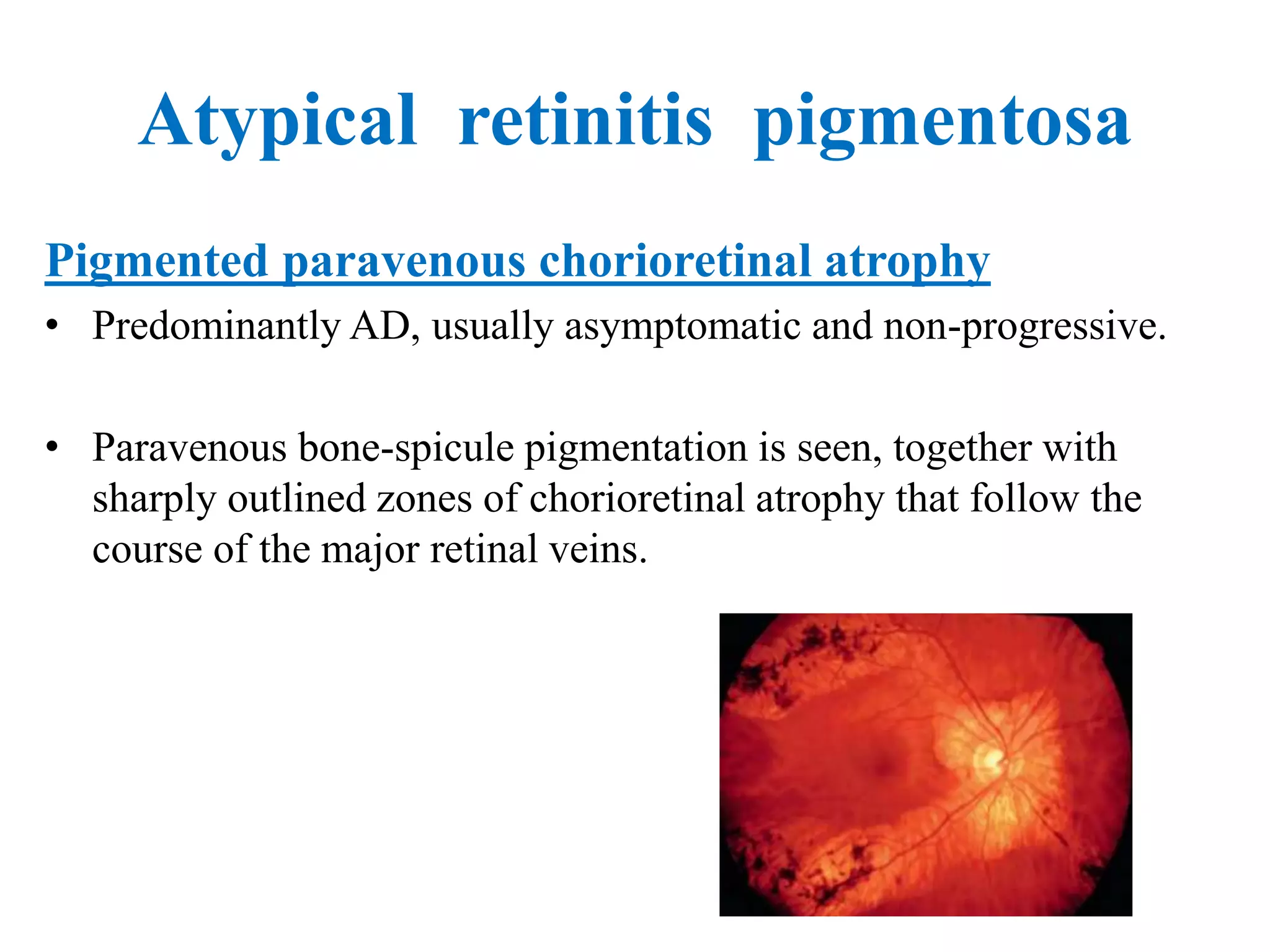
Pigmented paravenous chorioretinal atrophy
• Predominantly AD, usually asymptomatic and non-progressive.
• Paravenous bone-spicule pigmentation is seen, together with
sharply outlined zones of chorioretinal atrophy that follow the
course of the major retinal veins.
Stargardt disease/fundus
flavimaculatus
Introduction
• Characterized by the accumulation of lipofuscin
within the RPE.
• Three types are recognized:
- STGD1 (AR): most common, and is usually caused by
mutation in the gene ABCA4.
- STGD3 (AD).
- STGD4 (AD): uncommon, and are related to different
genes.
Clinical features
Symptoms
• Gradual impairment of central vision.
• Reduced colour vision.
• Impairment of dark adaptation.
Signs
• Macula may initially be normal or show non-specific mottling
• Later progressing to an oval ‘snail slime’ or ‘beaten-bronze’
appearance and subsequently to geographic atrophy that may
tend to a bull’s-eye configuration.
• Small proportion develop choroidal neovascularization (CNV).
Stargardt disease: (A) Non-specific macular mottling; (B) ‘snail
slime’ maculopathy surrounded by flecks; (C) ‘beaten-bronze’
paramacular appearance;
Investigation
• OCT: demonstrate flecks and atrophy.
• FAF: shows a characteristic appearance with hyperautofluorescent
flecks and macular hypoautofluorescence.
• ERG: Photopic is normal to subnormal, scotopic may be normal.
• EOG: subnormal, especially in advanced cases.
(A) Central visual field loss; (B) OCT showing RPE and outer retinal atrophy sparing the
fovea; (C) FAF showing macular hypoautofluorescence and surrounding flecks. The black
areas in the macula represent RPE atrophy; (D) FA showing hyperfluorescent spots and a
‘dark choroid’
Treatment
• Protection from excessive high energy light exposure.
• Vitamin A supplementation is avoided as it may accelerate
lipofuscin accumulation.
• Gene therapy and stem cell trials have been initiated and
show promising results.
Best vitelliform macular dystrophy
Introduction
• Early- or juvenile-onset vitelliform macular
dystrophy
• second most common macular dystrophy, after
Stargardt disease.
• Due to allelic variation in the bestrophin (BEST1)
gene on chromosome 11q13.
• Inheritance is AD with variable penetrance and
expressivity.
Diagnosis
Signs
There is gradual evolution through the following stages:
○ Pre-vitelliform is characterized by a subnormal EOG
in an asymptomatic infant or child with a normal
fundus.
○ Vitelliform develops in infancy or early childhood and
does not usually impair vision.
-Asymmetrical
A round, sharply delineated (‘sunny side up egg yolk’) macular lesion
between half a disc and two disc diameters in size develops within the RPE
• Pseudohypopyon may occur when part of the lesion
regresses, often at puberty.
• Vitelliruptive:The lesion breaks up and visual acuity
drops.
• Atrophic in which all pigment has disappeared
leaving an atrophic area of RPE
B.Pseudohypopyon C.Vitelliruptive
Investigation
• FAF: the yellowish material is intensely
hyperautofluorescent. In the later atrophic stages
hypoautofluorescent areas supervene
• FA shows corresponding hypofluorescence due to
masking
• OCT shows material beneath, above and within the
RPE
• EOG is severely subnormal during all stages and is
also abnormal in carriers with clinically normal fundi
D.FA shows corresponding hypofluorescence E.OCT showing subretinal hyporeflective
component
Treatment
• There is no medical & Surgical management
available
• Treatment of Complications
Hereditary Retinal disease .pptx

Hereditary Retinal disease .pptx

  • 1.
    Hereditary Retinal Dystrophy Dr.Md. Ashfakur Rahaman (Rayhan) DO Student Ophthalmology Dept. RpMCH
  • 2.
    Introduction • Group ofdisorders • Commonly exert their major effect on Retinal pigment epithelium Photoreceptor complex Choriocapillaris
  • 3.
    Classification By inheritance pattern: A.Generalized B.Central/Macular Focus of the pathological process (e.g. photoreceptors, RPE or choroid) by whether they are stationary (non-progressive) or progressive
  • 4.
    Generalized Photoreceptor Dystrophy: 1) RetinitisPigmentosa 2) Atypical Retinal Pigmentosa 3) Leber Congenital Amaurosis 4) Cone Dystrophy 5) Bietti crystalline corneo- retinal dystrophy 6) Familial Benign Fleck Retina 7) Congenital Stationary Night Blindness Macular Dystrophy: 1) Stargardt’s Dystrophy 2) Best Vitelliform Macular Dystrophy 3) Familial Dominant Drusens 4) Sorbsy Pseudo-inflammatory macular Dystrophy 5) North Carolina Macular Dystrophy 6) Butterfly Macular Dystrophy 7) Concentric annular macular Dystrophy
  • 5.
    Retinitis pigmentosa Introduction • Mostcommon hereditary fundus dystrophy. • Clinically and genetically diverse group of inherited diffuse retinal degenerative disease. • Predominantly affecting the rod photoreceptors, with later degeneration of cones (rod-cone dystrophy).
  • 6.
    Inheritance  Sporadic disorder:Isolated without family history due to mutation of multiple gene including rhodopsin gene.  Inherited disorder: Autosomal recessive –. most common(25%), intermediate severe. Autosomal dominant – next common(25%), least severe. X-linked – least common(10%), most severe.
  • 7.
    Epidemiology Prevalence: approximately 1: 5000. Age: appears in childhood and progresses slowly. Sex: males are more commonly affected than females. Laterality: Almost invariably bilateral. Leading cause of blindness certification in the working age population (age 16–64 years) in the UK.
  • 8.
    Pathogenesis • Degeneration ofrods and cones. • Migration of pigments into the retina. • Degenerated ganglion cells and their axons are replaced by neuroglial tissue. • Attenuation of the blood vessels. • Atrophy of the optic disc.
  • 9.
    Clinical features The classictriad of findings comprises bone-spicule retinal pigmentation arteriolar attenuation and ‘waxy’ disc pallor.
  • 10.
    Symptoms • Night blindness. •Dark adaptation difficulties. • Tubular vision. • Reduced central vision tends to be a late feature.
  • 11.
    Signs • Visual acuity(VA) may be normal. • Bilateral mid-peripheral intraretinal perivascular ‘bone- spicule’ pigmentary changes. • RPE atrophy associated with arteriolar narrowing. • Tessellated fundus appearance develops due to unmasking of large choroidal vessels.
  • 12.
    • Peripheral pigmentationmay become severe, with marked arteriolar narrowing and disc pallor. • The macula may show atrophy, epiretinal membrane (ERM) formation and cystoid macular oedema (CMO). • Myopia is common. • Optic disc drusen occur more frequently in patients with RP.
  • 13.
    Investigation • Full-field ERGis a sensitive diagnostic test. In early disease it shows reduced scotopic rod and combined response. • EOG is subnormal, with absence of the light rise. • Perimetry initially demonstrates small mid-peripheral scotomata.
  • 14.
    • Optical coherencetomography (OCT) will identify CMO. • Genetic analysis may identify the particular mutation responsible in an individual patient.
  • 15.
    Treatment • Regular follow-up(e.g. annual) is essential to detect treatable vision-threatening complications. • No specific treatment is yet commercially available, but modalities such as gene therapy and retinal prostheses show promise for the future. • Cataract surgery is generally beneficial. • Low-vision aid provision, rehabilitation.
  • 16.
    • Sunglasses, ‘nanometer-controlled’to block wavelengths up to about 550 nm. • High-dose vitamin A supplementation (e.g. palmitate 15 000 units per day) probably has a marginal benefit. • Potentially (even mildly) retinotoxic medications should be avoided or used with caution.
  • 17.
    Complications  Posterior subcapsularcataract.  Open-angle glaucoma (3%).  Keratoconus.  Posterior vitreous detachment.  Occasionally seen intermediate uveitis.  Exudative retinal detachment.
  • 18.
    Atypical retinitis pigmentosa AtypicalRP associated with a systemic disorder (syndromic RP) Usher syndrome • Type I (75%): profound congenital sensorineural deafness and severe RP. • Type III (2%): progressive hearing loss, vestibular dysfunction and relatively late-onset pigmentary retinopathy. Kearns–Sayre syndrome • Characterized by chronic progressive external ophthalmoplegia with ptosis associated with other systemic problems.
  • 19.
    Bassen–Kornzweig syndrome • Fatand fat-soluble vitamin absorption is dysfunctional. • There is a failure to thrive in infancy, with the development of severe spinocerebellar ataxia. • The fundus exhibits scattered white dots followed by RP-like changes developing towards the end of the first decade.
  • 20.
    Refsum disease • Phytanicacid accumulates throughout the body, with substantial and varied skin, neurological and visceral features. • Retinal changes may be similar to RP or take on a salt and pepper appearance. • Ocular features such as cataract and optic atrophy.
  • 21.
    Atypical retinitis pigmentosa Retinitispigmentosa sine pigmento • Characterized by an absence or paucity of pigment accumulation, which may subsequently appear with time. • Functional manifestations are similar to typical RP.
  • 22.
    Atypical retinitis pigmentosa Retinitispunctata albescens • Characterized by scattered whitish-yellow spots, most numerous at the equator, usually sparing the macula, and associated with arteriolar attenuation. • Nyctalopia and progressive field loss occur.
  • 23.
    Atypical retinitis pigmentosa Sectorretinitis pigmentosa • Sector (sectoral) RP is AD. • Characterized by involvement of inferior quadrants only. • Progression is slow, and many cases are apparently stationary. • Unilateral RP can also occur.
  • 24.
    Atypical retinitis pigmentosa Lebercongenital amaurosis • Severe rod-cone dystrophy that is the commonest genetically defined cause of visual impairment in children. • Systemic associations include mental handicap, deafness, epilepsy, central nervous system and renal anomalies, skeletal malformations and endocrine dysfunction.
  • 25.
    Presentation • Blindness atbirth or early infancy. • Roving eye movements or nystagmus, and photoaversion. Signs • Absent or diminished pupillary light reflexes. • The fundi may be normal in early life apart from mild arteriolar narrowing. • Initially mild peripheral pigmentary retinopathy, salt and pepper changes, and less frequently yellow flecks. • Severe macular pigmentation or coloboma like atrophy.
  • 26.
    Atypical retinitis pigmentosa Pigmentedparavenous chorioretinal atrophy • Predominantly AD, usually asymptomatic and non-progressive. • Paravenous bone-spicule pigmentation is seen, together with sharply outlined zones of chorioretinal atrophy that follow the course of the major retinal veins.
  • 27.
    Stargardt disease/fundus flavimaculatus Introduction • Characterizedby the accumulation of lipofuscin within the RPE. • Three types are recognized: - STGD1 (AR): most common, and is usually caused by mutation in the gene ABCA4. - STGD3 (AD). - STGD4 (AD): uncommon, and are related to different genes.
  • 28.
    Clinical features Symptoms • Gradualimpairment of central vision. • Reduced colour vision. • Impairment of dark adaptation. Signs • Macula may initially be normal or show non-specific mottling • Later progressing to an oval ‘snail slime’ or ‘beaten-bronze’ appearance and subsequently to geographic atrophy that may tend to a bull’s-eye configuration. • Small proportion develop choroidal neovascularization (CNV).
  • 29.
    Stargardt disease: (A)Non-specific macular mottling; (B) ‘snail slime’ maculopathy surrounded by flecks; (C) ‘beaten-bronze’ paramacular appearance;
  • 30.
    Investigation • OCT: demonstrateflecks and atrophy. • FAF: shows a characteristic appearance with hyperautofluorescent flecks and macular hypoautofluorescence. • ERG: Photopic is normal to subnormal, scotopic may be normal. • EOG: subnormal, especially in advanced cases.
  • 31.
    (A) Central visualfield loss; (B) OCT showing RPE and outer retinal atrophy sparing the fovea; (C) FAF showing macular hypoautofluorescence and surrounding flecks. The black areas in the macula represent RPE atrophy; (D) FA showing hyperfluorescent spots and a ‘dark choroid’
  • 32.
    Treatment • Protection fromexcessive high energy light exposure. • Vitamin A supplementation is avoided as it may accelerate lipofuscin accumulation. • Gene therapy and stem cell trials have been initiated and show promising results.
  • 33.
    Best vitelliform maculardystrophy Introduction • Early- or juvenile-onset vitelliform macular dystrophy • second most common macular dystrophy, after Stargardt disease. • Due to allelic variation in the bestrophin (BEST1) gene on chromosome 11q13. • Inheritance is AD with variable penetrance and expressivity.
  • 34.
    Diagnosis Signs There is gradualevolution through the following stages: ○ Pre-vitelliform is characterized by a subnormal EOG in an asymptomatic infant or child with a normal fundus. ○ Vitelliform develops in infancy or early childhood and does not usually impair vision. -Asymmetrical
  • 35.
    A round, sharplydelineated (‘sunny side up egg yolk’) macular lesion between half a disc and two disc diameters in size develops within the RPE
  • 36.
    • Pseudohypopyon mayoccur when part of the lesion regresses, often at puberty. • Vitelliruptive:The lesion breaks up and visual acuity drops. • Atrophic in which all pigment has disappeared leaving an atrophic area of RPE
  • 37.
  • 38.
    Investigation • FAF: theyellowish material is intensely hyperautofluorescent. In the later atrophic stages hypoautofluorescent areas supervene • FA shows corresponding hypofluorescence due to masking • OCT shows material beneath, above and within the RPE • EOG is severely subnormal during all stages and is also abnormal in carriers with clinically normal fundi
  • 39.
    D.FA shows correspondinghypofluorescence E.OCT showing subretinal hyporeflective component
  • 40.
    Treatment • There isno medical & Surgical management available • Treatment of Complications