Retinitis Pigmentosa
MEHEDI HASAN
Retinitis Pigmentosa
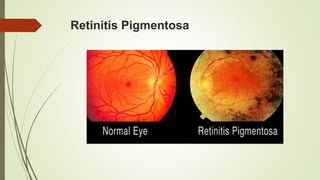
 Retinitis pigmentosa (RP) is a group of inherited diseases that damage the light-
sensitive rods and cones in the retina. The rods, which provide side (peripheral)
and night vision, are affected more than the cones, which provide color and clear
central vision.So RP patients mainly suffer from night blindness(nyctalopia) and
peripheral vision loss that can lead to central vision loss.
Retinitis Pigmentosa
 What causes RP?
 RP is an inherited disorder that results from harmful changes in any one of more
than 50 genes. These genes carry the instructions for making proteins that are
needed in cells within the retina, called photoreceptors. Some of the changes, or
mutations, within genes are so severe that the gene cannot make the required
protein, limiting the cellís function. Other mutations produce a protein that is toxic
to the cell. Still other mutations lead to an abnormal protein that doesnít function
properly. In all three cases, the result is damage to the photoreceptors.
 RP is considered a rare disorder. Although current statistics are not available, it is
generally estimated that the disorder affects roughly 1 in 4,000 people, both in the
United States and worldwide.
Retinitis Pigmentosa
 How is RP inherited?
 To understand how RP is inherited, itís important to know a little more about genes
and how they are passed from parent to child. Genes are bundled together on
structures called chromosomes. Each cell in your body contains 23 pairs of
chromosomes. One copy of each chromosome is passed by a parent at
conception through egg and sperm cells. The X and Y chromosomes, known as
sex chromosomes, determine whether a person is born female (XX) or male (XY).
The 22 other paired chromosomes, called autosomes, contain the vast majority of
genes that determine non-sex traits. RP can be inherited in one of three ways:
Retinitis Pigmentosa
 Autosomal recessive Inheritance :
 In autosomal recessive inheritance, it takes two copies of the mutant gene to give
rise to the disorder. An individual with a recessive gene mutation is known as a
carrier. When two carriers have a child, there is a:
 1 in 4 chance the child will have the disorder
 1 in 2 chance the child will be a carrier
 1 in 4 chance the child will neither have the disorder nor be a carrier
Retinitis Pigmentosa
 Autosomal dominant InheritanceInheritance :
 In this inheritance pattern, it takes just one copy of the gene with a disorder-
causing mutation to bring about the disorder. When a parent has a dominant gene
mutation, there is a 1 in 2 chance that any children will inherit this mutation and
the disorder.
Retinitis Pigmentosa
 X-linked Inheritance
 In this form of inheritance, mothers carry the mutated gene on one of their X
chromosomes and pass it to their sons. Because females have two X
chromosomes, the effect of a mutation on one X chromosome is offset by the
normal gene on the other X chromosome. If a mother is a carrier of an X-linked
disorder there is a:
 1 in 2 chance of having a son with the disorder
 1 in 2 chance of having a daughter who is a carrier
Retinitis Pigmentosa
 SIGNS AND SYMPTOMS :
 Since retinitis pigmentosa begins as rod degeneration, the patient first notices
increasing difficulty in night vision, followed by difficulty seeing in the periphery.
Slowly progressive constriction of the visual field leads to tunnel vision. A small
area of central vision in both eyes usually persists for years. Generally night
blindness precedes tunnel vision by years or even decades. Total blindness
eventually ensues in most cases. The age of appearance of legal blindness ranges
from as early as childhood to as late as the 40s.
Retinitis Pigmentosa
 How is Retinitis Pigmentosa diagnosed?
 Acuity Tests: measures the accuracy of your central vision.
 Color Testing: helps determine the status of your cone cells, the retinal cells that
interpret color.
 Donut shaped visual field loss progressing to severe constriction (loss of peripheral
vision)
 Color Testing: helps determine the status of your cone cells, the retinal cells that
interpret color.
 Dark Adaptation Test: measures how well your eyes adjust to changes in lighting.
 ERG Test (electrophysiological test): records the electrical currents produced by
the retina due to a light stimulus.
Retinitis Pigmentosa
 Available treatment and management :
Living with vision loss, As still there is no specific cure for retinitis pigmentosa.
 For years, vitamin A therapy has been recommended for many RP patients, based
on research dating back to the early 1990s. A randomized, controlled trial
of vitamins A and E found that 15,000 IU a day of vitamin A palmitate could slow
the course of the condition among adults with typical forms of RP. Vitamin E,
however, at a 400 IU a day dose appeared to have an adverse effect on the course
of RP in the same study.
Retinitis Pigmentosa
 Another study among adult patients with RP has shown that an omega-3-
rich diet containing docosahexaenoic acid can further slow disease progression.
Such a dietincludes one to two 3-ounce servings per week of oily fish such as
salmon, tuna, herring, mackerel, or sardines. Researchers estimated that the
combination of vitamin A plus this diet could provide almost 20 additional years of
useful vision for adults who start the regimen in their 30s.
 RP patients are usually forwarded to Low Vision Clinic or Low Vision Specialist for
Low Vision Aid.
Retinitis Pigmentosa
 Children with RP may benefit from low vision aids that maximize existing vision.
For example, there are special lenses that magnify central vision to expand visual
field and eliminate glare. Computer programs that read text are readily available.
Closed circuit televisions with a camera can adjust text to suit oneís vision.
Portable lighting devices can adjust a dark or dim environment. Mobility training
can teach people to use a cane or a guide dog, and eye scanning techniques can
help people to optimize remaining vision. Once a child is diagnosed, he or she will
be referred to a low vision specialist for a comprehensive evaluation.
THANK YOU.

Retinitis pigmentosa ppt

  • 1.
  • 2.
    Retinitis Pigmentosa  Retinitispigmentosa (RP) is a group of inherited diseases that damage the light- sensitive rods and cones in the retina. The rods, which provide side (peripheral) and night vision, are affected more than the cones, which provide color and clear central vision.So RP patients mainly suffer from night blindness(nyctalopia) and peripheral vision loss that can lead to central vision loss.
  • 3.
  • 4.
    Retinitis Pigmentosa  Whatcauses RP?  RP is an inherited disorder that results from harmful changes in any one of more than 50 genes. These genes carry the instructions for making proteins that are needed in cells within the retina, called photoreceptors. Some of the changes, or mutations, within genes are so severe that the gene cannot make the required protein, limiting the cellís function. Other mutations produce a protein that is toxic to the cell. Still other mutations lead to an abnormal protein that doesnít function properly. In all three cases, the result is damage to the photoreceptors.  RP is considered a rare disorder. Although current statistics are not available, it is generally estimated that the disorder affects roughly 1 in 4,000 people, both in the United States and worldwide.
  • 5.
    Retinitis Pigmentosa  Howis RP inherited?  To understand how RP is inherited, itís important to know a little more about genes and how they are passed from parent to child. Genes are bundled together on structures called chromosomes. Each cell in your body contains 23 pairs of chromosomes. One copy of each chromosome is passed by a parent at conception through egg and sperm cells. The X and Y chromosomes, known as sex chromosomes, determine whether a person is born female (XX) or male (XY). The 22 other paired chromosomes, called autosomes, contain the vast majority of genes that determine non-sex traits. RP can be inherited in one of three ways:
  • 6.
    Retinitis Pigmentosa  Autosomalrecessive Inheritance :  In autosomal recessive inheritance, it takes two copies of the mutant gene to give rise to the disorder. An individual with a recessive gene mutation is known as a carrier. When two carriers have a child, there is a:  1 in 4 chance the child will have the disorder  1 in 2 chance the child will be a carrier  1 in 4 chance the child will neither have the disorder nor be a carrier
  • 7.
    Retinitis Pigmentosa  Autosomaldominant InheritanceInheritance :  In this inheritance pattern, it takes just one copy of the gene with a disorder- causing mutation to bring about the disorder. When a parent has a dominant gene mutation, there is a 1 in 2 chance that any children will inherit this mutation and the disorder.
  • 8.
    Retinitis Pigmentosa  X-linkedInheritance  In this form of inheritance, mothers carry the mutated gene on one of their X chromosomes and pass it to their sons. Because females have two X chromosomes, the effect of a mutation on one X chromosome is offset by the normal gene on the other X chromosome. If a mother is a carrier of an X-linked disorder there is a:  1 in 2 chance of having a son with the disorder  1 in 2 chance of having a daughter who is a carrier
  • 9.
    Retinitis Pigmentosa  SIGNSAND SYMPTOMS :  Since retinitis pigmentosa begins as rod degeneration, the patient first notices increasing difficulty in night vision, followed by difficulty seeing in the periphery. Slowly progressive constriction of the visual field leads to tunnel vision. A small area of central vision in both eyes usually persists for years. Generally night blindness precedes tunnel vision by years or even decades. Total blindness eventually ensues in most cases. The age of appearance of legal blindness ranges from as early as childhood to as late as the 40s.
  • 10.
    Retinitis Pigmentosa  Howis Retinitis Pigmentosa diagnosed?  Acuity Tests: measures the accuracy of your central vision.  Color Testing: helps determine the status of your cone cells, the retinal cells that interpret color.  Donut shaped visual field loss progressing to severe constriction (loss of peripheral vision)  Color Testing: helps determine the status of your cone cells, the retinal cells that interpret color.  Dark Adaptation Test: measures how well your eyes adjust to changes in lighting.  ERG Test (electrophysiological test): records the electrical currents produced by the retina due to a light stimulus.
  • 11.
    Retinitis Pigmentosa  Availabletreatment and management : Living with vision loss, As still there is no specific cure for retinitis pigmentosa.  For years, vitamin A therapy has been recommended for many RP patients, based on research dating back to the early 1990s. A randomized, controlled trial of vitamins A and E found that 15,000 IU a day of vitamin A palmitate could slow the course of the condition among adults with typical forms of RP. Vitamin E, however, at a 400 IU a day dose appeared to have an adverse effect on the course of RP in the same study.
  • 12.
    Retinitis Pigmentosa  Anotherstudy among adult patients with RP has shown that an omega-3- rich diet containing docosahexaenoic acid can further slow disease progression. Such a dietincludes one to two 3-ounce servings per week of oily fish such as salmon, tuna, herring, mackerel, or sardines. Researchers estimated that the combination of vitamin A plus this diet could provide almost 20 additional years of useful vision for adults who start the regimen in their 30s.  RP patients are usually forwarded to Low Vision Clinic or Low Vision Specialist for Low Vision Aid.
  • 13.
    Retinitis Pigmentosa  Childrenwith RP may benefit from low vision aids that maximize existing vision. For example, there are special lenses that magnify central vision to expand visual field and eliminate glare. Computer programs that read text are readily available. Closed circuit televisions with a camera can adjust text to suit oneís vision. Portable lighting devices can adjust a dark or dim environment. Mobility training can teach people to use a cane or a guide dog, and eye scanning techniques can help people to optimize remaining vision. Once a child is diagnosed, he or she will be referred to a low vision specialist for a comprehensive evaluation.
  • 14.