بنام خدا   الله نورالسموات والارض
 
 
Retinal Diseases Retinal Detachment Acquired Macular Diseases Herditary Fundus Dystrophy Retinal Vascular Diseases Intraocular Tumours


Retinal Vein Occlusion   Symptoms  : The visual symptoms can vary in severity , and are dependent on whether the central retinal vein or a branch retinal vein is involved.  Recovery from a central vein occlusion is much less likely since it affects the  macula .
This problem appears  equally in males and females  It  is more common  after the age of 60 .
Symptoms  Sudden onset  Blurred or missing area of vision (if a branch vein is involved)  loss of central vision (if a central vein is involved)     
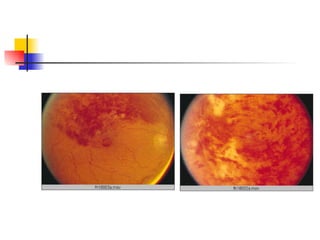
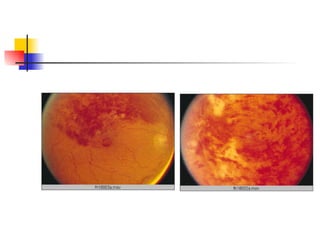
Retinal Vein Occlusion   A  obstructed blood vessel, causing  hemorrhages in the  retina .  Swelling and ischemia  (lack of oxygen) of the retina as well as glaucoma are fairly common complications.
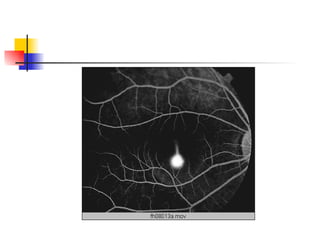
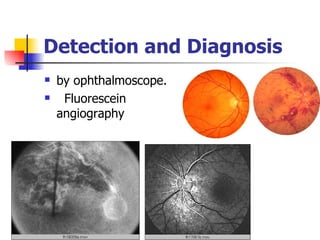
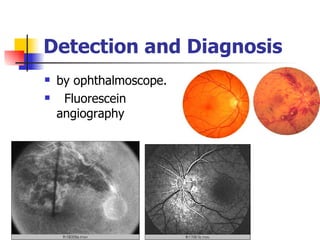
Detection and Diagnosis by ophthalmoscope. Fluorescein angiography
 
Treatment  T o treat the secondary complications. LASER The following are common risk factors for vein occlusion :  ·Diabetes  ·Hypertension  ·Cardiovascular disease  
Retinal Artery Occlusion
Signs and Symptoms  Tra nsient loss of vision prior to the artery occlusion (in some cases)
 
 
Retinal Vein Occlusion   Symptoms  : The visual symptoms can vary in severity , and are dependent on whether the central retinal vein or a branch retinal vein is involved.  Recovery from a central vein occlusion is much less likely since it affects the  macula .  This problem appears  equally in males and females  It  is more common  after the age of 60 .
Symptoms  Sudden onset  Blurred or missing area of vision (if a branch vein is involved)  loss of central vision (if a central vein is involved)     
Retinal Vein Occlusion   A  obstructed blood vessel, causing  hemorrhages in the  retina .  Swelling and ischemia  (lack of oxygen) of the retina as well as glaucoma are fairly common complications.
Detection and Diagnosis by ophthalmoscope. Fluorescein angiography
 
Treatment  T o treat the secondary complications. LASER The following are common risk factors for vein occlusion :  ·Diabetes  ·Hypertension  ·Cardiovascular disease  
Retinal Artery Occlusion
Signs and Symptoms  Tra nsient loss of vision prior to the artery occlusion (in some cases)
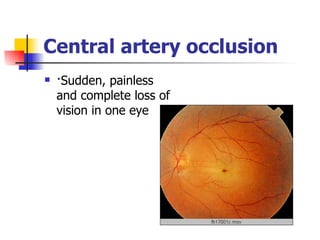
Central artery occlusion ·Sudden, painless and complete loss of vision in one eye
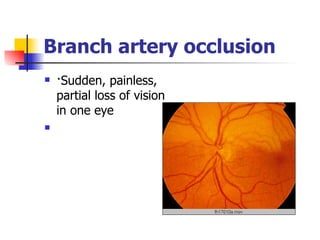
Branch artery occlusion ·Sudden, painless, partial loss of vision in one eye    
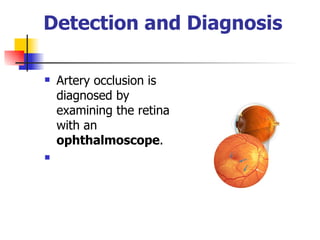
Detection and Diagnosis  Artery occlusion is diagnosed by examining the retina with an  ophthalmoscope .   
Treatment  Unfortunately, there is no   treatment that can consistently restore vision lost from an artery occlusion.  However, if it is caught within the first hour and treatment is initiated immediately , recovery is possible in rare cases.  The following conditions increase the risk of vessels of the eye:  ·Hypertension  ·Diabetes  ·High cholesterol  · H eart disease  ·Arteriosclerosis  ·Glaucoma  
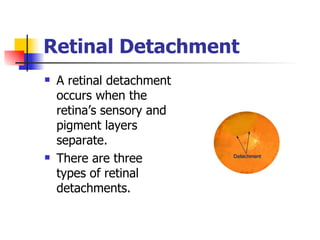
Retinal Detachment A retinal detachment occurs when the retina’s sensory and pigment layers separate.  There are three types of retinal detachments.  Retinal Detachment  A retinal detachment occurs when the retina’s sensory and pigment layers separate.  There are three types of retinal detachments.
Retinal Detachment: Vitreoretinal Traction  Dynamic traction  Static Traction A:Tangential B:Anteroposterior C:Bridging
Retinal Tear and Detachment  Retinal tears commonly occur when there is traction on the  retina  by the  vitreous  gel inside the eye.                                                                                                                              
Signs and Symptoms ·Light flashes  ·“Wavy,” or “watery” vision  ·Veil or curtain obstructing vision  ·Shower of floaters that resemble spots, bugs, or spider webs  ·Sudden decrease of vision
Detection and Diagnosis Retinal detachments are usually found: calls the doctor’s office critical early, early treatment improve restoring vision.  thoroughly  ophthalmoscopy .  The macula is responsible for the central vision.  Ultrasound imaging
Treatment  The appropriate treatment depends on the type, severity and location of the detachment.  Pneumatic retinopexy   scleral buckle .  other types of retinal detachment surgeries are either inappropriate or unsuccessful , vitreous gel is removed and replaced Treatment  There are a number of ways to treat retinal detachment. The appropriate treatment depends on the type, severity and location of the detachment.  Pneumatic retinopexy   scleral buckle .  other types of retinal detachment surgeries are either inappropriate or unsuccessful , The vitreous gel is removed and replaced with silicone oil.
What  we  can do What you can do…  Early detection  Awareness of vision ٍٍٍٍ higher-risk group nearsighted or diabetic. ٍ Compare the vision of your eyes daily Notify your doctor immediately if notice any of the following:  An obstruction of peripheral vision (veil, shadow, or curtain)  Sudden shower of floaters  Light flashes  Spider webs
Retinitis pigmentosa
D iagnosed during childhood when the symptoms begin to become apparent.    However, depending on the progression of the disease, it may not be detected until later in life.
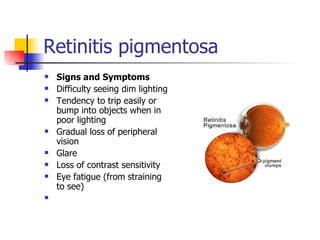
Retinitis pigmentosa Signs and Symptoms   Difficulty seeing dim lighting  Tendency to trip easily or bump into objects when in poor lighting  Gradual loss of peripheral vision  Glare  Loss of contrast sensitivity  Eye fatigue (from straining to see)    Signs and Symptoms   Difficulty seeing dim lighting  Tendency to trip easily or bump into objects when in poor lighting  Gradual loss of peripheral vision  Glare  Loss of contrast sensitivity  Eye fatigue (from straining to see)   
Detection and Diagnosis   Retinitis pigmentosa is usually diagnosed before adulthood.  often the patient complains of difficultly with night vision.   The diagnoses by examining the retina with an ophthalmoscope The classic sign of RP "bone-spicules.“ E lectroretinography (ERG). 
Treatment   There is currently no standard treatment or therapy for retinitis pigmentosa; however, scientists have isolated several genes responsible for the disease.  Once RP is discovered, patients and their families are encouraged to seek genetic counseling.
Current Research    Scientists at Johns Hopkins University are developing a micro-computer chip prosthesis called the Multiple-unit Artificial Retina Chipset (MARC).    Once implanted in the retina, the chip transmits images to the brain that are captured from a small camera mounted on the patient's glasses.   The chip is still in development and is not yet available for widespread use.  Doctors continue to search for treatments for RP but have yet to find a cure.
متشكرم
 

Retinitis pigmentosa 1

  • 1.
    بنام خدا الله نورالسموات والارض
  • 2.
  • 3.
  • 4.
    Retinal Diseases RetinalDetachment Acquired Macular Diseases Herditary Fundus Dystrophy Retinal Vascular Diseases Intraocular Tumours
  • 5.
  • 6.
  • 7.
  • 8.
  • 9.
    Retinal Vein Occlusion Symptoms : The visual symptoms can vary in severity , and are dependent on whether the central retinal vein or a branch retinal vein is involved. Recovery from a central vein occlusion is much less likely since it affects the macula .
  • 10.
    This problem appears equally in males and females It is more common after the age of 60 .
  • 11.
    Symptoms Suddenonset Blurred or missing area of vision (if a branch vein is involved) loss of central vision (if a central vein is involved)    
  • 12.
    Retinal Vein Occlusion  A obstructed blood vessel, causing hemorrhages in the retina . Swelling and ischemia (lack of oxygen) of the retina as well as glaucoma are fairly common complications.
  • 13.
    Detection and Diagnosisby ophthalmoscope. Fluorescein angiography
  • 14.
  • 15.
    Treatment To treat the secondary complications. LASER The following are common risk factors for vein occlusion : ·Diabetes ·Hypertension ·Cardiovascular disease  
  • 16.
  • 17.
    Signs and Symptoms Tra nsient loss of vision prior to the artery occlusion (in some cases)
  • 18.
  • 19.
  • 20.
    Retinal Vein Occlusion Symptoms : The visual symptoms can vary in severity , and are dependent on whether the central retinal vein or a branch retinal vein is involved. Recovery from a central vein occlusion is much less likely since it affects the macula . This problem appears equally in males and females It is more common after the age of 60 .
  • 21.
    Symptoms Suddenonset Blurred or missing area of vision (if a branch vein is involved) loss of central vision (if a central vein is involved)    
  • 22.
    Retinal Vein Occlusion  A obstructed blood vessel, causing hemorrhages in the retina . Swelling and ischemia (lack of oxygen) of the retina as well as glaucoma are fairly common complications.
  • 23.
    Detection and Diagnosisby ophthalmoscope. Fluorescein angiography
  • 24.
  • 25.
    Treatment To treat the secondary complications. LASER The following are common risk factors for vein occlusion : ·Diabetes ·Hypertension ·Cardiovascular disease  
  • 26.
  • 27.
    Signs and Symptoms Tra nsient loss of vision prior to the artery occlusion (in some cases)
  • 28.
    Central artery occlusion·Sudden, painless and complete loss of vision in one eye
  • 29.
    Branch artery occlusion·Sudden, painless, partial loss of vision in one eye  
  • 30.
    Detection and Diagnosis Artery occlusion is diagnosed by examining the retina with an ophthalmoscope .  
  • 31.
    Treatment Unfortunately,there is no treatment that can consistently restore vision lost from an artery occlusion. However, if it is caught within the first hour and treatment is initiated immediately , recovery is possible in rare cases. The following conditions increase the risk of vessels of the eye: ·Hypertension ·Diabetes ·High cholesterol · H eart disease ·Arteriosclerosis ·Glaucoma  
  • 32.
    Retinal Detachment Aretinal detachment occurs when the retina’s sensory and pigment layers separate. There are three types of retinal detachments. Retinal Detachment A retinal detachment occurs when the retina’s sensory and pigment layers separate. There are three types of retinal detachments.
  • 33.
    Retinal Detachment: VitreoretinalTraction Dynamic traction Static Traction A:Tangential B:Anteroposterior C:Bridging
  • 34.
    Retinal Tear andDetachment Retinal tears commonly occur when there is traction on the retina by the vitreous gel inside the eye.                                                                                                                           
  • 35.
    Signs and Symptoms·Light flashes ·“Wavy,” or “watery” vision ·Veil or curtain obstructing vision ·Shower of floaters that resemble spots, bugs, or spider webs ·Sudden decrease of vision
  • 36.
    Detection and DiagnosisRetinal detachments are usually found: calls the doctor’s office critical early, early treatment improve restoring vision. thoroughly ophthalmoscopy . The macula is responsible for the central vision. Ultrasound imaging
  • 37.
    Treatment Theappropriate treatment depends on the type, severity and location of the detachment. Pneumatic retinopexy scleral buckle . other types of retinal detachment surgeries are either inappropriate or unsuccessful , vitreous gel is removed and replaced Treatment There are a number of ways to treat retinal detachment. The appropriate treatment depends on the type, severity and location of the detachment. Pneumatic retinopexy scleral buckle . other types of retinal detachment surgeries are either inappropriate or unsuccessful , The vitreous gel is removed and replaced with silicone oil.
  • 38.
    What we can do What you can do… Early detection Awareness of vision ٍٍٍٍ higher-risk group nearsighted or diabetic. ٍ Compare the vision of your eyes daily Notify your doctor immediately if notice any of the following: An obstruction of peripheral vision (veil, shadow, or curtain) Sudden shower of floaters Light flashes Spider webs
  • 39.
  • 40.
    D iagnosed duringchildhood when the symptoms begin to become apparent.   However, depending on the progression of the disease, it may not be detected until later in life.
  • 41.
    Retinitis pigmentosa Signsand Symptoms Difficulty seeing dim lighting Tendency to trip easily or bump into objects when in poor lighting Gradual loss of peripheral vision Glare Loss of contrast sensitivity Eye fatigue (from straining to see)   Signs and Symptoms Difficulty seeing dim lighting Tendency to trip easily or bump into objects when in poor lighting Gradual loss of peripheral vision Glare Loss of contrast sensitivity Eye fatigue (from straining to see)  
  • 42.
    Detection and Diagnosis Retinitis pigmentosa is usually diagnosed before adulthood.  often the patient complains of difficultly with night vision.  The diagnoses by examining the retina with an ophthalmoscope The classic sign of RP "bone-spicules.“ E lectroretinography (ERG). 
  • 43.
    Treatment There is currently no standard treatment or therapy for retinitis pigmentosa; however, scientists have isolated several genes responsible for the disease.  Once RP is discovered, patients and their families are encouraged to seek genetic counseling.
  • 44.
    Current Research  Scientists at Johns Hopkins University are developing a micro-computer chip prosthesis called the Multiple-unit Artificial Retina Chipset (MARC).   Once implanted in the retina, the chip transmits images to the brain that are captured from a small camera mounted on the patient's glasses.  The chip is still in development and is not yet available for widespread use. Doctors continue to search for treatments for RP but have yet to find a cure.
  • 45.
  • 46.