VASCULAR AND HEREDITARY RETINAL DISEASE Dr Russell J Watkins
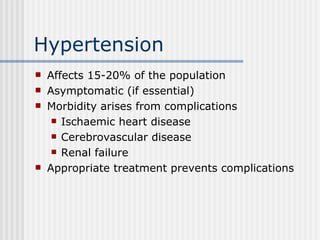
Hypertension Affects 15-20% of the population Asymptomatic (if essential) Morbidity arises from complications Ischaemic heart disease Cerebrovascular disease Renal failure Appropriate treatment prevents complications
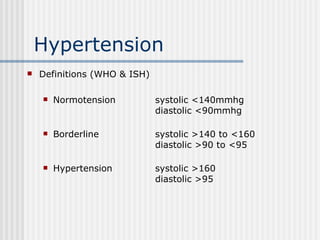
Hypertension Definitions (WHO & ISH) Normotension  systolic <140mmhg diastolic <90mmhg Borderline systolic >140 to <160 diastolic >90 to <95 Hypertension systolic >160 diastolic >95
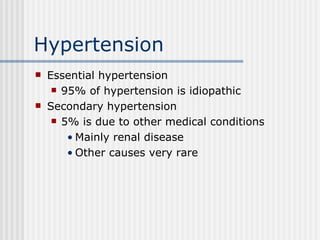
Hypertension Essential hypertension 95% of hypertension is idiopathic Secondary hypertension 5% is due to other medical conditions Mainly renal disease Other causes very rare
Hypertension Both essential & secondary hypertension can be subclassified as Benign Malignant or accelerated
Hypertension The spectrum of hypertensive eye disease [Arteriosclerotic retinopathy] Hypertensive retinopathy CRVO/BRVO CRAO/BRAO AION Cranial neuropathies
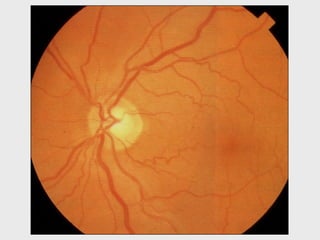
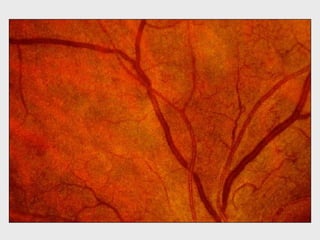
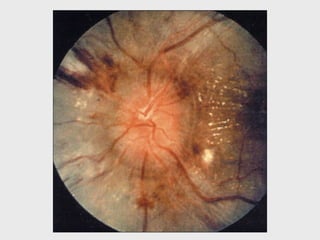
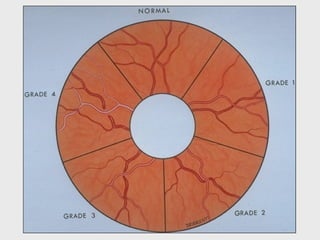
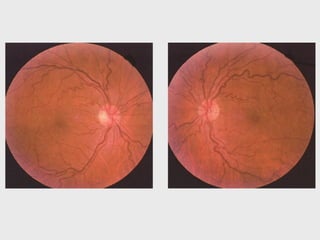
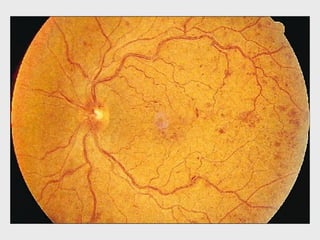
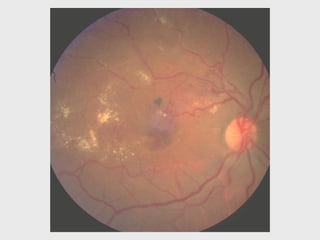
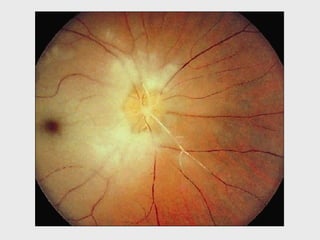
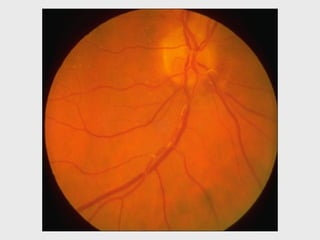
Hypertensive Retinopathy Grading Grade 1: arteriolar silver wiring Grade 2: grade 1 changes + AV nipping Grade 3: grade 2 changes + haemorrhage, exudate & cotton wool spots Grade 4: grade 3 changes + disc swelling Macular star Occurs if exudates collect in Henle’s layer


Arteriosclerotic Retinopathy NOTE not ATHEROsclerosis Usually associated with hypertension Accelerated by DM
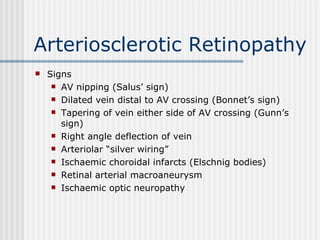
Arteriosclerotic Retinopathy Signs AV nipping (Salus’ sign) Dilated vein distal to AV crossing (Bonnet’s sign) Tapering of vein either side of AV crossing (Gunn’s sign) Right angle deflection of vein  Arteriolar “silver wiring” Ischaemic choroidal infarcts (Elschnig bodies) Retinal arterial macroaneurysm Ischaemic optic neuropathy
 
 
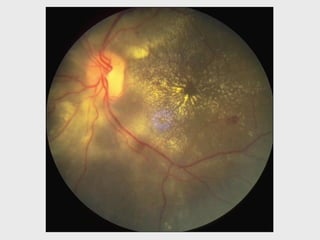
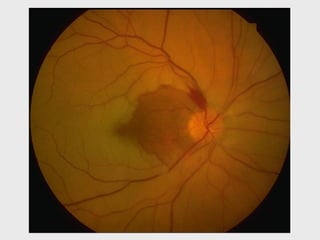
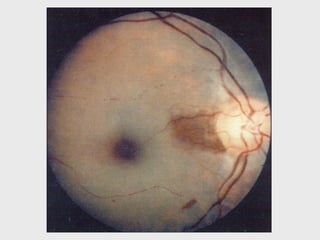
Retinal Macroaneurysm Occurs in  Elderly hypertensive patients Arteriosclerotic patients Single or multiple Usually at posterior pole
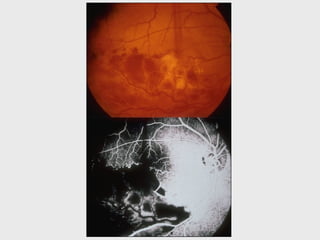
Retinal Macroaneurysm Outcomes: May occlude spontaneously May bleed - trilayer haemorrhage May leak    circinate exudate ±macular oedema Management Refer as priority Either managed conservatively or undergo focal/grid photocoagulation
 
 
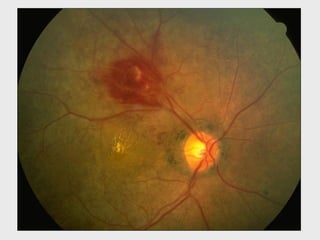
Retinal Vein Occlusion Causes Pressure on the vein AV nipping,   IOP Vessel wall disease DM, periphlebitis Hyperviscosity Hyperlipdaemia, polycythaemia, myeloma, leukaemia
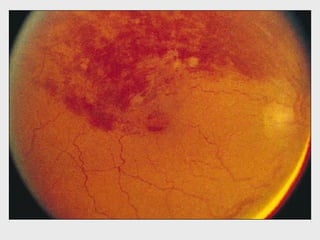
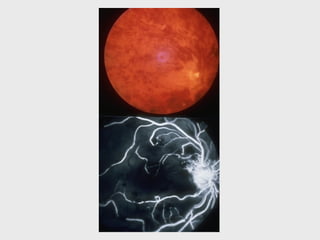
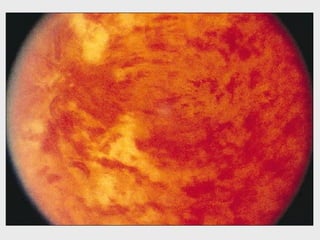
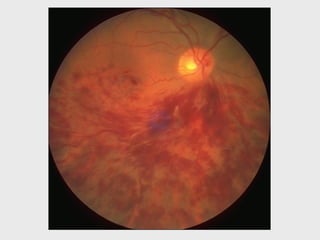
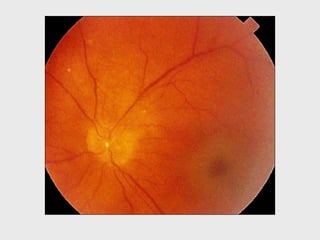
Retinal Vein Occlusion Clinical signs Dilated veins Flame shaped haemorrhages Retinal oedema CWS Venous sheathing (occasionally arterial) Exudates
Retinal Vein Occlusion Complications Macular oedema NVD & NVE Tractional RD Rubeosis (100-day glaucoma) Optometric management Referral as priority for investigation of underlying cause Photocoagulation if marked ischaemia/NV


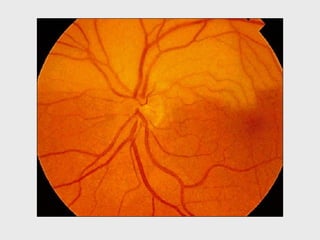
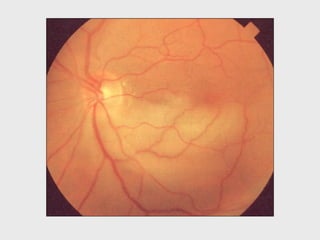
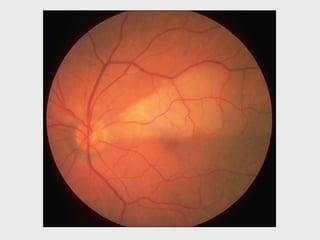
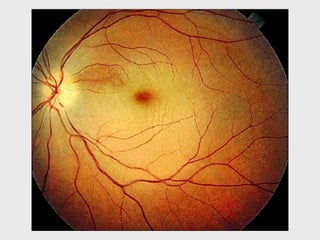
Retinal Artery Occlusion Causes External pressure CAG, RD surgery Vessel wall disease Atheroma, arteritis (GCA, PAN, SLE) Embolisation Carotid, cardiac wall or valve
Retinal Artery Occlusion Types of embolus Cholesterol (Hollenhorst plaques) Fibrinoplatelet (amaurosis fugax) Calcific (usually permanent occlusion)
Retinal Artery Occlusion Clinical features Sudden painless loss of vision Field defect if BRAO APD White, oedematous retina with reflex from choroidal vessels visible at fovea (cherry red spot) ~20% develop rubeosis Optic atrophy with no other features
Retinal Artery Occlusion Optometric management Refer as emergency May be GCA, though this is less likely than embolus Recovery unlikely (but possible) Possible measures Ocular massage in supine position IV acetazolamide AC paracentesis CO 2  rebreathing


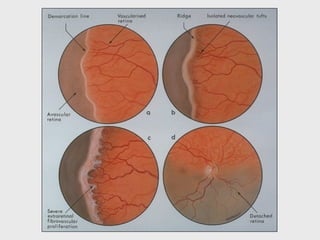
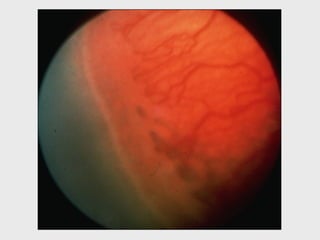
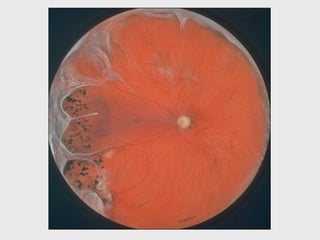
Retinopathy of Prematurity A cicatrising or proliferative retinopathy affecting premature babies ? Exposure to high levels of oxygen In the UK, all neonates <32/40 gestation are screened Severe ROPs are treated with photocoagulation or cryotherapy Classification depends on degree of peripheral retinal changes, fibrovascular proliferation & vitreoretinal traction The most severe ROP causes total RD & 2° ACG


Hereditary retinal disease…
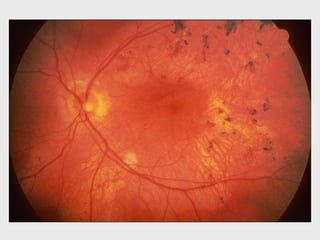
Retinitis Pigmentosa Group of progressive bilateral disorders of retinal photoreceptor/RPE complex Triad of Night blindness Visual field defect Typical fundal appearance RP may be familial RP may be associated with other defects & may be the result of a syndrome
Retinitis Pigmentosa Symptoms Night blindness Visual difficulties because of field loss Photophobia & glare Patients with RP may have Myopia PSCLO Keratoconus Optic disc drusen Glaucoma CMO
Retinitis Pigmentosa Early signs  dark adaptation Annular scotoma Equatorial patchy RPE atrophy & hypertrophy Attenuated retinal vessels
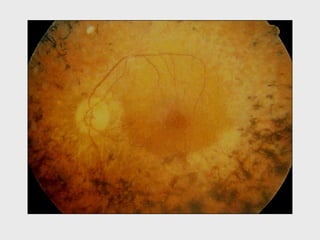
Retinitis Pigmentosa Late signs Tubular fields (2-3°) Bone corpuscle pigmentation Choroidal atrophy Retinal venous sheathing Drusen Waxy optic atrophy
Retinitis Pigmentosa Inheritance (varies with geographical location) AR  51% AD  26% XLR  23% Prognosis 25% maintain adequate reading vision LVAs usually required
Retinitis Pigmentosa Atypical variations Sine pigmento Macular type (preceding macular changes) Pericentric (possible rod-cone dystrophy) Sectoral (symmetrical, bilateral, commonly inferonasal) Fundus albipunctatus


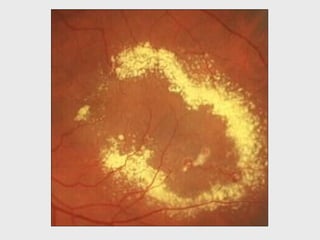
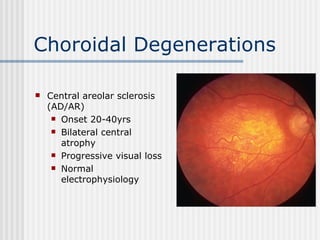
Choroidal Degenerations Central areolar sclerosis (AD/AR) Onset 20-40yrs Bilateral central atrophy Progressive visual loss Normal electrophysiology
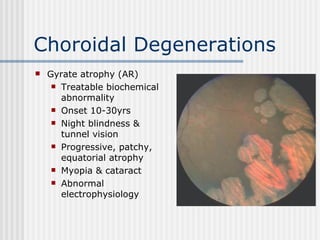
Choroidal Degenerations Gyrate atrophy (AR) Treatable biochemical abnormality Onset 10-30yrs Night blindness & tunnel vision Progressive, patchy, equatorial atrophy Myopia & cataract Abnormal electrophysiology
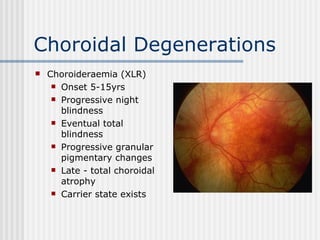
Choroidal Degenerations Choroideraemia (XLR) Onset 5-15yrs Progressive night blindness Eventual total blindness Progressive granular pigmentary changes Late - total choroidal atrophy Carrier state exists
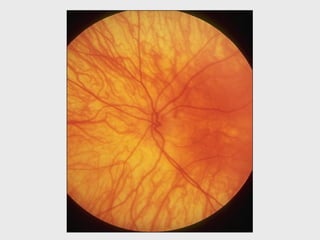
Albinism Failure of melanocyte/melanosomes Variable deficiency of melanin Enzyme defects are Tyrosinase positive Tyrosinase negative Types of albinism Generalised (oculocutaneous) - AR Ocular - XLR
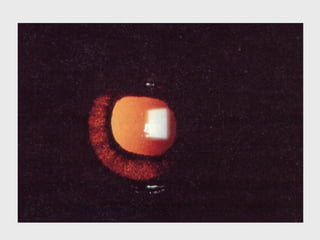
Albinism Oculocutaneous albinism T-pos Mild, improves with age Iris transillumination Nystagmus Poor vision Refractive errors
Albinism Oculocutaneous albinism T-neg Severe disease Photophobia Poor vision & large refractive errors Nystagmus Iris transillumination No fundal pigmentation or foveal reflex Abnormal chiasmal decussation    abnormal architecture of LGN
Albinism Ocular albinism (XLR) Confined to eyes Giant melanosomes in RPE Carriers have iris transillumination & granular RPE


VASCULAR AND HEREDITARY RETINAL DISEASE

  • 1.
    VASCULAR AND HEREDITARYRETINAL DISEASE Dr Russell J Watkins
  • 2.
    Hypertension Affects 15-20%of the population Asymptomatic (if essential) Morbidity arises from complications Ischaemic heart disease Cerebrovascular disease Renal failure Appropriate treatment prevents complications
  • 3.
    Hypertension Definitions (WHO& ISH) Normotension systolic <140mmhg diastolic <90mmhg Borderline systolic >140 to <160 diastolic >90 to <95 Hypertension systolic >160 diastolic >95
  • 4.
    Hypertension Essential hypertension95% of hypertension is idiopathic Secondary hypertension 5% is due to other medical conditions Mainly renal disease Other causes very rare
  • 5.
    Hypertension Both essential& secondary hypertension can be subclassified as Benign Malignant or accelerated
  • 6.
    Hypertension The spectrumof hypertensive eye disease [Arteriosclerotic retinopathy] Hypertensive retinopathy CRVO/BRVO CRAO/BRAO AION Cranial neuropathies
  • 7.
    Hypertensive Retinopathy GradingGrade 1: arteriolar silver wiring Grade 2: grade 1 changes + AV nipping Grade 3: grade 2 changes + haemorrhage, exudate & cotton wool spots Grade 4: grade 3 changes + disc swelling Macular star Occurs if exudates collect in Henle’s layer
  • 8.
  • 9.
  • 10.
  • 11.
  • 12.
    Arteriosclerotic Retinopathy NOTEnot ATHEROsclerosis Usually associated with hypertension Accelerated by DM
  • 13.
    Arteriosclerotic Retinopathy SignsAV nipping (Salus’ sign) Dilated vein distal to AV crossing (Bonnet’s sign) Tapering of vein either side of AV crossing (Gunn’s sign) Right angle deflection of vein Arteriolar “silver wiring” Ischaemic choroidal infarcts (Elschnig bodies) Retinal arterial macroaneurysm Ischaemic optic neuropathy
  • 14.
  • 15.
  • 16.
    Retinal Macroaneurysm Occursin Elderly hypertensive patients Arteriosclerotic patients Single or multiple Usually at posterior pole
  • 17.
    Retinal Macroaneurysm Outcomes:May occlude spontaneously May bleed - trilayer haemorrhage May leak  circinate exudate ±macular oedema Management Refer as priority Either managed conservatively or undergo focal/grid photocoagulation
  • 18.
  • 19.
  • 20.
    Retinal Vein OcclusionCauses Pressure on the vein AV nipping,  IOP Vessel wall disease DM, periphlebitis Hyperviscosity Hyperlipdaemia, polycythaemia, myeloma, leukaemia
  • 21.
    Retinal Vein OcclusionClinical signs Dilated veins Flame shaped haemorrhages Retinal oedema CWS Venous sheathing (occasionally arterial) Exudates
  • 22.
    Retinal Vein OcclusionComplications Macular oedema NVD & NVE Tractional RD Rubeosis (100-day glaucoma) Optometric management Referral as priority for investigation of underlying cause Photocoagulation if marked ischaemia/NV
  • 23.
  • 24.
  • 25.
  • 26.
  • 27.
  • 28.
  • 29.
  • 30.
    Retinal Artery OcclusionCauses External pressure CAG, RD surgery Vessel wall disease Atheroma, arteritis (GCA, PAN, SLE) Embolisation Carotid, cardiac wall or valve
  • 31.
    Retinal Artery OcclusionTypes of embolus Cholesterol (Hollenhorst plaques) Fibrinoplatelet (amaurosis fugax) Calcific (usually permanent occlusion)
  • 32.
    Retinal Artery OcclusionClinical features Sudden painless loss of vision Field defect if BRAO APD White, oedematous retina with reflex from choroidal vessels visible at fovea (cherry red spot) ~20% develop rubeosis Optic atrophy with no other features
  • 33.
    Retinal Artery OcclusionOptometric management Refer as emergency May be GCA, though this is less likely than embolus Recovery unlikely (but possible) Possible measures Ocular massage in supine position IV acetazolamide AC paracentesis CO 2 rebreathing
  • 34.
  • 35.
  • 36.
  • 37.
  • 38.
  • 39.
  • 40.
  • 41.
  • 42.
  • 43.
    Retinopathy of PrematurityA cicatrising or proliferative retinopathy affecting premature babies ? Exposure to high levels of oxygen In the UK, all neonates <32/40 gestation are screened Severe ROPs are treated with photocoagulation or cryotherapy Classification depends on degree of peripheral retinal changes, fibrovascular proliferation & vitreoretinal traction The most severe ROP causes total RD & 2° ACG
  • 44.
  • 45.
  • 46.
  • 47.
  • 48.
    Retinitis Pigmentosa Groupof progressive bilateral disorders of retinal photoreceptor/RPE complex Triad of Night blindness Visual field defect Typical fundal appearance RP may be familial RP may be associated with other defects & may be the result of a syndrome
  • 49.
    Retinitis Pigmentosa SymptomsNight blindness Visual difficulties because of field loss Photophobia & glare Patients with RP may have Myopia PSCLO Keratoconus Optic disc drusen Glaucoma CMO
  • 50.
    Retinitis Pigmentosa Earlysigns  dark adaptation Annular scotoma Equatorial patchy RPE atrophy & hypertrophy Attenuated retinal vessels
  • 51.
    Retinitis Pigmentosa Latesigns Tubular fields (2-3°) Bone corpuscle pigmentation Choroidal atrophy Retinal venous sheathing Drusen Waxy optic atrophy
  • 52.
    Retinitis Pigmentosa Inheritance(varies with geographical location) AR 51% AD 26% XLR 23% Prognosis 25% maintain adequate reading vision LVAs usually required
  • 53.
    Retinitis Pigmentosa Atypicalvariations Sine pigmento Macular type (preceding macular changes) Pericentric (possible rod-cone dystrophy) Sectoral (symmetrical, bilateral, commonly inferonasal) Fundus albipunctatus
  • 54.
  • 55.
  • 56.
  • 57.
    Choroidal Degenerations Centralareolar sclerosis (AD/AR) Onset 20-40yrs Bilateral central atrophy Progressive visual loss Normal electrophysiology
  • 58.
    Choroidal Degenerations Gyrateatrophy (AR) Treatable biochemical abnormality Onset 10-30yrs Night blindness & tunnel vision Progressive, patchy, equatorial atrophy Myopia & cataract Abnormal electrophysiology
  • 59.
    Choroidal Degenerations Choroideraemia(XLR) Onset 5-15yrs Progressive night blindness Eventual total blindness Progressive granular pigmentary changes Late - total choroidal atrophy Carrier state exists
  • 60.
    Albinism Failure ofmelanocyte/melanosomes Variable deficiency of melanin Enzyme defects are Tyrosinase positive Tyrosinase negative Types of albinism Generalised (oculocutaneous) - AR Ocular - XLR
  • 61.
    Albinism Oculocutaneous albinismT-pos Mild, improves with age Iris transillumination Nystagmus Poor vision Refractive errors
  • 62.
    Albinism Oculocutaneous albinismT-neg Severe disease Photophobia Poor vision & large refractive errors Nystagmus Iris transillumination No fundal pigmentation or foveal reflex Abnormal chiasmal decussation  abnormal architecture of LGN
  • 63.
    Albinism Ocular albinism(XLR) Confined to eyes Giant melanosomes in RPE Carriers have iris transillumination & granular RPE
  • 64.
  • 65.