Amino acid
Amino Acids 1
CONTENTS
Amino Acids 2
Introduction
Classification of amino acid
Physical properties of amino acids
Chemical properties of amino acids
 Medicinal properties of amino acids
Functions of amino acids
Introduction
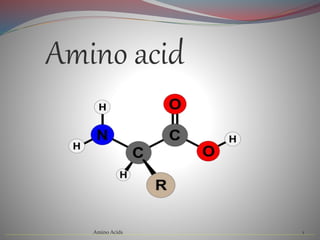
 Amino acids are the molecules having one amino
group, one carboxyl group, one H-atom and one
specific group(R-group) attached to the central carbon
atom.
 The specific group i.e. R-group varies in the size,
structure, and electric charge.
R-group also influence the solubility of amino acid in
water.
Amino acids are also known as “Building blocks of
protein”.
The basic elements of amino acids are C,N,O,H
Amino Acids 3
Amino Acids 4
Amino acids are classified into three main
groups which are as follows:-
 Essential amino acids
 Non essential amino acids
 Conditional amino acids
Amino Acids 5
 Essential amino acids are those amino acids which
are not synthesised or made by the body.
It is supplied through our day to day diet.
 It is required for proper growth and maintenance of
individual.
 It includes Valine, Histidine, Isoleucine, Leucine,
Lysine, Methionine, Threonine, Tryptophan, and
Phenylalanine.
Amino Acids 6
Str. Of Valine Str. Of Leucine
Amino Acids 7
 Non essential amino acids are those amino acid
which are synthesizes or produce by our body even
if we don't get it from our day to day diet.
 It includes Alanine, Arginine, Asparagine,
Aspartic acid, Cysteine, Glutamic acid, Glutamine,
Glycine, Proline, Serine and Tyrosine.
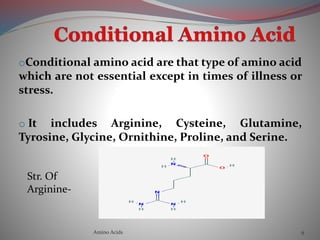
Str. Of Arginine-
Amino Acids 8
oConditional amino acid are that type of amino acid
which are not essential except in times of illness or
stress.
o It includes Arginine, Cysteine, Glutamine,
Tyrosine, Glycine, Ornithine, Proline, and Serine.
Amino Acids 9
Str. Of
Arginine-
•Solubility : Most of the amino acids are soluble in
water but insoluble in organic solvents.
•Melting point : Amino acids generally melt at high
temperature , often above 2000° c.
• Taste : Amino acids may be sweet(Glycine,
Alanine, Valine); tasteless (Arginine, Leucine);
Monosodium glutamate(MSG is used as flavoring
agent in food industry).
Amino Acids 10
 Decarboxylation: The amino acids will undergo
decarboxylation to form the corresponding “amines”.
Thus, amines are produced.
 Histidine Histamine + CO2
 Tyrosine Tyramine + CO2
 Lysine Cadaverine + CO2
Amino Acids 11
Amino acids contain both acidic group (-COOH) and
basic (-NH2 ) group.
They can donate or accept a proton and hence known
as Ampholytes.
Amino Acids 12
In strongly acidic pH amino acid is +vely
charged.
 In strongly alkaline pH amino acid is –vely
charged.
Amino Acids 13
Isoelectric pH may be defined as a pH at which a
molecule exist as a zwitter ion or dipolar ion and “carries
no net charge”
Molecule is electrically neutral at Isoelectric pH.
Amino Acids 14
Amino Acids 15
1. Reactions due to amino group
2. Reactions due to carboxyl group
3. Reactions due to side chain
4. Reactions due to both amino and carboxyl groups
Amino Acids 16
 Transamination:- Transfer of an amino group
from an α keto acid to form a new amino acid and a
corresponding keto acid.
Amino Acids 17
 Decarboxylation:- Amino acids undergo α
decarboxylation to form corresponding amines. E.g.
Glutamic acid GABA
Histidine Histamine
Tyrosine Tyramine
Amino Acids 18
Reactions due to SH group (Formation of sulphide bond):-
 Cysteine has a sulfhydryl group (SH) this group can form a
disulphide (S-S) bond with another cysteine residue.
 The dimer formed is Cysteine.
Amino Acids 19
Formation of peptide bond- Carboxyl group of an
amino acid binds with amino group of another
amino acid forming a peptide bond with loss of one
molecule o water.
Amino Acids 20
Use for treatment of brain metabolism and
neurotransmission imbalances.
An important key for the applications of immune
function
 In treatment of liver diseases
 In fatigueness
 In Cancer prevention
.
Amino Acids 21
 In treatment of cardiovascular and gastrointestinal
health
 In treatment of burn, trauma, and sepsis
 In treatment of maple urine disease
 In treatment of diabetes
Amino Acids 22
1. Provide the monomer units from which the long
polypeptide chain of propertied are
synthesized.(Condensation of two molecules of
amino acids from a peptide bond)
2. L – amino acids are their derivatives participate in
cellular functions as diverse as nerve transmission
and the biosynthesis of purines, pyrimidines,
poryphyrins and urea
Amino Acids 23
3. Short polymers of amino acids called Polypeptide
perform prominent roles in the neuroendocrine
system as hormones, hormone-releasing factors,
neurotransmitters
4. Niacin, Serotonin and Melatonin are synthesized
from Tryptophan
5. Melanin, Thyroid hormone, Catecholamines are
synthesized from Tyrosine
Amino Acids 24
6. GABA(Neurotransmitter) is synthesized from
Glutamic acid
7. Nitric oxide is a smooth muscle relaxant is
synthesized from Arginine
8. Amino acid acts as poryphyrins, purines, and
pyrimidines.
Amino Acids 25
Thank You
Amino Acids 26

Amino acid

  • 1.
  • 2.
    CONTENTS Amino Acids 2 Introduction Classificationof amino acid Physical properties of amino acids Chemical properties of amino acids  Medicinal properties of amino acids Functions of amino acids
  • 3.
    Introduction  Amino acidsare the molecules having one amino group, one carboxyl group, one H-atom and one specific group(R-group) attached to the central carbon atom.  The specific group i.e. R-group varies in the size, structure, and electric charge. R-group also influence the solubility of amino acid in water. Amino acids are also known as “Building blocks of protein”. The basic elements of amino acids are C,N,O,H Amino Acids 3
  • 4.
  • 5.
    Amino acids areclassified into three main groups which are as follows:-  Essential amino acids  Non essential amino acids  Conditional amino acids Amino Acids 5
  • 6.
     Essential aminoacids are those amino acids which are not synthesised or made by the body. It is supplied through our day to day diet.  It is required for proper growth and maintenance of individual.  It includes Valine, Histidine, Isoleucine, Leucine, Lysine, Methionine, Threonine, Tryptophan, and Phenylalanine. Amino Acids 6
  • 7.
    Str. Of ValineStr. Of Leucine Amino Acids 7
  • 8.
     Non essentialamino acids are those amino acid which are synthesizes or produce by our body even if we don't get it from our day to day diet.  It includes Alanine, Arginine, Asparagine, Aspartic acid, Cysteine, Glutamic acid, Glutamine, Glycine, Proline, Serine and Tyrosine. Str. Of Arginine- Amino Acids 8
  • 9.
    oConditional amino acidare that type of amino acid which are not essential except in times of illness or stress. o It includes Arginine, Cysteine, Glutamine, Tyrosine, Glycine, Ornithine, Proline, and Serine. Amino Acids 9 Str. Of Arginine-
  • 10.
    •Solubility : Mostof the amino acids are soluble in water but insoluble in organic solvents. •Melting point : Amino acids generally melt at high temperature , often above 2000° c. • Taste : Amino acids may be sweet(Glycine, Alanine, Valine); tasteless (Arginine, Leucine); Monosodium glutamate(MSG is used as flavoring agent in food industry). Amino Acids 10
  • 11.
     Decarboxylation: Theamino acids will undergo decarboxylation to form the corresponding “amines”. Thus, amines are produced.  Histidine Histamine + CO2  Tyrosine Tyramine + CO2  Lysine Cadaverine + CO2 Amino Acids 11
  • 12.
    Amino acids containboth acidic group (-COOH) and basic (-NH2 ) group. They can donate or accept a proton and hence known as Ampholytes. Amino Acids 12
  • 13.
    In strongly acidicpH amino acid is +vely charged.  In strongly alkaline pH amino acid is –vely charged. Amino Acids 13
  • 14.
    Isoelectric pH maybe defined as a pH at which a molecule exist as a zwitter ion or dipolar ion and “carries no net charge” Molecule is electrically neutral at Isoelectric pH. Amino Acids 14
  • 15.
  • 16.
    1. Reactions dueto amino group 2. Reactions due to carboxyl group 3. Reactions due to side chain 4. Reactions due to both amino and carboxyl groups Amino Acids 16
  • 17.
     Transamination:- Transferof an amino group from an α keto acid to form a new amino acid and a corresponding keto acid. Amino Acids 17
  • 18.
     Decarboxylation:- Aminoacids undergo α decarboxylation to form corresponding amines. E.g. Glutamic acid GABA Histidine Histamine Tyrosine Tyramine Amino Acids 18
  • 19.
    Reactions due toSH group (Formation of sulphide bond):-  Cysteine has a sulfhydryl group (SH) this group can form a disulphide (S-S) bond with another cysteine residue.  The dimer formed is Cysteine. Amino Acids 19
  • 20.
    Formation of peptidebond- Carboxyl group of an amino acid binds with amino group of another amino acid forming a peptide bond with loss of one molecule o water. Amino Acids 20
  • 21.
    Use for treatmentof brain metabolism and neurotransmission imbalances. An important key for the applications of immune function  In treatment of liver diseases  In fatigueness  In Cancer prevention . Amino Acids 21
  • 22.
     In treatmentof cardiovascular and gastrointestinal health  In treatment of burn, trauma, and sepsis  In treatment of maple urine disease  In treatment of diabetes Amino Acids 22
  • 23.
    1. Provide themonomer units from which the long polypeptide chain of propertied are synthesized.(Condensation of two molecules of amino acids from a peptide bond) 2. L – amino acids are their derivatives participate in cellular functions as diverse as nerve transmission and the biosynthesis of purines, pyrimidines, poryphyrins and urea Amino Acids 23
  • 24.
    3. Short polymersof amino acids called Polypeptide perform prominent roles in the neuroendocrine system as hormones, hormone-releasing factors, neurotransmitters 4. Niacin, Serotonin and Melatonin are synthesized from Tryptophan 5. Melanin, Thyroid hormone, Catecholamines are synthesized from Tyrosine Amino Acids 24
  • 25.
    6. GABA(Neurotransmitter) issynthesized from Glutamic acid 7. Nitric oxide is a smooth muscle relaxant is synthesized from Arginine 8. Amino acid acts as poryphyrins, purines, and pyrimidines. Amino Acids 25
  • 26.