Biophysics Notes Chapter #05 Biomolecular Structure
Page 1 of 16
Biomolecular Structure
The most vital organic molecules, biomolecules, are engaged in the upkeep and metabolic
functions of living things. These inanimate molecules are the real foot soldiers in the war
for Ife’s nourishment. They range in size from massive macromolecules like proteins
nucleic acids carbohydrates, lipids, etc. to tiny molecules like hormones and primary and
secondary metabolites
There are four major classes of Biomolecules:
• Carbohydrates
• Proteins
• Nucleic acids
• Lipids
Nucleic Acids
Nucleic acids are the genetic material in every cell, transmitting parental genes to
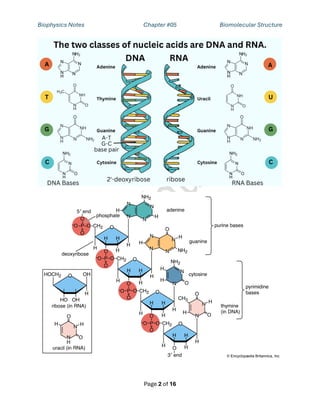
offspring. There are two types of nucleic acids. RNA (ribonucleic acid) and DNA
(deoxyribonucleic acid). Their primary roles are in translation and transcription; processes
may convey genetic information and synthesize proteins. Nucleotides are the monomeric
units of nucleic acids, consisting of a phosphate group. pentose sugar, and a nitrogenous
base. Phosphodiester bonds connect nucleotides through the 3 and 5' positions. The
uniqueness of a nucleotide comes from the nitrogenous base attached to the pentose
sugar.
Biophysics Notes Chapter #05 Biomolecular Structure
Page 2 of 16
Biophysics Notes Chapter #05 Biomolecular Structure
Page 3 of 16
DNA (Deoxyribonucleic Acid)
Hereditary materials (genetic instructions) are carried and transmitted from parents to
offspring by DNA (Deoxyribonucleic Acid) Johannes Friedrich Miescher, a Swiss biologist.
discovered and named DNA in 1869 while studying white blood cells James Watson and
Francis Crick used experimental data to identify the double helix structure of DNA.
Genetic information in living organisms is stored in DNA. DNA plays a crucial role in the
synthesis of proteins. Nuclear DNA is found in the nucleus of eukaryotic cells and codes for
most of the organism's genome. Mitochondrial DNA is found inside the mitochondria of
cells and is inherited maternally. The human mitochondrial DNA contains about 16,000
base pairs. Plastids have their own DNA and are essential for photosynthesis DNA
Structure consists of a sugar-phosphate backbone and nucleotide bases (guanine,
cytosine. adenine, and thymine).
DNA Structure DNA
structure can be visualized as a twisted ladder. This structure is known as the double helix.
DNA is a type of nucleic acid, and its building blocks are nucleotides. Nucleotides are
made up of three distinct components:
• A Phosphate Group
• A sugar molecule (deoxyribose in DNA)
• A nitrogenous base (adenine, thymine, cytosine, or guanine)
Pentose Sugar
• The basic building block of DNA is deoxyribose sugar.
• Deoxyribose is different from ribose because it contains a hydrogen (H) atom at the 2
carbon (where ribose has a hydroxyl (-OH) group).
• Attached to the 5’ carbon deoxyribose is a triphosphate group.
• The triphosphate group plays a crucial role in DNA synthesis, as it reacts with the 3' OH
group of another nucleotide to form polydeoxynucleotides in the DNA chain.
Nitrogenous Bases
The final component of the DNA molecule is a nitrogen base, which is attached to the 1'
carbon of the sugar.
There are four possible nitrogenous bases:
• Two pyrimidines: thymine (T) and cytosine (C).
• Two purines: adenine (A) and guanine (G).
• The double-stranded DNA molecule is held together by hydrogen bonds between
complementary bases.
Biophysics Notes Chapter #05 Biomolecular Structure
Page 4 of 16
Base pairing is specific:
• Adenine (A) pairs with Thymine (T).
• Guanine (G) pairs with Cytosine (C).
• The specific atoms involved in these pairings contribute to the stability of the DNA
structure.
Chargaff's Rule
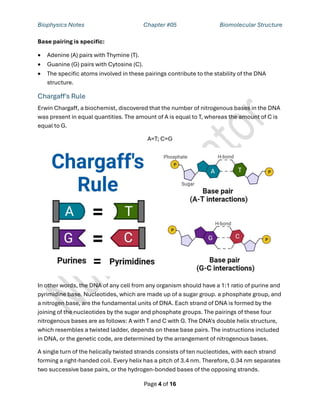
Erwin Chargaff, a biochemist, discovered that the number of nitrogenous bases in the DNA
was present in equal quantities. The amount of A is equal to T, whereas the amount of C is
equal to G.
A=T; C=G
In other words, the DNA of any cell from any organism should have a 1:1 ratio of purine and
pyrimidine base. Nucleotides, which are made up of a sugar group. a phosphate group, and
a nitrogen base, are the fundamental units of DNA. Each strand of DNA is formed by the
joining of the nucleotides by the sugar and phosphate groups. The pairings of these four
nitrogenous bases are as follows: A with T and C with G. The DNA's double helix structure,
which resembles a twisted ladder, depends on these base pairs. The instructions included
in DNA, or the genetic code, are determined by the arrangement of nitrogenous bases.
A single turn of the helically twisted strands consists of ten nucleotides, with each strand
forming a right-handed coil. Every helix has a pitch of 3.4 nm. Therefore, 0.34 nm separates
two successive base pairs, or the hydrogen-bonded bases of the opposing strands.
Biophysics Notes Chapter #05 Biomolecular Structure
Page 5 of 16
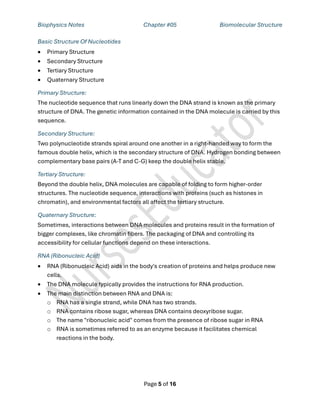
Basic Structure Of Nucleotides
• Primary Structure
• Secondary Structure
• Tertiary Structure
• Quaternary Structure
Primary Structure:
The nucleotide sequence that runs linearly down the DNA strand is known as the primary
structure of DNA. The genetic information contained in the DNA molecule is carried by this
sequence.
Secondary Structure:
Two polynucleotide strands spiral around one another in a right-handed way to form the
famous double helix, which is the secondary structure of DNA. Hydrogen bonding between
complementary base pairs (A-T and C-G) keep the double helix stable.
Tertiary Structure:
Beyond the double helix, DNA molecules are capable of folding to form higher-order
structures. The nucleotide sequence, interactions with proteins (such as histones in
chromatin), and environmental factors all affect the tertiary structure.
Quaternary Structure:
Sometimes, interactions between DNA molecules and proteins result in the formation of
bigger complexes, like chromatin fibers. The packaging of DNA and controlling its
accessibility for cellular functions depend on these interactions.
RNA (Ribonucleic Acid)
• RNA (Ribonucleic Acid) aids in the body's creation of proteins and helps produce new
cells.
• The DNA molecule typically provides the instructions for RNA production.
• The main distinction between RNA and DNA is:
o RNA has a single strand, while DNA has two strands.
o RNA contains ribose sugar, whereas DNA contains deoxyribose sugar.
o The name "ribonucleic acid" comes from the presence of ribose sugar in RNA
o RNA is sometimes referred to as an enzyme because it facilitates chemical
reactions in the body.
Biophysics Notes Chapter #05 Biomolecular Structure
Page 6 of 16
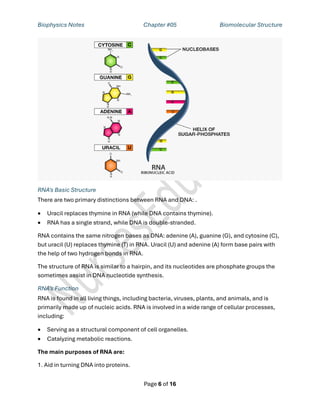
RNA's Basic Structure
There are two primary distinctions between RNA and DNA: .
• Uracil replaces thymine in RNA (while DNA contains thymine).
• RNA has a single strand, while DNA is double-stranded.
RNA contains the same nitrogen bases as DNA: adenine (A), guanine (G), and cytosine (C),
but uracil (U) replaces thymine (T) in RNA. Uracil (U) and adenine (A) form base pairs with
the help of two hydrogen bonds in RNA.
The structure of RNA is similar to a hairpin, and its nucleotides are phosphate groups the
sometimes assist in DNA nucleotide synthesis.
RNA's Function
RNA is found in all living things, including bacteria, viruses, plants, and animals, and is
primarily made up of nucleic acids. RNA is involved in a wide range of cellular processes,
including:
• Serving as a structural component of cell organelles.
• Catalyzing metabolic reactions.
The main purposes of RNA are:
1. Aid in turning DNA into proteins.
Biophysics Notes Chapter #05 Biomolecular Structure
Page 7 of 16
2. Serve as a molecule that adapts during protein creation.
3. Act as a liaison between the ribosomes and DNA.
4 Carry genetic information in every living cell.
5. Encourage ribosomes to select the appropriate amino acids for building new proteins in
the body.
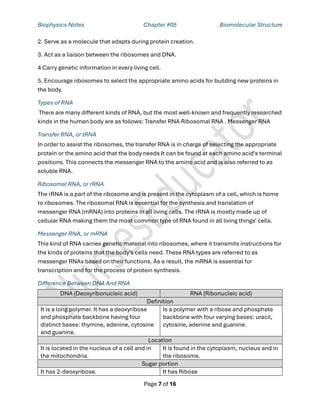
Types of RNA
There are many different kinds of RNA, but the most well-known and frequently researched
kinds in the human body are as follows: Transfer RNA Ribosomal RNA . Messenger RNA
Transfer RNA, or tRNA
In order to assist the ribosomes, the transfer RNA is in charge of selecting the appropriate
protein or the amino acid that the body needs It can be found at each amino acid's terminal
positions. This connects the messenger RNA to the amino acid and is also referred to as
soluble RNA.
Ribosomal RNA, or rRNA
The rRNA is a part of the ribosome and is present in the cytoplasm of a cell, which is home
to ribosomes. The ribosomal RNA is essential for the synthesis and translation of
messenger RNA (mRNA) into proteins in all living cells. The rRNA is mostly made up of
cellular RNA making them the most common type of RNA found in all living things' cells.
Messenger RNA, or mRNA
This kind of RNA carries genetic material into ribosomes, where it transmits instructions for
the kinds of proteins that the body's cells need. These RNA types are referred to as
messenger RNAs based on their functions. As a result, the mRNA is essential for
transcription and for the process of protein synthesis.
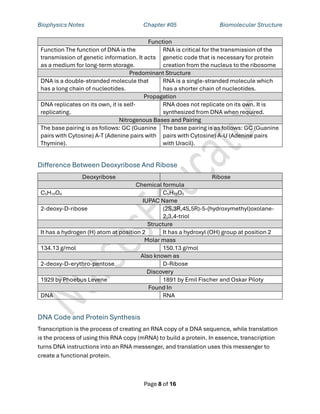
Difference Between DNA And RNA
DNA (Deoxyribonucleic acid) RNA (Ribonucleic acid)
Definition
It is a long polymer. It has a deoxyribose
and phosphate backbone having four
distinct bases: thymine, adenine, cytosine
and guanine.
Is a polymer with a ribose and phosphate
backbone with four varying bases: uracil,
cytosine, adenine and guanine.
Location
It is located in the nucleus of a cell and in
the mitochondria.
It is found in the cytoplasm, nucleus and in
the ribosome.
Sugar portion
It has 2-deoxyribose. It has Ribose
Biophysics Notes Chapter #05 Biomolecular Structure
Page 8 of 16
Function
Function The function of DNA is the
transmission of genetic information. It acts
as a medium for long-term storage.
RNA is critical for the transmission of the
genetic code that is necessary for protein
creation from the nucleus to the ribosome
Predominant Structure
DNA is a double-stranded molecule that
has a long chain of nucleotides.
RNA is a single-stranded molecule which
has a shorter chain of nucleotides.
Propagation
DNA replicates on its own, it is self-
replicating.
RNA does not replicate on its own. It is
synthesized from DNA when required.
Nitrogenous Bases and Pairing
The base pairing is as follows: GC (Guanine
pairs with Cytosine) A-T (Adenine pairs with
Thymine).
The base pairing is as follows: GC (Guanine
pairs with Cytosine) A-U (Adenine pairs
with Uracil).
Difference Between Deoxyribose And Ribose
Deoxyribose Ribose
Chemical formula
C5H10O4 C5H10O5
IUPAC Name
2-deoxy-D-ribose (2S,3R,4S,5R)-5-(hydroxymethyl)oxolane-
2,3,4-triol
Structure
It has a hydrogen (H) atom at position 2 It has a hydroxyl (OH) group at position 2
Molar mass
134.13 g/mol 150.13 g/mol
Also known as
2-deoxy-D-erythro-pentose D-Ribose
Discovery
1929 by Phoebus Levene 1891 by Emil Fischer and Oskar Piloty
Found In
DNA RNA
DNA Code and Protein Synthesis
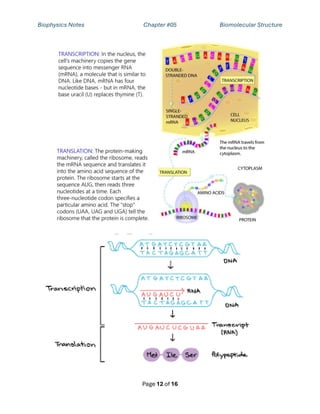
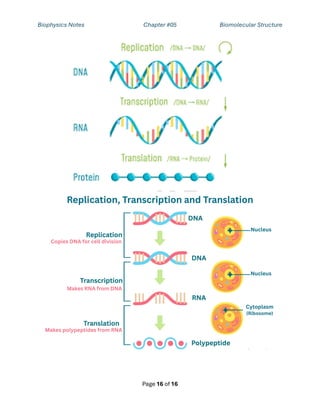
Transcription is the process of creating an RNA copy of a DNA sequence, while translation
is the process of using this RNA copy (mRNA) to build a protein. In essence, transcription
turns DNA instructions into an RNA messenger, and translation uses this messenger to
create a functional protein.
Biophysics Notes Chapter #05 Biomolecular Structure
Page 9 of 16
Transcription:
This process involves RNA polymerase, an enzyme that reads a DNA sequence and creates
a complementary RNA molecule (mRNA). This mRNA carries the genetic code from the
nucleus (in eukaryotes) to the ribosomes, where translation occurs.
Translation:
Once the mRNA is produced, it moves to the ribosomes, which are cellular machinery
responsible for protein synthesis. The ribosome reads the mRNA code, and transfer RNA
(tRNA) molecules bring specific amino acids to the ribosome, aligning them according to
the mRNA sequence. These amino acids are then linked together to form a protein chain,
which eventually folds into a functional protein.
• Key Difference:
Transcription creates RNA from DNA, while translation creates proteins from mRNA.
• Location:
In prokaryotes (bacteria), both transcription and translation occur in the cytoplasm. In
eukaryotes (animals, plants, fungi), transcription happens in the nucleus, and translation
occurs on ribosomes in the cytoplasm.
• Central Dogma:
Transcription and translation are crucial steps in the central dogma of molecular biology,
which describes the flow of genetic information from DNA to RNA to protein.
Polypeptides
A polypeptide is an uninterrupted, unbranched chain of amino acids connected by peptide
bonds. The peptide bond forms between the amine group of one amino acid and the
carboxyl group of the next amino acid, creating an amide. Proteins are made up of
polypeptides and play crucial roles in the body, including:
• Building blocks of muscles, bones, hair, and nails.
• Responsible for synthesizing enzymes, antibodies, connective tissue, and other
biological structures.
Peptides are similar to polypeptides but are composed of shorter chains of amino acids.
Peptide Bond
When the carboxyl group of one amino acid is connected to the amino group of another
without the removal of a water molecule, a covalent connection is created. The chemical
connection formed between amino acids creates the essential connectivity in all protein
Biophysics Notes Chapter #05 Biomolecular Structure
Page 10 of 16
structures. One amino acid's carboxyl group (COOH) joins forces with another amino acid's
NH2 group to form the sequence CONH, which releases water in the form of a peptide
bond (H2O).
Structure Of Polypeptides
Proteins are made up of one or more polypeptide chains.
• Each polypeptide chain consists of linked amino acids, which are the building blocks of
polypeptides, and in turn, the building blocks of proteins.
• An amino acid can be thought of as a single paper clip, and when several amino acids
are linked together, they form a polypeptide chain (like a chain of paper clips).
• A polypeptide chain on its own can perform the functions of a protein.
• Many proteins consist of multiple polypeptide chains working together.
Formation Of Polypeptides
• Polypeptides are formed partially through the release of water during the process.
• Every amino acid contains an amino group (NH2), where N stands for nitrogen and H
stands for hydrogen.
• Amino acids also contain a carboxyl group (COOH), made up of carbon (C), oxygen (O),
and hydrogen (H).
• When two amino acids are positioned next to each other, the amino group of one amino
acid and the carboxyl group of the other form a peptide bond by reaching out to each
other.
• The formation of the peptide bond is a condensation reaction, where water is released
as a result of the chemical connection.
o The amino group (NH2) releases an H (hydrogen atom).
o The carboxyl group (COOH) releases an OH (hydroxyl group).
• This process is called condensation because two molecules combine to form a larger
molecule while releasing a smaller one (water, in this case).
Function Of Polypeptides
Proteins and peptides perform important biological functions in cells:
o Proteins give cells their shape and enable them to respond to external signals.
o Peptides regulate the actions of other chemicals.
Both proteins and peptides share a similar structural makeup, with peptide bonds (also
known as amide bonds) linking the amino acids together.
Peptides are divided into two groups:
Biophysics Notes Chapter #05 Biomolecular Structure
Page 11 of 16
1. Polypeptides, which consist of many amino acids.
2. Oligopeptides, which contain a few amino acids.
Proteins are made up of one or more polypeptides joined together, making them essentially
long peptides. Polypeptides typically refer to chains with fifty or more amino acids, while
oligopeptides (shorter chains) are often called peptides by some researchers.
Biophysics Notes Chapter #05 Biomolecular Structure
Page 12 of 16
Biophysics Notes Chapter #05 Biomolecular Structure
Page 13 of 16
DNA Replication
DNA replication is the process where a cell creates an exact copy of its DNA, ensuring each
daughter cell receives a complete set of genetic instructions. This is a fundamental
process for cell division, allowing for growth, repair, and reproduction.
1. Purpose and Importance:
• Ensuring genetic continuity:
Replication ensures that each new cell created during division receives a complete copy of
the parent cell's DNA.
• Inheritance:
This process is crucial for passing down genetic information from one generation to the
next.
• Cell division:
Replication must occur before a cell can divide, as each daughter cell needs its own
complete set of DNA.
2. The Process:
• Semiconservative replication:
Each new DNA molecule contains one original strand and one newly synthesized strand.
• Enzymes involved:
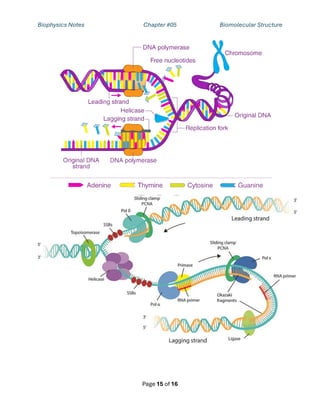
Key enzymes like DNA polymerase, helicase, and ligase play crucial roles.
• DNA polymerase: This enzyme adds new nucleotides to the growing DNA strand,
following the base pairing rules (A with T, C with G).
• Helicase: This enzyme unwinds the double helix, separating the two strands of DNA.
• Ligase: This enzyme seals the gaps between DNA fragments, creating a continuous
strand.
• Leading and lagging strands:
DNA replication occurs on both strands simultaneously, but one strand (the leading strand)
is synthesized continuously, while the other (the lagging strand) is synthesized in short
fragments (Okazaki fragments).
• Proofreading:
Biophysics Notes Chapter #05 Biomolecular Structure
Page 14 of 16
DNA polymerase also has a proofreading function to ensure accuracy and minimize errors.
3. Key Concepts:
• Initiation: The process begins at specific sites called origins of replication.
• Elongation: DNA polymerase adds new nucleotides to the growing strands.
• Termination: The replication process stops at specific termination sites.
• Eukaryotic vs. prokaryotic replication: While the basic mechanism is similar, there
are some differences between eukaryotes (like humans) and prokaryotes (like bacteria),
particularly in initiation and the number of origins of replication.
Biophysics Notes Chapter #05 Biomolecular Structure
Page 15 of 16
Biophysics Notes Chapter #05 Biomolecular Structure
Page 16 of 16

Biophysics Chapter 5 Biomoelculat Structure.pdf

  • 1.
    Biophysics Notes Chapter#05 Biomolecular Structure Page 1 of 16 Biomolecular Structure The most vital organic molecules, biomolecules, are engaged in the upkeep and metabolic functions of living things. These inanimate molecules are the real foot soldiers in the war for Ife’s nourishment. They range in size from massive macromolecules like proteins nucleic acids carbohydrates, lipids, etc. to tiny molecules like hormones and primary and secondary metabolites There are four major classes of Biomolecules: • Carbohydrates • Proteins • Nucleic acids • Lipids Nucleic Acids Nucleic acids are the genetic material in every cell, transmitting parental genes to offspring. There are two types of nucleic acids. RNA (ribonucleic acid) and DNA (deoxyribonucleic acid). Their primary roles are in translation and transcription; processes may convey genetic information and synthesize proteins. Nucleotides are the monomeric units of nucleic acids, consisting of a phosphate group. pentose sugar, and a nitrogenous base. Phosphodiester bonds connect nucleotides through the 3 and 5' positions. The uniqueness of a nucleotide comes from the nitrogenous base attached to the pentose sugar.
  • 2.
    Biophysics Notes Chapter#05 Biomolecular Structure Page 2 of 16
  • 3.
    Biophysics Notes Chapter#05 Biomolecular Structure Page 3 of 16 DNA (Deoxyribonucleic Acid) Hereditary materials (genetic instructions) are carried and transmitted from parents to offspring by DNA (Deoxyribonucleic Acid) Johannes Friedrich Miescher, a Swiss biologist. discovered and named DNA in 1869 while studying white blood cells James Watson and Francis Crick used experimental data to identify the double helix structure of DNA. Genetic information in living organisms is stored in DNA. DNA plays a crucial role in the synthesis of proteins. Nuclear DNA is found in the nucleus of eukaryotic cells and codes for most of the organism's genome. Mitochondrial DNA is found inside the mitochondria of cells and is inherited maternally. The human mitochondrial DNA contains about 16,000 base pairs. Plastids have their own DNA and are essential for photosynthesis DNA Structure consists of a sugar-phosphate backbone and nucleotide bases (guanine, cytosine. adenine, and thymine). DNA Structure DNA structure can be visualized as a twisted ladder. This structure is known as the double helix. DNA is a type of nucleic acid, and its building blocks are nucleotides. Nucleotides are made up of three distinct components: • A Phosphate Group • A sugar molecule (deoxyribose in DNA) • A nitrogenous base (adenine, thymine, cytosine, or guanine) Pentose Sugar • The basic building block of DNA is deoxyribose sugar. • Deoxyribose is different from ribose because it contains a hydrogen (H) atom at the 2 carbon (where ribose has a hydroxyl (-OH) group). • Attached to the 5’ carbon deoxyribose is a triphosphate group. • The triphosphate group plays a crucial role in DNA synthesis, as it reacts with the 3' OH group of another nucleotide to form polydeoxynucleotides in the DNA chain. Nitrogenous Bases The final component of the DNA molecule is a nitrogen base, which is attached to the 1' carbon of the sugar. There are four possible nitrogenous bases: • Two pyrimidines: thymine (T) and cytosine (C). • Two purines: adenine (A) and guanine (G). • The double-stranded DNA molecule is held together by hydrogen bonds between complementary bases.
  • 4.
    Biophysics Notes Chapter#05 Biomolecular Structure Page 4 of 16 Base pairing is specific: • Adenine (A) pairs with Thymine (T). • Guanine (G) pairs with Cytosine (C). • The specific atoms involved in these pairings contribute to the stability of the DNA structure. Chargaff's Rule Erwin Chargaff, a biochemist, discovered that the number of nitrogenous bases in the DNA was present in equal quantities. The amount of A is equal to T, whereas the amount of C is equal to G. A=T; C=G In other words, the DNA of any cell from any organism should have a 1:1 ratio of purine and pyrimidine base. Nucleotides, which are made up of a sugar group. a phosphate group, and a nitrogen base, are the fundamental units of DNA. Each strand of DNA is formed by the joining of the nucleotides by the sugar and phosphate groups. The pairings of these four nitrogenous bases are as follows: A with T and C with G. The DNA's double helix structure, which resembles a twisted ladder, depends on these base pairs. The instructions included in DNA, or the genetic code, are determined by the arrangement of nitrogenous bases. A single turn of the helically twisted strands consists of ten nucleotides, with each strand forming a right-handed coil. Every helix has a pitch of 3.4 nm. Therefore, 0.34 nm separates two successive base pairs, or the hydrogen-bonded bases of the opposing strands.
  • 5.
    Biophysics Notes Chapter#05 Biomolecular Structure Page 5 of 16 Basic Structure Of Nucleotides • Primary Structure • Secondary Structure • Tertiary Structure • Quaternary Structure Primary Structure: The nucleotide sequence that runs linearly down the DNA strand is known as the primary structure of DNA. The genetic information contained in the DNA molecule is carried by this sequence. Secondary Structure: Two polynucleotide strands spiral around one another in a right-handed way to form the famous double helix, which is the secondary structure of DNA. Hydrogen bonding between complementary base pairs (A-T and C-G) keep the double helix stable. Tertiary Structure: Beyond the double helix, DNA molecules are capable of folding to form higher-order structures. The nucleotide sequence, interactions with proteins (such as histones in chromatin), and environmental factors all affect the tertiary structure. Quaternary Structure: Sometimes, interactions between DNA molecules and proteins result in the formation of bigger complexes, like chromatin fibers. The packaging of DNA and controlling its accessibility for cellular functions depend on these interactions. RNA (Ribonucleic Acid) • RNA (Ribonucleic Acid) aids in the body's creation of proteins and helps produce new cells. • The DNA molecule typically provides the instructions for RNA production. • The main distinction between RNA and DNA is: o RNA has a single strand, while DNA has two strands. o RNA contains ribose sugar, whereas DNA contains deoxyribose sugar. o The name "ribonucleic acid" comes from the presence of ribose sugar in RNA o RNA is sometimes referred to as an enzyme because it facilitates chemical reactions in the body.
  • 6.
    Biophysics Notes Chapter#05 Biomolecular Structure Page 6 of 16 RNA's Basic Structure There are two primary distinctions between RNA and DNA: . • Uracil replaces thymine in RNA (while DNA contains thymine). • RNA has a single strand, while DNA is double-stranded. RNA contains the same nitrogen bases as DNA: adenine (A), guanine (G), and cytosine (C), but uracil (U) replaces thymine (T) in RNA. Uracil (U) and adenine (A) form base pairs with the help of two hydrogen bonds in RNA. The structure of RNA is similar to a hairpin, and its nucleotides are phosphate groups the sometimes assist in DNA nucleotide synthesis. RNA's Function RNA is found in all living things, including bacteria, viruses, plants, and animals, and is primarily made up of nucleic acids. RNA is involved in a wide range of cellular processes, including: • Serving as a structural component of cell organelles. • Catalyzing metabolic reactions. The main purposes of RNA are: 1. Aid in turning DNA into proteins.
  • 7.
    Biophysics Notes Chapter#05 Biomolecular Structure Page 7 of 16 2. Serve as a molecule that adapts during protein creation. 3. Act as a liaison between the ribosomes and DNA. 4 Carry genetic information in every living cell. 5. Encourage ribosomes to select the appropriate amino acids for building new proteins in the body. Types of RNA There are many different kinds of RNA, but the most well-known and frequently researched kinds in the human body are as follows: Transfer RNA Ribosomal RNA . Messenger RNA Transfer RNA, or tRNA In order to assist the ribosomes, the transfer RNA is in charge of selecting the appropriate protein or the amino acid that the body needs It can be found at each amino acid's terminal positions. This connects the messenger RNA to the amino acid and is also referred to as soluble RNA. Ribosomal RNA, or rRNA The rRNA is a part of the ribosome and is present in the cytoplasm of a cell, which is home to ribosomes. The ribosomal RNA is essential for the synthesis and translation of messenger RNA (mRNA) into proteins in all living cells. The rRNA is mostly made up of cellular RNA making them the most common type of RNA found in all living things' cells. Messenger RNA, or mRNA This kind of RNA carries genetic material into ribosomes, where it transmits instructions for the kinds of proteins that the body's cells need. These RNA types are referred to as messenger RNAs based on their functions. As a result, the mRNA is essential for transcription and for the process of protein synthesis. Difference Between DNA And RNA DNA (Deoxyribonucleic acid) RNA (Ribonucleic acid) Definition It is a long polymer. It has a deoxyribose and phosphate backbone having four distinct bases: thymine, adenine, cytosine and guanine. Is a polymer with a ribose and phosphate backbone with four varying bases: uracil, cytosine, adenine and guanine. Location It is located in the nucleus of a cell and in the mitochondria. It is found in the cytoplasm, nucleus and in the ribosome. Sugar portion It has 2-deoxyribose. It has Ribose
  • 8.
    Biophysics Notes Chapter#05 Biomolecular Structure Page 8 of 16 Function Function The function of DNA is the transmission of genetic information. It acts as a medium for long-term storage. RNA is critical for the transmission of the genetic code that is necessary for protein creation from the nucleus to the ribosome Predominant Structure DNA is a double-stranded molecule that has a long chain of nucleotides. RNA is a single-stranded molecule which has a shorter chain of nucleotides. Propagation DNA replicates on its own, it is self- replicating. RNA does not replicate on its own. It is synthesized from DNA when required. Nitrogenous Bases and Pairing The base pairing is as follows: GC (Guanine pairs with Cytosine) A-T (Adenine pairs with Thymine). The base pairing is as follows: GC (Guanine pairs with Cytosine) A-U (Adenine pairs with Uracil). Difference Between Deoxyribose And Ribose Deoxyribose Ribose Chemical formula C5H10O4 C5H10O5 IUPAC Name 2-deoxy-D-ribose (2S,3R,4S,5R)-5-(hydroxymethyl)oxolane- 2,3,4-triol Structure It has a hydrogen (H) atom at position 2 It has a hydroxyl (OH) group at position 2 Molar mass 134.13 g/mol 150.13 g/mol Also known as 2-deoxy-D-erythro-pentose D-Ribose Discovery 1929 by Phoebus Levene 1891 by Emil Fischer and Oskar Piloty Found In DNA RNA DNA Code and Protein Synthesis Transcription is the process of creating an RNA copy of a DNA sequence, while translation is the process of using this RNA copy (mRNA) to build a protein. In essence, transcription turns DNA instructions into an RNA messenger, and translation uses this messenger to create a functional protein.
  • 9.
    Biophysics Notes Chapter#05 Biomolecular Structure Page 9 of 16 Transcription: This process involves RNA polymerase, an enzyme that reads a DNA sequence and creates a complementary RNA molecule (mRNA). This mRNA carries the genetic code from the nucleus (in eukaryotes) to the ribosomes, where translation occurs. Translation: Once the mRNA is produced, it moves to the ribosomes, which are cellular machinery responsible for protein synthesis. The ribosome reads the mRNA code, and transfer RNA (tRNA) molecules bring specific amino acids to the ribosome, aligning them according to the mRNA sequence. These amino acids are then linked together to form a protein chain, which eventually folds into a functional protein. • Key Difference: Transcription creates RNA from DNA, while translation creates proteins from mRNA. • Location: In prokaryotes (bacteria), both transcription and translation occur in the cytoplasm. In eukaryotes (animals, plants, fungi), transcription happens in the nucleus, and translation occurs on ribosomes in the cytoplasm. • Central Dogma: Transcription and translation are crucial steps in the central dogma of molecular biology, which describes the flow of genetic information from DNA to RNA to protein. Polypeptides A polypeptide is an uninterrupted, unbranched chain of amino acids connected by peptide bonds. The peptide bond forms between the amine group of one amino acid and the carboxyl group of the next amino acid, creating an amide. Proteins are made up of polypeptides and play crucial roles in the body, including: • Building blocks of muscles, bones, hair, and nails. • Responsible for synthesizing enzymes, antibodies, connective tissue, and other biological structures. Peptides are similar to polypeptides but are composed of shorter chains of amino acids. Peptide Bond When the carboxyl group of one amino acid is connected to the amino group of another without the removal of a water molecule, a covalent connection is created. The chemical connection formed between amino acids creates the essential connectivity in all protein
  • 10.
    Biophysics Notes Chapter#05 Biomolecular Structure Page 10 of 16 structures. One amino acid's carboxyl group (COOH) joins forces with another amino acid's NH2 group to form the sequence CONH, which releases water in the form of a peptide bond (H2O). Structure Of Polypeptides Proteins are made up of one or more polypeptide chains. • Each polypeptide chain consists of linked amino acids, which are the building blocks of polypeptides, and in turn, the building blocks of proteins. • An amino acid can be thought of as a single paper clip, and when several amino acids are linked together, they form a polypeptide chain (like a chain of paper clips). • A polypeptide chain on its own can perform the functions of a protein. • Many proteins consist of multiple polypeptide chains working together. Formation Of Polypeptides • Polypeptides are formed partially through the release of water during the process. • Every amino acid contains an amino group (NH2), where N stands for nitrogen and H stands for hydrogen. • Amino acids also contain a carboxyl group (COOH), made up of carbon (C), oxygen (O), and hydrogen (H). • When two amino acids are positioned next to each other, the amino group of one amino acid and the carboxyl group of the other form a peptide bond by reaching out to each other. • The formation of the peptide bond is a condensation reaction, where water is released as a result of the chemical connection. o The amino group (NH2) releases an H (hydrogen atom). o The carboxyl group (COOH) releases an OH (hydroxyl group). • This process is called condensation because two molecules combine to form a larger molecule while releasing a smaller one (water, in this case). Function Of Polypeptides Proteins and peptides perform important biological functions in cells: o Proteins give cells their shape and enable them to respond to external signals. o Peptides regulate the actions of other chemicals. Both proteins and peptides share a similar structural makeup, with peptide bonds (also known as amide bonds) linking the amino acids together. Peptides are divided into two groups:
  • 11.
    Biophysics Notes Chapter#05 Biomolecular Structure Page 11 of 16 1. Polypeptides, which consist of many amino acids. 2. Oligopeptides, which contain a few amino acids. Proteins are made up of one or more polypeptides joined together, making them essentially long peptides. Polypeptides typically refer to chains with fifty or more amino acids, while oligopeptides (shorter chains) are often called peptides by some researchers.
  • 12.
    Biophysics Notes Chapter#05 Biomolecular Structure Page 12 of 16
  • 13.
    Biophysics Notes Chapter#05 Biomolecular Structure Page 13 of 16 DNA Replication DNA replication is the process where a cell creates an exact copy of its DNA, ensuring each daughter cell receives a complete set of genetic instructions. This is a fundamental process for cell division, allowing for growth, repair, and reproduction. 1. Purpose and Importance: • Ensuring genetic continuity: Replication ensures that each new cell created during division receives a complete copy of the parent cell's DNA. • Inheritance: This process is crucial for passing down genetic information from one generation to the next. • Cell division: Replication must occur before a cell can divide, as each daughter cell needs its own complete set of DNA. 2. The Process: • Semiconservative replication: Each new DNA molecule contains one original strand and one newly synthesized strand. • Enzymes involved: Key enzymes like DNA polymerase, helicase, and ligase play crucial roles. • DNA polymerase: This enzyme adds new nucleotides to the growing DNA strand, following the base pairing rules (A with T, C with G). • Helicase: This enzyme unwinds the double helix, separating the two strands of DNA. • Ligase: This enzyme seals the gaps between DNA fragments, creating a continuous strand. • Leading and lagging strands: DNA replication occurs on both strands simultaneously, but one strand (the leading strand) is synthesized continuously, while the other (the lagging strand) is synthesized in short fragments (Okazaki fragments). • Proofreading:
  • 14.
    Biophysics Notes Chapter#05 Biomolecular Structure Page 14 of 16 DNA polymerase also has a proofreading function to ensure accuracy and minimize errors. 3. Key Concepts: • Initiation: The process begins at specific sites called origins of replication. • Elongation: DNA polymerase adds new nucleotides to the growing strands. • Termination: The replication process stops at specific termination sites. • Eukaryotic vs. prokaryotic replication: While the basic mechanism is similar, there are some differences between eukaryotes (like humans) and prokaryotes (like bacteria), particularly in initiation and the number of origins of replication.
  • 15.
    Biophysics Notes Chapter#05 Biomolecular Structure Page 15 of 16
  • 16.
    Biophysics Notes Chapter#05 Biomolecular Structure Page 16 of 16