Nucleotides and nucleic acids
10/10/05
1
Fig. 8-1, 8-19, 8-25
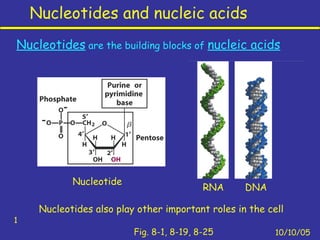
Nucleotides are the building blocks of nucleic acids
Nucleotides also play other important roles in the cell
Nucleotide
DNARNA
Roles of nucleotides
10/10/05
2
• Building blocks of nucleic acids (RNA, DNA)
•Analogous to amino acid role in proteins
• Energy currency in cellular metabolism (ATP:
adenosine triphosphate)
• Allosteric effectors
• Structural components of many enzyme
cofactors (NAD: nicotinamide adenine
dinucleotide)
Roles of nucleic acids
10/10/05
3
• DNA contains genes, the information needed to
synthesize functional proteins and RNAs
• DNA contains segments that play a role in regulation of
gene expression (promoters)
• Ribosomal RNAs (rRNAs) are components of ribosomes,
playing a role in protein synthesis
• Messenger RNAs (mRNAs) carry genetic information
from a gene to the ribosome
• Transfer RNAs (tRNAs) translate information in mRNA
into an amino acid sequence
• RNAs have other functions, and can in some cases
perform catalysis
Structure of nucleotides
10/10/05
4 Fig. 8-1
A phosphate group
Nucleotides have three characteristic components:
A nitrogenous base
(pyrimidines or purine)
A pentose sugar
Basic Structure of Nucleic Acids
Monophosphate
Diphosphate
Triphosphate
Adenine
Guanine
Thymine
Cytosine
Uracil
Nucleoside (Adenosine)
Nucleotide (Adenosine monophosphate, AMP)
Purine
Pyrimidine
核苷
核苷酸
磷酸
五環糖
Ribose,
Deoxyribose
鹼基
1’
2’3’
4’
5’
JuangRH(2004)BCbasics
Structure of nucleosides
10/10/05
5
Remove the phosphate group, and you have a nucleoside.
H
ATP is a nucleotide - energy currency
10/10/05
6
∆G = -50 kJ/mol
triphosphate
Base (adenine)
Ribose sugar
NAD is an important enzyme cofactor
10/10/05
7
Fig. 13-15
NADH is a hydride transfer agent,
or a reducing agent.
Derived from Niacin
nicotinamide
Nucleotides play roles in regulation
10/10/05
8
Fig. 6-30
Structure of nucleotides
10/10/05
9
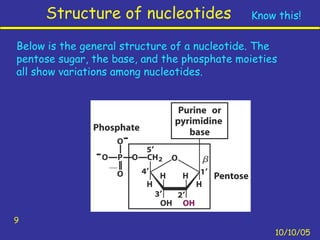
Below is the general structure of a nucleotide. The
pentose sugar, the base, and the phosphate moieties
all show variations among nucleotides.
Know this!
The ribose sugar
10/10/05
10
Ribose
10/10/0511
Fig. 8-3
• Ribose (β-D-furanose) is
a pentose sugar (5-
membered ring).
• Note numbering of the
carbons. In a nucleotide,
"prime" is used (to
differentiate from base
numbering).
5
1
23
4
Ribose
10/10/0512
Fig. 8-3
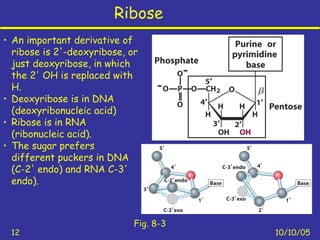
• An important derivative of
ribose is 2'-deoxyribose, or
just deoxyribose, in which
the 2' OH is replaced with
H.
• Deoxyribose is in DNA
(deoxyribonucleic acid)
• Ribose is in RNA
(ribonucleic acid).
• The sugar prefers
different puckers in DNA
(C-2' endo) and RNA C-3'
endo).
The purine or pyrimidine base
10/10/05
13
Pyrimidine and purine
10/10/05
14 Fig. 8-1
Know these!
Nucleotide bases in nucleic acids are pyrimidines or purines.
Pyrimidine and purine
10/10/05
15
Nucleotide bases in nucleic acids are pyrimidines or purines.
Major bases in nucleic acids
10/10/05
16 Fig. 8-2
• Among the pyrimidines, C
occurs in both RNA and
DNA, but
• T occurs in DNA, and
• U occurs in RNA
Know these!
• The bases are
abbreviated by their first
letters (A, G, C, T, U).
• The purines (A, G) occur
in both RNA and DNA
Some minor bases
10/10/05
17
Fig. 8-5
• 5-Methylcytidine occurs in DNA of animals and higher plants
• N6
-methyladenosine occurs in bacterial DNA
Fig. 8-5
The phosphate
10/10/05
18
Variation in phosphate group
10/10/05x
Fig. 8-6, 8-42
• Adenosine 3', 5'-cyclic
monophosphate (cyclic AMP,
or cAMP) is an important
regulatory nucleotide.
• In hydrolysis of RNA by
some enzymes,
ribonucleoside 2',3'-cyclic
monophosphates are isolable
intermediates;
ribonucleoside 3'-
monophosphates are end
products
• Another variation - multiple
phosphates (like ATP).
cAMP
19 10/10/05
Nucleotides in nucleic acids
10/10/05
20
• Bases attach to the C-1' of ribose or deoxyribose
• The pyrimidines attach to the pentose via the N-1 position of
the pyrimidine ring
• The purines attach through the N-9 position
• Some minor bases may have different attachments.
Deoxyribonucleotides
10/10/0521
Fig. 8-4
2'-deoxyribose sugar
Deoxyribonucleotides are abbreviated (for example) A, or
dA (deoxyA), or dAMP (deoxyadenosine monophosphate)
Phosphorylate the 5' position
and you have a nucleotide(here,
deoxyadenylate or
deoxyguanylate)
with a base (here, a purine,
adenine or guanine)
attached to the C-1'
position is a
deoxyribonucleoside
(here deoxyadenosine and
deoxyguanosine).
The major deoxyribonucleotides
10/10/05
22
Fig. 8-4
Ribonucleotides
10/10/05
23 Fig. 8-4
• The ribose sugar with a
base (here, a pyrimidine,
uracil or cytosine) attached
to the ribose C-1' position
is a ribonucleoside (here,
uridine or cytidine).
• Phosphorylate the 5'
position and you have a
ribonucleotide (here,
uridylate or cytidylate)
• Ribonucleotides are abbreviated (for example) U, or UMP
(uridine monophosphate)
The major ribonucleotides
10/10/05
24 Fig. 8-4
Nucleotide nomenclature
10/10/05
25
Nucleotide nomenclature
10/10/05
26 Fig. 8-39
Nucleic acids
10/10/05
27 Fig. 8-7
Nucleotide monomers
can be linked together via a
phosphodiester linkage
formed between the 3' -OH
of a nucleotide
and the phosphate of the
next nucleotide.
Two ends of the resulting poly-
or oligonucleotide are defined:
The 5' end lacks a nucleotide at
the 5' position,
and the 3' end lacks a nucleotide
at the 3' end position.
Sugar-phosphate backbone
10/10/05
28
Berg Fig. 1.1
• The polynucleotide or nucleic acid backbone thus consists of
alternating phosphate and pentose residues.
• The bases are analogous to side chains of amino acids; they vary
without changing the covalent backbone structure.
• Sequence is written from the 5' to 3' end: 5'-ATGCTAGC-3'
• Note that the backbone is polyanionic. Phosphate groups pKa ~ 0.
The bases can take syn or anti positions
10/10/05
29 Fig. 8-18b
Sugar phosphate backbone conformation
10/10/05
30 Fig. 8-18a
• Polynucleotides have
unrestricted rotation about most
backbone bones (within limits of
sterics)
• with the exception of the sugar
ring bond
• This behavior contrasts with the
peptide backbone.
• Also in contrast with proteins,
specific, predictable interactions
between bases are often formed:
A with T, and G with C.
• These interactions can be
interstrand, or intrastrand.
Compare polynucleotides and polypeptides
10/10/05
31
• As in proteins, the sequence of side chains
(bases in nucleic acids) plays an important
role in function.
• Nucleic acid structure depends on the
sequence of bases and on the type of ribose
sugar (ribose, or 2'-deoxyribose).
• Hydrogen bonding interactions are
especially important in nucleic acids.
Interstrand H-bonding between DNA bases
10/10/05
32
Fig. 8-11
Watson-Crick base pairing
DNA structure determination
10/10/0533
• Franklin collected x-ray
diffraction data (early 1950s)
that indicated 2 periodicities
for DNA: 3.4 Å and 34 Å.
• Watson and Crick proposed a 3-
D model accounting for the data.
DNA structure
10/10/05
34
Fig. 8-15
• DNA consists of two helical
chains wound around the
same axis in a right-handed
fashion aligned in an
antiparallel fashion.
• There are 10.5 base pairs, or
36 Å, per turn of the helix.
• Alternating deoxyribose and
phosphate groups on the
backbone form the outside
of the helix.
• The planar purine and
pyrimidine bases of both
strands are stacked inside
the helix.
DNA structure
10/10/05
35
Fig. 8-15
• The furanose ring usually is
puckered in a C-2' endo
conformation in DNA.
• The offset of the
relationship of the base pairs
to the strands gives a major
and a minor groove.
• In B-form DNA (most
common) the depths of the
major and minor grooves are
similar to each other.
Base stacking in DNA
10/10/05
36
Berg Fig. 1.4; 5.13
• C-G (red) and A-T (blue) base
pairs are isosteric (same shape
and size), allowing stacking along
a helical axis for any sequence.
•Base pairs stack
inside the helix.
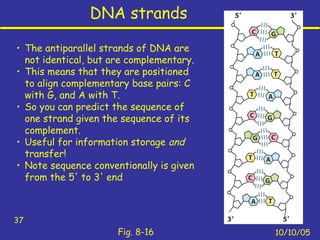
DNA strands
10/10/05
37
Fig. 8-16
• The antiparallel strands of DNA are
not identical, but are complementary.
• This means that they are positioned
to align complementary base pairs: C
with G, and A with T.
• So you can predict the sequence of
one strand given the sequence of its
complement.
• Useful for information storage and
transfer!
• Note sequence conventionally is given
from the 5' to 3' end
B,A and Z DNA
10/10/0538
Fig. 8-19
• B form - The most common
conformation for DNA.
• A form - common for RNA
because of different sugar
pucker. Deeper minor groove,
shallow major groove
• A form is favored in conditions
of low water.
• Z form - narrow, deep minor
groove. Major groove hardly
existent. Can form for some DNA
sequences; requires alternating
syn and anti base configurations.
36 base pairs
Backbone - blue;
Bases- gray
Nucleic acids
10/10/05
39 Fig. 8-19
RNA has a rich and varied structure
10/10/05
40 Fig. 8-26
Watson-
Crick base pairs
(helical segments;
Usually A-form).
Helix is secondary
structure.
Note A-U pairs in
RNA.
DNA can
form
structures
like this as
well.
RNA displays interesting tertiary structure
10/10/05
41 Fig. 8-28Fig. 8-25
Single-
stranded
RNA
right-
handed
helix
T. thermophila intron,
A ribozyme (RNA enzyme)
(1GRZ)
Hammerhead ribozyme
(1MME)
Yeast tRNAPhe
(1TRA)
The mother of all biomolecules
10/10/05
42
1ffk
Large subunit of the ribosome(proteins at least)

Nucleotides- 13

  • 1.
    Nucleotides and nucleicacids 10/10/05 1 Fig. 8-1, 8-19, 8-25 Nucleotides are the building blocks of nucleic acids Nucleotides also play other important roles in the cell Nucleotide DNARNA
  • 2.
    Roles of nucleotides 10/10/05 2 •Building blocks of nucleic acids (RNA, DNA) •Analogous to amino acid role in proteins • Energy currency in cellular metabolism (ATP: adenosine triphosphate) • Allosteric effectors • Structural components of many enzyme cofactors (NAD: nicotinamide adenine dinucleotide)
  • 3.
    Roles of nucleicacids 10/10/05 3 • DNA contains genes, the information needed to synthesize functional proteins and RNAs • DNA contains segments that play a role in regulation of gene expression (promoters) • Ribosomal RNAs (rRNAs) are components of ribosomes, playing a role in protein synthesis • Messenger RNAs (mRNAs) carry genetic information from a gene to the ribosome • Transfer RNAs (tRNAs) translate information in mRNA into an amino acid sequence • RNAs have other functions, and can in some cases perform catalysis
  • 4.
    Structure of nucleotides 10/10/05 4Fig. 8-1 A phosphate group Nucleotides have three characteristic components: A nitrogenous base (pyrimidines or purine) A pentose sugar
  • 5.
    Basic Structure ofNucleic Acids Monophosphate Diphosphate Triphosphate Adenine Guanine Thymine Cytosine Uracil Nucleoside (Adenosine) Nucleotide (Adenosine monophosphate, AMP) Purine Pyrimidine 核苷 核苷酸 磷酸 五環糖 Ribose, Deoxyribose 鹼基 1’ 2’3’ 4’ 5’ JuangRH(2004)BCbasics
  • 6.
    Structure of nucleosides 10/10/05 5 Removethe phosphate group, and you have a nucleoside. H
  • 7.
    ATP is anucleotide - energy currency 10/10/05 6 ∆G = -50 kJ/mol triphosphate Base (adenine) Ribose sugar
  • 8.
    NAD is animportant enzyme cofactor 10/10/05 7 Fig. 13-15 NADH is a hydride transfer agent, or a reducing agent. Derived from Niacin nicotinamide
  • 9.
    Nucleotides play rolesin regulation 10/10/05 8 Fig. 6-30
  • 10.
    Structure of nucleotides 10/10/05 9 Belowis the general structure of a nucleotide. The pentose sugar, the base, and the phosphate moieties all show variations among nucleotides. Know this!
  • 11.
  • 12.
    Ribose 10/10/0511 Fig. 8-3 • Ribose(β-D-furanose) is a pentose sugar (5- membered ring). • Note numbering of the carbons. In a nucleotide, "prime" is used (to differentiate from base numbering). 5 1 23 4
  • 13.
    Ribose 10/10/0512 Fig. 8-3 • Animportant derivative of ribose is 2'-deoxyribose, or just deoxyribose, in which the 2' OH is replaced with H. • Deoxyribose is in DNA (deoxyribonucleic acid) • Ribose is in RNA (ribonucleic acid). • The sugar prefers different puckers in DNA (C-2' endo) and RNA C-3' endo).
  • 14.
    The purine orpyrimidine base 10/10/05 13
  • 15.
    Pyrimidine and purine 10/10/05 14Fig. 8-1 Know these! Nucleotide bases in nucleic acids are pyrimidines or purines.
  • 16.
    Pyrimidine and purine 10/10/05 15 Nucleotidebases in nucleic acids are pyrimidines or purines.
  • 17.
    Major bases innucleic acids 10/10/05 16 Fig. 8-2 • Among the pyrimidines, C occurs in both RNA and DNA, but • T occurs in DNA, and • U occurs in RNA Know these! • The bases are abbreviated by their first letters (A, G, C, T, U). • The purines (A, G) occur in both RNA and DNA
  • 18.
    Some minor bases 10/10/05 17 Fig.8-5 • 5-Methylcytidine occurs in DNA of animals and higher plants • N6 -methyladenosine occurs in bacterial DNA Fig. 8-5
  • 19.
  • 20.
    Variation in phosphategroup 10/10/05x Fig. 8-6, 8-42 • Adenosine 3', 5'-cyclic monophosphate (cyclic AMP, or cAMP) is an important regulatory nucleotide. • In hydrolysis of RNA by some enzymes, ribonucleoside 2',3'-cyclic monophosphates are isolable intermediates; ribonucleoside 3'- monophosphates are end products • Another variation - multiple phosphates (like ATP). cAMP 19 10/10/05
  • 21.
    Nucleotides in nucleicacids 10/10/05 20 • Bases attach to the C-1' of ribose or deoxyribose • The pyrimidines attach to the pentose via the N-1 position of the pyrimidine ring • The purines attach through the N-9 position • Some minor bases may have different attachments.
  • 22.
    Deoxyribonucleotides 10/10/0521 Fig. 8-4 2'-deoxyribose sugar Deoxyribonucleotidesare abbreviated (for example) A, or dA (deoxyA), or dAMP (deoxyadenosine monophosphate) Phosphorylate the 5' position and you have a nucleotide(here, deoxyadenylate or deoxyguanylate) with a base (here, a purine, adenine or guanine) attached to the C-1' position is a deoxyribonucleoside (here deoxyadenosine and deoxyguanosine).
  • 23.
  • 24.
    Ribonucleotides 10/10/05 23 Fig. 8-4 •The ribose sugar with a base (here, a pyrimidine, uracil or cytosine) attached to the ribose C-1' position is a ribonucleoside (here, uridine or cytidine). • Phosphorylate the 5' position and you have a ribonucleotide (here, uridylate or cytidylate) • Ribonucleotides are abbreviated (for example) U, or UMP (uridine monophosphate)
  • 25.
  • 26.
  • 27.
  • 28.
    Nucleic acids 10/10/05 27 Fig.8-7 Nucleotide monomers can be linked together via a phosphodiester linkage formed between the 3' -OH of a nucleotide and the phosphate of the next nucleotide. Two ends of the resulting poly- or oligonucleotide are defined: The 5' end lacks a nucleotide at the 5' position, and the 3' end lacks a nucleotide at the 3' end position.
  • 29.
    Sugar-phosphate backbone 10/10/05 28 Berg Fig.1.1 • The polynucleotide or nucleic acid backbone thus consists of alternating phosphate and pentose residues. • The bases are analogous to side chains of amino acids; they vary without changing the covalent backbone structure. • Sequence is written from the 5' to 3' end: 5'-ATGCTAGC-3' • Note that the backbone is polyanionic. Phosphate groups pKa ~ 0.
  • 30.
    The bases cantake syn or anti positions 10/10/05 29 Fig. 8-18b
  • 31.
    Sugar phosphate backboneconformation 10/10/05 30 Fig. 8-18a • Polynucleotides have unrestricted rotation about most backbone bones (within limits of sterics) • with the exception of the sugar ring bond • This behavior contrasts with the peptide backbone. • Also in contrast with proteins, specific, predictable interactions between bases are often formed: A with T, and G with C. • These interactions can be interstrand, or intrastrand.
  • 32.
    Compare polynucleotides andpolypeptides 10/10/05 31 • As in proteins, the sequence of side chains (bases in nucleic acids) plays an important role in function. • Nucleic acid structure depends on the sequence of bases and on the type of ribose sugar (ribose, or 2'-deoxyribose). • Hydrogen bonding interactions are especially important in nucleic acids.
  • 33.
    Interstrand H-bonding betweenDNA bases 10/10/05 32 Fig. 8-11 Watson-Crick base pairing
  • 34.
    DNA structure determination 10/10/0533 •Franklin collected x-ray diffraction data (early 1950s) that indicated 2 periodicities for DNA: 3.4 Å and 34 Å. • Watson and Crick proposed a 3- D model accounting for the data.
  • 35.
    DNA structure 10/10/05 34 Fig. 8-15 •DNA consists of two helical chains wound around the same axis in a right-handed fashion aligned in an antiparallel fashion. • There are 10.5 base pairs, or 36 Å, per turn of the helix. • Alternating deoxyribose and phosphate groups on the backbone form the outside of the helix. • The planar purine and pyrimidine bases of both strands are stacked inside the helix.
  • 36.
    DNA structure 10/10/05 35 Fig. 8-15 •The furanose ring usually is puckered in a C-2' endo conformation in DNA. • The offset of the relationship of the base pairs to the strands gives a major and a minor groove. • In B-form DNA (most common) the depths of the major and minor grooves are similar to each other.
  • 37.
    Base stacking inDNA 10/10/05 36 Berg Fig. 1.4; 5.13 • C-G (red) and A-T (blue) base pairs are isosteric (same shape and size), allowing stacking along a helical axis for any sequence. •Base pairs stack inside the helix.
  • 38.
    DNA strands 10/10/05 37 Fig. 8-16 •The antiparallel strands of DNA are not identical, but are complementary. • This means that they are positioned to align complementary base pairs: C with G, and A with T. • So you can predict the sequence of one strand given the sequence of its complement. • Useful for information storage and transfer! • Note sequence conventionally is given from the 5' to 3' end
  • 39.
    B,A and ZDNA 10/10/0538 Fig. 8-19 • B form - The most common conformation for DNA. • A form - common for RNA because of different sugar pucker. Deeper minor groove, shallow major groove • A form is favored in conditions of low water. • Z form - narrow, deep minor groove. Major groove hardly existent. Can form for some DNA sequences; requires alternating syn and anti base configurations. 36 base pairs Backbone - blue; Bases- gray
  • 40.
  • 41.
    RNA has arich and varied structure 10/10/05 40 Fig. 8-26 Watson- Crick base pairs (helical segments; Usually A-form). Helix is secondary structure. Note A-U pairs in RNA. DNA can form structures like this as well.
  • 42.
    RNA displays interestingtertiary structure 10/10/05 41 Fig. 8-28Fig. 8-25 Single- stranded RNA right- handed helix T. thermophila intron, A ribozyme (RNA enzyme) (1GRZ) Hammerhead ribozyme (1MME) Yeast tRNAPhe (1TRA)
  • 43.
    The mother ofall biomolecules 10/10/05 42 1ffk Large subunit of the ribosome(proteins at least)