Classification Of
Amino Acids
Amino Acids
 Amino Acids are the building units of proteins linked
together by “Peptide bond”.
 There are about 300 amino acids occur in nature. Only 20 of
them occur in proteins.
LEARNING OBJECTIVES
1☺ Chemical classification:
2☺ Classification on the basis of polarity of
the side chain(R):
3☺ Nutritional classification:
4☺ Metabolic classification:
1- Chemical classification:
Standard amino acids
According to number of COOH and NH2 groups i.e. according to net
charge on amino acid.
A- Monobasic, monocarboxylic amino acids i.e. neutral or
uncharged:
The largest group of amino acids
Subclassification of neutral amino acids:
1- non-polar aliphatic amino acids
e.g. glycine, alanine, valine, leucine, isoleucine.
2- Sulfur containing amino acids:
e.g. Cysteine and Methionine.
3- Hydroxy amino acids:
e.g. Serine and Threonine.
4- Heterocyclic amino acids:
e.g. Tryptophan & Histidine.
5- Imino acid:
Proline & Hydroxy proline.
 6- Aromatic amino acids:
e.g. Phenyl alanine, Tryptophan & Tyrosine
B- Basic amino acids: having less COOH group & more
amino groups.
e.g.
a- Lysine.
b- Arginine.
c- Histidine.
C- Acidic Amino acids: having more COOH groups & less
amino group.
e.g.
a- Glutamic acid.
b- Aspartic acid.
Non-standard amino acids:
Have similar structure like that of amino
acids but don’t take part in the synthesis of
Proteins(because genes don’t have codons
for them). E.g. Taurine, Ornithine,
Citrulline & GABA(γ-aminobutyric acid)
etc…
2 Classification according to polarity of side chain
(R):
A. Non- polar Amino acids
e.g. Alanine, Leucine, Isoleucine, Valine, Methionine, Phenyl Alanine,
Tryptophan and Proline
B. Polar Amino acids with no charge on “R” group
e.g. Glycine, Serine, Threonine, Cysteine, Glutamine, Asparagine and
Tyrosine
C. Polar Amino acids with positive “R” group
e.g. Lysine, Arginine, Histidine
D. Polar Amino acids with negative “R” group
e.g. Aspartic acid and Glutamic acid
3 Nutritional classification:
1- Essential or Indispensable amino acids: Can’t be
synthesized in the body & have to be taken in the diet.
e.g. Valine, Isoleucine, leucine, Lysine, Methionine, Phenyl Alanine,
Threonine and Tryptophan
2- Semiessential amino acids: These are growth promoters.
Not synthesized in adequate amount in the body.
e.g. Arginine and Histidine.
3- Non essential or Dispensable amino acids: Can be
synthesized in the body & may not be the component of diet.
e.g. Glycine, Alanine, Serine, Cysteine, Asparagine, Glutamine,
Tyrosine, and Proline.
4 Metabolic classification:
according to metabolic or degradation products of amino acids they
may be:
a- Ketogenic amino acids: which give ketone bodies . Lysine and
Leucine are the only pure ketogenic amino acids.
b- Mixed ketogenic and glucogenic amino acids: which give
both ketonbodies and glucose. These are: isoleucine, phenyl alanine,
tyrosine and tryptophan.
c- Glucogenic amino acids: which give glucose. These are:
Glycine, Serine, Valine, Histidine, Arginine, Cysteine, Proline,
Alanine, Glutamine, Asparagine & Methionine.
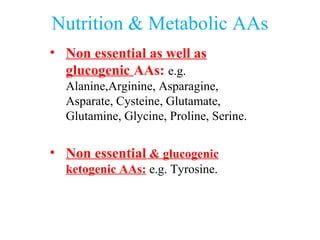
Nutrition & Metabolic AAs
• Non essential as well as
glucogenic AAs: e.g.
Alanine,Arginine, Asparagine,
Asparate, Cysteine, Glutamate,
Glutamine, Glycine, Proline, Serine.
• Non essential & glucogenic
ketogenic AAs: e.g. Tyrosine.
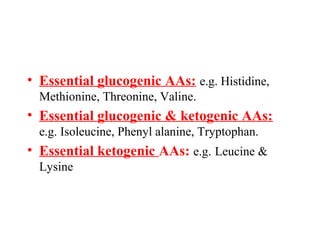
• Essential glucogenic AAs: e.g. Histidine,
Methionine, Threonine, Valine.
• Essential glucogenic & ketogenic AAs:
e.g. Isoleucine, Phenyl alanine, Tryptophan.
• Essential ketogenic AAs: e.g. Leucine &
Lysine
FARHAN ALI
Roll no. 81
5th
Batch
Session 2013-2017
Classification of Amino Acids by farhan ali

Classification of Amino Acids by farhan ali

  • 1.
  • 2.
    Amino Acids  AminoAcids are the building units of proteins linked together by “Peptide bond”.  There are about 300 amino acids occur in nature. Only 20 of them occur in proteins.
  • 3.
    LEARNING OBJECTIVES 1☺ Chemicalclassification: 2☺ Classification on the basis of polarity of the side chain(R): 3☺ Nutritional classification: 4☺ Metabolic classification:
  • 4.
    1- Chemical classification: Standardamino acids According to number of COOH and NH2 groups i.e. according to net charge on amino acid. A- Monobasic, monocarboxylic amino acids i.e. neutral or uncharged: The largest group of amino acids
  • 5.
    Subclassification of neutralamino acids: 1- non-polar aliphatic amino acids e.g. glycine, alanine, valine, leucine, isoleucine. 2- Sulfur containing amino acids: e.g. Cysteine and Methionine. 3- Hydroxy amino acids: e.g. Serine and Threonine. 4- Heterocyclic amino acids: e.g. Tryptophan & Histidine. 5- Imino acid: Proline & Hydroxy proline.
  • 6.
     6- Aromaticamino acids: e.g. Phenyl alanine, Tryptophan & Tyrosine
  • 7.
    B- Basic aminoacids: having less COOH group & more amino groups. e.g. a- Lysine. b- Arginine. c- Histidine. C- Acidic Amino acids: having more COOH groups & less amino group. e.g. a- Glutamic acid. b- Aspartic acid.
  • 8.
    Non-standard amino acids: Havesimilar structure like that of amino acids but don’t take part in the synthesis of Proteins(because genes don’t have codons for them). E.g. Taurine, Ornithine, Citrulline & GABA(γ-aminobutyric acid) etc…
  • 9.
    2 Classification accordingto polarity of side chain (R): A. Non- polar Amino acids e.g. Alanine, Leucine, Isoleucine, Valine, Methionine, Phenyl Alanine, Tryptophan and Proline B. Polar Amino acids with no charge on “R” group e.g. Glycine, Serine, Threonine, Cysteine, Glutamine, Asparagine and Tyrosine C. Polar Amino acids with positive “R” group e.g. Lysine, Arginine, Histidine D. Polar Amino acids with negative “R” group e.g. Aspartic acid and Glutamic acid
  • 10.
    3 Nutritional classification: 1-Essential or Indispensable amino acids: Can’t be synthesized in the body & have to be taken in the diet. e.g. Valine, Isoleucine, leucine, Lysine, Methionine, Phenyl Alanine, Threonine and Tryptophan 2- Semiessential amino acids: These are growth promoters. Not synthesized in adequate amount in the body. e.g. Arginine and Histidine. 3- Non essential or Dispensable amino acids: Can be synthesized in the body & may not be the component of diet. e.g. Glycine, Alanine, Serine, Cysteine, Asparagine, Glutamine, Tyrosine, and Proline.
  • 11.
    4 Metabolic classification: accordingto metabolic or degradation products of amino acids they may be: a- Ketogenic amino acids: which give ketone bodies . Lysine and Leucine are the only pure ketogenic amino acids. b- Mixed ketogenic and glucogenic amino acids: which give both ketonbodies and glucose. These are: isoleucine, phenyl alanine, tyrosine and tryptophan. c- Glucogenic amino acids: which give glucose. These are: Glycine, Serine, Valine, Histidine, Arginine, Cysteine, Proline, Alanine, Glutamine, Asparagine & Methionine.
  • 12.
    Nutrition & MetabolicAAs • Non essential as well as glucogenic AAs: e.g. Alanine,Arginine, Asparagine, Asparate, Cysteine, Glutamate, Glutamine, Glycine, Proline, Serine. • Non essential & glucogenic ketogenic AAs: e.g. Tyrosine.
  • 13.
    • Essential glucogenicAAs: e.g. Histidine, Methionine, Threonine, Valine. • Essential glucogenic & ketogenic AAs: e.g. Isoleucine, Phenyl alanine, Tryptophan. • Essential ketogenic AAs: e.g. Leucine & Lysine
  • 14.
    FARHAN ALI Roll no.81 5th Batch Session 2013-2017