
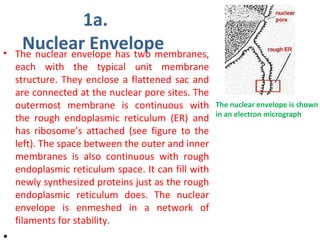

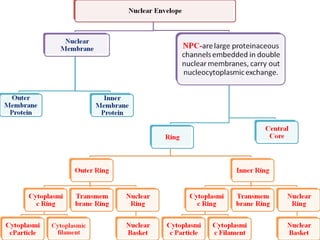
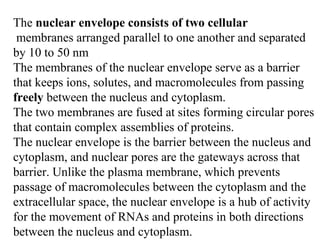

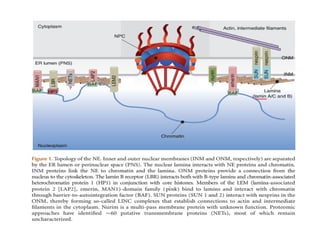
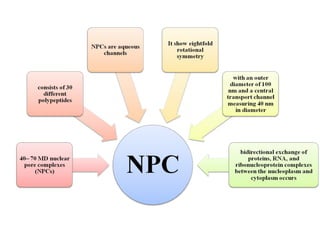
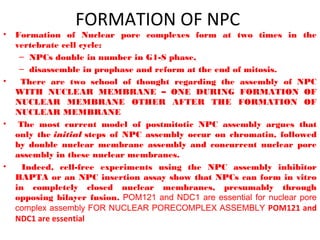
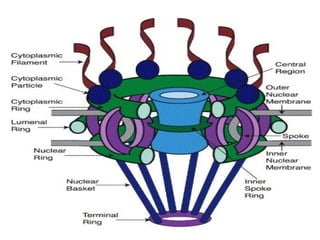


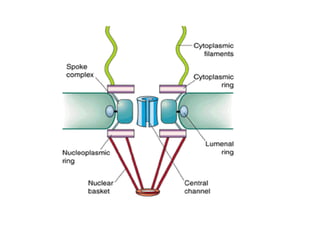



The nuclear envelope consists of two parallel membranes separated by 10-50 nm. It serves as a barrier between the nucleus and cytoplasm. Nuclear pores are circular complexes of proteins that form openings in the nuclear envelope, allowing transport of molecules between the nucleus and cytoplasm. The nuclear envelope forms through the recruitment of membrane vesicles to chromatin, fusion of these vesicles, and assembly of nuclear pore complexes. Key proteins like POM121 and NDC1 are essential for nuclear pore complex assembly after the formation of the double nuclear membrane.


![C &m ppt [autosaved]](https://cdn.slidesharecdn.com/ss_thumbnails/cmpptautosaved-190617173045-thumbnail.jpg?width=640&height=640&fit=bounds)


