THE NUCLEAR
   ENVELOPE,
NUCLEAR LAMINA
& PORE COMPLEX
TOPICS TO COVER:
               Nuclear envelope:

 Nuclear membranes – inner & outer membranes.
 Nuclear lamina

 Nuclear pore complexes

            – structure
            – function
NUCLEAR ENVELOPE

Nuclear envelope : consists of two nuclear membranes
 that envelops the nucleus of an eukaryotic cell, an
 underlying nuclear lamina, and nuclear pore
 complexes.

   Encloses nuclear DNA.
   Defines the nuclear compartment.
   Separates nucleus and cytoplasmic contents  separate
    metabolic compartments.
   Structural framework for nucleus.
TOPICS TO COVER:
               Nuclear envelope:

 Nuclear membranes – inner & outer membranes.
 Nuclear lamina

 Nuclear pore complexes

            – structure
            – function
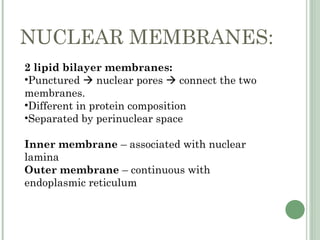
NUCLEAR MEMBRANES:
2 lipid bilayer membranes:
•Punctured  nuclear pores  connect the two
membranes.
•Different in protein composition
•Separated by perinuclear space

Inner membrane – associated with nuclear
lamina
Outer membrane – continuous with
endoplasmic reticulum
NUCLEAR MEMBRANES:
TOPICS TO COVER:
               Nuclear envelope:

 Nuclear membranes – inner & outer membranes.
 Nuclear lamina

 Nuclear pore complexes

            – structure
            – function
NUCLEAR LAMINA
•Intermediate filaments & membrane associated proteins
(Lamins & nuclear lamin-associated membrane proteins)
•Lamin types: A, B1, B2, & C
•Mechanical support
•Regulates cellular events
TOPICS TO COVER:
               Nuclear envelope:

 Nuclear membranes – inner & outer membranes.
 Nuclear lamina

 Nuclear pore complexes

            – structure
            – function
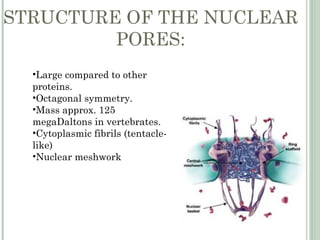
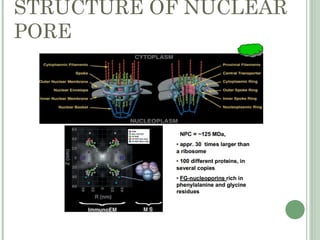
STRUCTURE OF THE NUCLEAR
         PORES:
  •Large compared to other
  proteins.
  •Octagonal symmetry.
  •Mass approx. 125
  megaDaltons in vertebrates.
  •Cytoplasmic fibrils (tentacle-
  like)
  •Nuclear meshwork
STRUCTURE OF NUCLEAR
PORE
STRUCTURE OF NUCLEAR
PORE
FUNCTION OF NUCLEAR
       PORE
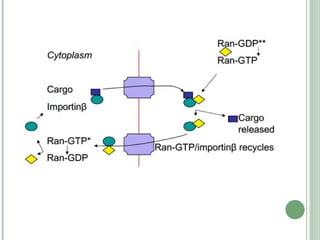
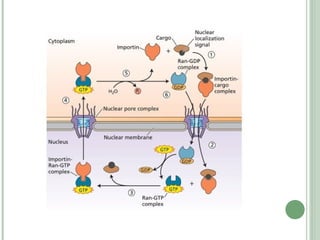
FUNCTION OF THE NUCLEAR PORE

 Passive diffusion of low molecular weight solutes
 Regulated transport of macromolecules larger
  than 40 kDa
 Nuclear import signal: NLS

 Nuclear export sequence: NES

 Importins: cytoplasm to nucleoplasm

 Exportins: nucleoplasm to cytoplasm

 GTPase Ran controls interactions of cargo and
  karyopherin
nuclear envelope
nuclear envelope

nuclear envelope

  • 1.
    THE NUCLEAR ENVELOPE, NUCLEAR LAMINA & PORE COMPLEX
  • 2.
    TOPICS TO COVER: Nuclear envelope:  Nuclear membranes – inner & outer membranes.  Nuclear lamina  Nuclear pore complexes – structure – function
  • 3.
    NUCLEAR ENVELOPE Nuclear envelope: consists of two nuclear membranes that envelops the nucleus of an eukaryotic cell, an underlying nuclear lamina, and nuclear pore complexes.  Encloses nuclear DNA.  Defines the nuclear compartment.  Separates nucleus and cytoplasmic contents  separate metabolic compartments.  Structural framework for nucleus.
  • 4.
    TOPICS TO COVER: Nuclear envelope:  Nuclear membranes – inner & outer membranes.  Nuclear lamina  Nuclear pore complexes – structure – function
  • 5.
    NUCLEAR MEMBRANES: 2 lipidbilayer membranes: •Punctured  nuclear pores  connect the two membranes. •Different in protein composition •Separated by perinuclear space Inner membrane – associated with nuclear lamina Outer membrane – continuous with endoplasmic reticulum
  • 6.
  • 8.
    TOPICS TO COVER: Nuclear envelope:  Nuclear membranes – inner & outer membranes.  Nuclear lamina  Nuclear pore complexes – structure – function
  • 9.
    NUCLEAR LAMINA •Intermediate filaments& membrane associated proteins (Lamins & nuclear lamin-associated membrane proteins) •Lamin types: A, B1, B2, & C •Mechanical support •Regulates cellular events
  • 10.
    TOPICS TO COVER: Nuclear envelope:  Nuclear membranes – inner & outer membranes.  Nuclear lamina  Nuclear pore complexes – structure – function
  • 11.
    STRUCTURE OF THENUCLEAR PORES: •Large compared to other proteins. •Octagonal symmetry. •Mass approx. 125 megaDaltons in vertebrates. •Cytoplasmic fibrils (tentacle- like) •Nuclear meshwork
  • 12.
  • 13.
  • 15.
  • 16.
    FUNCTION OF THENUCLEAR PORE  Passive diffusion of low molecular weight solutes  Regulated transport of macromolecules larger than 40 kDa  Nuclear import signal: NLS  Nuclear export sequence: NES  Importins: cytoplasm to nucleoplasm  Exportins: nucleoplasm to cytoplasm  GTPase Ran controls interactions of cargo and karyopherin