Nuclear Transport
Dr.Sujit Ghosh
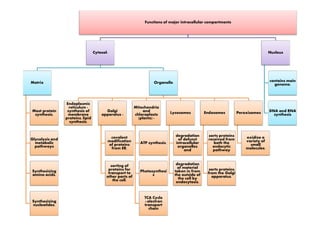
Functions of major intracellular compartments
Cytosol:
Matrix
Most protein
synthesis,
Organelle
Endoplasmic
reticulum -
synthesis of
membrane
Golgi
apparatus -
Mitochondria
and
chloroplasts Lysosomes Endosomes Peroxisomes
Nucleus
contains main
genome,
DNA and RNA
synthesis
Most protein
synthesis,
Glycolysis and
metabolic
pathways
Synthesizing
amino acids,
Synthesizing
nucleotides.
synthesis of
membrane
proteins, lipid
synthesis.
Golgi
apparatus -
covalent
modification
of proteins
from ER,
sorting of
proteins for
transport to
other parts of
the cell.
and
chloroplasts
(plants) -
ATP synthesis.
Photosynthesi
s
TCA Cycle
+electron
transport
chain
Lysosomes
degradation
of defunct
intracellular
organelles
and
degradation
of material
taken in from
the outside of
the cell by
endocytosis.
Endosomes
sorts proteins
received from
both the
endocytic
pathway
sorts proteins
from the Golgi
apparatus.
Peroxisomes
oxidize a
variety of
small
molecules.
DNA and RNA
synthesis
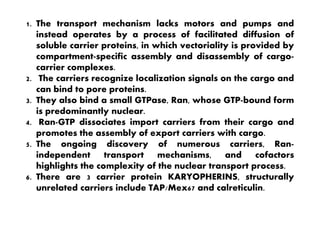
1. The transport mechanism lacks motors and pumps and
instead operates by a process of facilitated diffusion of
soluble carrier proteins, in which vectoriality is provided by
compartment-specific assembly and disassembly of cargo-
carrier complexes.
2. The carriers recognize localization signals on the cargo and
can bind to pore proteins.
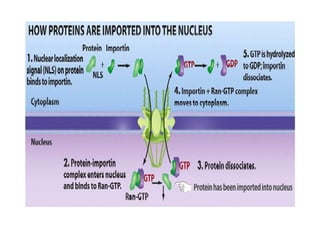
3. They also bind a small GTPase, Ran, whose GTP-bound form
is predominantly nuclear.is predominantly nuclear.
4. Ran-GTP dissociates import carriers from their cargo and
promotes the assembly of export carriers with cargo.
5. The ongoing discovery of numerous carriers, Ran-
independent transport mechanisms, and cofactors
highlights the complexity of the nuclear transport process.
6. There are 3 carrier protein KARYOPHERINS, structurally
unrelated carriers include TAP/Mex67 and calreticulin.
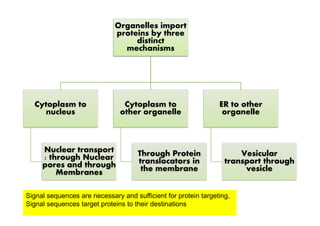
Organelles import
proteins by three
distinct
mechanisms
Cytoplasm to
nucleus
Cytoplasm to
other organelle
ER to other
organellenucleus
Nuclear transport
: through Nuclear
pores and through
Membranes
other organelle
Through Protein
translocators in
the membrane
organelle
Vesicular
transport through
vesicle
Signal sequences are necessary and sufficient for protein targeting,
Signal sequences target proteins to their destinations
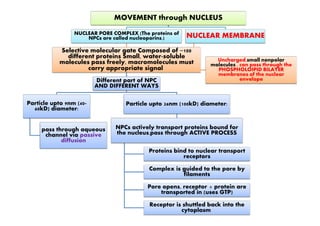
MOVEMENT through NUCLEUS
NUCLEAR PORE COMPLEX (The proteins of
NPCs are called nucleoporins.)
Selective molecular gate Composed of ~100
different proteins Small, water-soluble
molecules pass freely, macromolecules must
carry appropriate signal
Different part of NPC
AND DIFFERENT WAYS
Particle upto 9nm (40-
60kD) diameter:
Particle upto 26nm (100kD) diameter:
NUCLEAR MEMBRANE
Uncharged,small nonpolar
molecules , can pass through the
PHOSPHOLOIPID BILAYER
membranes of the nuclear
envelope
pass through aqueous
channel via passive
diffusion
NPCs actively transport proteins bound for
the nucleus,pass through ACTIVE PROCESS
Proteins bind to nuclear transport
receptors
Complex is guided to the pore by
filaments
Pore opens, receptor + protein are
transported in (uses GTP)
Receptor is shuttled back into the
cytoplasm
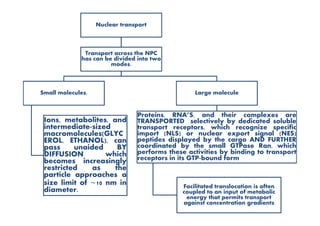
Nuclear transport
Transport across the NPC
has can be divided into two
modes.
Small molecules, Large molecule
Proteins, RNA’S, and their complexes are
Ions, metabolites, and
intermediate-sized
macromolecules(GLYC
EROL, ETHANOL), can
pass unaided BY
DIFFUSION which
becomes increasingly
restricted as the
particle approaches a
size limit of ∼10 nm in
diameter.
Proteins, RNA’S, and their complexes are
TRANSPORTED selectively by dedicated soluble
transport receptors, which recognize specific
import (NLS) or nuclear export signal (NES)
peptides displayed by the cargo AND FURTHER
coordinated by the small GTPase Ran, which
performs these activities by binding to transport
receptors in its GTP-bound form
Facilitated translocation is often
coupled to an input of metabolic
energy that permits transport
against concentration gradients
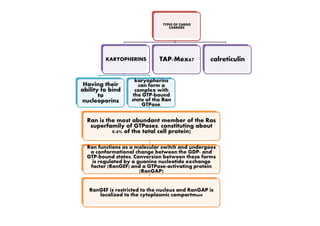
TYPES OF CARGO
CARRIERS
KARYOPHERINS
Having their
ability to bind
to
nucleoporins
karyopherins
can form a
complex with
the GTP-bound
state of the Ran
GTPase.
TAP/Mex67 calreticulin
Ran is the most abundant member of the Ras
superfamily of GTPases, constituting about
0.4% of the total cell protein)
Ran functions as a molecular switch and undergoes
a conformational change between the GDP- and
GTP-bound states. Conversion between these forms
is regulated by a guanine nucleotide exchange
factor (RanGEF) and a GTPase-activating protein
(RanGAP)
RanGEF is restricted to the nucleus and RanGAP is
localized to the cytoplasmic compartment
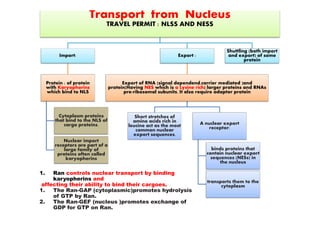
Transport from Nucleus
TRAVEL PERMIT : NLSS AND NESS
Import:
Protein : of protein
with Karyophorins
which bind to NLS
Export :
Export of RNA (signal dependend,carrier mediated )and
protein(Having NES which is a Lysine rich) larger proteins and RNAs
pre-ribosomal subunits. It also require adaptor protein
Shuttling (both import
and export) of some
protein
Cytoplasm proteins
that bind to the NLS of
cargo proteins.
Nuclear import
receptors are part of a
large family of
proteins often called
karyopherins
Short stretches of
amino acids rich in
leucine act as the most
common nuclear
export sequences.
A nuclear export
receptor:
binds proteins that
contain nuclear export
sequences (NESs) in
the nucleus
transports them to the
cytoplasm
1. Ran controls nuclear transport by binding
karyopherins and
affecting their ability to bind their cargoes.
1. The Ran-GAP (cytoplasmic)promotes hydrolysis
of GTP by Ran.
2. The Ran-GEF (nucleus )promotes exchange of
GDP for GTP on Ran.
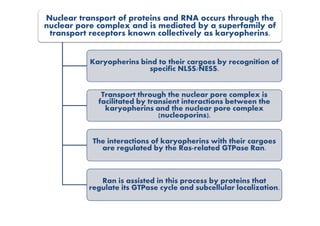
Nuclear transport of proteins and RNA occurs through the
nuclear pore complex and is mediated by a superfamily of
transport receptors known collectively as karyopherins.
Karyopherins bind to their cargoes by recognition of
specific NLSS/NESS.
Transport through the nuclear pore complex is
facilitated by transient interactions between the
karyopherins and the nuclear pore complex
(nucleoporins).(nucleoporins).
The interactions of karyopherins with their cargoes
are regulated by the Ras-related GTPase Ran.
Ran is assisted in this process by proteins that
regulate its GTPase cycle and subcellular localization.
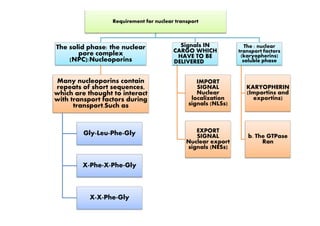
Requirement for nuclear transport
The solid phase: the nuclear
pore complex
(NPC):Nucleoporins
Many nucleoporins contain
repeats of short sequences,
which are thought to interact
with transport factors during
transport.Such as
Signals IN
CARGO WHICH
HAVE TO BE
DELIVERED
IMPORT
SIGNAL
Nuclear
localization
signals (NLSs)
The : nuclear
transport factors
(karyopherins)
soluble phase
KARYOPHERIN
(Importins and
exportins)
Gly-Leu-Phe-Gly
X-Phe-X-Phe-Gly
X-X-Phe-Gly
EXPORT
SIGNAL
Nuclear export
signals (NESs)
b. The GTPase
Ran
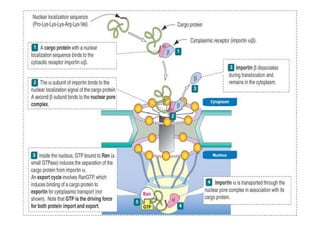
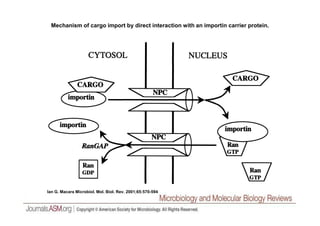
Mechanism of cargo import by direct interaction with an importin carrier protein.
Ian G. Macara Microbiol. Mol. Biol. Rev. 2001;65:570-594
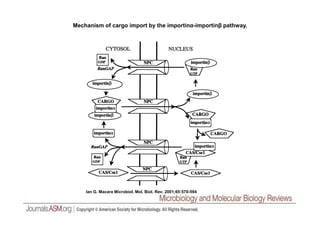
Mechanism of cargo import by the importinα-importinβ pathway.
Ian G. Macara Microbiol. Mol. Biol. Rev. 2001;65:570-594
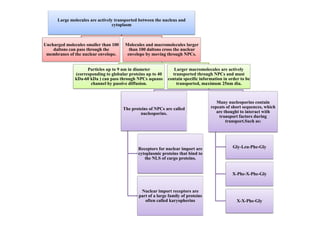
Large molecules are actively transported between the nucleus and
cytoplasm
Uncharged molecules smaller than 100
daltons can pass through the
membranes of the nuclear envelope.
Molecules and macromolecules larger
than 100 daltons cross the nuclear
envelope by moving through NPCs.
Particles up to 9 nm in diameter
(corresponding to globular proteins up to 40
kDa-60 kDa ) can pass through NPCs aquaus
channel by passive diffusion.
Larger macromolecules are actively
transported through NPCs and must
contain specific information in order to be
transported, maximum 25nm dia.
The proteins of NPCs are called
nucleoporins.
Many nucleoporins contain
repeats of short sequences, which
are thought to interact withnucleoporins.
Receptors for nuclear import are
cytoplasmic proteins that bind to
the NLS of cargo proteins.
Nuclear import receptors are
part of a large family of proteins
often called karyopherins
are thought to interact with
transport factors during
transport.Such as:
Gly-Leu-Phe-Gly
X-Phe-X-Phe-Gly
X-X-Phe-Gly
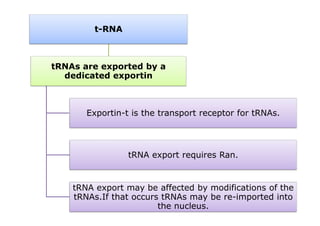
t-RNA
tRNAs are exported by a
dedicated exportin
Exportin-t is the transport receptor for tRNAs.Exportin-t is the transport receptor for tRNAs.
tRNA export requires Ran.
tRNA export may be affected by modifications of the
tRNAs.If that occurs tRNAs may be re-imported into
the nucleus.
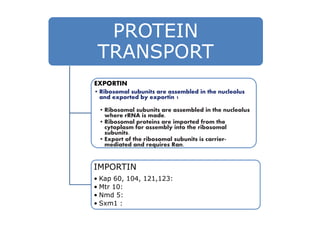
PROTEIN
TRANSPORT
EXPORTIN
• Ribosomal subunits are assembled in the nucleolus
and exported by exportin 1
• Ribosomal subunits are assembled in the nucleolus
where rRNA is made.
• Ribosomal subunits are assembled in the nucleolus
where rRNA is made.
• Ribosomal proteins are imported from the
cytoplasm for assembly into the ribosomal
subunits.
• Export of the ribosomal subunits is carrier-
mediated and requires Ran.
IMPORTIN
• Kap 60, 104, 121,123:
• Mtr 10:
• Nmd 5:
• Sxm1 :
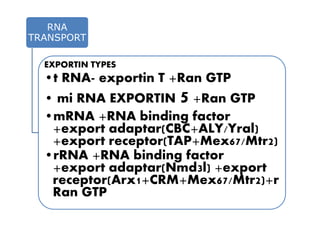
RNA
TRANSPORT
EXPORTIN TYPES
•t RNA- exportin T +Ran GTP
• mi RNA EXPORTIN 5 +Ran GTP
•mRNA +RNA binding factor•mRNA +RNA binding factor
+export adaptar(CBC+ALY/Yral)
+export receptor(TAP+Mex67/Mtr2)
•rRNA +RNA binding factor
+export adaptar(Nmd3l) +export
receptor(Arx1+CRM+Mex67/Mtr2)+r
Ran GTP
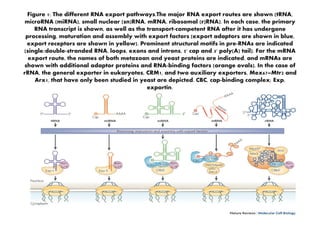
Figure 1: The different RNA export pathways.The major RNA export routes are shown (tRNA,
microRNA (miRNA), small nuclear (sn)RNA, mRNA, ribosomal (r)RNA). In each case, the primary
RNA transcript is shown, as well as the transport-competent RNA after it has undergone
processing, maturation and assembly with export factors (export adaptors are shown in blue,
export receptors are shown in yellow). Prominent structural motifs in pre-RNAs are indicated
(single/double-stranded RNA, loops, exons and introns, 5' cap and 3' poly(A) tail). For the mRNA
export route, the names of both metazoan and yeast proteins are indicated, and mRNAs are
shown with additional adaptor proteins and RNA-binding factors (orange ovals). In the case of
rRNA, the general exporter in eukaryotes, CRM1, and two auxiliary exporters, Mex67–Mtr2 and
Arx1, that have only been studied in yeast are depicted. CBC, cap-binding complex; Exp,
exportin.
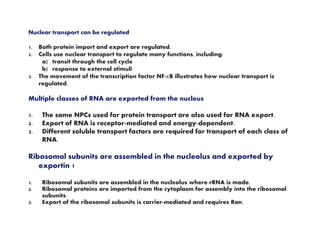
Nuclear transport can be regulated
1. Both protein import and export are regulated.
2. Cells use nuclear transport to regulate many functions, including:
a) transit through the cell cycle
b) response to external stimuli
3. The movement of the transcription factor NF-κB illustrates how nuclear transport is
regulated.
Multiple classes of RNA are exported from the nucleus
1. The same NPCs used for protein transport are also used for RNA export.1. The same NPCs used for protein transport are also used for RNA export.
2. Export of RNA is receptor-mediated and energy-dependent.
3. Different soluble transport factors are required for transport of each class of
RNA.
Ribosomal subunits are assembled in the nucleolus and exported by
exportin 1
1. Ribosomal subunits are assembled in the nucleolus where rRNA is made.
2. Ribosomal proteins are imported from the cytoplasm for assembly into the ribosomal
subunits.
3. Export of the ribosomal subunits is carrier-mediated and requires Ran.

Nuclear transport

  • 1.
  • 2.
    Functions of majorintracellular compartments Cytosol: Matrix Most protein synthesis, Organelle Endoplasmic reticulum - synthesis of membrane Golgi apparatus - Mitochondria and chloroplasts Lysosomes Endosomes Peroxisomes Nucleus contains main genome, DNA and RNA synthesis Most protein synthesis, Glycolysis and metabolic pathways Synthesizing amino acids, Synthesizing nucleotides. synthesis of membrane proteins, lipid synthesis. Golgi apparatus - covalent modification of proteins from ER, sorting of proteins for transport to other parts of the cell. and chloroplasts (plants) - ATP synthesis. Photosynthesi s TCA Cycle +electron transport chain Lysosomes degradation of defunct intracellular organelles and degradation of material taken in from the outside of the cell by endocytosis. Endosomes sorts proteins received from both the endocytic pathway sorts proteins from the Golgi apparatus. Peroxisomes oxidize a variety of small molecules. DNA and RNA synthesis
  • 3.
    1. The transportmechanism lacks motors and pumps and instead operates by a process of facilitated diffusion of soluble carrier proteins, in which vectoriality is provided by compartment-specific assembly and disassembly of cargo- carrier complexes. 2. The carriers recognize localization signals on the cargo and can bind to pore proteins. 3. They also bind a small GTPase, Ran, whose GTP-bound form is predominantly nuclear.is predominantly nuclear. 4. Ran-GTP dissociates import carriers from their cargo and promotes the assembly of export carriers with cargo. 5. The ongoing discovery of numerous carriers, Ran- independent transport mechanisms, and cofactors highlights the complexity of the nuclear transport process. 6. There are 3 carrier protein KARYOPHERINS, structurally unrelated carriers include TAP/Mex67 and calreticulin.
  • 4.
    Organelles import proteins bythree distinct mechanisms Cytoplasm to nucleus Cytoplasm to other organelle ER to other organellenucleus Nuclear transport : through Nuclear pores and through Membranes other organelle Through Protein translocators in the membrane organelle Vesicular transport through vesicle Signal sequences are necessary and sufficient for protein targeting, Signal sequences target proteins to their destinations
  • 5.
    MOVEMENT through NUCLEUS NUCLEARPORE COMPLEX (The proteins of NPCs are called nucleoporins.) Selective molecular gate Composed of ~100 different proteins Small, water-soluble molecules pass freely, macromolecules must carry appropriate signal Different part of NPC AND DIFFERENT WAYS Particle upto 9nm (40- 60kD) diameter: Particle upto 26nm (100kD) diameter: NUCLEAR MEMBRANE Uncharged,small nonpolar molecules , can pass through the PHOSPHOLOIPID BILAYER membranes of the nuclear envelope pass through aqueous channel via passive diffusion NPCs actively transport proteins bound for the nucleus,pass through ACTIVE PROCESS Proteins bind to nuclear transport receptors Complex is guided to the pore by filaments Pore opens, receptor + protein are transported in (uses GTP) Receptor is shuttled back into the cytoplasm
  • 6.
    Nuclear transport Transport acrossthe NPC has can be divided into two modes. Small molecules, Large molecule Proteins, RNA’S, and their complexes are Ions, metabolites, and intermediate-sized macromolecules(GLYC EROL, ETHANOL), can pass unaided BY DIFFUSION which becomes increasingly restricted as the particle approaches a size limit of ∼10 nm in diameter. Proteins, RNA’S, and their complexes are TRANSPORTED selectively by dedicated soluble transport receptors, which recognize specific import (NLS) or nuclear export signal (NES) peptides displayed by the cargo AND FURTHER coordinated by the small GTPase Ran, which performs these activities by binding to transport receptors in its GTP-bound form Facilitated translocation is often coupled to an input of metabolic energy that permits transport against concentration gradients
  • 7.
    TYPES OF CARGO CARRIERS KARYOPHERINS Havingtheir ability to bind to nucleoporins karyopherins can form a complex with the GTP-bound state of the Ran GTPase. TAP/Mex67 calreticulin Ran is the most abundant member of the Ras superfamily of GTPases, constituting about 0.4% of the total cell protein) Ran functions as a molecular switch and undergoes a conformational change between the GDP- and GTP-bound states. Conversion between these forms is regulated by a guanine nucleotide exchange factor (RanGEF) and a GTPase-activating protein (RanGAP) RanGEF is restricted to the nucleus and RanGAP is localized to the cytoplasmic compartment
  • 9.
    Transport from Nucleus TRAVELPERMIT : NLSS AND NESS Import: Protein : of protein with Karyophorins which bind to NLS Export : Export of RNA (signal dependend,carrier mediated )and protein(Having NES which is a Lysine rich) larger proteins and RNAs pre-ribosomal subunits. It also require adaptor protein Shuttling (both import and export) of some protein Cytoplasm proteins that bind to the NLS of cargo proteins. Nuclear import receptors are part of a large family of proteins often called karyopherins Short stretches of amino acids rich in leucine act as the most common nuclear export sequences. A nuclear export receptor: binds proteins that contain nuclear export sequences (NESs) in the nucleus transports them to the cytoplasm 1. Ran controls nuclear transport by binding karyopherins and affecting their ability to bind their cargoes. 1. The Ran-GAP (cytoplasmic)promotes hydrolysis of GTP by Ran. 2. The Ran-GEF (nucleus )promotes exchange of GDP for GTP on Ran.
  • 10.
    Nuclear transport ofproteins and RNA occurs through the nuclear pore complex and is mediated by a superfamily of transport receptors known collectively as karyopherins. Karyopherins bind to their cargoes by recognition of specific NLSS/NESS. Transport through the nuclear pore complex is facilitated by transient interactions between the karyopherins and the nuclear pore complex (nucleoporins).(nucleoporins). The interactions of karyopherins with their cargoes are regulated by the Ras-related GTPase Ran. Ran is assisted in this process by proteins that regulate its GTPase cycle and subcellular localization.
  • 11.
    Requirement for nucleartransport The solid phase: the nuclear pore complex (NPC):Nucleoporins Many nucleoporins contain repeats of short sequences, which are thought to interact with transport factors during transport.Such as Signals IN CARGO WHICH HAVE TO BE DELIVERED IMPORT SIGNAL Nuclear localization signals (NLSs) The : nuclear transport factors (karyopherins) soluble phase KARYOPHERIN (Importins and exportins) Gly-Leu-Phe-Gly X-Phe-X-Phe-Gly X-X-Phe-Gly EXPORT SIGNAL Nuclear export signals (NESs) b. The GTPase Ran
  • 13.
    Mechanism of cargoimport by direct interaction with an importin carrier protein. Ian G. Macara Microbiol. Mol. Biol. Rev. 2001;65:570-594
  • 14.
    Mechanism of cargoimport by the importinα-importinβ pathway. Ian G. Macara Microbiol. Mol. Biol. Rev. 2001;65:570-594
  • 15.
    Large molecules areactively transported between the nucleus and cytoplasm Uncharged molecules smaller than 100 daltons can pass through the membranes of the nuclear envelope. Molecules and macromolecules larger than 100 daltons cross the nuclear envelope by moving through NPCs. Particles up to 9 nm in diameter (corresponding to globular proteins up to 40 kDa-60 kDa ) can pass through NPCs aquaus channel by passive diffusion. Larger macromolecules are actively transported through NPCs and must contain specific information in order to be transported, maximum 25nm dia. The proteins of NPCs are called nucleoporins. Many nucleoporins contain repeats of short sequences, which are thought to interact withnucleoporins. Receptors for nuclear import are cytoplasmic proteins that bind to the NLS of cargo proteins. Nuclear import receptors are part of a large family of proteins often called karyopherins are thought to interact with transport factors during transport.Such as: Gly-Leu-Phe-Gly X-Phe-X-Phe-Gly X-X-Phe-Gly
  • 17.
    t-RNA tRNAs are exportedby a dedicated exportin Exportin-t is the transport receptor for tRNAs.Exportin-t is the transport receptor for tRNAs. tRNA export requires Ran. tRNA export may be affected by modifications of the tRNAs.If that occurs tRNAs may be re-imported into the nucleus.
  • 18.
    PROTEIN TRANSPORT EXPORTIN • Ribosomal subunitsare assembled in the nucleolus and exported by exportin 1 • Ribosomal subunits are assembled in the nucleolus where rRNA is made. • Ribosomal subunits are assembled in the nucleolus where rRNA is made. • Ribosomal proteins are imported from the cytoplasm for assembly into the ribosomal subunits. • Export of the ribosomal subunits is carrier- mediated and requires Ran. IMPORTIN • Kap 60, 104, 121,123: • Mtr 10: • Nmd 5: • Sxm1 :
  • 19.
    RNA TRANSPORT EXPORTIN TYPES •t RNA-exportin T +Ran GTP • mi RNA EXPORTIN 5 +Ran GTP •mRNA +RNA binding factor•mRNA +RNA binding factor +export adaptar(CBC+ALY/Yral) +export receptor(TAP+Mex67/Mtr2) •rRNA +RNA binding factor +export adaptar(Nmd3l) +export receptor(Arx1+CRM+Mex67/Mtr2)+r Ran GTP
  • 20.
    Figure 1: Thedifferent RNA export pathways.The major RNA export routes are shown (tRNA, microRNA (miRNA), small nuclear (sn)RNA, mRNA, ribosomal (r)RNA). In each case, the primary RNA transcript is shown, as well as the transport-competent RNA after it has undergone processing, maturation and assembly with export factors (export adaptors are shown in blue, export receptors are shown in yellow). Prominent structural motifs in pre-RNAs are indicated (single/double-stranded RNA, loops, exons and introns, 5' cap and 3' poly(A) tail). For the mRNA export route, the names of both metazoan and yeast proteins are indicated, and mRNAs are shown with additional adaptor proteins and RNA-binding factors (orange ovals). In the case of rRNA, the general exporter in eukaryotes, CRM1, and two auxiliary exporters, Mex67–Mtr2 and Arx1, that have only been studied in yeast are depicted. CBC, cap-binding complex; Exp, exportin.
  • 21.
    Nuclear transport canbe regulated 1. Both protein import and export are regulated. 2. Cells use nuclear transport to regulate many functions, including: a) transit through the cell cycle b) response to external stimuli 3. The movement of the transcription factor NF-κB illustrates how nuclear transport is regulated. Multiple classes of RNA are exported from the nucleus 1. The same NPCs used for protein transport are also used for RNA export.1. The same NPCs used for protein transport are also used for RNA export. 2. Export of RNA is receptor-mediated and energy-dependent. 3. Different soluble transport factors are required for transport of each class of RNA. Ribosomal subunits are assembled in the nucleolus and exported by exportin 1 1. Ribosomal subunits are assembled in the nucleolus where rRNA is made. 2. Ribosomal proteins are imported from the cytoplasm for assembly into the ribosomal subunits. 3. Export of the ribosomal subunits is carrier-mediated and requires Ran.