TELOMERE
Presented by:- Pallavi G. Shiwankar
M.Sc. Biotechnology(Sem 2)
St. Francis De Sales College, seminary hills,
Nagpur
CONTENT..
o Introduction
o History
o Structure of Telomeres
o Telomeric DNA sequence
o Structural proteins
o Function of Telomeres
o Telomere and aging
o Telomerase
o Reference
INTRODUCTION
Telomeres constitute the end of
chromosome. They are characterised by a
long series of short, tandemly repeated
sequences.
The type of sequence remains the same for
all eukaryotites. Thus, telomeres are
highly conserved region.
TELOMERE
STRUCTURE OF TELOMERE
o The telomere has two types of known core
components:-
1. The telomeric DNA
2. Proteins
o Telomeric DNA binding proteins binds to
telomeric DNA through recognition of it’s
nucleotide sequences, and in turn bind other
protein complex.
TELOMERIC DNA SEQUENCE
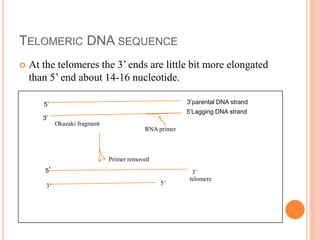
 At the telomeres the 3’ ends are little bit more elongated
than 5’ end about 14-16 nucleotide.
3’parental DNA strand
5’Lagging DNA strand
5’
3’
Primer removed
5’
3’
3’
5’
telomere
RNA primer
Okazaki fragment
 It has a repeating unit TTAGGG and
that’s why the telomere towards the
3’end appears like a single stranded
structure.
 As this sequence is rich in Guanine it
forms specific structures called ‘G-
quartets’.
STRUCTURAL PROTEINS
 Some proteins bind to the double stranded region of
telomeres which are responsible for the stability of
chromosomes.
 That proteins are:
1. TRF-1
2. TRF-2
o (TTAGGG Repeat Binding Factors 1 and 2) structurally
these two protein are related and posses similar domain
organisation.
 Both the proteins associate with telomeres
thoughout the cell cycle and bind to telomeres as
homodimers.
 The resulting nucleoprotein complex stabilizes
the end of DNA molecule and prevent it from
DNA damage.
 Thus, TRF-1 and 2 provides stability to the
telomeres and thus the complete DNA.
 TRF-2 is considered to be more effective than
TRF-1. Electron microscopy revealed that TRF-
2 proteins gives lariat like structure to the
telomere.
TELOSOME OR SHELTERIN
 POT 1 (protection of telomeres 1)binds to the
sequence in single stranded form.
 TIN1(TRF1- interacting protein) and TPP1
protein keep TRF1,TRF2 and POT1 together.
 This 6 proteins complex, SHELTERIN prevents
the activation of the DNA damage response.
 SHELTERIN is required for the recruitment of
telomerase.
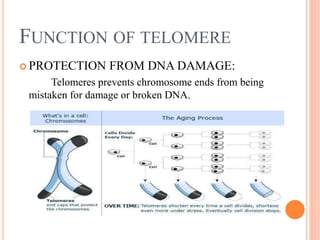
FUNCTION OF TELOMERE
 PROTECTION FROM DNA DAMAGE:
Telomeres prevents chromosome ends from being
mistaken for damage or broken DNA.
PROTECTION FROM RECOMBINATION
 Ends of linear eukaryotic chromosomal DNA
that are broken or have incomplete telomeric
structures are subjected to fusion, by
nonhomologous recombination, to other broken
DNA ends (but not to functional telomeric
termine).The resulting dicentric and other
aberrent chromosome are deleterious because
they cannot segregate properly.
ROLES OF TELOMERES IN MEIOSIS
 Early in meiotic prophase, telomere play the
distinctive function of anchoring chromosomes
to inner nuclear membrane. Subsequently, as a
consequence of the nuclear membrane
polirization,telomeres cluster together into
bouquet configuration, which facilitates pairing
and recombination of the homologous
chromosome.
TELOMERE AND AGING
After a certain number of cell
division, the telomere would be so
short a to somehow prevents the cell
from further proliferation- putting in a
state called senescense.
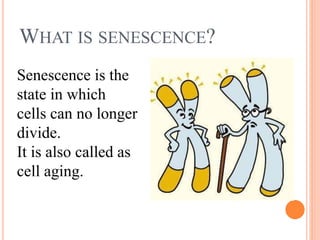
WHAT IS SENESCENCE?
Senescence is the
state in which
cells can no longer
divide.
It is also called as
cell aging.
WHAT IS TELOMERASE?
 Telomerase is the enzyme which maintains the
telomeres, also called as terminal transferase.
 Telomerae is an unusual enzyme composed of
protein and RNA.
 In case of humans, the RNA component is 450
nucleotide in length, and its 5’ terminal it
contains the sequence 5’-CUAACCCUAAC-3’.
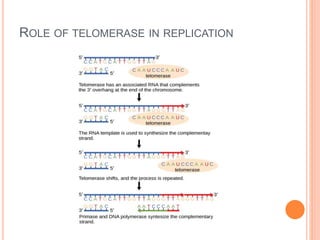
 The telomerase RNA sequence can be used as a
template for extension of telomere.
ROLE OF TELOMERASE IN REPLICATION
REFERENSES :-
 James D watson: Molecular Biology of the Gene
 Mapping and clonning of a human telomerase repressor
gene on chromosome 3’ Cooper
 www.els.net encyclopedia of life science
 yourgenome.org
 Tascience.com
 Spectracell.com
THANK YOU…

Telomere

  • 1.
    TELOMERE Presented by:- PallaviG. Shiwankar M.Sc. Biotechnology(Sem 2) St. Francis De Sales College, seminary hills, Nagpur
  • 2.
    CONTENT.. o Introduction o History oStructure of Telomeres o Telomeric DNA sequence o Structural proteins o Function of Telomeres o Telomere and aging o Telomerase o Reference
  • 3.
    INTRODUCTION Telomeres constitute theend of chromosome. They are characterised by a long series of short, tandemly repeated sequences. The type of sequence remains the same for all eukaryotites. Thus, telomeres are highly conserved region.
  • 4.
  • 5.
    STRUCTURE OF TELOMERE oThe telomere has two types of known core components:- 1. The telomeric DNA 2. Proteins o Telomeric DNA binding proteins binds to telomeric DNA through recognition of it’s nucleotide sequences, and in turn bind other protein complex.
  • 6.
    TELOMERIC DNA SEQUENCE At the telomeres the 3’ ends are little bit more elongated than 5’ end about 14-16 nucleotide. 3’parental DNA strand 5’Lagging DNA strand 5’ 3’ Primer removed 5’ 3’ 3’ 5’ telomere RNA primer Okazaki fragment
  • 7.
     It hasa repeating unit TTAGGG and that’s why the telomere towards the 3’end appears like a single stranded structure.  As this sequence is rich in Guanine it forms specific structures called ‘G- quartets’.
  • 8.
    STRUCTURAL PROTEINS  Someproteins bind to the double stranded region of telomeres which are responsible for the stability of chromosomes.  That proteins are: 1. TRF-1 2. TRF-2 o (TTAGGG Repeat Binding Factors 1 and 2) structurally these two protein are related and posses similar domain organisation.
  • 9.
     Both theproteins associate with telomeres thoughout the cell cycle and bind to telomeres as homodimers.  The resulting nucleoprotein complex stabilizes the end of DNA molecule and prevent it from DNA damage.  Thus, TRF-1 and 2 provides stability to the telomeres and thus the complete DNA.  TRF-2 is considered to be more effective than TRF-1. Electron microscopy revealed that TRF- 2 proteins gives lariat like structure to the telomere.
  • 10.
    TELOSOME OR SHELTERIN POT 1 (protection of telomeres 1)binds to the sequence in single stranded form.  TIN1(TRF1- interacting protein) and TPP1 protein keep TRF1,TRF2 and POT1 together.  This 6 proteins complex, SHELTERIN prevents the activation of the DNA damage response.  SHELTERIN is required for the recruitment of telomerase.
  • 11.
    FUNCTION OF TELOMERE PROTECTION FROM DNA DAMAGE: Telomeres prevents chromosome ends from being mistaken for damage or broken DNA.
  • 12.
    PROTECTION FROM RECOMBINATION Ends of linear eukaryotic chromosomal DNA that are broken or have incomplete telomeric structures are subjected to fusion, by nonhomologous recombination, to other broken DNA ends (but not to functional telomeric termine).The resulting dicentric and other aberrent chromosome are deleterious because they cannot segregate properly.
  • 13.
    ROLES OF TELOMERESIN MEIOSIS  Early in meiotic prophase, telomere play the distinctive function of anchoring chromosomes to inner nuclear membrane. Subsequently, as a consequence of the nuclear membrane polirization,telomeres cluster together into bouquet configuration, which facilitates pairing and recombination of the homologous chromosome.
  • 14.
    TELOMERE AND AGING Aftera certain number of cell division, the telomere would be so short a to somehow prevents the cell from further proliferation- putting in a state called senescense.
  • 15.
    WHAT IS SENESCENCE? Senescenceis the state in which cells can no longer divide. It is also called as cell aging.
  • 16.
    WHAT IS TELOMERASE? Telomerase is the enzyme which maintains the telomeres, also called as terminal transferase.  Telomerae is an unusual enzyme composed of protein and RNA.  In case of humans, the RNA component is 450 nucleotide in length, and its 5’ terminal it contains the sequence 5’-CUAACCCUAAC-3’.  The telomerase RNA sequence can be used as a template for extension of telomere.
  • 17.
    ROLE OF TELOMERASEIN REPLICATION
  • 18.
    REFERENSES :-  JamesD watson: Molecular Biology of the Gene  Mapping and clonning of a human telomerase repressor gene on chromosome 3’ Cooper  www.els.net encyclopedia of life science  yourgenome.org  Tascience.com  Spectracell.com
  • 19.