Lipid Rafts : An Overview
Jai Kumar
17BCB0070
DA 2, Cell Biology and
Biochemistry
VIT University
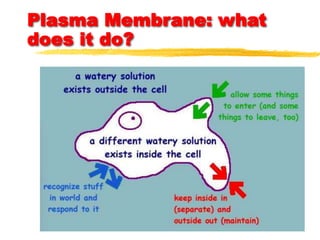
Plasma Membrane: what
does it do?
Plasma Membrane
Functions:
 Defines the boundary of the cell and isolates the cell.
 Acts as a selective barrier - maintains composition of
cytoplasm, which is very different from extracellular
space.
 Mediates the interaction of the cell with its
environment.
 Traversed by pathogens for access to the cell interior.
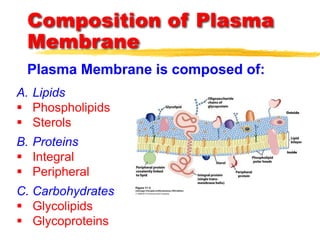
Plasma Membrane is composed of:
A. Lipids
 Phospholipids
 Sterols
B. Proteins
 Integral
 Peripheral
C. Carbohydrates
 Glycolipids
 Glycoproteins
Composition of Plasma
Membrane
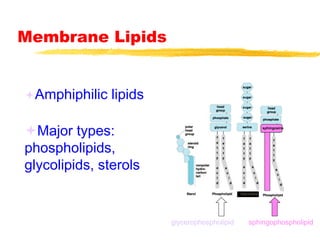
Membrane Lipids
Amphiphilic lipids
Major types:
phospholipids,
glycolipids, sterols
Glycolipid
sphingosine
glycerophospholipid sphingophospholipid
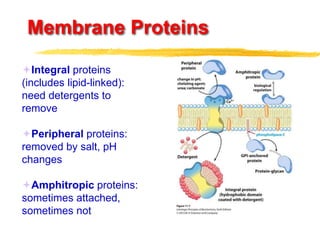
Membrane Proteins
Integral proteins
(includes lipid-linked):
need detergents to
remove
Peripheral proteins:
removed by salt, pH
changes
Amphitropic proteins:
sometimes attached,
sometimes not
Early Understanding of Functioning
of Plasma Membranes
Until 1982, it was understood
that phospholipids and membrane proteins were
randomly distributed in cell membranes, as per
Singer-Nicolson fluid mosaic model of 1972.
All models of cell membranes comprising domains
suffered from limitations of being general and not
explaining how specific biological functions
requiring domain formation were carried out.
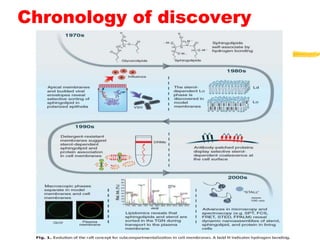
Lipid Rafts: How were these discovered?
 Singer & Nicholson in 1972 viewed Cell membranes as two
dimensional solutions of oriented globular proteins and lipids
 Simons and van Meer (1988) suggested existence of microdomains
or “rafts” in plasma membrane of epithelial cells
 Original concept of rafts was used to explain transport of
cholesterol from the trans Golgi network to the plasma
membrane.
 Jacobson & Dietrich, 1999 discussed the existence of rafts and
classified these into three, viz caveolae, glycosphingolipid enriched
membranes (GEM), and polyphospho inositol rich rafts.
 At the 2006 Keystone Symposium of Lipid Rafts and Cell Function,
lipid rafts were defined as "small (10-200nm), heterogeneous,
highly dynamic, sterol- and sphingolipid-enriched domains that
compartmentalize cellular processes
Chronology of discovery
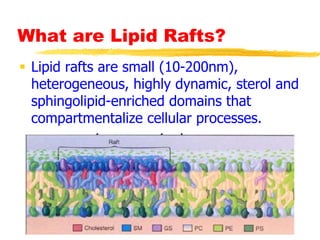
What are Lipid Rafts?
 Lipid rafts are small (10-200nm),
heterogeneous, highly dynamic, sterol and
sphingolipid-enriched domains that
compartmentalize cellular processes.
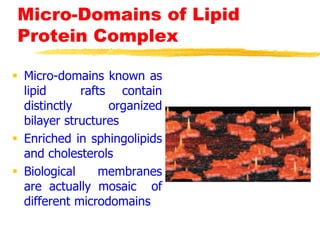
Micro-Domains of Lipid
Protein Complex
 Micro-domains known as
lipid rafts contain
distinctly organized
bilayer structures
 Enriched in sphingolipids
and cholesterols
 Biological membranes
are actually mosaic of
different microdomains
Key in Neural Functioning
 Lipid rafts are cholesterol-rich plasma
membrane microdomains that regulate a diverse
range of cellular functions.
 Rich in cholesterol and sphingolipids(high
melting lipids).
 Important for neuronal cell adhesion, axon
guidance and synaptic transmission.
 Crucial for neural development/function.
 Many diseases such as Alzheimer's,
Huntington's, Parkinson's disease, AIDS etc are
related to lipid rafts.
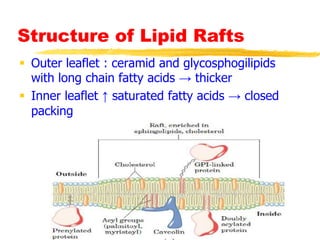
Structure of Lipid Rafts
 Outer leaflet : ceramid and glycosphogilipids
with long chain fatty acids → thicker
 Inner leaflet ↑ saturated fatty acids → closed
packing
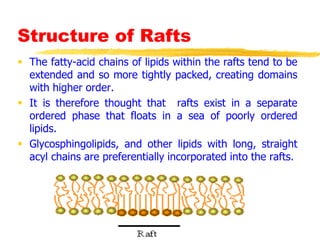
Structure of Rafts
 The fatty-acid chains of lipids within the rafts tend to be
extended and so more tightly packed, creating domains
with higher order.
 It is therefore thought that rafts exist in a separate
ordered phase that floats in a sea of poorly ordered
lipids.
 Glycosphingolipids, and other lipids with long, straight
acyl chains are preferentially incorporated into the rafts.
How do rafts function?
 Membrane is able to laterally segregate its constituents.
 This capability is based on dynamic liquid-liquid
immiscibility and underlies the raft concept of
membrane subcompartmentalization.
 Example in order to segregate and concentrate specific
protein and to facilitate their activity, proteins are
activated when several rafts fuse together or ligands
binding occurs which favors fusion of rafts
 Lipid rafts are fluctuating nanoscale assemblies
of sphingolipid, cholesterol, and proteins that can
be stabilized to coalesce, forming platforms that
function in membrane signaling and trafficking.
Two types of lipid rafts
(1) Planar lipid rafts (non-caveolar, or glycolipid, rafts) : Planar
rafts are continuous with plane of the plasma membrane: Planar rafts
contain flotillin proteins and are found in neurons where caveolae are
absent. Both types have similar lipid composition (enriched in
cholesterol and sphingolipids).
(2) Caveolae: Caveolae are flask shaped invaginations of the plasma
membrane that contain caveolin proteins : Caveolins are widely
expressed in the brain, micro-vessels of the nervous system,
endothelial cells, astrocytes, oligodendrocytes, Schwann cells, dorsal
root ganglia and hippocampal neurons.
BOTH Flotillin and caveolins have the ability to recruit signaling
molecules into lipid rafts, thus playing an important role in
neurotransmitter signal transduction.
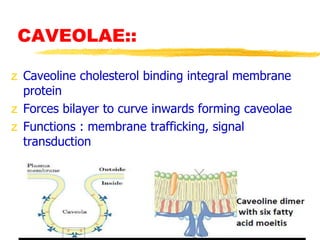
CAVEOLAE::
z Caveoline cholesterol binding integral membrane
protein
z Forces bilayer to curve inwards forming caveolae
z Functions : membrane trafficking, signal
transduction
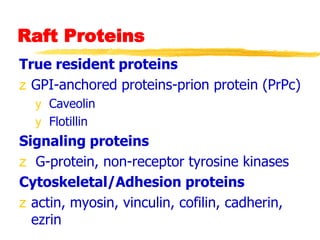
Raft Proteins
True resident proteins
z GPI-anchored proteins-prion protein (PrPc)
y Caveolin
y Flotillin
Signaling proteins
z G-protein, non-receptor tyrosine kinases
Cytoskeletal/Adhesion proteins
z actin, myosin, vinculin, cofilin, cadherin,
ezrin
Role of Cholesterol in
Membranes and Rafts
 Abundant component of the plasma membranes of eukaryotic cells
 Plays an essential role in maintaining membrane integrity and
fluidity.
 Critical for liquid-ordered raft/caveolae formation by serving as a
spacer between the hydrocarbon chains of sphingolipids.
 Alterations in the its content in cells modifies the properties of
these domains.
 Depletion of cholesterol from the plasma membrane causes
disruption of rafts/caveolae and release of raft/caveolae
constituents into a non-raft/caveola membrane, which renders
them nonfunctional.
 Cholesterol is crucial for maintaining intact raft/caveola structure
and function.
Lipid Rafts in various Disorders
and Diseases
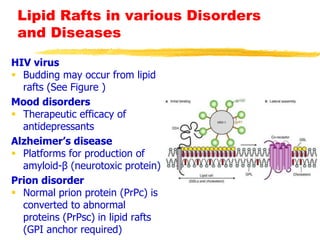
HIV virus
 Budding may occur from lipid
rafts (See Figure )
Mood disorders
 Therapeutic efficacy of
antidepressants
Alzheimer’s disease
 Platforms for production of
amyloid-β (neurotoxic protein)
Prion disorder
 Normal prion protein (PrPc) is
converted to abnormal
proteins (PrPsc) in lipid rafts
(GPI anchor required)
Lipid Rafts: Summary
 "Lipid rafts": dynamic regions of the plasma membrane
enriched in cholesterol, sphingomyelin, glycolipids, GPI-
anchored proteins and some membrane proteins.
 Size ranges from 10-200 nm
 Important for signaling.
 Important as sites for entry and egress of viruses.
 Markers for clathrin-mediated endocytosis are not
present in rafts.
 Insoluble in cold detergent; dispersed by cholesterol
depletion (methyl-b-cyclodextrin).
 Some contain caveolae
Areas of research to find
answers
 What are the effects of membrane protein levels?
 What is the physiological function of lipid rafts?
 What effect does flux of membrane lipids have on
raft formation?
 What effect do diet and drugs have on lipid rafts?
 What effect do proteins located at raft boundaries
have on lipid rafts?

Lipid rafts an overview

  • 1.
    Lipid Rafts :An Overview Jai Kumar 17BCB0070 DA 2, Cell Biology and Biochemistry VIT University
  • 2.
  • 3.
    Plasma Membrane Functions:  Definesthe boundary of the cell and isolates the cell.  Acts as a selective barrier - maintains composition of cytoplasm, which is very different from extracellular space.  Mediates the interaction of the cell with its environment.  Traversed by pathogens for access to the cell interior.
  • 4.
    Plasma Membrane iscomposed of: A. Lipids  Phospholipids  Sterols B. Proteins  Integral  Peripheral C. Carbohydrates  Glycolipids  Glycoproteins Composition of Plasma Membrane
  • 5.
    Membrane Lipids Amphiphilic lipids Majortypes: phospholipids, glycolipids, sterols Glycolipid sphingosine glycerophospholipid sphingophospholipid
  • 6.
    Membrane Proteins Integral proteins (includeslipid-linked): need detergents to remove Peripheral proteins: removed by salt, pH changes Amphitropic proteins: sometimes attached, sometimes not
  • 7.
    Early Understanding ofFunctioning of Plasma Membranes Until 1982, it was understood that phospholipids and membrane proteins were randomly distributed in cell membranes, as per Singer-Nicolson fluid mosaic model of 1972. All models of cell membranes comprising domains suffered from limitations of being general and not explaining how specific biological functions requiring domain formation were carried out.
  • 8.
    Lipid Rafts: Howwere these discovered?  Singer & Nicholson in 1972 viewed Cell membranes as two dimensional solutions of oriented globular proteins and lipids  Simons and van Meer (1988) suggested existence of microdomains or “rafts” in plasma membrane of epithelial cells  Original concept of rafts was used to explain transport of cholesterol from the trans Golgi network to the plasma membrane.  Jacobson & Dietrich, 1999 discussed the existence of rafts and classified these into three, viz caveolae, glycosphingolipid enriched membranes (GEM), and polyphospho inositol rich rafts.  At the 2006 Keystone Symposium of Lipid Rafts and Cell Function, lipid rafts were defined as "small (10-200nm), heterogeneous, highly dynamic, sterol- and sphingolipid-enriched domains that compartmentalize cellular processes
  • 9.
  • 10.
    What are LipidRafts?  Lipid rafts are small (10-200nm), heterogeneous, highly dynamic, sterol and sphingolipid-enriched domains that compartmentalize cellular processes.
  • 11.
    Micro-Domains of Lipid ProteinComplex  Micro-domains known as lipid rafts contain distinctly organized bilayer structures  Enriched in sphingolipids and cholesterols  Biological membranes are actually mosaic of different microdomains
  • 12.
    Key in NeuralFunctioning  Lipid rafts are cholesterol-rich plasma membrane microdomains that regulate a diverse range of cellular functions.  Rich in cholesterol and sphingolipids(high melting lipids).  Important for neuronal cell adhesion, axon guidance and synaptic transmission.  Crucial for neural development/function.  Many diseases such as Alzheimer's, Huntington's, Parkinson's disease, AIDS etc are related to lipid rafts.
  • 13.
    Structure of LipidRafts  Outer leaflet : ceramid and glycosphogilipids with long chain fatty acids → thicker  Inner leaflet ↑ saturated fatty acids → closed packing
  • 14.
    Structure of Rafts The fatty-acid chains of lipids within the rafts tend to be extended and so more tightly packed, creating domains with higher order.  It is therefore thought that rafts exist in a separate ordered phase that floats in a sea of poorly ordered lipids.  Glycosphingolipids, and other lipids with long, straight acyl chains are preferentially incorporated into the rafts.
  • 15.
    How do raftsfunction?  Membrane is able to laterally segregate its constituents.  This capability is based on dynamic liquid-liquid immiscibility and underlies the raft concept of membrane subcompartmentalization.  Example in order to segregate and concentrate specific protein and to facilitate their activity, proteins are activated when several rafts fuse together or ligands binding occurs which favors fusion of rafts  Lipid rafts are fluctuating nanoscale assemblies of sphingolipid, cholesterol, and proteins that can be stabilized to coalesce, forming platforms that function in membrane signaling and trafficking.
  • 16.
    Two types oflipid rafts (1) Planar lipid rafts (non-caveolar, or glycolipid, rafts) : Planar rafts are continuous with plane of the plasma membrane: Planar rafts contain flotillin proteins and are found in neurons where caveolae are absent. Both types have similar lipid composition (enriched in cholesterol and sphingolipids). (2) Caveolae: Caveolae are flask shaped invaginations of the plasma membrane that contain caveolin proteins : Caveolins are widely expressed in the brain, micro-vessels of the nervous system, endothelial cells, astrocytes, oligodendrocytes, Schwann cells, dorsal root ganglia and hippocampal neurons. BOTH Flotillin and caveolins have the ability to recruit signaling molecules into lipid rafts, thus playing an important role in neurotransmitter signal transduction.
  • 17.
    CAVEOLAE:: z Caveoline cholesterolbinding integral membrane protein z Forces bilayer to curve inwards forming caveolae z Functions : membrane trafficking, signal transduction
  • 18.
    Raft Proteins True residentproteins z GPI-anchored proteins-prion protein (PrPc) y Caveolin y Flotillin Signaling proteins z G-protein, non-receptor tyrosine kinases Cytoskeletal/Adhesion proteins z actin, myosin, vinculin, cofilin, cadherin, ezrin
  • 19.
    Role of Cholesterolin Membranes and Rafts  Abundant component of the plasma membranes of eukaryotic cells  Plays an essential role in maintaining membrane integrity and fluidity.  Critical for liquid-ordered raft/caveolae formation by serving as a spacer between the hydrocarbon chains of sphingolipids.  Alterations in the its content in cells modifies the properties of these domains.  Depletion of cholesterol from the plasma membrane causes disruption of rafts/caveolae and release of raft/caveolae constituents into a non-raft/caveola membrane, which renders them nonfunctional.  Cholesterol is crucial for maintaining intact raft/caveola structure and function.
  • 20.
    Lipid Rafts invarious Disorders and Diseases HIV virus  Budding may occur from lipid rafts (See Figure ) Mood disorders  Therapeutic efficacy of antidepressants Alzheimer’s disease  Platforms for production of amyloid-β (neurotoxic protein) Prion disorder  Normal prion protein (PrPc) is converted to abnormal proteins (PrPsc) in lipid rafts (GPI anchor required)
  • 21.
    Lipid Rafts: Summary "Lipid rafts": dynamic regions of the plasma membrane enriched in cholesterol, sphingomyelin, glycolipids, GPI- anchored proteins and some membrane proteins.  Size ranges from 10-200 nm  Important for signaling.  Important as sites for entry and egress of viruses.  Markers for clathrin-mediated endocytosis are not present in rafts.  Insoluble in cold detergent; dispersed by cholesterol depletion (methyl-b-cyclodextrin).  Some contain caveolae
  • 22.
    Areas of researchto find answers  What are the effects of membrane protein levels?  What is the physiological function of lipid rafts?  What effect does flux of membrane lipids have on raft formation?  What effect do diet and drugs have on lipid rafts?  What effect do proteins located at raft boundaries have on lipid rafts?